All posts filed under: Featured

Will the Caliph lead the armies directly?

The Prophet Muhammad ﷺ in his role as a ruler-prophet and head of state in Medina led many of the battles himself since he was the Commander-in-Chief. A battle or expedition that he ﷺ led directly is referred to in the Islamic history books as a ghazwa. Those expeditions where he appointed a sahabi to command are referred to as a sariyya. We can see from the data that the number of expeditions led directly by the Prophet ﷺ decreased over time as the sahaba took a more leading role after their training at the hands of the Messenger ﷺ. The Prophet ﷺ appointed a total of 43 different sahaba as commanders so they all gained experience in this role. After his ﷺ death these commanders played a vital role in the Islamic conquests such as Khalid ibn Al-Walid, Amr ibn al-Aas and Abu Ubaidah ibn al-Jarrah. Three of the Rightly Guided Caliphs were appointed as military commanders namely, Abu Bakr, Umar and Ali. This experience was important for their future roles as Commanders-in-chief of their respective armies. …
Scenarios for the emergence of a Unitary Islamic State today

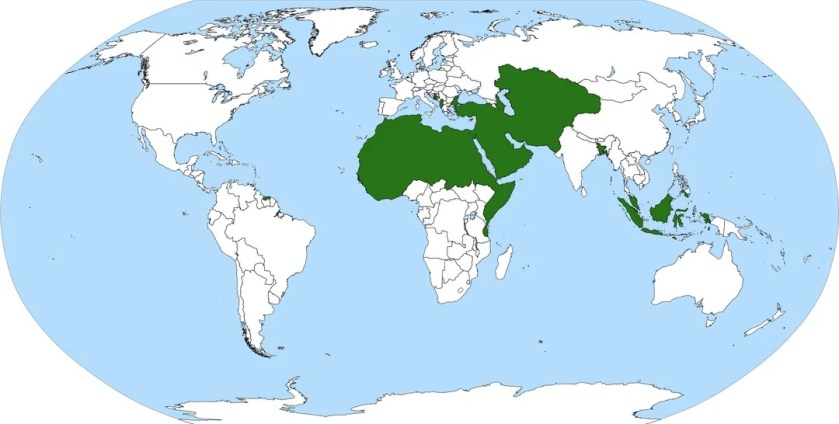
Assessing the maslaha (benefit) and mafsadah (harm) within the sphere of siyasa sharia is not an exact science. Every time and place needs to be assessed by highly skilled statesmen like the Prophet ﷺ, Rightly Guided Caliphs and those who follow in their footsteps, who can navigate these tumultuous waters. There are many options open to a Muslim ruler who is sincere in their attempts to implement Islam. Israr Ahmed (d.2010) says, “Since we cannot recreate as such the Islamic Order as it functioned during the age of the Rightly Guided Caliphate, we must adopt the following principle: we should take the principles and ideals from the model of the Prophet Muhammad ﷺ and the Rightly Guided Caliphs (RAA), and then incorporate these principles and ideals in the political institutions that have been developed in the contemporary civilized world as a result of the process of social evolution.”[1] Muhammad Haykal outlines a possible scenario for unification of the Muslim world once a caliphate has been established. He says, “When this Khilafah state is established via the bay’ah of the Muslims of a particular …

Maintaining a Unitary Islamic State

Loyalty to the Caliph is through the Bay’ah The bay’ah contract which is the citizenship contract between the Muslims and the caliph contains explicit words of loyalty and obedience to the head of state. Ubada ibn Al-Samit said: بَايَعْنَا رَسُولَ اللَّهِ صلى الله عليه وسلم عَلَى السَّمْعِ وَالطَّاعَةِ فِي الْمَنْشَطِ وَالْمَكْرَهِ‏.‏ ‏‏وَأَنْ لاَ نُنَازِعَ الأَمْرَ أَهْلَهُ، وَأَنْ نَقُومَ ـ أَوْ نَقُولَ ـ بِالْحَقِّ حَيْثُمَا كُنَّا لاَ نَخَافُ فِي اللَّهِ لَوْمَةَ لاَئِمٍ ‏‏‏  “We gave the bayah to Allah’s Messenger that we would listen and obey him both at the time when we were active and at the time when we were tired, and that we would not fight against the ruler or disobey him, and would stand firm for the truth or say the truth wherever we might be, and in the Way of Allah we would not be afraid of the blame of the blamers.”[1] Every citizen, including all the governors are bound first and foremost by the bay’ah. When the Islamic ideology is strong within the ummah and its governing bodies, then this should be the basis of …

Election of Amirs in the absence of an agreed upon caliph

The caliph’s appointment of governors is through a contract of appointment (عَقْد تَقْلِيد ‘aqd taqleed) which does not end with the death or removal of the caliph. It continues, and the new caliph will decide whether to renew the contract and keep the governors in place or appoint new governors. Abu Bakr for example, kept the same governors as the Prophet ﷺ had appointed, but Umar when he became caliph changed the governors and appointed new ones. During the volatile period after the death of Mu’awiya ibn Yazid, the people of Iraq and Khorasan actually elected new governors until a caliph had been chosen. This is based on the hadith, where the Messenger of Allah ﷺ said, وَلَا يَحِلُّ لِثَلَاثَةِ نَفَرٍ يَكُونُونَ بِأَرْضِ فَلَاةٍ إِلَّا أَمَّرُوا عَلَيْهِمْ أَحَدَهُمْ “It is not permissible for three people to be in an open country (desert) without appointing one of them as their Amir.”[1] Summary of Elected Amirs Province Elected Amir Damascus al-Dahhak bin Qays al-Fihri Basra 1. Ubaydallah ibn Ziyad2. Abd al-Malik bin Abdallah bin Amir3. Abdallah bin …

Election of Amirs in the Rightly Guided Caliphate

In the time of Abu Bakr and Umar the people trusted their opinion over their own, so there was no real requirement to consult the ordinary people of a province on who their governor should be. We can see this in the selection process for the next caliph where the Ahlul hali wal-aqd[1] (senior sahaba) said to Abu Bakr: “O Caliph of the Messenger Allah, your opinion is our opinion (i.e., appoint your successor for us).” He said, “Then give me some time, so that I can see what is best in the view of Allah and what is best for His religion and His slaves.”[2] Similarly, when Umar was stabbed and his death was imminent, the Ahlul hali wal-aqd came and asked him to nominate a successor as Abu Bakr had done for him. Umar couldn’t come to a decision so he appointed a council of six candidates who were all from the 10 promised jannah to meet after his death and appoint a caliph.  Near the end of Uthman’s caliphate and the loss of many senior sahaba, discontent and …

Administrative Divisions of the Prophet’s ﷺ State in Medina

The sunnah consists of the speech, actions and consent of the Prophet ﷺ. It is a fundamental source of Islamic Law (sharia) from which we guide our actions.[1] The sunnah is not just restricted to ‘ibadat (worships) but covers all aspects of life, state and society. Allah ta’ala says, وَمَآ ءَاتَىٰكُمُ ٱلرَّسُولُ فَخُذُوهُ وَمَا نَهَىٰكُمْ عَنْهُ فَٱنتَهُوا۟ “Whatever the Messenger gives you, take it. And whatever he forbids you from, leave it.”[2] The relative pronoun (مَا) is ‘aam (general) and means “whatever” so we do not restrict the sunnah to one sphere of life only. Today siyasa sharia (Islamic politics) is a neglected sunnah and an area which requires greater scrutiny and study to guide us through the maze of modern political life. In regards to the Islamic ruling system, the speech and actions of the Prophet ﷺ in Medina related to government are a divine evidence (شَرْع دَلِيل  shara’ daleel) for us to follow. The 12 Naqibs When the Prophet Muhammad ﷺ first established the state in Medina, the existing tribal structure was used to administer the state. The Aws …

Devolution in the Islamic State of Prophet Muhammad ﷺ

The devolving of the ruler’s executive powers to the provinces while keeping others with the central government, has its origins in the first Islamic State of the Prophet ﷺ. We already mentioned the Sahifa and the ‘election’ of 12 Naqibs who managed the subtribes of the Ansar as mini-provinces. The Sahifa “mentioned 40 subtribes or clans by name, and stated that each tribe will carry the responsibilities of its members; they will oversee their own blood-money disputes, prisoners of war, and the poor and needy.”[1] This is one evidence. As the state expanded most notably to Yemen, after the former Persian governor Bādhān ibn Sāsān embraced Islam, he ﷺ appointed separate judges and new governors of the districts. Ali ibn Abi Talib was appointed as Qadi (judge) for Yemen. It was narrated that ‘Ali ibn Abi Talib said: عَنْ عَلِيٍّ، رَضِيَ اللَّهُ عَنْهُ قَالَ بَعَثَنِي رَسُولُ اللَّهِ صَلَّى اللَّهُ عَلَيْهِ وَسَلَّمَ إِلَى الْيَمَنِ فَقُلْتُ إِنَّكَ تَبْعَثُنِي إِلَى قَوْمٍ وَهُمْ أَسَنُّ مِنِّي لِأَقْضِيَ بَيْنَهُمْ فَقَالَ اذْهَبْ فَإِنَّ اللَّهَ سَيَهْدِي قَلْبَكَ وَيُثَبِّتُ لِسَانَكَ “The Messenger of Allah ﷺ sent me to …

Devolution in an Islamic State: Judiciary

As the Islamic State of the Prophet ﷺ expanded, new officials of state were appointed to manage the ever-growing tasks especially in the new provinces. Once Yemen had joined the state under Bādhān ibn Sāsān, the Prophet ﷺ appointed separate judges to the province notably Ali ibn Abi Talib and Mua’th ibn Jabal. The judiciary was therefore a centralised institution in the time of the Prophet ﷺ, a situation which continued throughout the time of the Rightly Guided Caliphs and beyond although sometimes this was devolved to the governor if he was qualified. Al-Sallabi says, “Among these [governors] were some whom ‘Umar [ibn a-Khattab] kept as judges as well as appointing them as governors, as he did with Mu‘awiyah, and some from whom he took away the role of judge and limited them to their role as governor, as he did with al-Mugheerah and Abu Moosa al-Ash‘ari.”[1] This appointment of judges by the central government does not mean judicial independence was absent from the state. Sovereignty in an Islamic State is to the sharia, so …

Devolution in an Islamic State: Finance

State revenues and expenditure were always centralised even if the governor had full devolved powers over the collection and distribution of funds, because he was expected to send the tax revenues to the central caliphal government. From the time of Mu’awiya, a central Diwan Al-Kharaj (ministry of taxation) was established headed by a secretary (sahib). Ibn Khaldun describes this institution: “The ministry of taxation is an office that is necessary to the royal authority (mulk). It is concerned with tax operations. It guards the rights of the dynasty in the matters of income and expenditure. It takes a census of the names of all soldiers, fixes their salaries, and pays out their allowances at the proper times. In this connection recourse is had to rules set up by the chiefs of (tax) operations and the stewards of the dynasty. They are all written down in a book which gives all the details concerning income and expenditure. It is based upon a good deal of accounting, which is mastered only by those who have considerable skill in (tax) …

Devolution in an Islamic State: The Armed Forces

Al-Mawardi says, “If the territorial authority of this type of amir (Wali Khass) lies adjacent to a border he may not initiate a jihad except with the Caliph’s permission, although he must wage war on them and repulse them if they initiate the attack, without the Caliph’s permission, as this forms part of his duty to protect and defend what is inviolable.”[1] In a unitary state, the armed forces are all unified under the caliph who is the Commander-in-Chief. He has the sole power to declare war and despatch the military. Philip Hitti (d.1978) says, “The army was the ummah, the whole nation, in action. Its amir or commander in chief was the caliph in al-Madinah, who delegated the authority to his lieutenants or generals.”[2] Muhammad Haykal says, “For the management and disposal to belong to the Imam represents the ‘Asl (original position) in relation to the Qitaal (fighting) of the enemies, when he exists, and it is obligatory to obey him in accordance to the speech of Allah ta’ala: يَـٰٓأَيُّهَا ٱلَّذِينَ ءَامَنُوٓا۟ أَطِيعُوا۟ ٱللَّهَ وَأَطِيعُوا۟ ٱلرَّسُولَ …