
By Yasir Qadhi
This is an extract from the lecture: Why Muslims Divide – The psychology of why the people closest to you are the hardest to tolerate
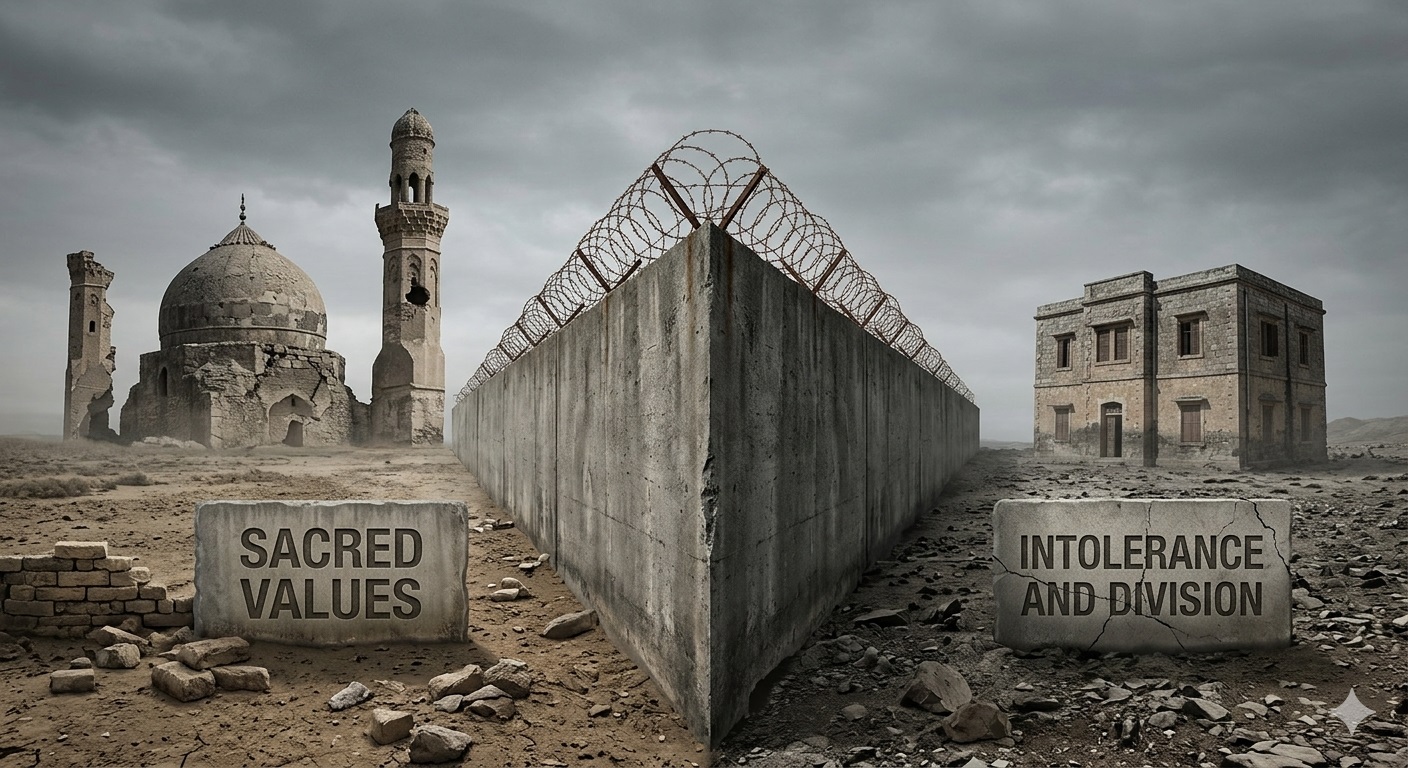
The paradox of being introduced to sacred values. What do I mean by this? The irony of becoming more religious and more intolerant at the same time, makes complete sense when you understand the introduction of sacred values.
So anecdotally, we are all aware that people by and large who are non-religious, lump all religious folks together and don’t really care about what version of religion you follow. Your grandmother, my grandmother, they don’t care how you label yourself. Is he a good person or not? Does he pray? Is he honest? That’s what they’re looking at. They really don’t care about abstract values. Your local Sheikh however, in all likelihood is very interested about what type of Muslim is he. What version of Islam does he follow?
Why is there this disconnect even though both of them, your grandmother and your sheikh, are praying five times a day, and loving Allah and his Messenger. Why is one of them so concerned about specific issues and the other isn’t?
The issue goes back to what we’re talking about right now, which is sacred values that are introduced to you, and you acquired in your cognitive beliefs become the core identifying marker of what you consider to be religious and sacred. Your grandmother has not been introduced to advanced theology or abstract theology. She’s a simple lady. She just loves Allah and his Messenger. When she meets another Muslim who loves Allah, that’s good enough for her. But you, Masha’Allah, have attended halaqat from Sheikh so and so, you have gone through the manual of ‘aqeeda written by Imam and Sheikh ul Islam of the 7th or 8th century, right? You have acquired a set of values that your grandmother does not have, and you have been taught, and now you believe that those values, that dogma, that creed, that ideology is important. Your grandmother was not taught this. You have gone through an experience, a camaraderie in halaqa. You have been exposed to a spirituality through your lectures and your studies which your grandmother was not exposed to. In the process you have come out at the end of all of that believing in the sanctity, in the sacredness of a particular idea or rituals or dogma or whatever it might be. The core defining value of that trend is now part of you, so it becomes important to you because that’s who you are. This is actually one of the most difficult biases to overcome, because the reality is that it does define you if you want to ally yourself with that particular sect.
I’m going to have to give some examples here, and even these examples are controversial because to merely mention them, you are shaking core values of a particular strand. But I have to give examples because that’s the whole point here.
We are all in this audience Sunni Muslims. What are some of the values that define Sunni Muslims? The integrity of the sahaba. That is a defining characteristic of Sunni Islam. In modern Sunnism, you are not a Sunni if you don’t respect all of the sahaba. As you remain in a Sunni circle and you attend lectures, this notion is going to be validated. It will become a part of your core identity as a Sunni. Now you meet somebody who doesn’t have this value. You have acquired a sanctity of this value by virtue of the fact that you have associated with that strand for so long. That value, which is a defining value of this strand, has a certain status, a certain sanctity, sacredness. That sacredness and sanctity is by and large not appreciated by your grandmother, because they haven’t gone through your program. So if they meet somebody of another label, they’re not really asking what do you say about this sahabi. They’re not interested in that, but because we have a value attached to a theology or a ritual or an ideology, that value was acquired. We weren’t born with it. Why was it acquired? Because we associated with a particular strand. It is the marker of that strand.
So when you associate with that strand, if you continue to associate, you have to carry the marker, correct? So when you carry that marker, when you associate with that marker, when that value becomes a part of your identity, you cherish it, you care about it because that’s now your new identity. You didn’t know about it before, but now you do. Immediately the first response is going to be, hold on a sec, isn’t it important to respect the sahaba? I didn’t talk about the theology. I’m talking about the sociology right now. I’m talking about the psychology.
If this one, you can’t think about it rationally, choose another one. Anyone doesn’t matter. Whatever strand you follow, by definition, that strand has to have certain aspects that are unique to that strand. That’s what makes the strand. So if you are a part of that strand, they have to give value to what makes them unique or else they become meaningless. When you associate with that and you absorb that, then all of a sudden what used to be unknown to you, what used to be not on your agenda, not on your list of important factors, becomes on your list of very important factors. That’s the irony, as I said, the contradictory irony of the more religious you become, the closer you get to a particular type of religious scholarship, automatically you actually begin to start looking down or looking at people differently who don’t have the same ideology as you. This goes back to the paradox of what is considered sacred or sacrosanct or holy.
Of course, because every sect, every strand, every ideology has certain core values, when you associate with them, you also must make those core values sacred. Before your association, those core values would not have been sacred to you, or else you would be part of that group.
So how do you overcome this? By the way, again, by overcoming, I don’t mean you have to empathize and disagree. You just have to separate as a Muslim. You have to separate between a value that is clearly basic Quran versus a value that is derived and developed by a particular strand. That’s the only thing you need to understand.
There’s clearly a value that is an umbrella for the entire religion. Belief in one God, belief in the Prophet ﷺ, and belief in the Day of Judgment. That’s straight Quranic and you will be able to tell this by the umbrella fact that all religious strands associating with Islam by and large follow that, versus the defining characteristic of one particular strand. If you find only one group derived something from the Quran and others don’t, it might be a correct derivation. I’m not saying it’s not correct, I’m simply saying it cannot hold the same value as a derivation that is basic Quranic. The very fact that only one segment of the ummah has derived this fact and other segments have not, automatically indicates that this derivation doesn’t have the same epistemic weight, the same sacrosanct status as a fact that is universal in the faith. I’m not saying it’s right or wrong. Please don’t miss quote me in this regard. So that’s the first point.
More in this series:
How Sacred Values Lead to Intolerance and Division
Exaggerating Minor Differences to Maintain Group Identity
How Social Identity Fuels Intergroup Discrimination