
By Yasir Qadhi
This is an extract from the lecture: Why Muslims Divide – The psychology of why the people closest to you are the hardest to tolerate
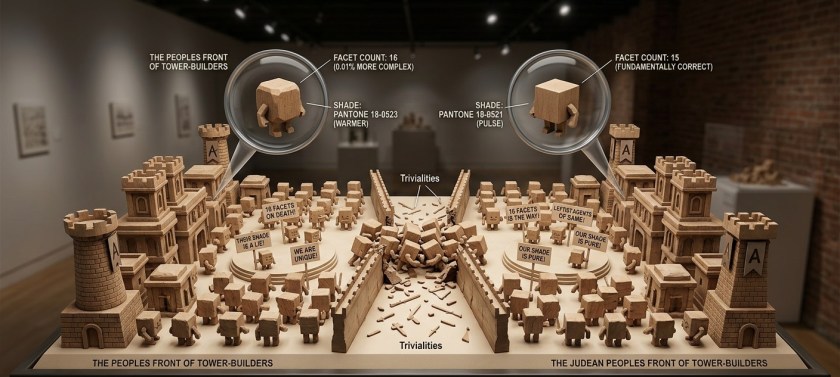
The second psychological and anthropological observed reality is called the narcissism of small differences. This is a well observed and documented phenomenon across all strands of movements, whether they are religious, whether they are social, whether they are political, it doesn’t matter. This can be summarized with the following statement:
“Groups that are very similar exaggerate smaller differences to maintain their boundaries and identity.”
I repeat, you can put it this way, the closer the groups are, the bigger their petty differences are exaggerated.
This is an observable phenomenon observed by, as I said, by anthropologists, by psychiatrists, by anybody who’s observed large groups of people in whatever field. This is a phenomenon that transcends religion.
In fact, not to justify, I’m just saying this, even Sigmund Freud has an entire chapter about this reality and he writes, not that I love Sigmund Freud, obviously that’s not what I’m saying. It’s an observed phenomenon to take it from him. If you don’t like him, take it from other anthropologists that have written about this. He says it is precisely communities with adjoining territories who are the most prone to mutual hostility. When your boundaries are relatively close, you actually exaggerate your differences. The closer the ideology, the closer the theology, the more threatening the difference becomes.
A very simple phenomenon that the entire Ummah can sympathize with, especially in the western world, is the fact that interfaith dialogue is infinitely easier than intra-faith dialogue.
I just came back from Austin, Texas today. I attended an interfaith event yesterday. There were some evangelical priests and ministers, and I was there and we had a very nice conversation. We went back and forth, agreed to disagree, what not, and not a single backlash from anybody is going to happen, even though on that panel, the pastor, the minister kept on trying to put in the fact that we believe in Jesus as a son. He wanted to give that word to the Muslims, the audience. He said, Jesus died for our sins and this is the guy. He keeps on saying it and not a single Muslim is going to be insulted or problematizing the fact that I sat on the stage with him and I gave my two cents. I have been in numerous interfaith dialogues. We have invited Christian priests, and before the situation in the Middle East we invited rabbis to our interfaith dinners before the politics got in the way, and nobody batted an eyelid. We have invited Christian ministers into the Musallah here at Epic, and I have spoken with Pastor Bob Roberts and others here. When I was in Memphis, we invited people as well and nobody has a problem.
To this day however, we have never invited a single Ithna Ashari (Twelver Shia) to our mosque and we will not do so in the foreseeable future because the backlash that would happen would be astronomical!
We didn’t have a single backlash about interfaith. Not one person came to me and said, “How could you have invited a Christian minister!?” Everybody understands. Smiling, taking pictures. Now imagine if I invited a Twelver cleric. I’m being very blunt here. I’m sick and tired of our petty mindedness. It is problematic for our own Masjid if the fact that I’m inviting a person doesn’t mean I agree with them. It’s so backward. But this is the narcissism of small differences.
I have not yet participated in a public intrafaith dialogue to this day because I choose my battles wisely. A day will come when I will do it and the backlash will happen.
You think I’m cancelled right now? Just wait till I dare shake hands with a Muslim who wears a black turban from a city in Qom. Just wait until the fact that I shook hands with somebody like that.
Wait till the cancellations come after that, you will see. It’s just the reality. I don’t agree with the person. I didn’t agree with the priest, but my sitting with the priest is overlooked. My sitting with a Twelver cleric will never be forgiven. The fact that they’re closer to us, they pray to the same qibla. They read the Quran, because they’re closer to us, right? But their differences become visceral. This is an observed reality. When you know this is an observed reality, then check yourself.
Now you know this is a reality and it is a phenomenon called groupthink. Why should you fall prey to it when you know why it happens? it’s demarcation. The other person represents a threat.
More in this series:
How Sacred Values Lead to Intolerance and Division
Exaggerating Minor Differences to Maintain Group Identity
How Social Identity Fuels Intergroup Discrimination
 Islamic Civilization