
By Yasir Qadhi
This is an extract from the lecture: Why Muslims Divide – The psychology of why the people closest to you are the hardest to tolerate
Cognitive dissonance amplification is most prominently championed by a very famous modern social psychologist of our times, Jonathan Haidt. He’s one of the most famous professors in this field of social psychology. Once again, he has written books and articles about this reality. He writes and I quote “the bitterest of conflicts are often amongst those who share the most similar beliefs.”
This is a reality that we are all familiar with because who are you the most jealous of? Who do you find your problems are the most easy to amplify with? It’s your closest circle. You’re not jealous of Bill Gates, who has $50 billion, but if your cousin becomes a multi-millionaire, that’s where the jealousy will come. You’re not jealous of the most famous Hollywood actor, but if your friend becomes the life of the party, that’s where something happens. That’s the irony here. The bitterest conflicts are amongst those who are the closest to you and share the same beliefs. This is also called the heretic versus infidel effect.
Now, these terms are not familiar to us because we don’t use the term heretic as much as others do.
We can use the term Mubtadi’ (innovator) versus kafir effect.
The Shia guy in our case is considered far more dangerous because they claim legitimacy from our same source, the Qur’an and the Sunnah. So they become an actual threat, whereas the kafir guy represents no threat. Nobody’s worried that a person is going to become a Christian if I invite a minister here. But if I were to invite to a Twelver shia there be an angry reaction. Why? Because your seen to be validating their position, or you’re bringing somebody that’s potentially going to harm or corrupt.
They don’t consider a non-Muslim in that way or deal with them with that level of violence or threat of violence. Why? Because when somebody close to your belief system disagrees, when somebody who’s tapping into your same trajectory disagrees with your conclusion, it creates an internal tension that an outsider will never create.
When somebody is next to you, looking up to the same sources as you but deriving a different opinion, that is a far greater threat intellectually. You’re more irritated than the guy who doesn’t look to your sources and hence has radically different beliefs. To you, it doesn’t matter because they’re not tapping into your sources.
Hence, it is more important when you understand this bias, to reject a dissident insider, than a dissident outsider. It becomes far more important to understand that somebody who shares 80% of your beliefs but disagrees strongly with 20%, is actually going to provoke your internal mechanism much more than somebody who disagrees with you 90% and agrees with you 10%.
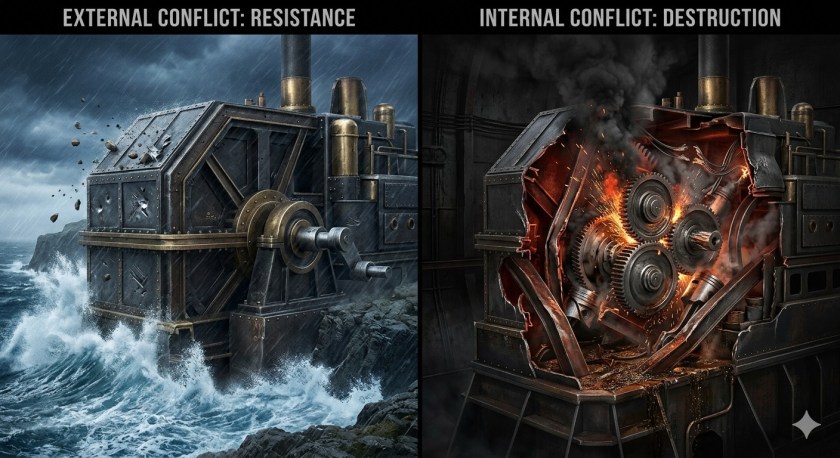
To put it another way, external enemies actually bring about unity in your group. You need to understand this because that’s another topic we’re going to talk about. We’re going to come to why do people have to create enemies. You create enemies to solidify your own group. In fact, I have a whole library chat about the refutation culture.
Why do I not refute other people that much? Because honestly, refuting to me personally, it’s actually very petty. It’s a very level of IQ that I think I want to dissociate from. I think the people that do that are on a different wavelength than me. But the reality is that refutation culture is more about preaching to your own choir than about refuting the other person.
So what happens? Your external enemy represents an opportunity for you to create unity amongst your own ranks. Hence why the MAGA crowd needs us to validate their existence. You have to understand there’s a psychological reality for the far right going crazy and berserk on us, knowing full well that we are not whom their intellectual leaders say we are. They know they’re lying. Our governor [Greg Abbott] knows he’s lying. He’s too intelligent to not know this. People that are saying these things about us, they know they’re lying. Why are they doing it? Because by creating an external threat, what happens, you solidify your internal identity. You understand now what’s going to happen if your internal identity fractures and I have to get relevant here. Our president [Trump], did you not see his tweet against Tucker Carlson and Candace Owens and others?
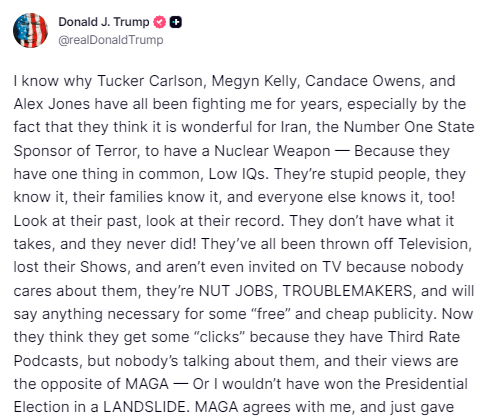
The visceral hatred. This is internal descent. He hasn’t even lashed out at us as much as he’s lashed out at his own, who has abandoned him. This is the same phenomenon. Once you understand this sectarianism and what’s happening with the MAGA crowd, it’s all the same. It’s that once you understand cognitive biases, you can no longer be as petty as so many of these other people are.
This is why I hope when I teach you all of this, I want in shāʾ Allāh, my students to reflect this maturity and wisdom and sensibility that is not found amongst those who don’t go through this training.
Once you understand basic cognitive biases in human psychology, you cannot resort to the types of thinking we find in other types of people. Here, external enemies are actually an excuse to tighten your ranks. It’s a good mechanism to get rid of internal descent because when you have an external enemy, that becomes the priority, whereas internal descent threatens what you do.
They can fracture the movement. Internal descents are potentially lethal. External descents are fortifying. Once you understand this, realize they are creating an external threat out of us because it’s validating their system and we have to understand that.
We need to amplify the internal dissent from amongst them because that is the biggest threat to them. They represent a bigger threat to their internal cohesion than we do. So understand this point, cognitive dissonance amplification.
Once you understand this, once again, you will understand why it is so much easier to hate on a fellow Muslim who disagrees with you on abstract issues versus somebody who’s far, far away.
Some of you are very familiar with the Sufi-Salafi bashing taking place constantly for the last Allah knows how much time. The reality is that the Sufis and Salafis in particular don’t just agree on the fundamentals, they agree on the sources, on the giants, on the traditions. Their books are going to be exactly by and large the same. They’re books of tafsir, of hadith, the Mustalah of Lugha (Arabic terminology),they’re exactly the same. The level of animosity and hatred and bashing is truly surreal! But once you understand psychology, you understand it is so high because that is the biggest threat to them, far bigger than other movements because they’re so similar.
More in this series:
How Sacred Values Lead to Intolerance and Division
Exaggerating Minor Differences to Maintain Group Identity
How Social Identity Fuels Intergroup Discrimination
 Islamic Civilization