All posts filed under: Featured

400 years of peace: Palestine under Ottoman rule

This has been reproduced from the Daily Sabah. Ruling the Palestine region for more than 400 years, the Ottomans fought fiercely to keep the ancient lands during World War I but eventually lost them to the British Palestine, which has witnessed many conflicts throughout history, came under Ottoman rule in the 16th century. When Yavuz Sultan Selim defeated the Mamluk ruler Kansu Gavri in the Battle of Marj Dabiq in 1516, Syria and Palestine joined the Ottoman lands. Yavuz Sultan Selim entered Jerusalem on Dec. 29, 1516. Under Ottoman rule, the Palestinian territory was organized into three states, Jerusalem, Gaza and Nablus, all linked to the Damascus Province. Palestine, in the last period of the Ottoman Empire, was first linked to the state of Sidon, later to Syria and then to Beirut, which was founded in the last period. The Ottomans ruled in Palestine for 401 years. Palestine was and still is a region of great importance for Muslims, Christians and Jews. In particular, the sacred places in Jerusalem could not be shared. Even the …

Liberation of Jerusalem: Salahudeen’s mercy towards the Crusaders

Salahudin Ayubi liberated Jerusalem (Al-Quds) on Friday 27 Rajab 583 AH/12 October 1187 CE after Lord Balian of Ibelin, the crusader commander in charge of Jerusalem, surrendered the city. This marked an end to nearly 100 years of crusader occupation and the liberation of Masjid Al-Aqsa. When the crusaders first entered Jerusalem in 1099, they massacred the Muslim and Jewish inhabitants, yet Salahudin on retaking the city never enacted revenge on them for this, nor the subsequent atrocities they had committed over the past century. He followed in the footsteps of the Prophet Muhammad ﷺ who on entering Makkah did not enact revenge on Quraish who had persecuted him and the Muslims for over 20 years. This was the because the character of the Prophet ﷺ was the Qur’an.[1] Allah ta’ala says, يَـٰٓأَيُّهَا ٱلَّذِينَ ءَامَنُوا۟ كُونُوا۟ قَوَّٰمِينَ لِلَّهِ شُهَدَآءَ بِٱلْقِسْطِ ۖ وَلَا يَجْرِمَنَّكُمْ شَنَـَٔانُ قَوْمٍ عَلَىٰٓ أَلَّا تَعْدِلُوا۟ ۚ ٱعْدِلُوا۟ هُوَ أَقْرَبُ لِلتَّقْوَىٰ ۖ وَٱتَّقُوا۟ ٱللَّهَ ۚ إِنَّ ٱللَّهَ خَبِيرٌۢ بِمَا تَعْمَلُونَ O believers! Stand firm for Allah and bear true testimony. Do not let …

Islamic Conquest of Damascus: Rule of law at the height of war

ذِمَّةُ اَلْمُسْلِمِينَ وَاحِدَةٌ يَسْعَى ِبهَا أَدْنَاهُمْ “The protection granted by one Muslim is like one given by them all, and this right is extended to the humblest of them.”[1] The Qur’anic character of the companions (sahaba) and early Muslims lead to their extraordinary restraint in the height of war, something virtually unheard of in modern warfare. The ‘civilised’ west, with all their talk of the rule of law, human rights and the Geneva convention have perpetrated according to Dr Gideon Polya a “Post-9/11 Muslim Holocaust & Muslim Genocide” where 30 million Muslims have been killed in avoidable deaths due to western, or western backed military intervention. There is no clearer example of this than the horrific ongoing genocide in Gaza, which America and its allies are actively financing, arming and providing cover for at the United Nations with their right of veto. As Samuel Huntington said, “The West won the world not by the superiority of its ideas or values or religion (to which few members of other civilizations converted) but rather by its superiority …

What is the meaning of “Allah prevents by the authority (sultan) what He does not prevent by the Qur’an”? 

إن الله يزع بالسلطان ما لا يزع بالقرآن Allah prevents by the authority (sultan) what He does not prevent by the Qur’an Sheikh Bin Baz answers this question: “This is a well-known narration on the authority of Uthman (ra) and it is proven on the authority of Uthman bin Affan, the third rightly-guided caliph (ra). It is also narrated on the authority of Umar (ra)…It means, Allah ta’ala prevents the committing of forbidden acts through the authority (sultan), more than what He prohibits by the Qur’an. Since some people are weak in faith (iman), the Qur’an’s prohibitions do not affect them. Rather, they resort to forbidden things and do not care. However, when they learn that there is a punishment from the authority, they become deterred and fear the authority’s punishment. The meaning of Allah punishes through the authority is that the authority’s punishments, punish some criminals more than what Allah punishes them through the Qur’an. Due to the weakness of their faith and their lack of fear of Allah ta’ala they fear the Sultan …

Gaza: Cruel Zionism, Past and Present with Professor Avi Shlaim

This has been reproduced from The Thinking Muslim. Today, we are confronting nothing short of a campaign of ethnic cleansing of the Palestinians of Gaza, not seen since the Nakba or Catastrophe of 1948. Yet many in the Western world are silent about the suffering. Much of what justifies Israel and its actions in the West is premised on history, and many European and American historians have been ready to present a compelling argument for Zionism and the case for Israel in the heart of the Middle East. This historical justification, based on persecution and antisemitism, gives the story of Israel a potency that has for many years served to find acceptance in the West – of impunity to act without restraint – that is not offered to any other state. At the same time, the Palestinian story has been undermined by these same historians. They were a Bedouin community, readily able to vacate their land – it is said. Palestinians, according to leading Israeli politicians, are a mythical people. Today, we are honoured to have …

Late Ḥanafī Authorities on the Imamate

BY ASIM AYUB. This has been reproduced from Ummatics. This article presents four annotated translations of excerpts on Sharīʿa governance from “late” (post-7th century Hijri) classical Ḥanafi works in rational theology (kalām) and spiritual psychology (taṣawwuf).1 A previous piece was dedicated to earlier authorities in the school.2 Collectively, these excerpts are representative of the Ḥanafi position that the imamate, or caliphate, is a communal obligation of utmost importance. They express the reasoning for this—including an assessment of opposing heterodox views—as well as articulating the roles, benefits, and significance of the imamate. Most of the scholarly reflection on the imamate, despite it being a matter of positive law (fiqh), is found in theological works. For the Ḥanafīs, this means in works of Māturīdī theology. Our first passage, in turn, is from one such work by Kamāl al-Dīn al-Andakānī (d. 726/1325) in which he presents consensus as the textual proof for the obligation of imamate as well as a rational proof tied to its fulfilment of sociopolitical roles necessary for the Umma. The next two extracts exemplify the synthesis of the …

Jews in the Ottoman Caliphate

This article has been reproduced from caliphate1.com In 1492, when Spain’s rulers (Ferdinand II of Aragon and Isabella I of Castile) expelled its Jewish population as a result of the Spanish Inquisition and the Alhambra Decree, Sultan Bayazid II sent out the Ottoman Navy under the command of admiral Kemal Reis to evacuate them safely to Ottoman lands. He sent out proclamations throughout the Caliphate that the refugees were to be welcomed. He granted the Jews permission to settle in the Ottoman State and become Ottoman citizens and issued a firman (decree) to the governors of his European provinces to give them a friendly and welcome reception. “You venture to call Ferdinand a wise ruler,” he said to his courtiers, “he who has impoverished his own country and enriched mine!” [The Jewish Encyclopaedia – Vol. 2, Isadore Singer and Cyrus Adler, Funk and Wagnalls, 1912, p. 460] Bernard Lewis, in his scholarly overview entitled The Jews of Islam, documents how Jews lived, worked and flourished under Ottoman rule. For example, many Jews were experts in medicine: “The prominence …

INFOGRAPHIC: Structure of the Islamic State

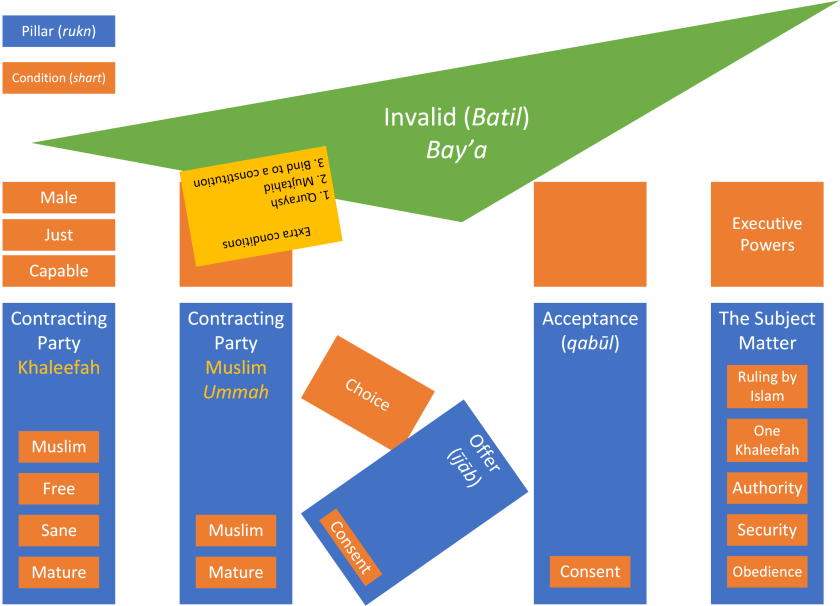
The Islamic State (al-dowlah al-Islamiyyah الدولة الإسلامية) consists of a distinct form (shakl شَكْل) and structure (tanzeem تَنْظِيم) of government that is unlike any other ruling system. It is unique in terms of the foundations (usul أُصُول) upon which it is built, and the principles (qawa’id قَواعِد) which underpin its institutions (ajhizah أَجْهِزَة) and systems (anzimah أَنْظِمَة). Abdul-Qadeem Zallum says, “The Islamic ruling system is distinct from all other existing ruling systems in the world. It is unique in terms of the basis upon which it is built. As a result it is distinct in the thoughts, concepts, criteria and laws by which it looks after the affairs, the constitution and laws which it implements and executes, and in the shape by which the state is represented and distinguished from all other shapes of ruling in the whole world.”[1] Having said this, the Islamic ruling system will inevitably share characteristics with other forms of government, since the top-level institutions such as having a ruler, judiciary, military, police, executive departments and so forth are the same …

‘Comfort after Calamity’, a poem by Imam Ali

الْفَرَجُ بَعْدَ الشدَّة ‘Comfort after Calamity’ Many a times, especially in the current Muslim world, we find ourselves in situations which render the soul helpless, and leave no hope in sight. It is in such moments that the faith of a Muslim is tested. One should always remember that the night is always darkest before the dawn, and after hardship there always comes ease. If the believers choose to pass these moments complaining and without faith, then they shall be questionable before Allāh. However, if these moments are passed with patience and prayer, then these very moments will pave the path for spiritual elevation and success for the believers.[1] 1- When calamities reach their final extent That their intensity causes the soul to melt 2- When adversities take root, and solace bids farewell then in dire and hard times, comes comfort and rest[2] Notes [1] Abdullah Ayaz Mullanee, ‘The Poetic works of Sayyiduna Ali,’ a translation of Diwan Ali, p.73 [2] Ibid

Do not think that Allah is unaware of what the wrongdoers do

Allah ta’ala says,  وَلَا تَحْسَبَنَّ ٱللَّهَ غَـٰفِلًا عَمَّا يَعْمَلُ ٱلظَّـٰلِمُونَ ۚ إِنَّمَا يُؤَخِّرُهُمْ لِيَوْمٍۢ تَشْخَصُ فِيهِ ٱلْأَبْصَـٰرُ مُهْطِعِينَ مُقْنِعِى رُءُوسِهِمْ لَا يَرْتَدُّ إِلَيْهِمْ طَرْفُهُمْ ۖ وَأَفْـِٔدَتُهُمْ هَوَآءٌۭ Do not think ˹O Prophet˺ that Allah is unaware of what the wrongdoers do. He only delays them until a Day when ˹their˺ eyes will stare in horror—rushing forth, heads raised, never blinking, hearts void.[1]