All posts filed under: Featured

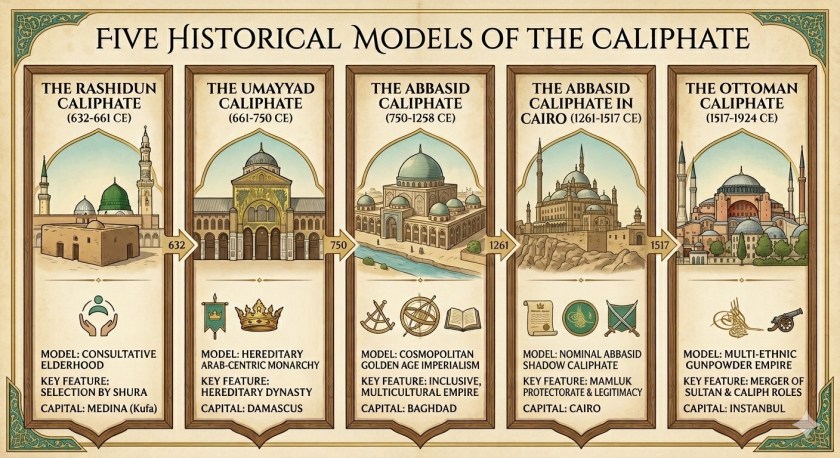
Five Historical Models of the Caliphate

For most of Islamic history the Caliphate was a decentralised confederation, with executive power held by the various Islamic emirates and sultanates who recognised the caliph through a nominal bay’ah. Al-Radhi (r.934-940CE) was the last independent Abbasid caliph after the rise of the Buwahids (Buyids) in 934CE, and the establishment of their emirate over Iraq, and central and southern Iran. This reduced the caliph’s executive power to the Dar ul-Khilafah which was a section of Baghdad that housed the Caliphal palace. Al-Khatib (d. 463H,1071CE) mentions that Al-Radhi was “the last of the Caliphs who undertook the sole direction of the army and the finances.”[1] After Al-Radhi, his brother Al-Muttaqi (r.940-944CE) became the caliph and Al-Suyuti says about him that “He had nothing of authority but the name.”[2] Dr. Ovamir Anjum says, “This third model (940-1517CE) has been called classical Islamic constitutionalism.[3] It is important because, with the exception of the first couple of centuries, it is what the caliphate has actually looked like throughout most of Islamic history.”[4] Time period Dates Length Rightly Guided Caliphate 11-41H / 632-661    30 years Umayyads, …

Ikhtilaf (difference) and Iftiraq (division) in Islam

An Islamic society is not a one-party communist totalitarian society where differences and individuality are expunged. Human beings differ in their colours, languages, tastes, interests and intellectual capacity. In themselves these differences are not a problem unless they are used to cause dissent and division. Allah ta’ala clearly says in the Qur’an: يَـٰٓأَيُّهَا ٱلنَّاسُ إِنَّا خَلَقْنَـٰكُم مِّن ذَكَرٍۢ وَأُنثَىٰ وَجَعَلْنَـٰكُمْ شُعُوبًۭا وَقَبَآئِلَ لِتَعَارَفُوٓا۟ ۚ إِنَّ أَكْرَمَكُمْ عِندَ ٱللَّهِ أَتْقَىٰكُمْ ۚ إِنَّ ٱللَّهَ عَلِيمٌ خَبِيرٌۭ O humanity! Indeed, We created you from a male and a female, and made you into peoples (شُعُوب) and tribes (قَبائِل) so that you may ˹get to˺ know one another. Surely the most noble of you in the sight of Allah is the most righteous among you. Allah is truly All-Knowing, All-Aware.[1] We need to distinguish between two Arabic words in relation to Islamic unity. They are Ikhtilaf (difference) and Iftiraq (division) which are both found in the Qur’an and Sunnah. Allah ta’ala says, وَلَا تَكُونُوا۟ كَٱلَّذِينَ تَفَرَّقُوا۟ وَٱخْتَلَفُوا۟ مِنۢ بَعْدِ مَا جَآءَهُمُ ٱلْبَيِّنَـٰتُ ۚ وَأُو۟لَـٰٓئِكَ لَهُمْ عَذَابٌ عَظِيمٌۭ “And do …

Is the caliph sovereign?

The caliph in origin, has all executive power invested in him, similar to the US President. Article II of the US constitution states, “The executive Power shall be vested in a President of the United States of America.” This doesn’t make the caliph an absolute monarch or dictator, in the same way it doesn’t make the US president an absolute monarch or dictator, because both posts are restricted by other branches of government namely the legislative branch which is ultimately sovereign. In an Islamic state the legislative branch is the sharia, which binds the caliph, limits his powers and prevents him from overstepping the law. This is primarily achieved through binding the caliph to a constitution when he is given the bay’a on taking office. This is continuously enforced through institutional mechanisms such as the Supreme Court, Majlis al-Nuwaab (House of Representatives) and the Dar al-‘Adl (House of Justice) fulfilling the function of an upper house. The Messenger of Allah ﷺ said: لا تُحْرِجُوا أُمَّتِي ثَلاثَ مَرَّاتٍ ، اللَّهُمَّ مَنْ أَمَرَ أُمَّتِي بِمَا لَمْ تَأْمُرْهُمْ بِهِ ، أَوْ آمُرْهُمْ فَإِنَّهُمْ مِنْهُ فِي حِلٍّ “Do not oppress …

What is sharia?

Islam is not a religion like Christianity which, “Renders unto Caesar the things that are Caesar’s, and unto God the things that are God’s”.[1] There is no separation between religion and politics in Islam. All spheres of life, state and society are governed by Allah’s guidance in the form of the sharia (شَرِيعَة). Sharia comprises of all the rules (ahkam) derived from the legislative sources of Islam. These rules are not just limited to areas covering beliefs and morals, but rather the Islamic rules cover every action performed by an individual or state. Allah (Most High) says: فَرَّطْنَا فِي الْكِتَابِ مِن شَيْءٍ “Nothing have We omitted from the book”[2] Iyad Hilal says, “The linguistic meaning of the word Sharia is a non-exhaustive source of water with which people satisfy their thirst. Thus, the linguistic significance of Sharia is that the Islamic laws are effectively a source of guidance. As water is the fundamental basis of life, the Islamic laws are an essential source for guiding human life. Sharia is composed of all the laws derived from the legislative sources of …

Rhetorical Perceptions in Surah Al-‘Asr

This is a translation from Dr Fadhel Saleh Al-Samarra’i’s لَمَسات بَيانِيَّة لِسُوَر القُرْآن الكَرِيم ‘Rhetorical Perceptions in the Surahs of the Holy Qur’an.’ Dr Fadhel (b.1933) is a former Professor of Literature at the College of Arabic Language at the University of Sharjah. His full biography can be read here. Surah Al-‘Asr وَٱلْعَصْرِ By the ˹passage of˺ time! إِنَّ ٱلْإِنسَـٰنَ لَفِى خُسْرٍ Surely humanity is in ˹grave˺ loss, إِلَّا ٱلَّذِينَ ءَامَنُوا۟ وَعَمِلُوا۟ ٱلصَّـٰلِحَـٰتِ وَتَوَاصَوْا۟ بِٱلْحَقِّ وَتَوَاصَوْا۟ بِٱلصَّبْرِ except those who have faith, do good, and urge each other to the truth, and urge each other to perseverance. The Purpose of the Surah This Meccan surah is remarkably concise in wording yet profound in meaning. Imam al-Shafi’i said of this surah: “If Allah Almighty had revealed nothing else in the Quran but Surah al-‘Asr, it would have sufficed for humanity.” This is because Islam ultimately rests on four pillars: iman, righteous deeds, mutual exhortation to truth (التواصي بالحق) for the sake of upholding the deen on earth, and mutual exhortation to patience (التواصي بالصبر), since upholding the deen exposes …

War and Peace in Islam: Non-Muslims entering Muslim lands

Continuing our series on War and Peace in Islam, some of the extreme Jihadi-Salafi groups in Iraq began killing Christians and destroying their churches, in a country which was the heartland of the Abbasid Caliphate for 511 years. ISIS went even further and started to enslave Yazidis, whose existence pre-dates Islam and who managed to survive 1300 years of caliphal rule. A few years of ISIS ‘rule’ however and they nearly became extinct. This is evidence enough that there is nothing Islamic about ISIS let alone its claim to the caliphate. Categories of non-Muslims entering Muslim lands There are four main categories of non-Muslims entering either a caliphate or Muslim country. These are: The Mu’ahid is a citizen of a foreign state with which the state has a treaty. The citizens of this state (mu’ahideen) can enter without a passport or visa if this is reciprocated to the citizens of the Muslim state.[15] The Must’amin is a citizen of a foreign state with which the Muslim country has no treaty. The citizens of these states can enter, but only …

Did Al-ʿAbbās spy in Makkah for the Islamic State in Medina?

According to some historians Al-ʿAbbās remained in Makkah after his conversion to Islam in order to inform the Prophet ﷺ of the events in the city i.e. spying. Some may misconstrue this as an evidence to permit Muslim citizens of non-Islamic lands to spy for a future caliphate, even though this is a clear breach of their Aman (citizenship and residency status). Al-ʿAbbās ibn Abd al-Muttalib (May Allah be pleased with him) was the Prophet Muhammad’s ﷺ uncle. When the Prophet ﷺ migrated to Medina to establish the Islamic State, Al-ʿAbbās remained behind in Makkah as he hadn’t converted to Islam at this point in time. Just before the Conquest of Makkah, he converted to Islam and made hijra to Medina as the final emigrant, giving him a high status among the sahaba compared to those who converted after the conquest. Allah (Most High) says, لَا يَسْتَوِى مِنكُم مَّنْ أَنفَقَ مِن قَبْلِ ٱلْفَتْحِ وَقَـٰتَلَ ۚ أُو۟لَـٰٓئِكَ أَعْظَمُ دَرَجَةًۭ مِّنَ ٱلَّذِينَ أَنفَقُوا۟ مِنۢ بَعْدُ وَقَـٰتَلُوا۟ Those of you who donated and fought before the victory ˹over …

War and Peace in Islam: Citizenship and residency visas

Continuing our series on war and peace in Islam, there is confusion over the classical ‘covenant of security’ and when it applies and when it breaks. This will be continued over a number of articles as it’s a very important topic to be understood in light of the historical attrocities that have been committed in both Muslim and non-Muslim countries. Citizenship and residency visas are the modern equivalents of the classical sharia concept of Al-Amān (الأَمان) which are security covenants. Ahmed Al-Dawoody says, “Amān (literally, protection, safety) forms an essential part of the Islamic law of war.”[1] He continues, “Some contemporary Muslim scholars have likened this safe conduct status to the “passport” system. Indeed, this ancient safe conduct system is similar to the visa system in some respects. It is a temporary permission to stay in a foreign country and can be renewed after its expiry date.”[2] Fulfilling security covenants is a well-established rule, that was codified by the imams of the classical schools of thought and applied throughout Islamic history. While abuses, mistakes and collateral …

How is a caliphate divided up?

A caliphate is essentially a group of emirates, states or provinces which are bound together by the bay’ah ruling contract with its ruler – the caliph. The Caliphate from its initial establishment after the death of the Prophet ﷺ under its first caliph Abu Bakr Al-Siddiq, had always been an ‘empire’ encompassing vast areas of land, and in later periods spanning multiple continents. In Islamic history the caliphate was broadly divided up into four levels of governance: Level Name Head 1st Level Province (ولاية  Wiliyah) Emirate (إِمَارَةِ)Sultanate (سَلْطَنَة) WaliAmirSultan 2nd Level District (عمالة  I’mala)   ‘AmilHakimAmir 3rd Level City (بَلَد  Balad)Fortified town (قصبة  Qasabah) AmirHakimRa’is 4th Level Neighbourhood (حَيّ  Hayy)[1] Tribe/Clan (قَبِيلَة Qabilah)[2] MuqaddamSheikhNaqib Administering such a huge state relied heavily on the local governors of the various provinces being loyal, competent and just in their positions. The logistical challenges of ancient communications meant it could take weeks or even months for the governors of Egypt, North Africa, and Khorasan to receive a letter from the caliph. The governor would therefore need to have a great deal of autonomy and authority to …

What is an Islamic Society?

Society is defined as “a large group of people who live together in an organized way, making decisions about how to do things and sharing the work that needs to be done. All the people in a country, or in several similar countries, can be referred to as a society.”[1] The concept of society (مُجْتَمَع) is intrinsically linked to the discussion of authority, because it’s the authority and government which plays the greatest role in shaping and controlling society. The Ottoman historian Tursun Beg (d.1499) said, “With the pen of scribes, the ruler turns the noble into a wretched, and the wretched into a noble…with the sword of executioners he takes lives. As such he manifests the attributes of the Necessary Existent as if he shares the sultanate with Him except that the ruler of the world is a mortal.”[2] The source of authority (masdar al-sultah) is based on societal concepts which are in turn based on the Islamic ‘aqeeda which forms a distinct viewpoint of life, and which influences the type of authority that is established. This is why …