All posts filed under: Government

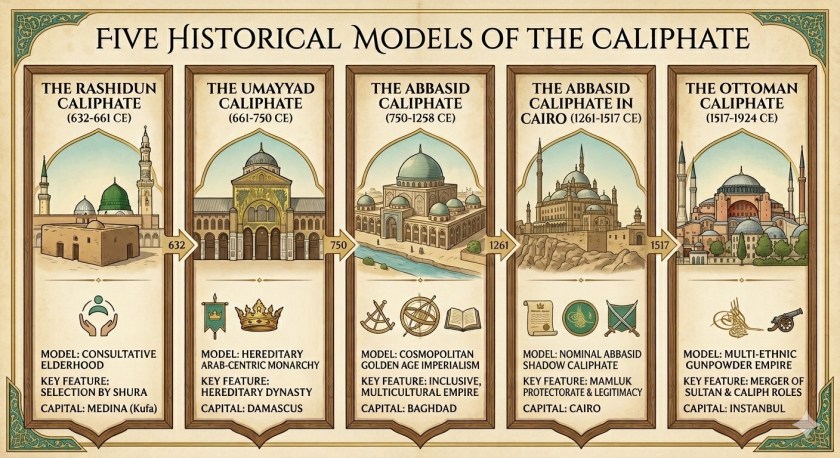
Five Historical Models of the Caliphate

For most of Islamic history the Caliphate was a decentralised confederation, with executive power held by the various Islamic emirates and sultanates who recognised the caliph through a nominal bay’ah. Al-Radhi (r.934-940CE) was the last independent Abbasid caliph after the rise of the Buwahids (Buyids) in 934CE, and the establishment of their emirate over Iraq, and central and southern Iran. This reduced the caliph’s executive power to the Dar ul-Khilafah which was a section of Baghdad that housed the Caliphal palace. Al-Khatib (d. 463H,1071CE) mentions that Al-Radhi was “the last of the Caliphs who undertook the sole direction of the army and the finances.”[1] After Al-Radhi, his brother Al-Muttaqi (r.940-944CE) became the caliph and Al-Suyuti says about him that “He had nothing of authority but the name.”[2] Dr. Ovamir Anjum says, “This third model (940-1517CE) has been called classical Islamic constitutionalism.[3] It is important because, with the exception of the first couple of centuries, it is what the caliphate has actually looked like throughout most of Islamic history.”[4] Time period Dates Length Rightly Guided Caliphate 11-41H / 632-661    30 years Umayyads, …

Ikhtilaf (difference) and Iftiraq (division) in Islam

An Islamic society is not a one-party communist totalitarian society where differences and individuality are expunged. Human beings differ in their colours, languages, tastes, interests and intellectual capacity. In themselves these differences are not a problem unless they are used to cause dissent and division. Allah ta’ala clearly says in the Qur’an: يَـٰٓأَيُّهَا ٱلنَّاسُ إِنَّا خَلَقْنَـٰكُم مِّن ذَكَرٍۢ وَأُنثَىٰ وَجَعَلْنَـٰكُمْ شُعُوبًۭا وَقَبَآئِلَ لِتَعَارَفُوٓا۟ ۚ إِنَّ أَكْرَمَكُمْ عِندَ ٱللَّهِ أَتْقَىٰكُمْ ۚ إِنَّ ٱللَّهَ عَلِيمٌ خَبِيرٌۭ O humanity! Indeed, We created you from a male and a female, and made you into peoples (شُعُوب) and tribes (قَبائِل) so that you may ˹get to˺ know one another. Surely the most noble of you in the sight of Allah is the most righteous among you. Allah is truly All-Knowing, All-Aware.[1] We need to distinguish between two Arabic words in relation to Islamic unity. They are Ikhtilaf (difference) and Iftiraq (division) which are both found in the Qur’an and Sunnah. Allah ta’ala says, وَلَا تَكُونُوا۟ كَٱلَّذِينَ تَفَرَّقُوا۟ وَٱخْتَلَفُوا۟ مِنۢ بَعْدِ مَا جَآءَهُمُ ٱلْبَيِّنَـٰتُ ۚ وَأُو۟لَـٰٓئِكَ لَهُمْ عَذَابٌ عَظِيمٌۭ “And do …

Is the caliph sovereign?

The caliph in origin, has all executive power invested in him, similar to the US President. Article II of the US constitution states, “The executive Power shall be vested in a President of the United States of America.” This doesn’t make the caliph an absolute monarch or dictator, in the same way it doesn’t make the US president an absolute monarch or dictator, because both posts are restricted by other branches of government namely the legislative branch which is ultimately sovereign. In an Islamic state the legislative branch is the sharia, which binds the caliph, limits his powers and prevents him from overstepping the law. This is primarily achieved through binding the caliph to a constitution when he is given the bay’a on taking office. This is continuously enforced through institutional mechanisms such as the Supreme Court, Majlis al-Nuwaab (House of Representatives) and the Dar al-‘Adl (House of Justice) fulfilling the function of an upper house. The Messenger of Allah ﷺ said: لا تُحْرِجُوا أُمَّتِي ثَلاثَ مَرَّاتٍ ، اللَّهُمَّ مَنْ أَمَرَ أُمَّتِي بِمَا لَمْ تَأْمُرْهُمْ بِهِ ، أَوْ آمُرْهُمْ فَإِنَّهُمْ مِنْهُ فِي حِلٍّ “Do not oppress …

What is an Islamic Society?

Society is defined as “a large group of people who live together in an organized way, making decisions about how to do things and sharing the work that needs to be done. All the people in a country, or in several similar countries, can be referred to as a society.”[1] The concept of society (مُجْتَمَع) is intrinsically linked to the discussion of authority, because it’s the authority and government which plays the greatest role in shaping and controlling society. The Ottoman historian Tursun Beg (d.1499) said, “With the pen of scribes, the ruler turns the noble into a wretched, and the wretched into a noble…with the sword of executioners he takes lives. As such he manifests the attributes of the Necessary Existent as if he shares the sultanate with Him except that the ruler of the world is a mortal.”[2] The source of authority (masdar al-sultah) is based on societal concepts which are in turn based on the Islamic ‘aqeeda which forms a distinct viewpoint of life, and which influences the type of authority that is established. This is why …

The Ummah’s Political Representatives (Ahlul hali wal-aqd)

What is the Ahlul hali wal-aqd? The sharia texts related to the bay’ah are ‘aam (general) in their address by use of the relative pronoun مَنْ which translates as whoever.[1] They therefore include the entire Muslim ummah, which is why we say the source of authority in origin is with the ummah. This is seen in numerous ahadith on the bay’ah: مَنْ كَرِهَ مِنْ أَمِيرِهِ “Whoever sees in his Ameer…”[2] مَنْ خَرَجَ مِنَ الطَّاعَةِ “Whoever withdraws obedience (to the Ameer)…”[3] مَنْ بَايَعَ إِمَامًا “Whoever gave bay’ah to an Imam…”[4] مَنْ مَاتَ وَلَيْسَ فِي عُنُقِهِ بَيْعَةٌ “Whoever dies while having no bay’ah on his neck…”[5] When it comes to exercising that authority however, a problem arises because the bay’ah is a contract of one-to-millions i.e. between the caliph and the Muslim ummah. This is different to other Islamic contracts which are one-to-one such as buying, selling and marriage. This poses a challenge on how you get the consent of millions of people which is a condition in Islamic contracts. Historically it was not possible for every Muslim to participate in the election of the Imam, which is why in the rightly guided caliphate of …

Devolution in an Islamic State

Devolution is the transfer or delegation of power to a lower level, especially by central government to a local or regional administration. This is different to a federal state where power is shared between states and the central (federal) government. In such a model, provinces have a constitutional right to disobey the central government, and execute their own policies and laws in certain (non-federal) areas. Therefore, in origin the caliphate is a unitary state with devolution and not a federal state even though the differences between the two are small. In the case of America’s federal model, it’s almost identical administratively to how a future caliphate would look i.e. a United States of Islam (USI). The Islamic State has a unitary executive, where in origin all executive ruling power is with the caliph. This power is transferred to the caliph from the ummah who are the source of authority (مَصْدَر السُلْطَة masdar al-sultah)[1] via the bay’ah contract. Muhammad Haykal says, “The sultah (authority) in Islam belongs to the Ummah and she passes it to the ruler in accordance to a contract …

Election of Amirs in the Prophet’s ﷺ State in Medina

The 12 Naqibs The Aws and Khazraj tribes whom Islam united together as the Ansar (helpers), were sub-divided into various clans who managed their own administrative affairs as devolved ‘mini-provinces’. The chiefs of these clans were not appointed by the Prophet ﷺ, but rather ‘elected’ by the tribes themselves on his ﷺ orders. Ka’b ibn Malik narrates that the Prophet ﷺ said, أَخْرِجُوا إلَيَّ مِنْكُمْ اثْنَيْ عَشَرَ نَقِيبًا، لِيَكُونُوا عَلَى قَوْمِهِمْ بِمَا فِيهِمْ. فَأَخْرَجُوا مِنْهُمْ اثْنَيْ عَشَرَ نَقِيبًا، تِسْعَةً مِنْ الْخَزْرَجِ، وَثَلَاثَةً مِنْ الْأَوْسِ. أَسَمَاءُ النُّقَبَاءِ الِاثْنَيْ عَشَرَ وَتَمَامُ خَبَرِ الْعَقَبَةِ “Bring out to me from among you twelve chiefs (naqibs), so that they may be in charge of their people and what is in them.” So they brought out from among them twelve chiefs, nine from the Khazraj, and three from the Aws.[1] It is clear from the Sahifa and the command of the Prophet ﷺ: أَخْرِجُوا إلَيَّ مِنْكُمْ اثْنَيْ عَشَرَ نَقِيبًا، لِيَكُونُوا عَلَى قَوْمِهِمْ بِمَا فِيهِمْ “Bring out to me from among you twelve chiefs (naqibs), so that they may be in charge of their people …

Shura on Government Appointments

Shura is a principle of ruling Shura (consultation) is a key principle of the Islamic Ruling System and underpins all the institutions of the state. In order for the governors and mayors of the provinces and cities to be focussed on their citizens’ affairs and not their own personal interests, they need to be elected by the people they are ruling over. Ibn Atiyyah (d.1147CE) said that: الشورى من قواعد الشريعة وعزائم الأحكام، ومن لا يستشير أهل العلم والدين، فعزله واجب. هذا ما لا خلاف فيه، وقد مدح الله المؤمنين بقوله:  وَأَمْرُهُمْ شُورَى بَيْنَهُمْ “Shura is one of the principles of Sharia and the firmest of rulings, and whoever does not consult the people of knowledge and religion must be removed. This is something that is not disputed, and Allah praised the believers by saying: وَأَمْرُهُمْ شُورَى بَيْنَهُمْ ‘And their affairs are conducted by mutual consultation.’[1]”[2] Al-Zamakhshari (d.1143CE) explains the limits of shura in his explanation of the verse,وَشَاوِرْهُمْ فِي الْأَمْرِ “And consult them in the matter”[3] يعنى في أمر الحرب ونحوه مما لم ينزل عليك فيه وحي لتستظهر برأيهم “It …

How is a caliphate divided up?

A caliphate is essentially a group of emirates, states or provinces which are bound together by the bay’ah ruling contract with its ruler – the caliph. The Caliphate from its initial establishment after the death of the Prophet ﷺ under its first caliph Abu Bakr Al-Siddiq, had always been an ‘empire’ encompassing vast areas of land, and in later periods spanning multiple continents. In Islamic history the caliphate was broadly divided up into four levels of governance: Level Name Head 1st Level Province (ولاية  Wiliyah) Emirate (إِمَارَةِ)Sultanate (سَلْطَنَة) WaliAmirSultan 2nd Level District (عمالة  I’mala)   ‘AmilHakimAmir 3rd Level City (بَلَد  Balad)Fortified town (قصبة  Qasabah) AmirHakimRa’is 4th Level Neighbourhood (حَيّ  Hayy)[1] Tribe/Clan (قَبِيلَة Qabilah)[2] MuqaddamSheikhNaqib Administering such a huge state relied heavily on the local governors of the various provinces being loyal, competent and just in their positions. The logistical challenges of ancient communications meant it could take weeks or even months for the governors of Egypt, North Africa, and Khorasan to receive a letter from the caliph. The governor would therefore need to have a great deal of autonomy and authority to …

Structure of an Islamic State: The Provinces

Every state is divided up into administrative divisions in order to organise and manage the local affairs of its citizens. The names and sizes of these divisions will vary between different countries, and an Islamic State or caliphate can use any of these administrative divisions from any system which suits its requirements at the time. The underlying principle here is to keep the caliphate united upon the Islamic ‘aqeeda (creed), even if administratively and politically it consists of separate states and entities. The top-level division in a caliphate is the province or state known as a Wiliyah (ولاية) or Emirate (إِمَارَةِ). The head of this province is called a Wali or an Amir. In the latter half of the Abbasid Caliphate, when the provinces became powerful semi-independent ‘empires’ then Sultanate (سَلْطَنَة) was used as in the case of the Seljuks, Mamluks and Ottomans. For the citizens of an Islamic State, their first point of contact with the leadership of the state is the governor of their province or emirate, and their local mayors in the …