All posts filed under: History

How Ramadan times were calculated in the Ottoman era

BY ERHAN AFYONCU This has been reproduced from Daily Sabah During the tenure of Şeyhülislam Musa Kazım Efendi in the Second Constitutional Period (II Meşrutiyet), the Qadi of Istanbul and a fatwa consultant (fetva emini) came on the 28th day of the month of Ramadan to inform that a witness sighted the new crescent moon, marking the end of Ramadan.

The First Muslim Navy: Sailing on the Sea Like Kings on Thrones

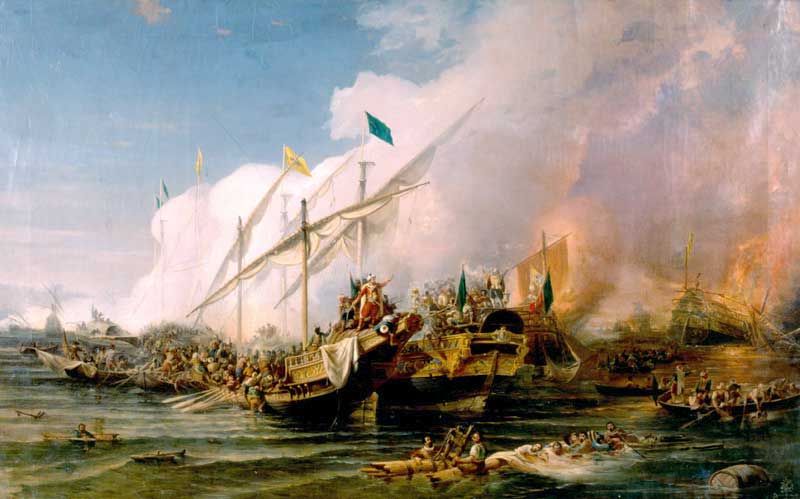
The establishment of the first Muslim navy during the Caliphate of Uthman bin Affan, offers a fascinating insight in to what Muslims can achieve if they have a state, and the correct understanding of tawakkul (reliance on Allah) and the spheres of actions which are within and outside their control. The early Islamic conquests have always perplexed western historians. How was it possible for the desert Arabs, who were viewed by the Persian and Byzantine empires as insignificant, and posing no threat to them, to rise up and within a few years destroy their longstanding empires? George Hourani, a maritime historian who has researched the early Muslim navy discusses “the problem of the earliest Arab ventures on the Mediterranean: how could they be successfully carried out in such a surprisingly short time? The decisive event is the battle of Dhaat al-Sawaari (Battle of the Masts). To fight a naval battle, many resources were required: naval bases, including docks, shipbuilding yards, building materials and skilled shipbuilders; [and] warships with their complements of trained sailors, marines and …


Umar ibn Al-Khattab reinforces the army of Egypt with four men

Amr ibn Al-Aas was the Amir of Jihad in Egypt during the Caliphate of Umar ibn al-Khattab. Umar wrote a letter to Amr: “I am very surprised at how long it is taking to conquer Egypt, as you have been fighting for the last two years, unless it is because of some sins that you have committed, or you have started to love this world as your enemy does. Allah, may He be blessed and exalted, only grants victory to people who are sincere. I am sending to you four individuals, and I have told you that each one of them is equivalent to one thousand men as far as I know, unless something has changed them…”[1]

The Conquest of Constantinople: Making the impossible possible

On the authority of Abdullah bin Bishr Al-Khathami from his father that he heard the Prophet ﷺ say: لَتُفْتَحَنَّ الْقُسْطَنْطِينِيَّةُ فَلَنِعْمَ الْأَمِيرُ أَمِيرُهَا وَلَنِعْمَ الْجَيْشُ ذَلِكَ الْجَيْشُ “You will open Constantinople, its Amir is a wonderful Amir, and its army is a wonderful army.” He said, Maslama ibn Abdul Malik called for me and asked me, so I mentioned the Hadith to him so he attempted to invade Constantinople. (Narrated by Ahmad. In Mujma’ Az-Zawaa’id, in its comment it states: “Narrated by Ahmad, Al-Bazzar, Al-Tabarani and its men are trustworthy…”)

How European History shaped its View of Religion

by Ustadh Abu Yusuf European history and its long and bloody religious wars brought about the idea of secularism i.e. separating religion from life’s affairs. This audio lecture will show how their experience of religion shaped their view not only of Christianity but also Islam and how this idea of secularism has penetrated the Muslim mindset today.

The Khilafah and the Indian Subcontinent

BY ABU ISMAEL AL-BEIRAWI This article has been reproduced from Islamic Revival. After yet another anniversary of the abolishment of the Khilafah state it is important for us to reflect upon its history and the reaction of the Muslims towards its demise and eventual destruction. It is assumed by some that the Muslims and their scholars did not react to the call for the abolishment of Khilafah and that they did not realise its significance. This is untrue, history is a testament to the reaction of the Muslims, their struggle to maintain it and their pain at the eventual removal of the shade of Allah (swt) from the earth. The example of the Muslims of India and its renowned Khilafat Movement demonstrates this.

Ottoman Bosnia

Introduction The Ottoman Sultanate which later became the seat of the Caliphate in 1517 was by no means perfect. A decline in Islamic thought, weakness in the Arabic language and closing the doors of ijtihad all had an impact on the implementation of Islam across the state. Yet despite this, the Ottoman State remained an Islamic State, and its concepts, criteria and convictions were Islamic. Legislation and administrative laws (kanun) were based on sharia, even if this was a tenuous link in some cases due to the decline in ijtihad, such as the devshirme, hereditary bay’a and tanzimat reforms.