All posts filed under: Ruling

The First Attempt at Entering the Interaction Stage in Makkah

DR MUHAMMAD KHAIR HAIKAL This is an extract from his PhD thesis ‘Al-Jihad wa’l Qital fi as-Siyasa ash-Shar’iyya’ It appears that this stage, the stage of manifestation and open declaration, in accordance to the understanding that we have explained, did not take place in one go, even if this gradual transition came to its climax when ‘Umar Ibn Al-Khattaab declared, after having been in the trench of the Kuffaar, with a certain heart and mind, that he had moved into another trench of the battle, transforming what he had carried in respect to this Da’wah in terms of a storm of hatred and violent vigour, transforming that all to the opposing side, to become the strongest of believers in backbone and firmness and most challenging in the face of the disbelievers.

What was the objective of the First Pledge of Al-Aqaba?

DR MUHAMMAD KHAIR HAIKAL This is an extract from his PhD thesis ‘Al-Jihad wa’l Qital fi as-Siyasa ash-Shar’iyya’ We are already aware that the meeting of the Messenger ﷺ with the Aws and the Khazraj only took place within the context of the search for the Nusrah (support) that he had been seeking from the leaders of the Arab tribes and those of a position of honour, nobility and leadership amongst them.

Law-making in the time of Umar ibn al-Khattab

When Umar ibn Al-Khattab was Caliph he wanted to adopt a law which would limit the Mahr for women.[1] So one day Umar delivered a khutbah[2] and said: “Do not give more than forty uqiyahs[3] in dowries to women, even if she is the daughter of Dhu al-Qissah – i.e., Yazeed ibn al-Husayn[4]. Whoever gives more than that, I will seize the extra amount and put it in the Bayt ul-mal[5].”

“All pious Muslims well-read in the Hadith firmly believe in the need to establish an Islamic State headed by a Muslim Caliph.” Sami Moubayed

“All pious Muslims well-read in the Hadith (the compiled sayings of the Prophet) firmly believe in the need to establish an Islamic State headed by a Muslim Caliph. This is mentioned twice in the Holy Quran and it’s central to the Islamic faith. No Muslim scholar would debate an Islamic state and the caliphate. Muslim Sunnis claim that the caliph should hail from Meccan notability. Shiite Muslims add that he must be from Ahl al-Bayt; a member of the prophet’s family.” (Sami Moubayed, Daily Telegraph, 23 Sep 2015)

Imam Nawawi’s explanation of the hadith on accounting the rulers

The Messenger of Allah ﷺ said: سَتَكُونُ أُمَرَاءُ فَتَعْرِفُونَ وَتُنْكِرُونَ فَمَنْ عَرَفَ بَرِئَ وَمَنْ أَنْكَرَ سَلِمَ وَلَكِنْ مَنْ رَضِيَ وَتَابَعَ ‏ ‏.‏ قَالُوا أَفَلاَ نُقَاتِلُهُمْ قَالَ ‏ لاَ مَا صَلَّوْا ‏‏ “‘There will be ameers, you recognise (something of what they do) and you reject (some). Whosoever recognised, he would be absolved (of sin) and whosoever rejected, he would be safe. But whosoever accepted and followed (what they do, he would not be safe).’ They (the Sahabah) asked ‘Shouldn’t we fight them?’ He said; ‘No, as long as they pray.’” (Sahih Muslim 1854a)

How many people are needed to contract the bay’ah?

The bay’ah is a ruling contract which governs the relationship between Muslims and the Islamic state. For those Muslims living under the authority of the Khilafah the bay’ah is their citizenship contract with the state. Unlike most Islamic contracts which are one-to-one such as buying, selling, and marriage, the bay’ah is one-to-millions i.e. between the Khaleefah and the Muslim ummah. This poses a challenge on how you get the free choice and consent of millions of people which is a condition in Islamic contracts.

The Best of Martyrs

Among the teeming and terrified crowd of protesters in Cairo’s Tahrir Square in January 2011, a young man and an older man crouched huddled next to each other as bullets from the security services whizzed overhead. In the din, the two spoke of how the Prophet Muhammad had once declared that whoever dies speaking truth to a tyrant will die a martyr.[1] They spoke of the great martyrs of the Prophet’s day, who awaited those latter-day believers who would one day join them in Paradise. Seized by inspiration, the young man cried, “I will greet them for you,” stood up and was shot in the head. “I touched his blood with my hands,” the elder man, a famous Muslim preacher, it turns out, recounted later in a TV interview, “It smelled like perfumed musk.”[2]     Notes [1] Prophet Muhammad ﷺ said: “The master of the martyrs is Hamza ibn Abdul Mattalib, and a man who stands (in front of) an oppressive ruler and enjoins the good and forbids the evil and so is killed …

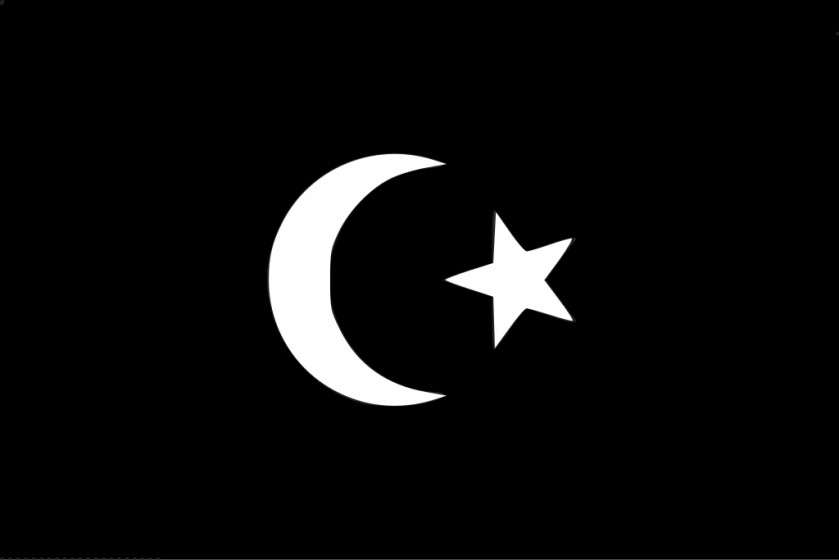
What is the official flag of the Caliphate?

Introduction There is no official flag for an Islamic State specified directly in the Qur’an and Sunnah. What we find are flags and banners used by the army of the Prophet ﷺ in Medina. Using qiyas (analogy) some contemporary scholars have extended the use of these flags and banners to a modern state and its citizens, and not just confined them to the armed forces. The use of flags to denote states is a modern phenomenon. Historically, flags were mainly used in warfare to identify the different armies on the battlefield. Ibn Khaldun says, “Flags have been the insignia of war since the creation of the world. The nations have always displayed them on battlefields and during raids. This was also the case in the time of the Prophet and that of the caliphs who succeeded him.”[1] In modern times flags are used to identify different countries and are used as a symbol to unite the nation. In America, there is a specific pledge for the flag and most public schools are required to schedule regular …