All posts filed under: Caliphate

Abbasid Caliph Al-Mansur: Supervising the Districts of Baghdad

The Caliphate is divided up administratively to aid the Caliph in the task of ruling. The territories which the Islamic State rules over are divided into provinces where each province is known as a wiliyah or imarah and ruled over by a governor (wali) or Emir respectively. These provinces are further sub-divided down to the local level as we find in all countries of the world today. For the citizens of the Caliphate, their first point of contact with the leadership of the state is their local leader who is managing people’s day to day affairs on a local level. If this leader is oppressive then this affects people’s daily lives more than any other government official including the Caliph. It is therefore of paramount importance for the Caliph to be fully aware of what is happening in all the various provinces of the Caliphate, and he will appoint government officials from his executive office to monitor them. This office of Sahib ul-Ummal was first held by Muhammad ibn Maslamah under the Caliphate of Umar ibn …
​”The Ottoman Empire lay at our feet dismembered and impotent, its capital and Caliph at the mercy of our guns.” [Harold Nicolson]

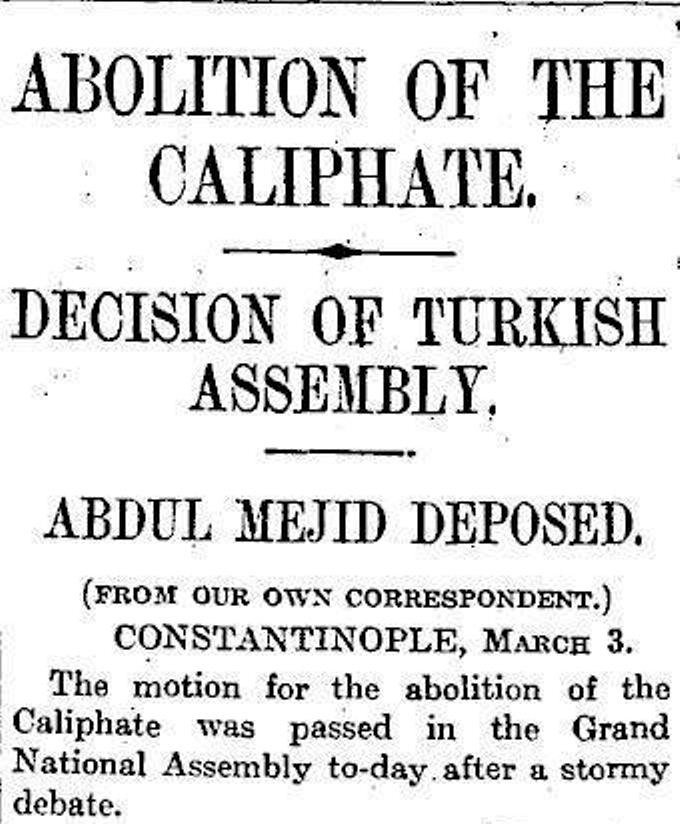
​”The Ottoman Empire lay at our feet dismembered and impotent, its capital and Caliph at the mercy of our guns.” [Harold Nicolson][1] The 28th Rajab 1442AH (Friday 12th March 2021) marks the centenary anniversary of the Caliphate’s (Ottoman Empire) formal abolition in Turkey in 1342H/1924 CE. The magnitude of this event and its effect on the problems facing the Muslim world today cannot be underestimated. After 100 years without a central Islamic authority to implement, protect and propagate Islam it’s important to reflect back on the result of the Caliphate’s destruction.

How to get away with murder

BY TAJI MUSTAFA Pardon criminals? Obama and Clinton did it. Yes, Trump is doing it. There is a way to commit the ‘perfect crime’ in America. No it’s not to kill, rape or murder and not get caught. It’s OK to get caught, just make sure you know a president who can pardon you afterwards or commute your sentence.

Impeachment in the Caliphate

These are extracts from the book “Accountability in the Caliphate” by AK Newell. It should be noted that the Caliphate is an ideological Islamic State. This means all elements of the state work towards achieving Islamic objectives not material objectives. Before any of the state accountability mechanisms take effect the Caliph is restrained by his Islamic belief and taqwa. Secular democracy emanates from the belief that religion should be kept separate from politics. The ruler in a democratic system is therefore not restrained from tyranny by fearing God or divine accountability. With this fundamental aspect of accountability missing i.e. consciousness of God (taqwa) the ruler in a democratic system is prone to tyranny if he isn’t restrained by the mechanisms of government.

Q&A: Does Islam have a clergy like Christianity and Judaism?

Sheikh Abu Iyas Mahmoud bin Abdul Latif al-Uweida from Jordan answers this question. He says, There are no clerics in Islam like those found in Judaism and Christianity. Every Muslim is commanded to carry the call of Islam, spread it, guard it, and abide by its rules. The ulema (scholars) and fuquhaa (jurists) are only there to teach people about Islam. They have no religious powers like those of the Jewish and Christian clergy, such as accepting the repentance of penitents, granting forgiveness, baptizing followers, legislating, and so on.

The Global Vision of the Early Muslims

BY ABU YUSUF الٓمٓ  غُلِبَتِ ٱلرُّومُ “Alif Lam Mim. The Romans have been defeated” (Ar-Rum, 30:1-2) Most commentators of the Qur’an when explaining this verse mention that the Muslims were hoping for the Romans to be victorious over the Persians, because the Romans were people of the Book whereas the Persians were mushrikeen like Quraish.