Author: islamciv

Election of Amirs in the Prophet’s ﷺ State in Medina

The 12 Naqibs The Aws and Khazraj tribes whom Islam united together as the Ansar (helpers), were sub-divided into various clans who managed their own administrative affairs as devolved ‘mini-provinces’. The chiefs of these clans were not appointed by the Prophet ﷺ, but rather ‘elected’ by the tribes themselves on his ﷺ orders. Ka’b ibn Malik narrates that the Prophet ﷺ said, أَخْرِجُوا إلَيَّ مِنْكُمْ اثْنَيْ عَشَرَ نَقِيبًا، لِيَكُونُوا عَلَى قَوْمِهِمْ بِمَا فِيهِمْ. فَأَخْرَجُوا مِنْهُمْ اثْنَيْ عَشَرَ نَقِيبًا، تِسْعَةً مِنْ الْخَزْرَجِ، وَثَلَاثَةً مِنْ الْأَوْسِ. أَسَمَاءُ النُّقَبَاءِ الِاثْنَيْ عَشَرَ وَتَمَامُ خَبَرِ الْعَقَبَةِ “Bring out to me from among you twelve chiefs (naqibs), so that they may be in charge of their people and what is in them.” So they brought out from among them twelve chiefs, nine from the Khazraj, and three from the Aws.[1] It is clear from the Sahifa and the command of the Prophet ﷺ: أَخْرِجُوا إلَيَّ مِنْكُمْ اثْنَيْ عَشَرَ نَقِيبًا، لِيَكُونُوا عَلَى قَوْمِهِمْ بِمَا فِيهِمْ “Bring out to me from among you twelve chiefs (naqibs), so that they may be in charge of their people …

Devolution in an Islamic State

Devolution is the transfer or delegation of power to a lower level, especially by central government to a local or regional administration. This is different to a federal state where power is shared between states and the central (federal) government. In such a model, provinces have a constitutional right to disobey the central government, and execute their own policies and laws in certain (non-federal) areas. Therefore, in origin the caliphate is a unitary state with devolution and not a federal state even though the differences between the two are small. In the case of America’s federal model, it’s almost identical administratively to how a future caliphate would look i.e. a United States of Islam (USI). The Islamic State has a unitary executive, where in origin all executive ruling power is with the caliph. This power is transferred to the caliph from the ummah who are the source of authority (مَصْدَر السُلْطَة masdar al-sultah)[1] via the bay’ah contract. Muhammad Haykal says, “The sultah (authority) in Islam belongs to the Ummah and she passes it to the ruler in accordance to a contract …

Bay’ah through Domination

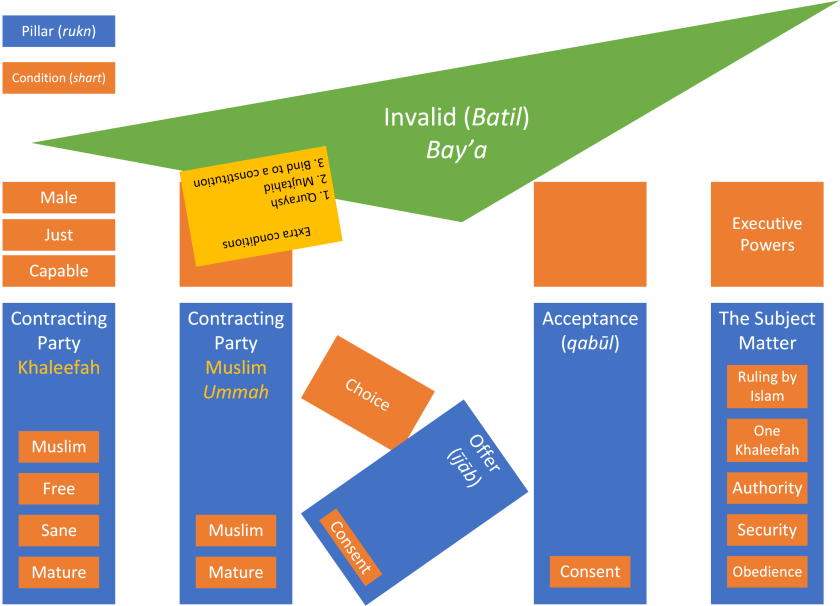
The last way of appointing a caliph by the ummah is where a usurper or dominant sultan takes power by force. Since the ummah in origin has not consented to this dominant sultan then he cannot be a caliph and the bay’ah would be considered batil as one of its pillars (rukn) is missing. The bay’ah is a contract and must conform to the rules of contracts in Islam which is free choice and consent of both parties. If the ummah and her representatives decide to accept the legitimacy of this ruler, then the bay’ah will become legally convened. Ibn Hajar says, “The jurists have unanimously agreed that it is obligatory to obey the dominant sultan and jihad with him, and that obedience to him is better than revolting against him because of that of shedding blood and pacifying the masses.”[1] Such a situation has been permitted by the ‘ulema but it is an emergency situation and should not be the norm. If this occurred in a future Islamic state due to the removal of a corrupt caliph in a coup d’etat for instance, then elections …

4 ways of appointing a caliph

Dr. Wahbah Az-Zuhaili (d.2015) mentions four ways of appointing a caliph. He says, “The Fuqaha’ of Islam have mentioned four ways in respect to the manner of appointing the highest ruler for the state and these are: We will see that the correct Islamic method, in accordance with the principle of Shura and the principle of collective obligations, is one method, which is the bay’ah of the Ahlul hali wal-aqd, and the inclusion of the ummah’s approval of his (caliph) choice. As for anything other than that, its basis is weak due to arbitrary interpretation of texts, or reliance on weak texts and personal whims, or approval of an existing reality that Muslims did not find wisdom or interest in revolting against, or eliminating its existence to stop the bloodshed and prevent chaos, and taking into account external circumstances, or fear of the ferocity of the one holding power that came to him through illegitimate means such as inheritance and the like.”[2] Shaykh Khudari Bak (d.1927) in a similar manner lists the same ways of appointing an Imam as Wahbah Az-Zuhaili, with the …

The Ummah’s Political Representatives (Ahlul hali wal-aqd)?

What is the Ahlul hali wal-aqd? The sharia texts related to the bay’ah are ‘aam (general) in their address by use of the relative pronoun مَنْ which translates as whoever.[1] They therefore include the entire Muslim ummah, which is why we say the source of authority in origin is with the ummah. This is seen in numerous ahadith on the bay’ah: مَنْ كَرِهَ مِنْ أَمِيرِهِ “Whoever sees in his Ameer…”[2] مَنْ خَرَجَ مِنَ الطَّاعَةِ “Whoever withdraws obedience (to the Ameer)…”[3] مَنْ بَايَعَ إِمَامًا “Whoever gave bay’ah to an Imam…”[4] مَنْ مَاتَ وَلَيْسَ فِي عُنُقِهِ بَيْعَةٌ “Whoever dies while having no bay’ah on his neck…”[5] When it comes to exercising that authority however, a problem arises because the bay’ah is a contract of one-to-millions i.e. between the caliph and the Muslim ummah. This is different to other Islamic contracts which are one-to-one such as buying, selling and marriage. This poses a challenge on how you get the consent of millions of people which is a condition in Islamic contracts. Historically it was not possible for every Muslim to participate in the election of the Imam, which is why in the rightly guided caliphate of …

What is an Islamic Society?

Society is defined as “a large group of people who live together in an organized way, making decisions about how to do things and sharing the work that needs to be done. All the people in a country, or in several similar countries, can be referred to as a society.”[1] The concept of society (مُجْتَمَع) is intrinsically linked to the discussion of authority, because it’s the authority and government which plays the greatest role in shaping and controlling society. The Ottoman historian Tursun Beg (d.1499) said, “With the pen of scribes, the ruler turns the noble into a wretched, and the wretched into a noble…with the sword of executioners he takes lives. As such he manifests the attributes of the Necessary Existent as if he shares the sultanate with Him except that the ruler of the world is a mortal.”[2] The source of authority (masdar al-sultah) is based on societal concepts which are in turn based on the Islamic ‘aqeeda which forms a distinct viewpoint of life, and which influences the type of authority that is established. This is why …

War and Peace in Islam: War is Deception

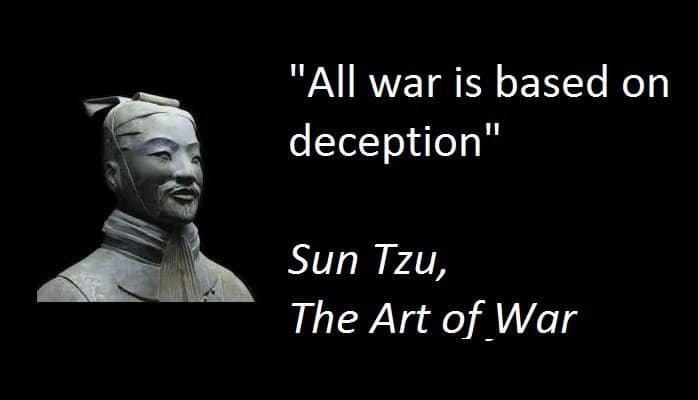
Continuing our series on war and peace in Islam, there is a clear difference between deception in war and treachery. Some may argue that since war is deception then it’s permitted to enter a land with a visa and then renegade on that based on an incorrect understanding of a hadith by Ka’b ibn Malik who reported that when the Prophet ﷺ intended to set out on a military expedition, he would pretend to go somewhere else. The Prophet would say, الْحَرْبُ خُدْعَةٌ “War is deception.”[1] This misconception shows the importance of understanding the Arabic language and the principles of Islamic jurisprudence (usul al-fiqh) before issuing Islamic edicts. We cannot read a hadith in English and apply the meaning of the word ‘deception’ in English and extract a ruling. There is a clear difference between deception (خُدْعَة) and treachery (خِيانَة) in Islam and even in the English language. Deception (خُدْعَة) in war is related to battle tactics and all militaries since wars began have used deceptive tactics against each other. During WWII Britain hatched an ingenious …

War and Peace in Islam: Treachery is not jihad

Continuing our series on war and peace in Islam, Islam categorically forbids treachery whether in peace or war. The Caliphate is not a treacherous state despite the attempts to malign Islamic history and the Islamic religion itself by the criminal acts of a tiny proportion of Muslims who contradicted the clear-cut rules of law in Islam. The Islamic civilisation flourished for over 1300 years with the caliphate and Islamic governance playing a pivotal role in this. This civilisation could not have remained in power for such a long period of time if it was known for treachery, injustice and tyranny. If the Islamic state had conducted itself in the same way as the hated western colonial powers, then its peoples would have rebelled en mass against Islamic rule which never occurred. In fact, all the internal rebellions against the caliphal governments ended up implementing the exact same system albeit with a different ruling family. This is because the rebellion was about “who” should rule, not “what” should be implemented. Islamic Spain is a stark example of …

War and Peace in Islam: Martyrdom

Continuing our series on war and peace in Islam, the seeking of shahada (martyrdom) is something all Muslims would love to achieve due to the high status and honour given to the shaheed in the next life. However, martyrdom has conditions in order to be accepted. Attempting to gain martyrdom through disobeying Allah such as by treachery, would negate the honour of receiving the shahada. The Prophet Muhammad ﷺ said, إِنَّمَا الْأَعْمَالُ بِالنِّيَّاتِ “Verily, actions are only [accepted] by intentions.”[1] “This is one of the most comprehensive hadith of the Prophet ﷺ. It touches upon almost every deed of Islam…Imam AbuDawood stated that this hadith is one-half of Islam; that is, Islam compriseswhat is apparent, the deeds of Islam, as well as what is not apparent, theintention behind the deeds. Al-Shafi’i also said that it encompasses half ofknowledge, meaning that the religion concerns both what is external and whatis internal. The deeds are the external aspect and the intention behind them isthe internal aspect.”[2] Rumi (d.1273CE) narrates a famous story of Ali ibn Abi Talib where he stopped …

War and Peace in Islam: Issuing Islamic edicts (fatawa)

Continuing our series on war and peace in Islam, the justifications Jihadi-Salafi groups give for their attacks that breach well-established Islamic rules on covenants and treaties are based on their issuing of erroneous Islamic edicts (fatawa). Issuing fatawa is only for qualified scholars Ijtihad (اِجْتِهاد) is derived from the root word Jahada (جهد). Linguistically, it means striving or self-exertion in any activity, which entails a measure of hardship. The great scholars of Usul such as Abu al-Husayn Ali otherwise known as Al-Amidi (d.631 AH) and Mohammad bin Ali Al-Shawkani (d.1255 AH) defined it as, “the total expenditure of effort made by a jurist in order to infer, with a degree of probability, the rules of Shariah from their detailed evidence in the sources.”[1] Extracting Islamic edicts (fatawa) from the Qur’an and Sunnah via ijtihad is only for those who are qualified. If someone is seriously ill, they will go to a doctor to diagnose their illness and prescribe medicine. If they went to an unqualified person, then they may end up losing their life due …