
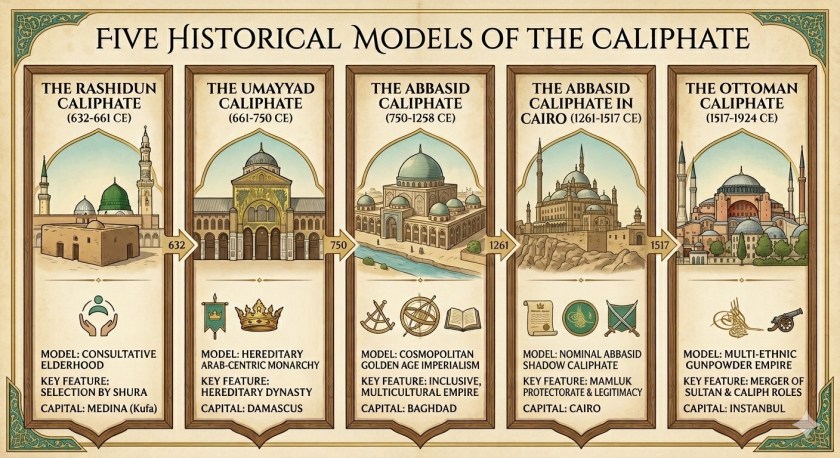
Five Historical Models of the Caliphate
For most of Islamic history the Caliphate was a decentralised confederation, with executive power held by the various Islamic emirates and sultanates who recognised the caliph through a nominal bay’ah. Al-Radhi (r.934-940CE) was the last independent Abbasid caliph after the rise of the Buwahids (Buyids) in 934CE, and the establishment of their emirate over Iraq, and central and southern Iran. This reduced the caliph’s executive power to the Dar ul-Khilafah which was a section of Baghdad that housed the Caliphal palace. Al-Khatib (d. 463H,1071CE) mentions that Al-Radhi was “the last of the Caliphs who undertook the sole direction of the army and the finances.”[1] After Al-Radhi, his brother Al-Muttaqi (r.940-944CE) became the caliph and Al-Suyuti says about him that “He had nothing of authority but the name.”[2] Dr. Ovamir Anjum says, “This third model (940-1517CE) has been called classical Islamic constitutionalism.[3] It is important because, with the exception of the first couple of centuries, it is what the caliphate has actually looked like throughout most of Islamic history.”[4] Time period Dates Length Rightly Guided Caliphate 11-41H / 632-661 30 years Umayyads, …







 Islamic Civilization