“My companions are like stars, whichever of them you use as a guide, you will be rightly guided.”[2]
The sahaba were the best generation and their diverse lives need to be studied so we can take lessons from them. Whichever characteristic we want to emulate we will find it exemplified in the sahaba. They hold qualities of bravery, chivalry, knowledge, sacrifice and leadership because they were trained by the best human being and master of the Prophets, Muhammad ﷺ.
Biography of Ubaadah ibn As-Saamit
Profile
Married to Umm Haram, the Prophet’s ﷺ maternal aunt. A senior sahaba and one of the Naqibs of the Ansar so is included in the words of the Messenger ﷺ, “If the Ansar took their way through a valley or a mountain pass, I would take Ansar’s valley. And but for the migration, I would have been one of the Ansar.”[3]When Jibrael (as) asked the Prophet ﷺ, “How do you look upon the warriors of Badr among yourselves?” He ﷺ replied, “As the best of the Muslims.”[4] This applies to Ubaadah who fought at Badr.
Umm Haraam (wife of Ubaadah ibn As-Saamit) heard the Messenger of Allah ﷺ say: “(Paradise) is granted to the first batch of my followers who will undertake a naval expedition (ghazwa).” Umm Haraam said, “O Messenger of Allah am I among them?” He said: “Yes you are.”[5] Umm Haraam was indeed on the first naval expedition to Cyprus along with her husband Ubaadah who was a commander on the mission.
Umar ibn Al-Khattab said he was equivalent to 1000 men when he sent Ubaadah at the head of 1000 soldiers to reinforce the army of Egypt.[6]
Born
38 before Hijri / 585 CE. Yathrib Hijaz
Died
34 after Hijri / 655 CE during Uthman’s Caliphate at the age of 72. Buried in Bab al-Rahma cemetery in Jerusalem.
Tribe
Khazraj.
Clan
Banu ‘Auf. A clan leader (naqib)
Appearance
Handsome man with dark skin and very muscular.
During the time of the Prophet ﷺ
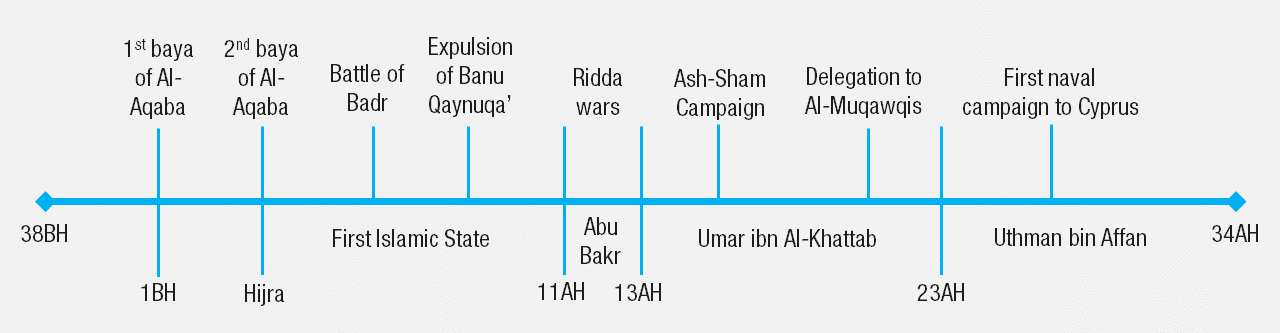
· Gave the 1st bay’a of Al-Aqaba[7]· One of the 12 naqibs (representatives) who gave the 2nd bay’a of Al-Aqba[8]
· Head of delegation to Al-Muqawqis, Vicegerent of Egypt for the Byzantine Empire[14]
During the Caliphate of Uthman
· First naval expedition to Cyprus[15]· In charge of spoils of war from Cyprus[16]
Famous Hadiths
Ibn Hajar notes that there are at least 181 hadith narrated by Ubaadah ibn As-Saamit.[17] Two of the most well-known are below.He who said: “There is no god but Allah, He is One and there is no associate with Him, that Muhammad is his servant and His messenger, that Christ is a servant and the son of His slave-girl and he (Christ) His word which He communicated to Mary and is His Spirit, that Paradise is a fact and Hell is a fact, Allah would make him (he who affirms these truths enter Paradise through any one of its eight doors which he would like.”[18]
Narrated Junada bin Abi Umaiya: We entered upon ‘Ubaadah bin As-Saamit while he was sick. We said, “May Allah make you healthy. Will you tell us a Hadith you heard from the Prophet ﷺ and by which Allah may make you benefit?” He said, “The Prophet ﷺ called us and we gave him the Pledge of allegiance for Islam, and among the conditions on which he took the Pledge from us, was that we were to listen and obey (the orders) both at the time when we were active and at the time when we were tired, and at our difficult time and at our ease and to be obedient to the ruler and give him his right even if he did not give us our right, and not to fight against him unless we noticed him having open Kufr (disbelief) for which we would have a proof with us from Allah.”[19]
Nusra (support) for establishing the first Islamic state
Ubaadah ibn As-Saamit (ra) was born 38 years before the hijra in Yathrib, Hijaz. He was a member of the Khazraj tribe and one of its clan leaders. A handsome man with dark skin and very muscular. For all intents and purposes Ubaadah was black which we will come back to later. He gave the first bay’a of Al-Aqaba which led to the daw’ah becoming firmly established in Medina.
After one year the dawah was successful and Yathrib was ready for the Prophet ﷺ to migrate and establish a new state with him ﷺ as its leader.
Ubaadah was not only present at the second bay’a of Al-Aqaba but was one of the 12 nuqubaa (leaders) who represented his people.
Once the first Islamic State was established in the newly renamed Medina he continued to sacrifice in support of the new state.
He married Umm Haram, the Prophet’s ﷺ maternal aunt and so had a familial relationship with him ﷺ. As one of the Ansar he is included in the words of the Messenger ﷺ, “If the Ansar took their way through a valley or a mountain pass, I would take Ansar’s valley. And but for the migration, I would have been one of the Ansar.”[20]
The first battle of Islam
Within the first year of hijra the Prophet ﷺ started sending out expeditions against the interests of Quraiysh to secure the new fledgling state. Some were led by his commanders Hamza ibn Abdul-Muttalib and Sa’d ibn Abi Waqqas and some were led directly by him ﷺ.
In Ramadan of the second year hijri these skirmishes culminated in the Battle of Badr which was the most decisive battle of Islam since it firmly established the new state as a power player in the region. From then on Medina got stronger and stronger until within 10 years the entire Arabian Peninsula had come under its authority and mostly accepted Islam. This fulfilled the Qur’anic prophecy, “when you see people embracing Allah’s faith in crowds”.[21]
Ubaadah was at the Battle of Badr along with all the major battles of Medina. When Jibrael (as) asked the Prophet ﷺ, “How do you look upon the warriors of Badr among yourselves?” He ﷺ replied, “As the best of the Muslims.”[22]
Expulsion of Banu Qaynuqa’
When the state was established in Medina there were a total of four Jewish tribes. Banu Qaynuqa’ was within Medina and three were outside Medina namely, Banu Nadir, Khaybar and Banu Quraydah. On his entering Medina the Prophet ﷺ wrote a document called As-Sahifa which established the rights and responsibilities of all citizens including the Jews of Banu Qaynuqa’. They signed up to this agreement but they reneged on it at every opportunity. After the battle of Badr, the Prophet ﷺ went to their marketplace and warned them to refrain from any further treachery but they were obstinate in their hatred of Islam and Muslims. They said, “O Muhammad, do not become self-deceived simply because you killed a group of people from the Quraish who do not know how to fight. Indeed, if you were to fight us, you would know that we are the people (to contend with). You have never met anyone that is like us (on the battlefield).”[23]
These tensions increased until Banu Qaynuqa’ finally crossed the line. One day a Muslim woman went to the marketplace of Banu Qaynuqa’ to sell some merchandise. She sat down next to a Jewish goldsmith who secretly pinned her garment so when she stood up her private areas were exposed. They laughed at her and a Muslim man nearby went to help her killing the goldsmith. The Jews then ganged up on the Muslim and killed him. When word reached the Prophet ﷺ he dispatched an army which laid siege to Banu Qaynuqa’ for 15 nights after which they surrendered.
Prior to the hijra, Ubaadah’s Banu ‘Auf clan was an ally of Banu Qaynuqa’. But after their treachery Ubaadah went to the Prophet ﷺ and said, “O Messenger of Allah, I declare my complete loyalty to Allah, His Messenger and the believers. And I absolve myself from any alliance or loyalty to these disbelievers.”[24]
After it was decided to expel Banu Qaynuqa’ from Medina, the Messenger ﷺ ordered Ubaadah to supervise their evacuation. Due to their previous alliance, Banu Qaynuqa’ tried to pressure Ubaadah in to making concessions for them but Ubaadah was steadfast in refusing. Abdullah ibn Ubai, the head of the hypocrites and another ally of Banu Qaynuqa’ also applied pressure. Ubaadah said to him, “O Abul-Hubaab, hearts have changed, and Islam has erased those covenants.”[25]
Egypt Campaign: delegation to Al-Muqawqis
Amr ibn Al-Aas was the Amir of Jihad for the Egyptian Campaign during the Caliphate of Umar ibn al-Khattab. This campaign was facing difficulties and taking time to complete so Umar wrote a letter to Amr:
“I am very surprised at how long it is taking to conquer Egypt, as you have been fighting for the last two years, unless it is because of some sins that you have committed, or you have started to love this world as your enemy does. Allah, may He be blessed and exalted, only grants victory to people who are sincere. I am sending to you four individuals, and I have told you that each one of them is equivalent to one thousand men as far as I know, unless something has changed them…”[26]
These four men were army generals who Umar each sent at the head of 1000 men. These generals were: az-Zubayr ibn al-‘Awwam, al-Miqdad ibn al-Aswad, Maslamah ibn Mukhallad and Ubaadah ibn as-Saamit. These commanders helped turn the tide of the conquest and Egypt was finally opened to Islam.
Ubaadah had a particularly important mission during this campaign, which was to speak with Al-Muqawqis, who was the Vicegerent of Egypt for the Byzantine Empire and leader of the Coptic Christians. Ubaadah was to present to him the three foreign policy options
accept Islam and become Muslim citizens or
live as non-Muslim citizens (dhimmi) or
fight
Al-Muqawqis didn’t want to lose his position and was unhappy about his people submitting to the Islamic authority, but after speaking with his advisors he agreed to sign a peace treaty (dhimma) with the Islamic State leading to the Copts becoming citizens of the state.
Ubaadah was instrumental in getting Al-Muqawqis to sign the dhimma.
In 641CE the Muslim army surrounded the Babylon Fortress where Al-Muqawqis resided and Ubaadah was sent as head of a delegation of 10 men to speak with him. As mentioned previously Ubaadah was a dark skinned Arab but to Al-Muqawqis he was a black man. When Ubaadah stepped forward al-Muqawqis became alarmed because of his blackness.
He said, “Take this black man away from me and let someone else come and speak to me!”
They said, “This black man is the best of us in knowledge and wisdom. He is our leader and the best of us, and has been appointed over us. We all refer to his opinion, and our leader has appointed him over us and ordered us not to go against him.”
Al-Muqawqis said to the delegation, “How could you accept this black man as the best among you? Rather he should be the least among you.”
They said, “No; even though he is black as you can see, he is the best in status among us, one of the foremost among us and one of the wisest. Blackness is not something bad among us.”
Al-Muqawqis said to Ubaadah, “Come forward, O black man, and speak to me gently, for your blackness alarms me, and if you speak harshly that will alarm me further.”
Ubaadah went forward and used Al-Muqawqis fear of black people to his advantage. He said, “I have heard what you said. Among my companions whom I left behind are a thousand men who are all as black as me, and even blacker than me and more terrifying to behold. If you saw them you would be even more alarmed. My youth has gone, but nevertheless I would not be scared if one hundred men of my enemy wanted to face me all at once, and the same is true of my companions, for our hope and our desire is to strive in jihad for the sake of Allah, seeking the pleasure of Allah.
The reason for our campaign against our enemies who wage war against Allah is not hope of worldly gains or the accumulation of wealth; rather Allah has permitted that to us and made the booty we acquire permissible for us. But none of us cares whether he has a qintar of gold or has nothing but a dirham, because all we want from this world is something to eat to ward off hunger, and a cloth to wrap around ourselves. If one of us owns nothing more than that, that is enough. If he gets a qintar of gold he will spend it for the sake of Allah and be content with the little that is left in his hand, because the pleasure of this world is not true pleasure and its luxury is not true luxury; rather real pleasure and luxury come in the Hereafter.
This is how our Lord has guided us and our Prophet has taught us; he advised us that our ambition in this world should be just to have enough to ward off hunger and cover our awrahs (nakedness); our main concern should be to please our Lord and strive in jihad against His enemies.”
When al-Muqawqis heard that, he said to those who were around him: “Have you ever heard anything like what this man is saying? His appearance alarmed me but his words alarm me more than his appearance. Allah has sent this man and his companions out to destroy the world! I think that they are bound to prevail over the entire world.”[27]
First Naval expedition
Ubaadah ibn As-Saamit not only played a key role in the conquest of Egypt but was also a commander for Abu Ubaidah ibn Al-Jarrah, the Ameer of Jihad for the Ash-Sham campaign. After this campaign Ubaadah made Ash-Sham his home residing in Palestine where he is buried.
One day the Messenger of Allah ﷺ entered the house of Umm Haraam, the wife of Ubaadah ibn As-Saamit, and she provided him with food and started grooming his head. Then the Messenger of Allah slept, and then he woke up smiling.
Umm Haraam asked, “What is making you smile, O Messenger of Allah?” He ﷺ said,
“Some people of my ummah were shown to me (in my dream) campaigning for the sake of Allah, sailing on the green sea like kings on thrones.”
Umm Haram added, “I said, ‘O Messenger of Allah! Pray to Allah to make me one of them.” So the Messenger of Allah ﷺ prayed to Allah for her and then laid his head down (and slept).
Then he woke up smiling (again). (Umm Haram added): I said, “What is making you smile, O Messenger of Allah?” He said, “Some people of my ummah were shown to me (in my dream) campaigning for the sake of Allah.”
He said the same as he had said before. I said, “O Messenger of Allah! Pray to Allah to make me one of them.” He said, “You will be among the first ones.”[28]
This prophecy was fulfilled during the Caliphate of Uthman bin Affan, who established the first Muslim navy. The first naval campaign was led by Muawiya, the governor of Ash-Sham to Cyprus. Umm Haram accompanied the navy during this campaign along with her husband Ubaadah ibn-As-Saamit, where she subsequently died and is buried.
Conclusion
The Prophet ﷺ cultured the sahaba and trained them to be leaders of the world after his death. He ﷺ noted their strengths and weaknesses and developed their strengths and minimised their weaknesses. He undertook a thorough culturing process developing their personalities.
One day the Prophet ﷺ consulted the people as to how he could call them to prayer. Many ideas were put forward, but that night Abdullah bin Zaid and Umar bin Al-Khattab both had a dream of the Adhan. Even though they had the dream the Prophet ﷺ insisted that Bilaal ibn Rabah call the Adhan since he had the best voice.[29]
Abu Dharr Al-Ghaffari narrated: I said to the Prophet ﷺ: “Oh Messenger of Allah, will you not appoint me to a public office?” He stroked my shoulder with his hand and said: “Abu Dharr, you are weak and authority is a trust, and on the Day of judgment it is a cause of humiliation and repentance except for one who fulfils its obligations and (properly) discharges the duties attendant thereon.”[30]
Every individual has strengths which they can contribute to Islam and the dawah. We must develop these and follow in the footsteps of the sahaba using them as role models on this path.
During the tenure of Şeyhülislam Musa Kazım Efendi in the Second Constitutional Period (II Meşrutiyet), the Qadi of Istanbul and a fatwa consultant (fetva emini) came on the 28th day of the month of Ramadan to inform that a witness sighted the new crescent moon, marking the end of Ramadan.
The bay’a (pledge of allegiance) is a ruling contract that governs the relationship between the Muslims and the head of the Islamic State. This is shown in the sunnah where the Messenger of Allah ﷺ took bay’a on ruling not belief because bay’a was only taken from mature Muslims.
The establishment of the first Muslim navy during the Caliphate of Uthman bin Affan, offers a fascinating insight in to what Muslims can achieve if they have a state, and the correct understanding of tawakkul (reliance on Allah) and the spheres of actions which are within and outside their control.
The early Islamic conquests have always perplexed western historians. How was it possible for the desert Arabs, who were viewed by the Persian and Byzantine empires as insignificant, and posing no threat to them, to rise up and within a few years destroy their longstanding empires?
George Hourani, a maritime historian who has researched the early Muslim navy discusses “the problem of the earliest Arab ventures on the Mediterranean: how could they be successfully carried out in such a surprisingly short time?
The decisive event is the battle of Dhaat al-Sawaari (Battle of the Masts). To fight a naval battle, many resources were required: naval bases, including docks, shipbuilding yards, building materials and skilled shipbuilders; [and] warships with their complements of trained sailors, marines and officers.”[1]
The power of Islam is derived from its aqeeda (belief) which forms the intellectual basis upon which all thoughts, actions and systems are based. This aqeeda motivated the early and later Muslims to accomplish astonishing feats, especially with regards to the Islamic conquests. When studying these events however, many focus solely on the strength of the sahaba’siman or supernatural events such as the angels of Badr, while neglecting other actions they undertook to achieve their victories. This results in many important lessons being missed which we can learn from and follow today.
David Nicolle, a military historian who wrote a book studying the Battle of Yarmouk says: “It is also difficult to separate fact from pious myth. Today, however, the ‘pendulum of credibility’ has swung back from the almost total disbelief of early 20th century Western historians to what might be described as a ‘twilight’ of historical reality.”[2] He then discusses the military tactics used by General Khalid ibn Walid, and the Muslim army which helped achieve this decisive victory.
This article will discuss the establishment and development of the first Islamic navy, and the factors which enabled its success.
Pre-Islamic Arabia and the sea
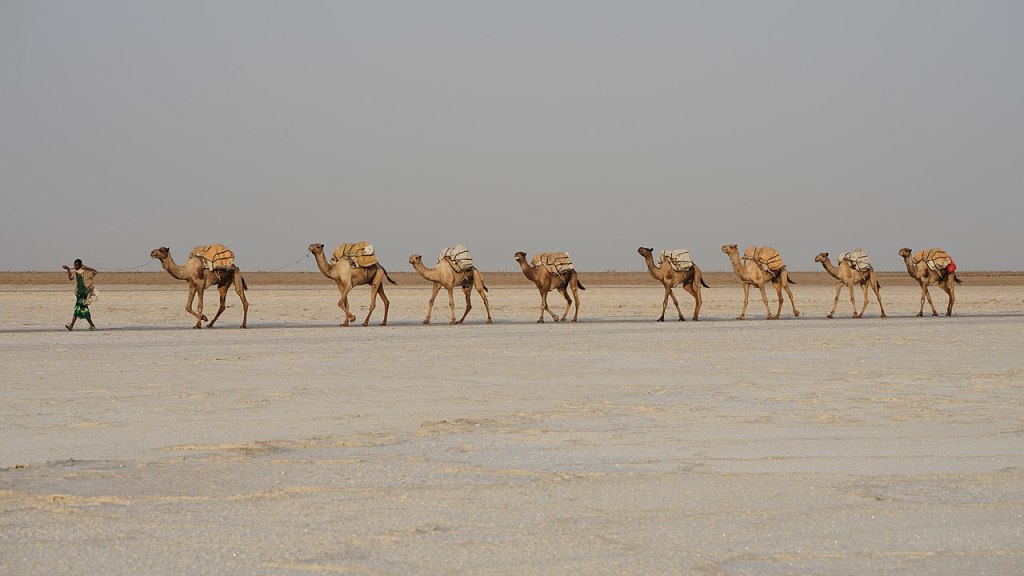
In the seventh century, at the time Islam was revealed, the Arab tribes had no seafaring experience and had no need for ships, because Quraysh had a well-established land route from Yemen to Syria. This camel route brought caravans of goods from the Indian Ocean via the port of Aden to the Byzantines in Ash-Sham. As mentioned by Montgomery Watt, the Quraysh “were prosperous merchants who had obtained something like a monopoly of the trade between the Indian Ocean and East Africa on the one hand and the Mediterranean on the other.”[3]
Securing these caravans was of utmost importance to Quraysh, so they established a network of tribal alliances all along the camel route which not only provided security from highway robbers, but also rest stops for the camels and merchants. This was seen as a far safer route than the potentially hazardous conditions a merchant ship could fall into on the Red Sea. Hourani mentions this; “Rather than face the terrors of the Red Sea, the Arabs developed camel routes along the whole western side of their peninsula.”[4] This lucrative trade made Quraysh very wealthy and it became a vital interest of theirs which they had to secure at all costs.
Allah (Most High) reminds Quraysh of this blessing He gave to them:
“In acknowledgment of the established tradition of Quraysh, their tradition of the winter and summer caravans: so let them worship the Lord of this House who has preserved them from hunger and secured them from fear.” (Surah Quraysh)
This is not to say that the Arabs were unaware of the sea. Makkah was a trade hub not only for goods arriving on the caravans from Yemen and Ash-Sham, but also from merchant ships arriving from Abyssinia at the port of Shaybah near Jeddah. It was one of these ships which the early Muslims from Makkah boarded when fleeing Quraysh’s persecution, en-route to the Negus in Abyssinia. Hourani says, “But it appears that the Quraysh had no ships of their own, for they were unable to pursue the fleeing emigrants (Muslim migration to Abyssinia) onto the sea. They would rather wait for foreign ships to be wrecked on their shore; the wood of a wrecked Greek vessel was taken for use in the roof of their Ka’bah. The pre-Islamic poetry of the desert Arabs seldom contains more than a passing reference to the sea.”[5]
Islam’s praise for Naval Expeditions
The most famous hadith on this subject is the prophecy narrated by Umm Haraam bint Milhan who was the maternal aunt of the Prophet Muhammad ﷺ. She accompanied the navy during its first campaign to Cyprus with her husband Ubadah ibn-As-Samit, where she subsequently died and is buried. This was foretold by the Messenger of Allah ﷺ.
One day the Messenger of Allah ﷺ entered the house of Umm Haraam, and she provided him with food and started grooming his head. Then the Messenger of Allah slept, and then he woke up smiling.
Umm Haraam asked, “What is making you smile, O Messenger of Allah?” He ﷺ said,
“Some people of my ummah were shown to me (in my dream) campaigning for the sake of Allah, sailing on the green sea like kings on thrones.”
Umm Haram added, “I said, ‘O Messenger of Allah! Pray to Allah to make me one of them.”‘ So the Messenger of Allah ﷺ prayed to Allah for her and then laid his head down (and slept).
Then he woke up smiling (again). (Umm Haram added): I said, “What is making you smile, O Messenger of Allah?” He said, “Some people of my ummah were shown to me (in my dream) campaigning for the sake of Allah, “
He said the same as he had said before. I said, “O Messenger of Allah! Pray to Allah to make me one of them.” He said, “You will be among the first ones.”[6]
“(Paradise) is granted to the first batch of my followers who will undertake a naval expedition (ghazwa).” Umm Haraam said, “O Messenger of Allah am I among them?” He said “Yes you are.”[7]
The Messenger of Allah ﷺ also said, “A Ghazwah on the sea is better than ten Ghazawaat (expeditions of battles) upon the land.”[8]
Ibn-Nuhaas says: “The author of al Mughni (Ibn Qudamah Al-Maqdisee) and others from the school of Imam Ahmad state that the expeditions of the sea are greater in reward than those of land since it is more difficult and dangerous.”[9]
Kaab al-Ahbar said: “When a man first sets his foot on the ship he leaves all his sins behind him and becomes clean like the day he was born. And the one who suffers seasickness is like the injured who is pouring his blood in the path of Allah. And the one who is patient in the sea is like a king with a crown on his head.”[10]
Naval Expedition’s in the Caliphate of Umar ibn al-Khattab
The Byzantines had a well-established navy and had been seafarers since ancient times. This posed a major threat to the coastlines of the Islamic State most notably Alexandria in Egypt and other coastal ports on the Mediterranean in Ash-Sham. A new navy had to be established in order to confront this threat.
Mu’aawiya, the governor of Ash-Sham tried to convince the Caliph Umar ibn Al-Khattab to establish a navy, but Umar on the advice of Amr ibn Al-‘Aas refused because he didn’t want to risk the lives of the Muslim soldiers by fighting a battle with the well-established Byzantine Navy. Umar said, “No, by the One Who sent Muhammad with the truth, I will never let a Muslim campaign by sea. By Allah, a Muslim is dearer to me than all that the Byzantines have. Stop suggesting that to me.”[11]
As mentioned previously the Arabs were not seafarers and had no naval experience. Therefore, the risk of naval warfare was too great for Umar so he refused Mu’aawiya’s request. As commander-in-chief Umar had the final say and Mu’aawiya was forced to abandon the idea, since all the army leadership is under the Caliph’s authority.
What enforced Umar’s opinion was the failed naval expedition of his governor of Bahrain, Al-Alaa al-Hadrami. The Muslim rulers of the past were not like those of today who are content to remain in their palaces while Muslims suffer under oppression all around them. The governors and caliphs of the past were eager to take Islam forward, which is why Al-Alaa al-Hadrami in his eagerness launched an unauthorised mission by sea to Fars in Persia.
Al-Alaa organised his army in to three corps to attack Fars. They departed Bahrain by ship and travelled across the Persian Gulf to present day Iran. The three corp commanders were:
al-Jarud ibn Mu’alla
al-Sawwar ibn Hammam
Khulayd ibn al-Mundhir ibn Sawa
The first two corps were defeated, and the third led by Khulayd were cut off from their ships by the Persians leaving the army trapped in Fars.
‘Umar wrote to the governor of Basra, ‘Utbah bin Ghazwan and said, “Al-Ala’ al-Hadrami compelled an armed force of Muslims to go overseas. Consequently, the inhabitants of Fars cut them off from returning to their ships. Al-‘Ala’ has disobeyed me, I do not think he was seeking Allah’s approval with this. Moreover, if they do not get help, I fear that those men marooned in Fars will be defeated, cut off from help as they are. Therefore, before they are wiped out, send them reinforcements and, once rescued, place them under your supervision.”[12]
The army escaped over land to Basra with the help of Utbah. Umar then dismissed Al-Alaa as governor of Bahrain and appointed him governor of Basra. However, Al-Alaa died before he reached Basra and was buried in Bahrain.[13]
Note here that this expedition is not considered the first naval ghazwa mentioned in the hadith of Umm Haraam, because the Prophet ﷺ said she would be on the first mission which was that of the campaign to Cyprus.
Umar’s opposition to the use of ships was only limited to naval warfare where the lives of Muslims would be at risk.
During the famine in Hijaz, Amr bin al-Aas used boats to send food supplies by ship to the port of Al-Jarr near Medina.
Umar sent word to ‘Amr ibn al-‘As, his governor in Egypt, saying: “From the slave of Allah ‘Umar ibn al-Khattab, the Ameer al-Mu’mineen, to ‘Amr ibn al-‘As. Peace be upon you. Do you want me and those around me to die, whilst you and those around you are living a life of luxury? Help, help!”
‘Amr ibn al-‘As wrote back to him: “To the slave of Allah Ameer al-Mu ’mineen from ‘ Amr ibn al-‘As. Peace be upon you. I praise Allah, beside Whom there is no other god. Help is on its way, just wait. I am sending to you a caravan the first of which will reach you whilst the last of it is still with me. I also hope to find a way to send help by sea.”[14]
‘Amr sent food supplies via the well-established camel route across the desert to Sinai, through Gaza and in to Hijaz, but he also managed to send some ships of corn via the newly dug Trajan’s Canal which linked the Nile to the Red Sea.[15]
When Uthman became Caliph, Mu’aawiya tried again to convince him of the necessity of establishing a navy. Uthman initially refused citing Umar’s opinion, but Mu’aawiya persisted and Uthman finally agreed when Mu’aawiya convinced him that the sea journey to Cyprus was not a risky venture. Uthman, however stipulated two conditions:
1- Mu’aawiya had to take his wife with him. If he thought it was safe for his wife, then it was safe for the other Muslims.
2- The sailors and marines had to volunteer for the campaign
First Naval Campaign to Cyprus 28AH/649CE
When Mu’aawiya received the letter from Uthman authorising him to establish a navy, he began mobilising the people for the campaign to Cyprus. He refurbished the sea port at Acre in Palestine as a launching point for the ships, and he ordered the people on the coast to repair their ships and bring them to the port.
As instructed Mu’aawiya brought his wife Fakhitah bint Qarzah along with him and one of his generals Ubadah ibn Samit brought his wife Umm Haraam bint Milhan as prophesised in the hadith. Although Mu’aawiya did not force anyone to accompany him, a huge force volunteered motivated by the hadith and love of conquest.
At the end of winter in 28AH/649CE the navy embarked from Acre towards Cyprus. When the Muslims landed on the Cyprus coast, Umm Haraam went to ride her mount, but the animal spooked and she fell to the ground, broke her neck and died.
The inhabitants of the island barricaded themselves in the capital Qustantina, awaiting reinforcements from the Byzantines which did not come, so they signed a peace treaty with Mu’aawiya. This treaty was not a full conquest of the island where Cyprus would come under the authority of the Islamic State. Rather it was an emergency treaty (Al-Mu’aahadaat Al-Idtiraariyyah) where the islanders would pay 7200 dinars a year in tax, inform the Muslims of the Byzantine movements and would not assist the Byzantines if they attacked the state.[17]
Four years later in 32AH/653CE the Cypriots under intense pressure from the Byzantines broke the treaty and this time Mu’aawiya led a full conquest of the island which all came under the authority of the Islamic State. Abdullah ibn Sa’d brought his navy from Egypt to assist Mu’aawiya in this campaign.[18]
The Shipbuilders
For the first naval campaign to Cyprus, Mu’aawiya ordered the people on Ash-Sham’s coasts to repair their existing ships. These may have been abandoned by the Byzantines after Yarmouk, or they may have been fishing vessels fallen in to disrepair. However, for building the later ships which took part in the decisive Dhaat Al-Sawaari, and the subsequent conquests of the Mediterranean islands, we need to look to Egypt. Hourani mentions, “Alexandria was a complete naval base, having a splendid harbor, capacious shipyards and Coptic builders; Egypt has always been a country of skilled craftsmen, and no doubt the Copts had profited from Greek science of which Alexandria had been the center ever since its foundation. The only thing lacking was good timber, in which Egypt is poor; this had to be brought from Syria or elsewhere. The ports of Syria, principally Acre and Tyre, were also bases from which a part of the fleet left for Dhat al-Sawari. But at this date there was no shipbuilding on the Syrian coast…The fleet which fought the battle, then, must have been constructed entirely in Alexandria.”[19]
When Amr bin Al-Aas conquered Egypt during the Caliphate of Umar ibn al-Khattab, he therefore had a ready-made naval base in Alexandria, and skilled shipbuilders from among the Coptic Christians who had become dhimmi, non-Muslim citizens of the Islamic State.
There were cordial relations between the Muslims and Copts since the first correspondence between the Prophet Muhammad ﷺ and Al-Muqawqis, head of the Copts, and Vicegerent of Egypt for the Byzantine Empire. After receiving the Prophet’s ﷺ letter, Al-Muqawqis kissed it and sent back his reply with some gifts – a ceremonial gown, a mule and saddle, and two slave girls, one of whom became Ibrahim’s mother. [20]
During the conquest of Egypt, the Muslims captured Al-Muqawqis’s daughter Armanoosah who was running away from a forced marriage to Constantine the son of Heraclius. Amr ibn Al-Aas, head of the campaign, gathered his advisors and reminded them of the words of Allah:
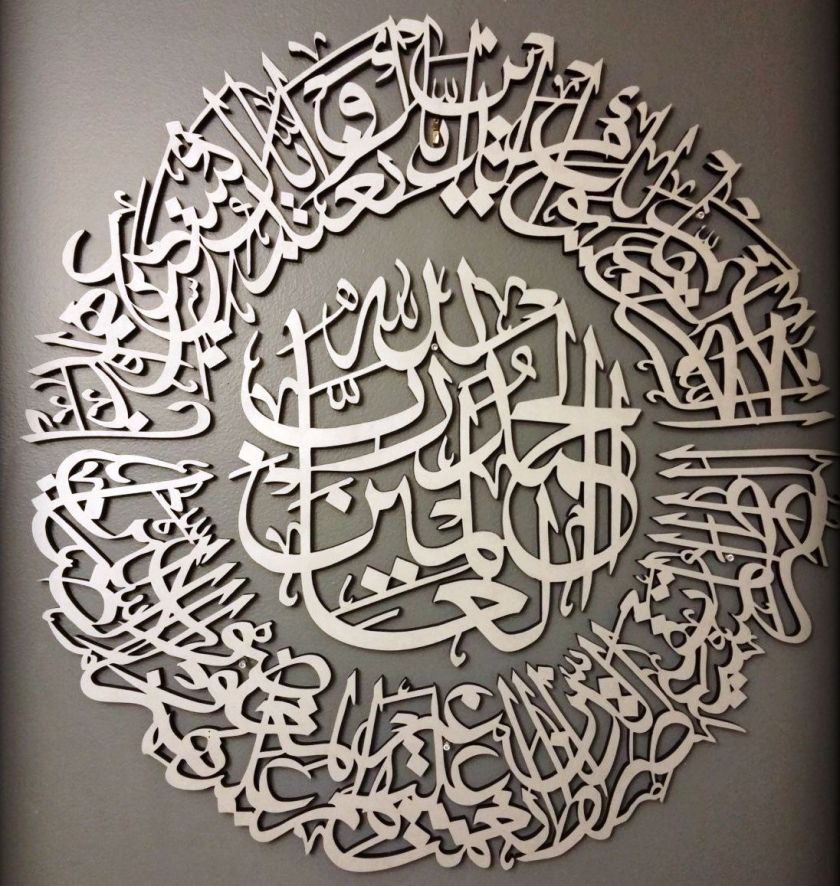
هَلْ جَزَاءُ الْإِحْسَانِ إِلَّا الْإِحْسَانُ
“Is there any reward for good other than good?” (Ar-Rahman, 55:60)
Then he said: “Al-Muqawqis sent a gift to our Prophet; I think we should return his daughter to him, and all of her servants and entourage whom we have captured, and their wealth that we seized.” They agreed to that. So ‘Amr sent her back to her father with honour; along with all her jewels and male and female slaves. Her servant Barbara said to her during the journey: “Oh my mistress, the Arabs are surrounding us on all sides.” Armanoosah said, “I feel that my life and my honour are safe among the tents of the Arabs, but I do not feel safe in the palace of my father.” When she reached her father, he was very pleased with her and the way that the Muslims had treated her.[21]
Ubadah ibn as-Samit was sent to speak with Al-Muqawqis and offer him the three foreign policy options: accept Islam and become Muslim citizens, live as non-Muslim citizens (dhimmi) or fight. Al-Muqawqis didn’t want to lose his position and was unhappy about his people submitting to the Islamic authority, but after speaking with his advisors he agreed to sign a peace treaty (dhimma) with the Islamic State leading to the Copts becoming citizens of the state.
The Byzantines were still in Egypt and it wasn’t until 21AH/641CE after a long siege and subsequent battle, that Alexandria was finally conquered under the command of Ubadah ibn as-Samit.
Five years later in 25AH/646CE when Uthman was Caliph, some inhabitants of Alexandria wrote to Constantine, the son of Heraclius requesting he reconquer the city and offering him assistance in that. Constantine sent Manuel al-Khassa in command of a huge force carried on three hundred ships to reconquer Egypt.
The Byzantine army was not like the Muslim army who fight for seeking a spiritual value. The Byzantines were not interested in the welfare of the Egyptians, and instead fought for prestige and wealth. During their short campaign they ransacked Alexandria and left it in ruins, and began plundering the wealth of the Egyptians. This led the local inhabitants to regret their decision and so they supported the Muslims again and requested their help in expelling Manuel.
Amr ibn Al-Aas led the campaign, and with the support of the local inhabitants managed to kill Manuel and expel the Byzantines. This then solidified the relationship with the Coptic Christians for centuries to come.[22]
Carole Hillenbrand, in ‘The Crusades: Islamic perspectives’ says: “…Saladin had a private secretary, ibn Sharafi, who was a Copt and Saladins brother al-Adil put a Copt named ibn al-Muqat in charge of the army ministry (diwan al-Jaysh). The appointment of a Christian to a position of such power in war-time and in an area that was military so sensitive tells its own story. Indeed, the loyalties of the Copts in the Ayyubid period seem often to have lain more with the Muslims and with their own local interests than with the Crusaders. This was demonstrated in the Crusade of Damietta in 1218 when the Copts helped to defend the city, and as a consequence suffered greatly at the hands of the Crusaders.”[23]
Undoubtably, the Copts used their ship building and naval skills to help develop and train the Muslim navy for years to come. Hourani says, “The Aphrodito Papyri (c. 710) reveal Copts being conscripted from Upper Egypt for the shipyards of Alexandria and for the annual koursa (raids); they were even being sent to serve on fleets based on Syria.”[24]
The Prophet ﷺ foretold of this assistance from the Copts when he ﷺ said,
“Allah is the god of the Copts, so you will prevail over them, and they will be your number and helpers in the path of Allah.”
It was narrated by al-Tabarani in al-Mu’jam al-Kabeer (561) on the authority of Umm Salamah, may God be pleased with her, with a chain of transmission, and it was classed as saheeh by al-Albaani in al-Sahihah (3113).
The Ships
One of the blessings Allah (most High) has given human beings is the sailing wind, which enables ships to sail across the globe:
“Among His Signs is that He sends the winds bearing good news, to give you a taste of His mercy, and to make the ships run by His command, and to enable you to seek His bounty so that hopefully you will be thankful.” (Ar-Rum, 30:46)
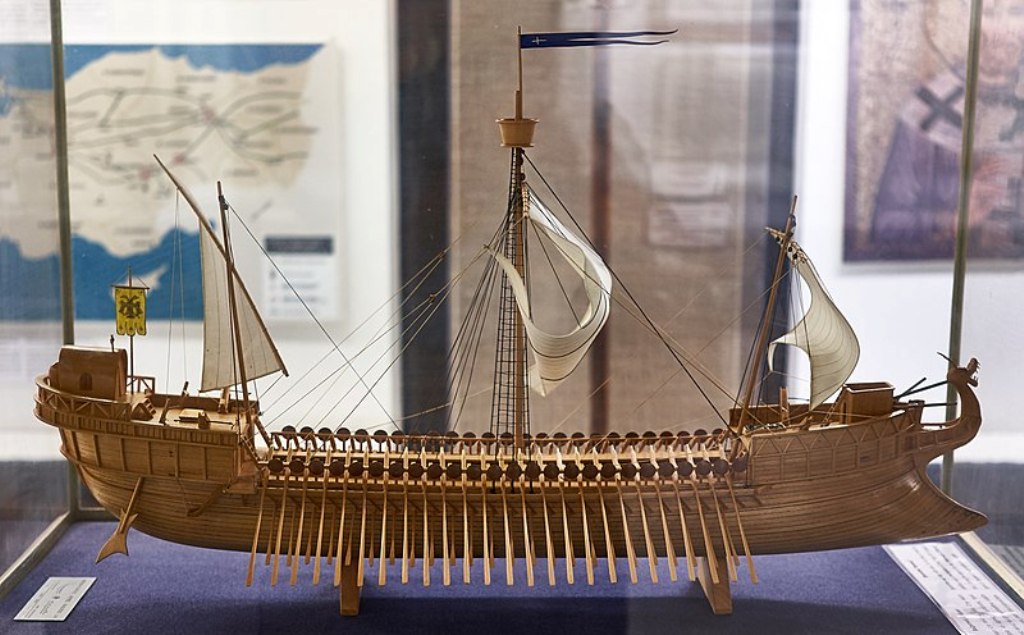
Cloth sails were used to catch the wind and move the ships across the water. During a sea battle, lines of oarsman would row the ships in to position especially if the wind was against them. Square sails were traditionally used for the sea voyage, but the triangular lateen sail was also in use by the Muslim navy for all its ships on the Mediterranean. This sail enabled greater manoeuvrability because it acted like an aeroplane wing, creating high- and low-pressure points which created lift. Hourani says: “Certainly the Greeks took away all existing warships at the time of the first capitulation of Alexandria (641), so that the whole Arab fleet had to be built afresh. It must have consisted of dromones of the regular Byzantine type, fast and light warships with one or two banks of oars; the classical Mediterranean square sails would be used on the voyage but not in the battle.”[25]
All ships were constructed from wood. The most suitable wood available in the region that doesn’t easily rot in the sea is from the Cypress and Cedar trees. This was brought in from Ash-Sham because as Hourani mentions, “The only thing lacking was good timber, in which Egypt is poor; this had to be brought from Syria or elsewhere.”[26] Lebanon is famous for its Cedar trees which is its national symbol appearing on its flag.
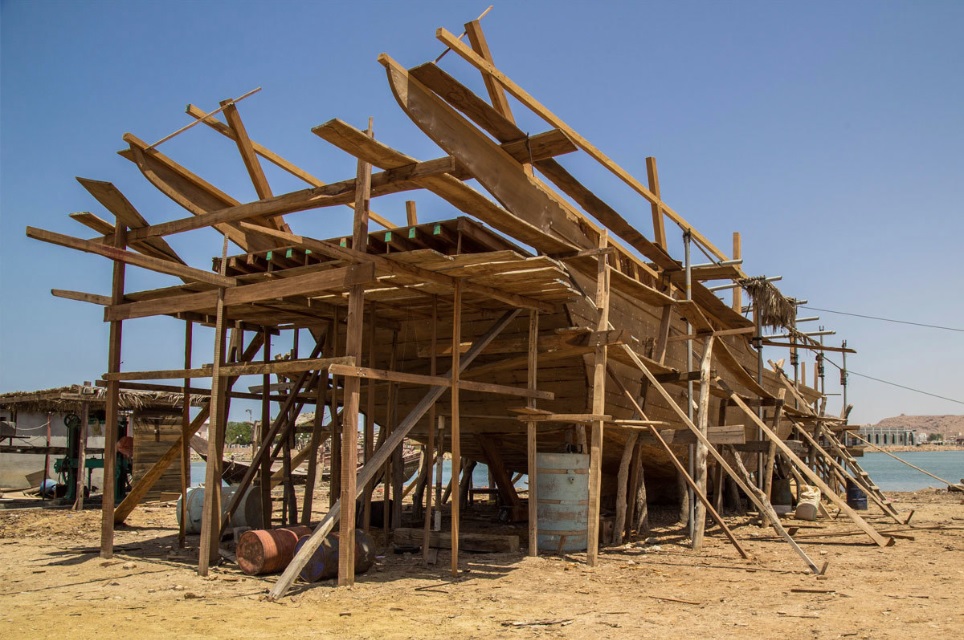
The wood was either nailed or stitched together using coir (coconut fibre), a technique used in Oman for constructing the traditional Dhow.[27] Coir was also used to create the ropes and rigging.
The Admirals
The Muslim commanders were known for their high values and were respected not only by their own troops but by their enemies as well. All those who became Admirals were former army generals so they already had well-established command abilities, which were easily transferable to their new naval roles. Battle planning on land was similar to the sea, and the technicalities of sea weather and ship movements could be easily overcome through the use of naval advisors from the Coptic community.
After the first naval campaign to Cyprus, Mu’aawiya appointed Abdullah ibn Qays as head of the Navy. He led fifty campaigns by sea, some in winter and some in summer, and no one drowned or was seriously injured. He used to pray to Allah to keep him and his marines safe, and not allow any of them to be harmed, and Allah granted that to him.
The high values of this Admiral are shown in the story of his death. One day, dressed as a merchant he took out his boat to scout a Byzantine port. While at the port he was approached by a beggar woman, to whom he gave some sadaqa. This woman then went back to her village and told the men, “Are you looking for Abdullah ibn Qays?” They said: “Where is he?” She said: “In the port.” They said: “O enemy of God, how do you know about Abdullah ibn Qays?” She told them off and said: “You are too incompetent to know about Abdullah ibn Qays.” They rushed to him and attacked him. He fought back, but was martyred. The sailor who was with him, managed to escape and return to the Muslim navy which then launched an attack on the port. When the beggar woman was asked how she knew it was Abdullah ibn Qays she said, “He looked like a merchant, but when I asked him (for charity) he gave like a king, so I knew that he was Abdullah ibn Qays.”
Sufyan ibn ‘Awf al-Azdi
Sufyan ibn ‘Awf replaced Abdullah ibn Qays. Sufyan was a sahabi, and an experienced army commander who served under Abu Ubaydah ibn al-Jarrah during the conquest of Damascus.
Busr ibn Abi Artat
Busr was another sahabi who was a commander in the conquest of Ash-Sham and Egypt. He was appointed as head of the navy in Ash-Sham and brought his fleet to join with Abdullah ibn Sa’d for the decisive Dhaat Al-Sawaari.
Abdullah ibn Sa’d, a sahabi, was appointed by Uthman as governor of Egypt after Amr ibn Al-Aas. He was Admiral of the Fleet during Dhaat Al-Sawaari as will be discussed later.
Abdullah ibn Sa’d became Muslim during the time of the Prophet ﷺ and served as his scribe writing down the revelation. He then apostatised from Islam and returned to Makkah. During the conquest of Makkah all the inhabitants were given amnesty except a small number who had harmed Islam, one of those on the list was Abdullah ibn Sa’d. The Prophet ﷺ said, “Kill them even if you find them clinging to the curtains of the Ka’bah.” However, an interesting turn of events unfolded.
Uthman bin Affan who was the milk brother of Abdullah ibn Sa’d came to the Prophet ﷺ interceding on his behalf. Uthman said, “O Messenger of Allah, accept the bay’a of ‘Abdullah.” He ﷺ raised his head and looked at him three times, refusing each time. After the third time He ﷺ accepted his bay’a. Then the Prophet ﷺ turned to his companions and said: “Was there not among you a wise man who would get up and deal with this man and kill him, when he saw me withholding my hand and refusing to accept his bay’a?” They said: “We did not know, O Messenger of Allah, what you were thinking of; why didn’t you gesture to us with your eyes?” He ﷺ said: “It is not befitting for a Prophet to deceive with his eyes.”
Even though the Prophet ﷺ initially wanted Abdullah ibn Sa’d to be killed, Allah (Most High) had a different plan for him. Abdullah’s contribution to Islam and the Islamic conquests was immense, especially in establishing naval dominance of the Muslim navy in the Mediterranean. There is an important lesson here that the doors of repentance and mercy are always open for people while they still have breath.
The Marines
The Royal Marines moto is, “By Sea, By Land”, which is a good summary of the skills of a marine, who can fight on ships or on land. The Muslim soldiers were well-experienced, hardened fighters on land so the ships were simply a means of transportation for them. Ship to ship combat, however was something they were not experienced in, and here the Byzantine Marines would have had the upper hand. This disadvantage was overcome in Dhaat Al-Sawaari as will be discussed later.
As with the land battles all of the fighters would have been Muslim and its unlikely any Copts or other dhimmi took on this role.
The sailors
Hourani poses the question, “Who manned the fleet? We do not know anything about the Syrian squadron. But at least in the Egyptian squadron sailors, rowers, helmsmen etc. were Copts. This is not only probable in itself, but we know that in much later time the Copts continued to be drafted into the navy.”[30]
As mentioned previously the warm relations between Copts and Muslims from the early days would have led to them training the Muslim soldiers and advising the admirals on naval affairs. With the correct motivation someone can learn new skills very quickly. We can see this from the example of Zayd ibn Thabit who was ordered by the Prophet ﷺ to learn Hebrew so he could communicate with the Jewish tribes around Medina. Zayd rose to the task and learnt the language in just 15 days![31]
There are many transferable skills between fighting on land and on sea. The Arabs used to navigate through the desert plains by use of the stars. This is the same method used at that time for navigating across the seas.
Learning to swim had been encouraged by the Prophet ﷺ himself where he said:
كل شيء ليس فيه ذكر الله فهو لهو ولعب إلا أربع: ملاعبة الرجل امرأته، وتأديب الرجل فرسه، ومشيه بين الغرضين، وتعليم الرجل السباحة
“Every activity that does not contain the remembrance of Allah is futile (lahw) and play (لعب), except for a man doing four things: Walking between two purposeful goals, grooming his horse, playing with his family, or teaching someone to swim.”[32]
Naval Warfare
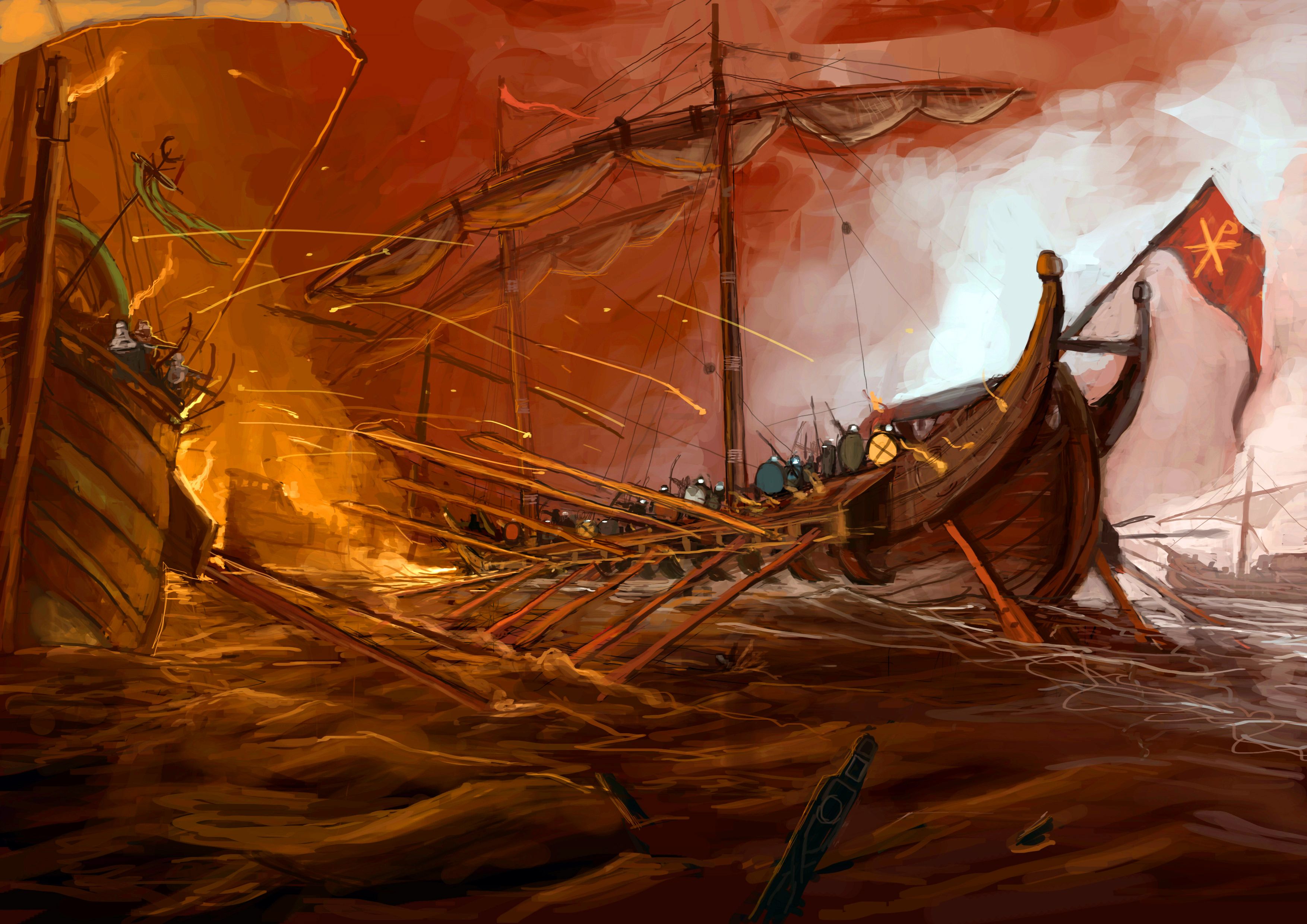
Naval weapons of the time were limited, but ship-to-ship combat mainly consisted of catapults for throwing rocks and fire, along with rows of archers firing ordinary and flaming arrows. Ropes with iron hooks were also used to bring down an enemy ship’s mast and sails.
“It was related that ‘Abdullah ibn Qais Al-Fazaari used to attack the people upon the sea in the era of Mu’aawiyah and he used to hurl fire at the enemy. He would burn them and they would burn him, and he said: ‘The affair of the Muslims is still upon that (i.e. they still engage in that type of warfare on the sea).’”[33]
Battle Planning
The commander at the Battle of Badr was none other than the noble Prophet ﷺ who was guaranteed victory and help from Allah. Yet despite this Al-Hubaab ibn Al-Mundhir approached the Prophet ﷺ and said, “O Messenger of Allah, concerning this particular spot (where we are making camp), is it a spot concerning which Allah sent down revelation to you, so that we may not advance from it or go behind it? Or is it based on opinion, warfare, and strategy?”
The Prophet ﷺ replied, “Rather, it is opinion, warfare, and strategy.”
Al-Hubaab said, “O Messenger of Allah, then indeed, this is not the place. Rise with the people, O Messenger of Allah, until we reach the water (i.e. well) that is closest to the people (i.e., to the army of the polytheists); there we should make camp and destroy all of the wells that are behind it. Then we should build a basin over it (the well) and fill it with water. Then we will fight the people (the enemy), and we will drink, and they will not drink.”
The Prophet approved of Al-Hubaab’s counsel and led his army to the well that was nearest the enemy. There they made camp and built basins; also, as per the counsel of Al-Hubaab they destroyed all the other wells.[34]
The sahaba clearly understood the spheres of life that are within human beings’ control and those that are not. Within their sphere of control, they would maximise their efforts to achieve the result, all the time making du’a to Allah and getting closer to Him through their good deeds. Military tactics and battle planning was one such area they excelled in. If one plan failed they would not give up but change tactics and deploy a new plan.
At the Battle of Yamama the famous Muslim general Khalid bin Al-Walid, the sword of Allah was in command. The Byzantines thought Khalid was named the Sword of Allah because he used a sword Allah had sent to the Prophet ﷺ, and that his victories were due to this ‘magic sword’.[35] But Khalid ibn Al-Walid was a human being and his battle strategies are studied to this day by western military historians like David Nicolle.
As the battle of Yamama begun, events didn’t go as planned and the Muslims were on the backfoot facing a possible defeat, with enemy soldiers even managing to enter Khalid’s command tent where his wife Laila was staying. Lt-General A.I. Akram describes what had gone wrong:
For this battle Khalid formed his men not in tribal groups, as had been the customheretofore, but in regiments and wings as required for battle, with tribal contingents intermingled.
Some lack of cohesion was now felt in the Muslim regiments due to the mixture of tribal contingents which were not yet accustomed to fighting side by side.
Khalid saw that forming regiments out of mixed tribal contingents had been a mistake, for the clan feeling was still very strong among the Arabs. It added another pillar of strength to the Islamic zeal and the individual courage and skill which distinguished the Muslim army. In face of the three-to-one superiority of the enemy and the blind, fanatical determination of Musailima’s followers, the absence of tribal loyalty had resulted in a weakening of cohesion in the Muslim regiments.
Khalid corrected this mistake and regrouped the army. He deployed it in the same battle formation with the same commanders, but the soldiers were now formed into clan and tribal units. Thus every man would fight not only for Islam but also for the honour of his clan. There would be healthy rivalry among the clans.
Once the reorganisation was complete, Khalid and his senior commanders went about the regiments. They spoke to the men and strengthened their resolve to punish Musailima for the disgrace that they had suffered. The men swore that if necessary they would fight with their teeth.[36]
Therefore, Khalid changed his battle tactics when he saw they weren’t working and the battle of Yamama became another victory for the Muslims.
Dhaat Al-Sawaari (Battle of the Masts) 654CE
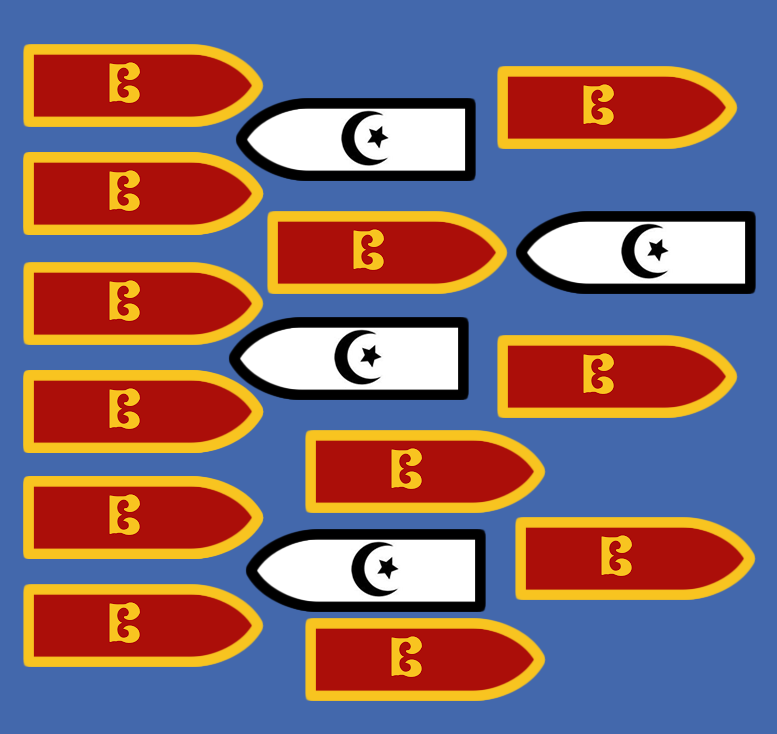
The Byzantines were rapidly losing territory in North Africa and the Mediterranean, so Constantine the son of Heraclius (Constans II) assembled a navy of 500-600 ships and set out to Alexandria to avenge their loses. Ibn Khaldoon says: “Then Ibn Abi’l-Sarh sent out detachments and they subjugated many lands, and they obeyed him and he went back to Egypt. When Ibn Abi’l-Sarh had achieved what he achieved in North Africa and gone back to Egypt, Constantine the son of Heraclius set out to attack Alexandria with six hundred ships.”[37]
19th-century illustration, “Battle of the Masts.”
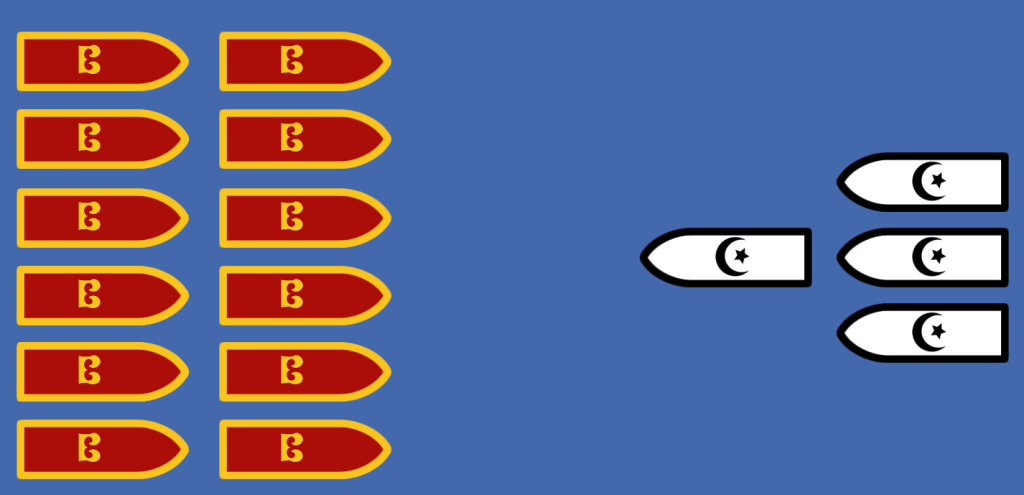
Abdullah ibn Sa’d ibn Abi Sarh, head of the Egyptian navy, set off from Alexandria with his ships and met up with Bisr ibn Artah, head of the Ash-Sham navy in order to confront the Byzantine threat. Abdullah ibn Sa’d was in overall command of the Muslim fleet and Constans was in command of the Byzantine fleet, which outnumbered the Muslims nearly 3 to 1. The two fleets faced off against each other, off the coast of Egypt to the west of Alexandria near the city of Marsi Matrooh.[38]
Malik ibn Aws ibn al-Hadathaan, who was one of the naval officers present at the battle, narrates how events unfolded. He said: “I was with them at Dhat Al-Sawari. We met in battle on the sea, and we looked at their ships and had never seen anything like them. The wind was against us – i.e., it was in the favour of the Byzantine ships – so we dropped anchor for a while and they dropped anchor near us.
Then the wind dropped, and we said to the Byzantines: ‘Let us make peace between us and you.’ They said: ‘We will give you that, and in return we want peace.’ The Muslims also said to the Byzantines: ‘If you wish, we will go to the coast and fight there until victory is decreed for one of us, or if you wish, we will fight on the sea.’ Maik ibn Aws said: They all shouted as one: ‘No, on the sea!’
Thus it seemed to us that they were putting their trust in their naval experience and hoping for victory because of their skills and experience at sea, as they were used to it and its climate, so they hoped for a victory at sea, especially since they knew that the Muslims were new in this field.”[39]
Peace wasn’t an option because it would mean the Byzantines submitting to the Islamic authority. Thus with war inevitable, the Byzantines who had been seafarers for centuries and whose ships outnumbered the Muslims nearly 3 to 1, had the upper hand. Similar to Quraysh in the Battle of Badr, they believed their numbers and military superiority would gain them victory. How wrong they were!
The Muslim navy spent the night in dhikr and tahajjud seeking the help of Allah in what seemed an impossible mission. After leading the Muslims at Fajr, Abdullah ibn Sa’d gathered his senior officers for counsel. The Muslim’s strength was in fighting on land in hand-to-hand combat, so they devised a brilliant plan which would play to their advantage.
Abdullah ibn Sa’d ordered his ships to get as close as possible to the Byzantine ships which is why this was called Battle of the Masts due to the closeness of the masts. Some Muslim marines then jumped in the water and tied the ships together creating one large land mass on the sea. The battle then became hand-to-hand combat. Hourani mentions, “The tactics employed made it resemble a land battle, with the opposing vessels locked together and the men fighting with arrows and swords. This method of combat suited the Arab warriors.”[40]
This was a fierce and chaotic battle which as Tabari described, “There was more blood than water in this battle.”[41] The Byzantines tried to isolate the Fleet Admiral’s ship by tying ropes to it and attempting to tow it away. A brave marine named ‘Ilqimah ibn Yazeed al-Ghutayfi sacrificed himself by jumping on the ropes and cutting them, saving Abdullah ibn Sa’d and the command ship.[42]
The Byzantine navy was finally defeated, with its ships destroyed and sailors laying dead in the water. Constans, seeing this destruction fled the battle and ended up in Sicily. When the local population found out about his defeat they said, “Christianity and its men are destroyed! If the Muslims want to invade, they will not find anyone to repel them!” They then killed him. Sicily became one of many Mediterranean islands that came under the authority of the Islamic State after this battle.
Aftermath
The Byzantine historian Theophanes the Confessor said, ‘This battle was a second Yarmouk for the Byzantines.’[43] This is because the battle of Yarmouk wiped out Byzantine dominance in Ash-Sham, and Dhaat Al-Sawaari wiped out Byzantine dominance in the Mediterranean.
The navy of the Islamic state then began conquering the Mediterranean islands one by one. Cyprus, Crete, Corsica, Sardinia and the Balearic Islands all fell to the Muslims.
Muslim naval dominance of the Mediterranean continued for centuries and Muslim sailors became renowned for their naval expertise. They excelled in cartography and navigation and are credited with enhancing many naval inventions such as the Astrolabe and the lateen sail.
Conclusion
Studying the Islamic conquests is important so we can link ourselves back to our glorious Islamic history and learn valuable lessons from them. There are three key lessons to take from the development of the Muslim navy.
1- Tawakul on Allah and constantly seeking His help through du’a and mandubaat (recommended actions).
2- Maximising the thinking and effort within the sphere that human beings dominate, and not forgetting the famous hadith, اعْقِلْهَا وَتَوَكَّلْ“Tie (the camel) and make tawakul.”[44]
3- The importance of the Islamic method (tareeqa) i.e. the Islamic State, in solving problems by utilising all elements of state and society to achieve a goal. Ash-Sham provided the timber and Egypt provided the ship builders. Both governors cooperated in developing the navy under the overall command of the Caliph Uthman ibn Affan.
By A.K.Newell, Editor of IslamCiv.com
Notes
[1] George Hourani, ‘Arab Seafaring in the Indian Ocean in Ancient and Early Medieval Times,’ Octagon Books, New York 1975, p.57
[2] David Nicolle, ‘The Muslim Conquest of Syria,’ Osprey Military, 1988, p.7
[3] Watt, W. Montgomery (1986). “Kuraysh”. The Encyclopaedia of Islam, New Edition, Volume V: Khe–Mahi. Leiden and New York: BRILL. p.434
Amr ibn Al-Aas was the Amir of Jihad in Egypt during the Caliphate of Umar ibn al-Khattab. Umar wrote a letter to Amr:
“I am very surprised at how long it is taking to conquer Egypt, as you have been fighting for the last two years, unless it is because of some sins that you have committed, or you have started to love this world as your enemy does. Allah, may He be blessed and exalted, only grants victory to people who are sincere. I am sending to you four individuals, and I have told you that each one of them is equivalent to one thousand men as far as I know, unless something has changed them…”[1]
In surah an-Nur, Allah (Most High) promises the believers that He will certainly establish them in the land لَيَسْتَخْلِفَنَّهُمْ, which is good news promising the establishment of a Khilafah which will implement Islam and change the fear Muslims are living in nowadays to one of security. Allah (Most High) says:
This is an extract from his PhD thesis ‘Al-Jihad wa’l Qital fi as-Siyasa ash-Shar’iyya’
It appears that this stage, the stage of manifestation and open declaration, in accordance to the understanding that we have explained, did not take place in one go, even if this gradual transition came to its climax when ‘Umar Ibn Al-Khattaab declared, after having been in the trench of the Kuffaar, with a certain heart and mind, that he had moved into another trench of the battle, transforming what he had carried in respect to this Da’wah in terms of a storm of hatred and violent vigour, transforming that all to the opposing side, to become the strongest of believers in backbone and firmness and most challenging in the face of the disbelievers.










 Islamic Civilization