All posts filed under: Caliphate

War and Peace in Islam: War is Deception

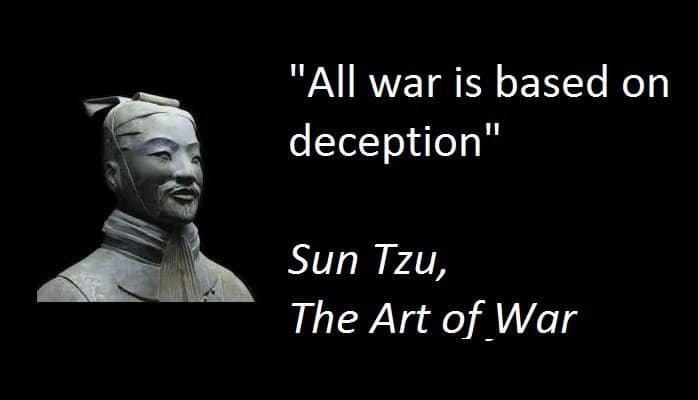
Continuing our series on war and peace in Islam, there is a clear difference between deception in war and treachery. Some may argue that since war is deception then it’s permitted to enter a land with a visa and then renegade on that based on an incorrect understanding of a hadith by Ka’b ibn Malik who reported that when the Prophet ﷺ intended to set out on a military expedition, he would pretend to go somewhere else. The Prophet would say, الْحَرْبُ خُدْعَةٌ “War is deception.”[1] This misconception shows the importance of understanding the Arabic language and the principles of Islamic jurisprudence (usul al-fiqh) before issuing Islamic edicts. We cannot read a hadith in English and apply the meaning of the word ‘deception’ in English and extract a ruling. There is a clear difference between deception (خُدْعَة) and treachery (خِيانَة) in Islam and even in the English language. Deception (خُدْعَة) in war is related to battle tactics and all militaries since wars began have used deceptive tactics against each other. During WWII Britain hatched an ingenious …


War and Peace in Islam: Treachery is not jihad

Continuing our series on war and peace in Islam, Islam categorically forbids treachery whether in peace or war. The Caliphate is not a treacherous state despite the attempts to malign Islamic history and the Islamic religion itself by the criminal acts of a tiny proportion of Muslims who contradicted the clear-cut rules of law in Islam. The Islamic civilisation flourished for over 1300 years with the caliphate and Islamic governance playing a pivotal role in this. This civilisation could not have remained in power for such a long period of time if it was known for treachery, injustice and tyranny. If the Islamic state had conducted itself in the same way as the hated western colonial powers, then its peoples would have rebelled en mass against Islamic rule which never occurred. In fact, all the internal rebellions against the caliphal governments ended up implementing the exact same system albeit with a different ruling family. This is because the rebellion was about “who” should rule, not “what” should be implemented. Islamic Spain is a stark example of …

War and Peace in Islam: Martyrdom

Continuing our series on war and peace in Islam, the seeking of shahada (martyrdom) is something all Muslims would love to achieve due to the high status and honour given to the shaheed in the next life. However, martyrdom has conditions in order to be accepted. Attempting to gain martyrdom through disobeying Allah such as by treachery, would negate the honour of receiving the shahada. The Prophet Muhammad ﷺ said, إِنَّمَا الْأَعْمَالُ بِالنِّيَّاتِ “Verily, actions are only [accepted] by intentions.”[1] “This is one of the most comprehensive hadith of the Prophet ﷺ. It touches upon almost every deed of Islam…Imam AbuDawood stated that this hadith is one-half of Islam; that is, Islam compriseswhat is apparent, the deeds of Islam, as well as what is not apparent, theintention behind the deeds. Al-Shafi’i also said that it encompasses half ofknowledge, meaning that the religion concerns both what is external and whatis internal. The deeds are the external aspect and the intention behind them isthe internal aspect.”[2] Rumi (d.1273CE) narrates a famous story of Ali ibn Abi Talib where he stopped …

War and Peace in Islam: Issuing Islamic edicts (fatawa)

Continuing our series on war and peace in Islam, the justifications Jihadi-Salafi groups give for their attacks that breach well-established Islamic rules on covenants and treaties are based on their issuing of erroneous Islamic edicts (fatawa). Issuing fatawa is only for qualified scholars Ijtihad (اِجْتِهاد) is derived from the root word Jahada (جهد). Linguistically, it means striving or self-exertion in any activity, which entails a measure of hardship. The great scholars of Usul such as Abu al-Husayn Ali otherwise known as Al-Amidi (d.631 AH) and Mohammad bin Ali Al-Shawkani (d.1255 AH) defined it as, “the total expenditure of effort made by a jurist in order to infer, with a degree of probability, the rules of Shariah from their detailed evidence in the sources.”[1] Extracting Islamic edicts (fatawa) from the Qur’an and Sunnah via ijtihad is only for those who are qualified. If someone is seriously ill, they will go to a doctor to diagnose their illness and prescribe medicine. If they went to an unqualified person, then they may end up losing their life due …

War and Peace in Islam: Jihadi-Salafis

Continuing our series on war and peace in Islam, we discuss the modern phenomenon of Jihadi-Salafism which post 9-11 has dominated the world scene as part of America’s war on terror. A brief history In the latter part of the 20th century, a number of Jihadi-Salafi groups emerged in the Muslim world. These groups were established as a reaction to the deaths and destruction inflicted upon Muslims in a number independence wars starting primarily with the Soviet invasion and occupation of Afghanistan (1979-1989). The resistance to the Soviet invasion was undertaken by Afghan mujahideen who had lived in the land for thousands of years, and who followed the Hanafi-Deobandi school of thought (mathhab). Throughout the 1980s many Arab volunteers who followed Salafism came to assist the Afghans bringing with them money from the Gulf countries who were rich in oil wealth. One of the most famous in this regard is Osama bin Laden whose family to this day are billionaires. The mujahideen were openly supported by America and the CIA who were actively training them …

War and Peace in Islam: What is jihad?

This is the first of a new series of articles addressing some misconceptions surrounding the issues of war and peace in Islam. It will focus primarily on the subject of Muslims living in non-Muslim countries who can face a moral dilemma with regards to split loyalties when their host country goes to war with a Muslim country. The Takfiri[1]Jihadi-Salafi groups in particular have attempted to influence Muslims across the world with their extreme misinterpretation of Islamic texts in order to justify treacherous actions, both in Muslim and non-Muslim countries. While their impact has been miniscule in comparison to other criminal acts, and blown out of all proportion by those interest groups who have nefarious agendas against the Islamic religion, their arguments still need to be addressed in order to remove any confusion that may arise in someone’s mind regarding such conduct. In most cases, as with any intolerant and extreme views, whether Muslim or not, other sociological and psychological factors are in fact the real motivations behind many of these despicable acts. Definition of jihad …

Rethinking the Wali Al-‘Ahd (Designated Successor)

Continuing our series on the bay’ah, one of the core issues which needs to be addressed is how to facilitate a smooth transition of power from one caliph to the next. Every ruling system faces this problem and if handled incorrectly may lead to instability and even civil war. This is something we witnessed throughout Islamic history when the caliphate transformed from a rightly guided caliphate into mulk (monarchy) not in the sense of the caliph being sovereign like an absolute monarch or king, but in the characteristics of a monarchy like hereditary rule and abuse of power. This was prophesised by the Messenger of Allah ﷺ who said, تَكُونُ الْخِلَافَةُ ثَلَاثِينَ سَنَةً ثُمَّ تَصِيرُ مُلْكًا “The caliphate will be for thirty years. Then it will become mulk (monarchy).”[1] Hereditary rule was introduced by Mu’awiya who made his son Yazid the Wali Al-’Ahd (heir apparent or designated successor) before he died. This was meant to facilitate a smooth transition of power and prevent another civil war as Ibn Khaldun says, “Mu‘âwiyah himself preferred his son …

Al-Mazalim (Court of Grievances) in the Rightly Guided Caliphate

The Islamic ruling system is underpinned by a number of principles (القَواعِد) which are derived from the Qur’an and Sunnah. These principles will map to one or more formal institutions (أَجْهِزَة) within the state which are necessary to meet the demands of a society in a specific time and place. Israr Ahmed (d.2010) says, “Since we cannot recreate as such the Islamic Order as it functioned during the age of the Rightly Guided Caliphate, we must adopt the following principle: we should take the principles and ideals from the model of the Prophet Muhammad ﷺ and the Rightly Guided Caliphs (RAA), and then incorporate these principles and ideals in the political institutions that have been developed in the contemporary civilized world as a result of the process of social evolution.”[1] What is the Wiliyat Al-Mazalim? One of the principles of the Islamic ruling system is “Removing Maẓālim” (plural: مَظالِم singular: مَظْلِمَة) which literally means removing oppression but in its istilahiyya (technical) meaning refers to removal of state oppression. The principle is shortened in the literature …

Structure of an Islamic State: The Provinces

Every state is divided up into administrative divisions in order to organise and manage the local affairs of its citizens. The names and sizes of these divisions will vary between different countries, and an Islamic State or caliphate can use any of these administrative divisions from any system which suits its requirements at the time. The underlying principle here is to keep the caliphate united upon the Islamic ‘aqeeda (creed), even if administratively and politically it consists of separate states and entities. The top-level division in a caliphate is the province or state known as a Wiliyah (ولاية) or Emirate (إِمَارَةِ). The head of this province is called a Wali or an Amir. In the latter half of the Abbasid Caliphate, when the provinces became powerful semi-independent ‘empires’ then Sultanate (سَلْطَنَة) was used as in the case of the Seljuks, Mamluks and Ottomans. For the citizens of an Islamic State, their first point of contact with the leadership of the state is the governor of their province or emirate, and their local mayors in the …

Structure of an Islamic State: The Dīwān

“The Arabic word dīwān (دِيوان) refers to a sitting room, where scribes can sit and attend to their work; it can also mean a collection of notebooks, or a ledger, containing the names of those who are registered in the military or who receive grants from the government.”[1] In modern times a dīwān is called a government department (دائِرَة da’ira). Al-Mawardi says, “The dīwān is a place for maintaining what is related to the authorities of the Sultan in terms of public works, finance, and the armies and governors (Al-‘Ummal) who carry them out.”[2] The original term dīwān is from Pahlavi (Middle Persian), because this administration of state bureaucracy was adopted from the Persian empire by Umar ibn Al-Khattab, the second caliph of Islam in the year 20H[3]. Abu Hurayra, who was the governor of al-Bahrain came to Umar with 500,000 dirhams in tax revenue. After Umar’s initial shock at the size of this amount he consulted the sahaba and he was advised to adopt the diwan of the Persians.[4] Administration (إِدارَة idara) can be …