Author: islamciv

The Caliphate must maintain an independent foreign policy

The caliphate is not an isolationist state. It will deal with other countries based upon a strict criteria set by the sharia which allows friendly relations, trade and multilateral treaties with other nations based upon cooperation and justice. This can be seen throughout Islamic history where the high values of the Islamic state gained international respect, and whose armies had a reputation for the rule of law at the height of war. The currency of the caliphate spread globally just a few decades after it was first minted by the Umayyad caliph Abdul-Malik ibn Marwan (r.692-705CE). A copy of a gold dinar minted by the Abbasid Caliph Al-Mansur (r. 745-775CE) even found its way to England during the reign of King Offa of Mercia (r. 757–796CE).[1] The sharia however, prohibits relations with those countries who are actively at war with Muslims like Israel, and limits relations with countries who have a history of occupation and interference in the Muslim world like America, Britain and France. No Occupation and foreign influence If the state is under occupation of a foreign …
Preventing Coup d’états in an Islamic State

There are three ways the caliph as Commander-in-Chief keeps full effective control of the armed forces. 1-     The bay’ah contract The bay’ah or pledge of allegiance, is a ruling contract which governs the relationship between Muslims and the Islamic state. For those Muslims living under the authority of the state, the bay’ah is their citizenship contract with its ruler – the caliph. This oath and pledge contains explicit words of loyalty and obedience to the head of state. Ubada ibn Al-Samit said: بَايَعْنَا رَسُولَ اللَّهِ صلى الله عليه وسلم عَلَى السَّمْعِ وَالطَّاعَةِ فِي الْمَنْشَطِ وَالْمَكْرَهِ‏.‏ ‏‏وَأَنْ لاَ نُنَازِعَ الأَمْرَ أَهْلَهُ، وَأَنْ نَقُومَ ـ أَوْ نَقُولَ ـ بِالْحَقِّ حَيْثُمَا كُنَّا لاَ نَخَافُ فِي اللَّهِ لَوْمَةَ لاَئِمٍ ‏‏‏  “We gave the bayah to Allah’s Messenger that we would listen and obey him both at the time when we were active and at the time when we were tired, and that we would not fight against the ruler or disobey him, and would stand firm for the truth or say the truth wherever we might be, and in the Way of Allah we would …

The Caliph is the Commander-in-Chief

In most Muslim countries today, the head of state is a mere figurehead in terms of their powers as the overall commander of the armed forces. They may hold titles such as Supreme Commander (القائِد الأَعْلَى) or even Commander-in-Chief (القائِد العامّ), but in reality they have no real effective power over the armed forces. The Pakistan constitution states, “Without prejudice to the generality of the foregoing provision, the Supreme Command of the Armed Forces shall vest in the President.”[1] The Egyptian constitution states, “The President of the Republic is the Supreme Commander of the Armed Forces.”[2] The Turkish constitution states, “The Office of Commander-in-Chief is inseparable from the spiritual existence of the Grand National Assembly of Turkey and is represented by the President of the Republic.”[3] This is why within the Muslim world so many western backed Coup d’états have occurred over the past decades, especially in the three countries mentioned above. Taqiuddin Al-Nabhani says, “The army (جَيْش  jaysh) must have a commander-in-chief (القائِد العامّ  Al-Qa’id Al-‘Amm), who is appointed by the Head of State ( رئيس الدولة Ra’is …

Al-Mawardi’s Amir of Jihad

The title Amir ul-Jihad (أَمِير الجِهاد) which literally means the Leader of War, is a grammatical construction (إِضافَة Iḍāfah) mostly used to indicate possession. As a formal title it was not used in the time of the Prophet ﷺ or the Rightly Guided Caliphate. Only the title Amir was used without the appendage for the overall commanders of a battle. It was also used for the commanders of smaller expeditions (sariyya) since the word Amir is a general term for any leader of any function even if it’s over two people. The Messenger of Allah ﷺ said: إِذَا خَرَجَ ثَلاَثَةٌ فِي سَفَرٍ فَلْيُؤَمِّرُوا أَحَدَهُمْ “When three are on a journey, they should appoint one of them as their Amir.”[1] The Prophet ﷺ would give the Amir of any expedition whether a small platoon (faṣīlah) or a large brigade (لِواء liwaʾ) a white flag called a liwaʾ which is the same word as a brigade. This flag is a special flag for the commander of an expedition (sariyya) or campaign, and by extension the commander in-chief of all the armed forces i.e. …

Importance of Correct Military Structuring in an Islamic State

Since the armed forces play such a major role in the Islamic state, their organisation and administration must be managed correctly. The military has its own culture and ethos, and is resistant to change. If not handled properly they can become a separate entity looking after the interests of themselves, rather than those of the state. In 1905, Field Marshal Sir Evelyn Wood told Richard Haldane, the Secretary of State for War, “If you organize the British army, you will ruin it.”[1] If the military becomes independent this may lead to riots, civil wars and even coup d’états as were witnessed during the Abbasid Caliphate after the formation of a professional standing army of freed Turkish slaves (Ghilmans/Mamluks) by the caliph Al-Mu’tasim (r. 833-842). The rise of the Turkic army and their power struggles with the Abbasid Caliphs, led them to assassinate Al‐Mutawakkil (r. 847-861) and install his son Al-Muntasir (r. 861–862) as the caliph. The subsequent coup d’états, assassinations and civil strife in the new Abbasid capital of Samarra, are known as the Anarchy of …

Administrative Structure of the Caliphate’s Military

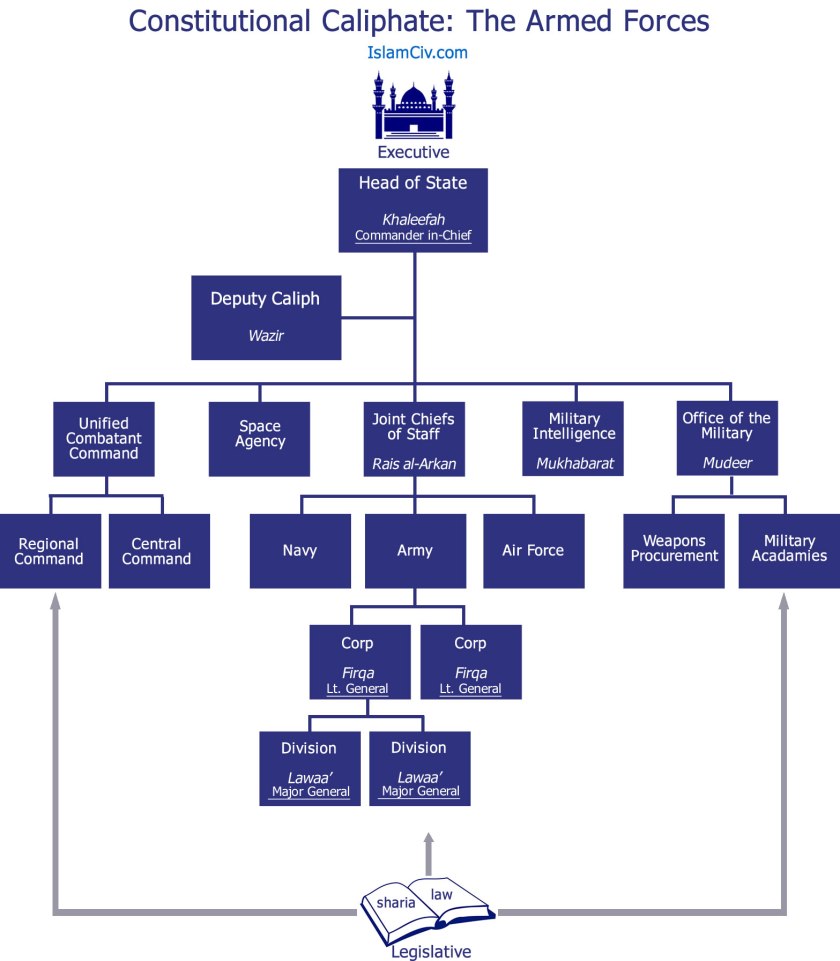
Al-Mawardi lists ten responsibilities[1] for the Amir of the army. These responsibilities in modern times fall under the remit of the defence department and the Chiefs of Staff who are tasked with creating a highly proficient and effective Islamic military, that is capable of assisting the caliph in protecting Islamic interests both at home and abroad. Protecting the army from attack Choosing the best location for the army encampments Preparing provisions for the army Knowledge of the enemy, their movements and tactics Organising the army for battle Motivating the army to fight by remembering Allah’s help Motivating the army to fight by remembering the immense reward of jihad Consulting the military experts for advice (shura) Ensuring that the army adheres to the sharia rules of engagement The army must concentrate on military matters and not involve itself in trade and agriculture The duties listed above cover a wide-range of areas including logistics, intelligence and educational programmes (tarbiya). These areas require the input and assistance of many other parts of the state such as the education …

Civilian Control of the Military in an Islamic State

Former French PM Georges Clemenceau said, “War is too serious a matter to entrust to military men.”[1] This is because military thinking focuses on achieving specific, measurable goals using force, while political thinking considers broader goals and uses a variety of tools, including military force, to achieve them. Military thinking emphasizes rationality, analytical skills, and feasibility, while political thinking involves critical examination, analysis of political concepts, and consideration of public interaction and the political dimension within a community. Samuel Huntington (d.2008) says, “A minister of war need not have a detailed knowledge of military affairs, and soldiers often make poor ministers. The military viewpoint will inevitably, of course, interact with the political objective, and policy must take into account the means at its disposal. Clausewitz voices the military warning to the statesman to note carefully the limits of his military strength in formulating goals and commitments. But in the end, policy must predominate. Policy may indeed ‘take a wrong direction, and prefer to promote ambitious ends, private interests or the vanity of rulers,’ but that does not concern the military man. …

Will the Caliph lead the armies directly?

The Prophet Muhammad ﷺ in his role as a ruler-prophet and head of state in Medina led many of the battles himself since he was the Commander-in-Chief. A battle or expedition that he ﷺ led directly is referred to in the Islamic history books as a ghazwa. Those expeditions where he appointed a sahabi to command are referred to as a sariyya. We can see from the data that the number of expeditions led directly by the Prophet ﷺ decreased over time as the sahaba took a more leading role after their training at the hands of the Messenger ﷺ. The Prophet ﷺ appointed a total of 43 different sahaba as commanders so they all gained experience in this role. After his ﷺ death these commanders played a vital role in the Islamic conquests such as Khalid ibn Al-Walid, Amr ibn al-Aas and Abu Ubaidah ibn al-Jarrah. Three of the Rightly Guided Caliphs were appointed as military commanders namely, Abu Bakr, Umar and Ali. This experience was important for their future roles as Commanders-in-chief of their respective armies. …

Scenarios for the emergence of a Unitary Islamic State today

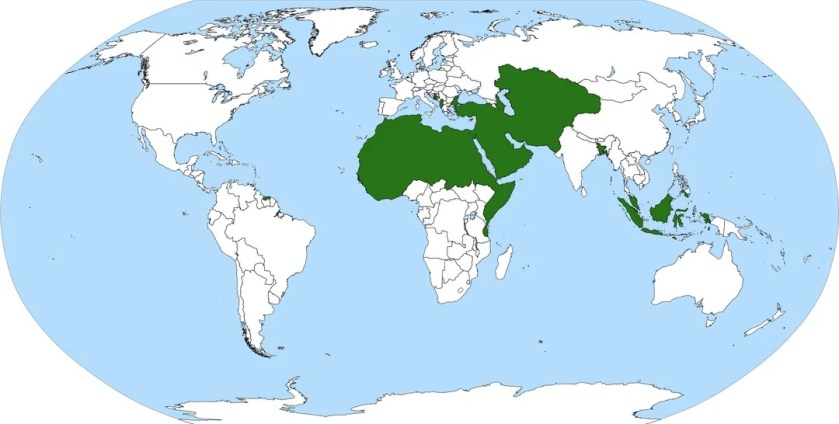
Assessing the maslaha (benefit) and mafsadah (harm) within the sphere of siyasa sharia is not an exact science. Every time and place needs to be assessed by highly skilled statesmen like the Prophet ﷺ, Rightly Guided Caliphs and those who follow in their footsteps, who can navigate these tumultuous waters. There are many options open to a Muslim ruler who is sincere in their attempts to implement Islam. Israr Ahmed (d.2010) says, “Since we cannot recreate as such the Islamic Order as it functioned during the age of the Rightly Guided Caliphate, we must adopt the following principle: we should take the principles and ideals from the model of the Prophet Muhammad ﷺ and the Rightly Guided Caliphs (RAA), and then incorporate these principles and ideals in the political institutions that have been developed in the contemporary civilized world as a result of the process of social evolution.”[1] Muhammad Haykal outlines a possible scenario for unification of the Muslim world once a caliphate has been established. He says, “When this Khilafah state is established via the bay’ah of the Muslims of a particular …

Maintaining a Unitary Islamic State

Loyalty to the Caliph is through the Bay’ah The bay’ah contract which is the citizenship contract between the Muslims and the caliph contains explicit words of loyalty and obedience to the head of state. Ubada ibn Al-Samit said: بَايَعْنَا رَسُولَ اللَّهِ صلى الله عليه وسلم عَلَى السَّمْعِ وَالطَّاعَةِ فِي الْمَنْشَطِ وَالْمَكْرَهِ‏.‏ ‏‏وَأَنْ لاَ نُنَازِعَ الأَمْرَ أَهْلَهُ، وَأَنْ نَقُومَ ـ أَوْ نَقُولَ ـ بِالْحَقِّ حَيْثُمَا كُنَّا لاَ نَخَافُ فِي اللَّهِ لَوْمَةَ لاَئِمٍ ‏‏‏  “We gave the bayah to Allah’s Messenger that we would listen and obey him both at the time when we were active and at the time when we were tired, and that we would not fight against the ruler or disobey him, and would stand firm for the truth or say the truth wherever we might be, and in the Way of Allah we would not be afraid of the blame of the blamers.”[1] Every citizen, including all the governors are bound first and foremost by the bay’ah. When the Islamic ideology is strong within the ummah and its governing bodies, then this should be the basis of …