Latest Posts

Bay’ah through Domination

  1. Yazid ibn Mu’awiya and Abdul-Malik ibn Marwan gain power through force
  2. What enabled this abnormal situation to become the norm?
  3. Notes

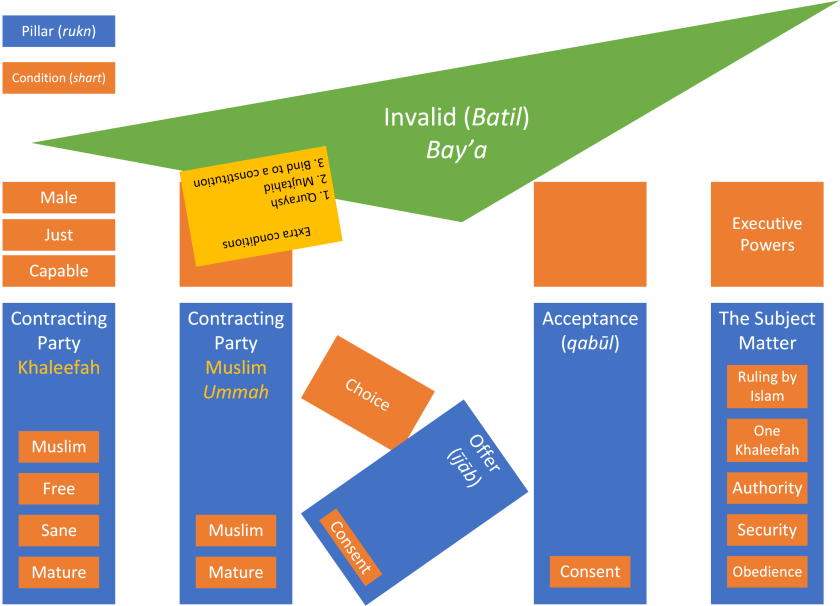
The last way of appointing a caliph by the ummah is where a usurper or dominant sultan takes power by force. Since the ummah in origin has not consented to this dominant sultan then he cannot be a caliph and the bay’ah would be considered batil as one of its pillars (rukn) is missing. The bay’ah is a contract and must conform to the rules of contracts in Islam which is free choice and consent of both parties.

If the ummah and her representatives decide to accept the legitimacy of this ruler, then the bay’ah will become legally convened. Ibn Hajar says, “The jurists have unanimously agreed that it is obligatory to obey the dominant sultan and jihad with him, and that obedience to him is better than revolting against him because of that of shedding blood and pacifying the masses.”[1]

Such a situation has been permitted by the ‘ulema but it is an emergency situation and should not be the norm. If this occurred in a future Islamic state due to the removal of a corrupt caliph in a coup d’etat for instance, then elections need to be held as soon as is feasibly possible because the ummah is the source of authority not the dominant sultan.

Shaykh Khudari Bak says, “There is a fourth way [of bay’ah] which the scholars after the first era instituted for the establishment of the imamate, and that is by way of dominance. This happens when the Muslims have no imam, there are differences among them, and they cannot agree on a particular person. In such a situation, it is lawful for a person who knows that he has the capacity to lead the Muslim community because of his knowledge or the influence of his tribe, to demand this post of caliph. He would hence oblige the people to obey him, whether they responded willingly or by force. Once the situation subsides and his claim is accepted, his caliphate will be established and obedience to him will become obligatory.”[2]

Dr. Wahbah Az-Zuhaili says “Subjugation (Al-Qahr) is an exceptional circumstance which does not conform to the origin which dictates that the authority be established by choice. Approving or accepting it, is based upon giving consideration to a situation that has befallen due to the necessity (Daroorah) and to prevent the shedding of blood …”[3]

Muhammad Haykal says, “Likewise, in respect to the method of gaining mastery (At-Taghallub), the Mutaghallib (one who takes over the rule by force) does not become the caliph by the mere taking control over the authority. Rather, he would only become the caliph at a time when the people accept him (by choice) and give the bay’ah to him. If they refuse to give him the bay’ah (pledge) he would remain a ruler who has usurped the authority.

That is just like when a person usurps a commodity from another and then if that other accepts and sells it to him (the usurper) the ownership of the property would be transferred to him. However, if the owner remains adamant about not selling the commodity to the usurper, then the one refusing remains the rightful Shar’i (legal) owner of the commodity. The usurper would remain as such irrespective of how much time passes over his usurpation.”[4]

Yazid ibn Mu’awiya and Abdul-Malik ibn Marwan gain power through force

Two examples of the use of force to take the bay’ah during the Umayyad Caliphate, are the rule of Yazid ibn Mu’awiya (r.60-64H/680-683CE) and Abdul-Malik ibn Marwan (r.73-86H/692-705CE).

There is ikhtilaaf (difference of opinion) among the ulema on Yazid’s legitimacy. Many scholars accept he was a legitimate caliph such as Al-Dhahabi, but that he was sinful and blameworthy for the oppression and persecution he committed against the sahaba, and the murder of al-Hussain and his family. Others such as Ibn Al-Jawzi reject his legitimacy and call him a usurper, because he never had a legally convened bay’ah that was given through free choice and consent by the majority of the Ahlul hali wal-aqd (political representatives of the ummah). The strongest opinion seems to be that of Ibn Al-Jawzi that Yazid was not a legitimate caliph.

It was mentioned in the Tafseer of Al-Alusi: “Ibn al-Jawzi (May Allah’s mercy be upon him) stated in his book: ‘As-Sirr ul-Masun’: “From the general beliefs that is prevalent amongst those attributed to the Sunnah is that they say: That Yazid was in the right and that Al-Hussain (ra) was wrong to rebel against him. Had they examined the Seerahs they would have become aware of how the bay’ah was contracted to him and that the people were compelled with it! And that he did every ugly (or abominable) act. If we would have evaluated the Sihhah (correctness and validity) of the bay’ah contract, then there appeared from it all that would oblige the annulment of the contract. Nobody inclines to that view except every ignorant person, blind in the Madhhab who believes that by adopting that opinion he is being harsh against the Rawaafid (i.e. Shi’ah).”[5]

With regards to Abdul-Malik, Suyuti summarises his bay’ah. “He received the bay’ah according to his father’s contract during the Caliphate of Ibn Al-Zubayr, but his Caliphate was not valid and he remained as the usurper (mutaghallib) of Egypt and Syria. He then seized Iraq and its provinces before Ibn Al-Zubayr was killed in 73H/692CE. From that day, his Caliphate became valid and his authority firmly established.”[6]

This then explains the difference between the bay’ah to Yazid ibn Mu’awiya and Abdul-Malik ibn Marwan who were both usurpers. The bay’ah to Yazid was never legally convened because the Ahlul hali wal-aqd never gave bay’ah through free choice and consent. Whereas with Abdul-Malik, the Ahlul hali wal-aqd in Hijaz and Iraq, finally agreed to give bay’ah once Abdullah ibn Al-Zubayr had been killed by Abdul-Malik’s infamous commander, Hajjaj bin Yusuf. Among those who gave bay’ah to Abdul-Malik after Ibn Al-Zubayr’s death were Abdullah ibn Umar and his family in Madinah.

Bukhari narrates from Abdullah bin Dinar: “I witnessed Ibn Umar when the people gathered around Abdul Malik. Ibn Umar wrote: ‘I gave the bay’ah that I will listen to and obey Allah’s Slave, Abdul-Malik, Ameer of the believers according to Allah’s Laws and the Traditions of His Messenger as much as I can; and my sons too, give the same pledge.’”[7]

There are numerous examples in Islamic history of rulers taking power and then the ummah consenting to their rule, legitimising the bay’ah. This occurred not just in the Umayyad period but also in the Abbasid and Ottoman Caliphates.

What enabled this abnormal situation to become the norm?

Rashid Rida answers this question. “You know now that what enabled—and enables—tyrants to rule is nothing but the partisan support of their own kin. Tyrants are motivated purely by a desire for power. Their aim in fighting is not to glorify Allah’s word, nor is it to establish the scales of truth and justice for all people. This community has had its affairs corrupted and its power stripped by nothing other than:

• people assuming that obedience to unjust and violent rulers is an absolute obligation under the shari‘ah

• people assuming that the rule of tyranny is lawful under the shari‘ah

• people assuming that the rule of a tyrant has the same legal validity as the rule of a rightful imam, an imam whose rule rests on a pledge of allegiance given by those in authority and those who loose and bind who elected him

• every unjust tyrant restricting authority and power and might to his own family by asserting that the right to appoint his son, or someone else among his kin, is his entitlement under the shari‘ah, and a principle to be observed in and of itself

• the failure to see how Mu‘awiyah’s designation of his son Yazid as his successor differed from Abu Bakr As-Siddiq’s designation of ‘Umar bin al-Khattab. Yazid was a dissolute wrongdoer, and Mu‘awiyah’s designation of him was rejected by the Muslims. ‘Umar, the just imam, was a man of great virtue. Abu Bakr consulted with the people who loose and bind, persuading them and receiving their consent before designating him.”[8]

Notes


[1] Ibn Hajar, Fath Al-Bari (13/7)

[2] Shaykh Muhammad Al-Khudari Bak Al-Bajuri, The History of the Four Caliphs, Itmam al-Wafa fi Sirat al-Khulafa’, Turath Publishing, p.27

[3] Al-Fiqh ul-Islaamiy Wa Adillatuhu: 6/682

[4] Muhammad Khayr Haykal, ‘Al-Jihad wa’l Qital fi as-Siyasa ash-Shar’iyya,’ vol.1, The Eighth Study, Qitaal Mughtasib As-Sultah (Fighting the usurper of the authority)

[5] Tafseer Aloosi (Ruh Al-Maani), 26/73

[6] Jalal ad-Din as-Suyuti, ‘History of the Umayyad Khaleefahs,’ translated by T.S.Andersson, Ta Ha Publishers, p.45

[7] Sahih al-Bukhari 7203, https://sunnah.com/bukhari:7203

[8] Muhammad Rashid Rida, ‘The Caliphate or Supreme Imamate,’ Translated by Simon A Wood, Yale University Press, 2024, p.98; Original Arabic: https://shamela.ws/book/9682

4 ways of appointing a caliph

Dr. Wahbah Az-Zuhaili (d.2015) mentions four ways of appointing a caliph. He says, “The Fuqaha’ of Islam have mentioned four ways in respect to the manner of appointing the highest ruler for the state and these are:

  1. An-Nass (the text)[1]
  2. Al-Bay’ah
  3. Wilayat ul-‘Ahd (designated successor)
  4. Coercion (Al-Qahr) and force (Al-Ghalabah).

We will see that the correct Islamic method, in accordance with the principle of Shura and the principle of collective obligations, is one method, which is the bay’ah of the Ahlul hali wal-aqd, and the inclusion of the ummah’s approval of his (caliph) choice. As for anything other than that, its basis is weak due to arbitrary interpretation of texts, or reliance on weak texts and personal whims, or approval of an existing reality that Muslims did not find wisdom or interest in revolting against, or eliminating its existence to stop the bloodshed and prevent chaos, and taking into account external circumstances, or fear of the ferocity of the one holding power that came to him through illegitimate means such as inheritance and the like.”[2]

Shaykh Khudari Bak (d.1927) in a similar manner lists the same ways of appointing an Imam as Wahbah Az-Zuhaili, with the exception of the textual method adopted by the shia. In regards to the bay’ah, he splits this in to two parts – specific and general shura.

“These three ways of choosing the imam (general shura, specific shura of a group chosen by the previous imam, or succession to the post) are the three ways which were practised in the first era of Islam.

There is a fourth way which the scholars after the first era instituted for the establishment of the imamate, and that is by way of dominance. This happens when the Muslims have no imam, there are differences among them, and they cannot agree on a particular person. In such a situation, it is lawful for a person who knows that he has the capacity to lead the Muslim community because of his knowledge or the influence of his tribe, to demand this post of caliph. He would hence oblige the people to obey him, whether they responded willingly or by force. Once the situation subsides and his claim is accepted, his caliphate will be established and obedience to him will become obligatory.”[3]

As the source of authority, only bay’ah through shura gives true consent and free choice to the ummah. In the other three ways i.e. text, designated succession and the dominant ruler, the ummah and her representatives may give consent and accept the status quo but this should not be the norm. Rashid Ridda says, “Nor should people allow power to become like a ball that tyrants can kick back and forth between themselves, and receive from each other. Those living in nations who have been wronged allowed that to happen, assenting to that because they were ignorant of the power that was latent within themselves. They did not realize that the power wielded by their monarchs and emirs was actually their own.”[4]

Notes


[1] This is the shia position

[2] Dr. Wahbah Az-Zuhaili, al-Fiqh al-Islami wa Adilataha, 6/673, https://shamela.ws/book/384/5968

[3] Shaykh Muhammad Al-Khudari Bak Al-Bajuri, The History of the Four Caliphs, Itmam al-Wafa fi Sirat al-Khulafa’, Turath Publishing, p.27

[4] Muhammad Rashid Rida, ‘The Caliphate or Supreme Imamate,’ Translated by Simon A Wood, Yale University Press, 2024, p.91; Original Arabic: https://shamela.ws/book/9682

The Ummah’s Political Representatives (Ahlul hali wal-aqd)?

  1. What is the Ahlul hali wal-aqd?
  2. Who are the Ahlul hali wal-aqd?
  3. Are the Ahlul hali wal-aqd elected or appointed to the Majlis?
  4. Conditions of the Ahlul hali wal-aqd
  5. Notes

What is the Ahlul hali wal-aqd?

The sharia texts related to the bay’ah are ‘aam (general) in their address by use of the relative pronoun مَنْ which translates as whoever.[1] They therefore include the entire Muslim ummah, which is why we say the source of authority in origin is with the ummah. This is seen in numerous ahadith on the bay’ah:

مَنْ كَرِهَ مِنْ أَمِيرِهِ “Whoever sees in his Ameer…”[2]

مَنْ خَرَجَ مِنَ الطَّاعَةِ “Whoever withdraws obedience (to the Ameer)…”[3]

مَنْ بَايَعَ إِمَامًا “Whoever gave bay’ah to an Imam…”[4]

مَنْ مَاتَ وَلَيْسَ فِي عُنُقِهِ بَيْعَةٌ “Whoever dies while having no bay’ah on his neck…”[5]

When it comes to exercising that authority however, a problem arises because the bay’ah is a contract of one-to-millions i.e. between the caliph and the Muslim ummah. This is different to other Islamic contracts which are one-to-one such as buying, selling and marriage. This poses a challenge on how you get the consent of millions of people which is a condition in Islamic contracts.

Historically it was not possible for every Muslim to participate in the election of the Imam, which is why in the rightly guided caliphate of the sahaba, the senior representatives of the people would contract the bay’ah to the caliph. The rest of the Muslims would accept their opinion and rush to pledge their bay’ah to the newly appointed caliph. This was done either directly in the Prophet’s Mosque in Madinah, which was the capital of the state, or indirectly through the governors in the other provinces.[6] The classical scholars called this contracting group the Ahlul hali wal-aqd which literally means the ‘people who loosen and bind’.

Ahmad ibn Hanbal says, “The imamah is not effective except with its conditions […], so if testimony was given to that by the Ahlul hali wal-aqd of the scholars of Islam and their trustworthy people, or the imam took that position for himself and then the Muslims were content with that, it is also effective.”[7]

Al-Mawardi says, “Imamate comes into being in two ways: the first of these is by the election of the Ahlul hali wal-aqd, and the second is by the delegation of the previous Imam.”[8]

This is why Sa‘d al-Taftazani said, “By ummah, he means those who loose and bind (Ahlul hali wal-aqd), namely, those who on the basis of their prestige and rank represent the community. Their leadership is over others, or over all individuals within the community.”[9]

Therefore, in modern times, the ummah elects the Ahlul hali wal-aqd to be their representatives in the Majlis al-Nuwwab (House of Representatives).[10] This House institutionalises the principles of shura and accountability, and will act as an electoral college for the election of the caliph. Dr. Abdul-Karim Zaidan (d.2014) mentions:

أما علاقة أهل العقد والحل بالأمَّة: فهي علاقة النائب والوكيل، فهم يباشرون انتخاب رئيس الدولة ـ الخليفة ـ نيابةً عن الأمة ومن ثَمَّ يعتبر انتخابهم ملزمًا للأمة.

“As for the relationship of the Ahlul hali wal-aqd with the ummah: it is the relationship of the representative (na’ib) and the agent (wakeel). They initiate the election of the head of state – the Caliph – on behalf of the ummah, and therefore their election is considered binding on the ummah.”[11]

Hasan al-Banna (d.1946) concludes a marriage between the ‘people of the authority’ (ahl al-al wa al-aqd) and the representatives of the ummah in the parliament when he writes: “The modern parliamentary system establishes the protocol for arriving at the people of authority (ahl al-al wa al-aqd) through what the constitutional fuqaha put in place of systems of elections and their various means,” with the result that, “this system ought not be declined so long as it leads to the choice of the people of authority (ahl al-al wa al-aqd).”[12]

Who are the Ahlul hali wal-aqd?

The sharia has not defined who the Ahlul hali wal-aqd or people’s representatives are, “it did not appoint them by name or by their persons”[13] as mentioned by Hasan al-Banna. This definition falls under manat ul-hukm (reality the rule is applied to) and will vary throughout the ages.

Hasan al-Banna describes the Ahlul hali wal-aqd as “being composed of three groups:

1) the mujtahidun of the fuqaha whose assertions can be depended upon in fatwas and matters of implementation of the rulings (al-ahkam);

2) the people of experience (ahl al-khibrah) in general matters;

3) whoever has a position as a leader or chief among people…all of these may be correctly subsumed under the rubric of ‘the people of authority’ (ahl al-al wa al-‘aqd).”[14]

Sa‘d al-Taftazani mentions something similar that “they are scholars [ulama], heads of the ummah, and people of distinction.” Imam Nawawi adds in Al-Minhaj: “they are those who are readily able to meet.” His commentator Ramli explicates that this is so since “they determine matters, and other people follow their decisions.”[15]

Are the Ahlul hali wal-aqd elected or appointed to the Majlis?

The reason for the existence of the Ahlul hali wal-aqd is to represent the ummah’s opinions in order for a valid bay’ah to be contracted to the Imam. Dr. Abdul-Karim Zaidan describes this relationship as “the relationship of the representative (na’ib) and the agent (wakeel).”[16]

Prior to the establishment of the Islamic State in Madinah, at the Second Bay’ah of Al-Aqaba, the Messenger of Allah ﷺ did not know all the representatives of the 75 attendees from Al-Aws and Al-Khazraj, so he ﷺ said to them,

أَخْرِجُوا إلَيَّ مِنْكُمْ اثْنَيْ عَشَرَ نَقِيبًا، لِيَكُونُوا عَلَى قَوْمِهِمْ بِمَا فِيهِمْ

“Choose from among you twelve leaders (naqibs) who will be responsible for themselves and their people.”

فَأَخْرَجُوا مِنْهُمْ اثْنَيْ عَشَرَ نَقِيبًا، تِسْعَةً مِنْ الْخَزْرَجِ، وَثَلَاثَةً مِنْ الْأَوْسِ

“So they brought out from among them twelve leaders, nine from the Khazraj,[17] and three from the Aws.”[18]

Once the state had been established, the Prophet ﷺ came to know who the natural representatives of the Ansar were, and so He ﷺ singled them out for consultation as he knew they represented the opinion of their respective clans. This continued throughout the Rightly Guided Caliphate.

In modern times it is not possible for the leader to know who the representatives are except for a select few such as leaders of groups, ‘ulema and influential businessmen. Therefore, the ummah will elect the Ahlul hali wal-aqd to be members of the Majlis. This is similar to what we see in western countries with elections every 2-4 years, and constituencies drawn up based on population size.

The caliph also reserves the right to appoint certain individuals to the Majlis if there is a shortage of qualified mujtahideen or those with particular expertise in fields such as economy and finance, which are necessary for scrutinising proposed laws sent to the Majlis for debate.

Conditions of the Ahlul hali wal-aqd

Although the primary reason for the Ahlul hali wal-aqd is to contract the caliph, there are other functions they serve such as accounting the caliph and his government, and acting as a ‘legislature-lite’ for laws and policies which fall under the scope of administrative law, which is the bulk of law in modern societies. For this reason, the scholars have placed some extra conditions on the Ahlul hali wal-aqd so that those chosen are competent enough to choose the best person for caliph, and play a role in the shura and accounting process after his election.

It should be noted however, that all that is required in sharia is that the person standing for election is mukallaf (legal responsible i.e. mature and sane), a citizen, and a representative of the people. This is due to the generality of the address “whoever” مَنْ  in the ahadith related to the bay’ah as discussed earlier.[19] The representatives can be men, women, Muslims or non-Muslims, although in the context of the bay’ah and the electoral college function of the Majlis, the non-Muslim members can voice their opinion but are not involved in the election. This is because non-Muslim citizens (dhimmi) have a different citizenship contract with the state called dhimma which is discussed elsewhere.

Al-Mawardi places three conditions on the Ahlul hali wal-aqd:

“There are three conditions regarding those eligible to make the choice:

1. That they be just and fulfil all the conditions implied in this quality

2. That they possess a knowledge by which they may comprehend who has a right to the Imamate and that they fulfil all the conditions implied by this knowledge

3. That they possess the insight and wisdom which will lead them to choose the person who is most fitting for the Imamate and who is the most upright and knowledgeable with respect to the management of the offices of administration.”[20]

Imam Al-Rafi’i (d.1226CE) adds that at least one of the Ahlul hali wal-aqd must be a mujtahid. He says, “The basic principle is the stipulation that one of them must be a qualified for ijtihad: a mujtahid.”[21] This is important in modern societies which require new laws and systems of a multitude unheard of previously. This means the caliph will need to appoint mujtahideen to the Majlis if not enough are elected by the ummah.

In addition to some Majlis members being mujtahid, there is a need for those in the Majlis to be knowledgeable in politics and governmental affairs. This is a natural quality for those running for office and shouldn’t require any specific appointments to the Majlis in this regard.

Rashid Rida elaborates on this point, “learning as a stipulated qualification evolves over time. The knowledge that would entitle someone to the imamate in this era differs from the knowledge that was required in previous eras. Certain scholars have said that one of the reasons why the Companions’ preference was to select Abu Bakr as caliph, may God be pleased with him, was that he was the one among them with the greatest knowledge of the Arabs’ lineages, circumstances, and strengths. For this reason, he did not fear what ‘Umar feared when it came to fighting apostates.

Now, the imam and those who make up the body of counselors – Ahlul hali wal-aqd who are the substance of his imamate and the pillars of his government—are required to be versed in the laws of war and peace, major treaties, and conditions in the nations and states neighboring and having political and commercial relationships with Islamic lands: their politics and power, what may be feared and hoped from them, and what is needed to avoid harming them and procure benefit from them.”[22]

Ibn Hajar (d.1449) says something similar when discussing the bay’ah to Uthman bin Affan. “What is apparent from ‘Umar’s conduct regarding his emirs, whom he appointed in the lands, is that he did not only consider the question of who was superior in religion. Rather, he also considered knowledge of politics, along with avoidance of what the revealed law prohibits. Hence, he installed, namely appointed as emir, Mu‘awiyah, Mughirah bin Shu‘bah, and ‘Amr bin al-‘As, although there were others who were superior in the matters of religion and learning, such as Abu al-Darda’ in Syria and Ibn Mas‘ud in Kufah.”[23]

This is the sunnah of the Prophet ﷺ where the tribal leaders and some governors, remained in positions of authority and responsibility after their conversion to Islam, because they already had a personality capable of looking after people’s affairs. Muhammad As-Sallabi says, “Kisra’s[24] viceroy to Yemen was Bādhān ibn Sāsān. During the Prophet’s lifetime, Bādhān embraced Islam, and the Prophet ﷺ recognizing good leadership qualities in Bādhān allowed him to remain governor of Yemen. It was always the case that the Messenger of Allah ﷺ appointed people based on their qualities and on the job performance that could be expected of them. The Prophet ﷺ knew that Bādhān was an experienced leader and that he was well-acquainted with the people of Yemen and with their needs; thus he, and not a person of high-ranking from Makkah or Al-Madeenah, was best suited for the job; hence the Prophet’s decision to allow Bādhān to stay on as governor.”[25]

Notes


[1] A relative pronoun (الاسم الموصول) in Arabic grammar is a pronoun that begins a relative clause and relates it to the main sentence where it is contained. There are terms like “who,” “whose,” “which,” and so on do the same role in the English language. https://kalimah-center.com/arabic-relative-pronouns-and-relative-clauses/

[2] Sahih al-Bukhari 7053, https://sunnah.com/bukhari:7053

[3] Sahih Muslim 1848, https://sunnah.com/muslim:1848a

[4] Sahih Muslim 1844a, https://sunnah.com/muslim:1844a

[5] Sahih Muslim 1851a, https://sunnah.com/muslim:1851a

[6] Dr Ali Muhammad As-Sallabi, ‘The Biography of Abu Bakr As-Siddeeq’, Dar us-Salam Publishers, p.250

[7] Ahmad, al-ʿAqīdah bi-Riwāyah al-Khallāl, 1/124

[8] Abu l-Hasan al-Mawardi, The Laws of Islamic Governance, translation of Al-Ahkam as-Sultaniyah, Ta Ha Publishers,  p.12

[9] Muhammad Rashid Rida, ‘The Caliphate or Supreme Imamate,’ Translated by Simon A Wood, Yale University Press, 2024, p.60; Original Arabic: https://shamela.ws/book/9682 p.63

[10] The Majlis al-Nuwwab is not a legislature like we find in the western liberal democracies. It does a legislative function but within a strict framework limiting voting to administrative laws only. Sharia laws will be subject to ijtihad and undertaken by the ‘ulema (scholars) in the Majlis only.

[11] Dr. Abdul-Karim Zaidan, Principles of calling to Allāh (Uṣūl ad-Da’wah أصول الدعوة) https://www.islamweb.net/ar/fatwa/204622/%D8%B4%D8%B1%D9%88%D8%B7-%D8%A7%D8%AE%D8%AA%D9%8A%D8%A7%D8%B1-%D8%A3%D9%87%D9%84-%D8%A7%D9%84%D8%AD%D9%84-%D9%88%D8%A7%D9%84%D8%B9%D9%82%D8%AF-%D9%88%D9%85%D9%86-%D9%8A%D8%AE%D8%AA%D8%A7%D8%B1%D9%87%D9%85

[12] Abdelilah Belkeziz, ‘The State in Contemporary Islamic Thought,’ I.B.Tauris Publishers, 2009, p.133

[13] Ibid

[14] Ibid

[15] Muhammad Rashid Rida, Op.cit., p.57

[16] Dr. Abdul-Karim Zaidan, Op.cit.

[17] There were three times more members of the Khazraj than the Aws at the bay’ah, hence three times more Khazraj representatives

[18] Ibn Hisham, https://shamela.ws/book/23833/466

[19] Muhammad Hussein Abdullah, ‘Al-Waadih Fee Usool ul-Fiqh,’ 1995, First Translated English Edition 2016, p.480

[20] Abu l-Hasan al-Mawardi, Op.cit., p.11

[21] Muhammad Rashid Rida, Op.cit., p.64

[22] Ibid

[23] Ibn Hajar, Fath al-Bari, Volume 13 (Al-Maktabah al-Salafiyyah), 198–99.

[24] Persian Emperor

[25] Dr Ali Muhammad As-Sallabi, ‘The Noble Life of the Prophet ﷺ,’ p.1625

What is an Islamic Society?

Society is defined as “a large group of people who live together in an organized way, making decisions about how to do things and sharing the work that needs to be done. All the people in a country, or in several similar countries, can be referred to as a society.”[1]

The concept of society (مُجْتَمَع) is intrinsically linked to the discussion of authority, because it’s the authority and government which plays the greatest role in shaping and controlling society. The Ottoman historian Tursun Beg (d.1499) said, “With the pen of scribes, the ruler turns the noble into a wretched, and the wretched into a noble…with the sword of executioners he takes lives. As such he manifests the attributes of the Necessary Existent as if he shares the sultanate with Him except that the ruler of the world is a mortal.”[2]

The source of authority (masdar al-sultah) is based on societal concepts which are in turn based on the Islamic ‘aqeeda which forms a distinct viewpoint of life, and which influences the type of authority that is established. This is why Ibn Al-Qayyum said, “Ponder upon the Hikmah (Wisdom) of Allah عز وجل where He has made people’s kings, leaders, and those of authority over them, of the same kind as their own deeds.  It is as if the people’s deeds appeared in the forms of their kings and leaders.”[3]

Society consists of individuals who through their regular interaction with one another form permanent relationships which are based on concepts. These relationships must be managed by a political authority because as Wael Hallaq says, “No society can live without an ordering apparatus that, by necessity, requires some type of discipline.”[4]

As soon as a person steps outside their house and starts to interact with others in whatever form, then societal concepts and the law of the land kicks in to manage these relationships. When going to buy goods you need to use the currency of the country. Shops won’t accept currency which isn’t legal tender. When driving you have to follow the traffic laws. If you decide to drive on the opposite side of the road it will end in a crash and maybe loss of life.

The Prophet ﷺ described the reality of society and these relationships in a famous hadith known as Hadith al-Safina (Hadith of the Ship) where he ﷺ said,

مَثَلُ الْقَائِمِ عَلَى حُدُودِ اللَّهِ وَالْوَاقِعِ فِيهَا كَمَثَلِ قَوْمٍ اسْتَهَمُوا عَلَى سَفِينَةٍ، فَأَصَابَ بَعْضُهُمْ أَعْلاَهَا وَبَعْضُهُمْ أَسْفَلَهَا، فَكَانَ الَّذِينَ فِي أَسْفَلِهَا إِذَا اسْتَقَوْا مِنَ الْمَاءِ مَرُّوا عَلَى مَنْ فَوْقَهُمْ فَقَالُوا لَوْ أَنَّا خَرَقْنَا فِي نَصِيبِنَا خَرْقًا، وَلَمْ نُؤْذِ مَنْ فَوْقَنَا‏.‏ فَإِنْ يَتْرُكُوهُمْ وَمَا أَرَادُوا هَلَكُوا جَمِيعًا، وَإِنْ أَخَذُوا عَلَى أَيْدِيهِمْ نَجَوْا وَنَجَوْا جَمِيعًا

“The example of the person abiding by Allah’s order and restrictions in comparison to those who violate them is like the example of those persons who drew lots for their seats in a boat. Some of them got seats in the upper part, and the others in the lower. When the latter needed water, they had to go up to bring water (and that troubled the others), so they said, ‘Let us make a hole in our share of the ship (and get water) saving those who are above us from troubling them.’ So, if the people in the upper part left the others do what they had suggested, all the people of the ship would be destroyed, but if they prevented them, both parties would be safe.”[5]

These relationships must be managed by an authority which prevents anyone overstepping the limits and threatening society. In the case of the hadith above, the authority (ship’s captain) is the one who would prevent the drilling of a hole in the bottom of the ship.

Ibn Khaldun elaborates on this point. “We have explained before that human beings cannot live and exist except through social organization and co-operation for the purpose of obtaining their food and other necessities of life. When they have organized, necessity requires that they deal with each other and satisfy their needs. Each one will stretch out his hand for whatever he needs and (try simply to) take it, since injustice and aggressiveness are in the animal nature. The others, in turn, will try to prevent him from taking it, motivated by wrathfulness and spite and the strong human reaction when one’s own property is menaced. This causes dissension, which leads to hostilities, and hostilities lead to trouble and bloodshed and loss of life, which lead to the destruction of the species. Now, (the human species) is one of the things the Creator has especially (enjoined us) to preserve.

People, thus, cannot persist in a state of anarchy and without a ruler who keeps them apart. Therefore, they need a person to restrain them. He is their ruler. As is required by human nature, he must be a forceful ruler, one who exercises authority.”[6]

Allah ta’ala says,

وَلَوِ ٱتَّبَعَ ٱلْحَقُّ أَهْوَآءَهُمْ لَفَسَدَتِ ٱلسَّمَـٰوَٰتُ وَٱلْأَرْضُ وَمَن فِيهِنَّ ۚ بَلْ أَتَيْنَـٰهُم بِذِكْرِهِمْ فَهُمْ عَن ذِكْرِهِم مُّعْرِضُونَ

“If the truth were to follow their whims and desires, the heavens and the earth and everyone in them would have been brought to ruin. No indeed! We have given them their Reminder, but they have turned away from it.”[7]

Ummah is the source of authority

In an Islamic society, these concepts which underpin the societal relationships must be based on the Islamic ‘aqeeda (belief), which creates a distinct viewpoint of life. This viewpoint then creates an opinion on which interests are deemed important and necessary, leading the people to establish an authority to fulfil these interests. In the words of Alexander Hamilton, “What is government itself but the greatest of all reflections on human nature?”[8]

Taqiuddin an-Nabhani (d.1977) says,“Authority (sultah) means looking after people’s interests. People’s viewpoint towards actions and things as being interests or not differs according to the difference in their viewpoint about life.

Hence, according to this viewpoint, their viewpoint about the interests is formed, and according to its change their viewpoint about the interests changes.

Therefore, if people were in agreement in their viewpoint about the interests, in a country such as Iraq[9] for instance, the authority would lie in the Ummah; and if there were no foreign power, stronger than her, intellectually and militarily, dominating her, she would in such a country establish someone to run her affairs, i.e. she would establish the authority that manages her interests, or she would keep silent about those who appointed themselves to manage her interests.”[10]

Tocqueville (d.1859) writing in the mid-19th century on democracy in America makes a similar observation. “The inhabitant of the United States attaches himself to the goods of this world as if he were assured of not dying, and he rushes so precipitately to grasp those that pass within his reach that one would say he fears at each instant he will cease to live before he has enjoyed them. He grasps them all but without clutching them, and he soon allows them to escape from his hands so as to run after new enjoyments… Death finally comes, and it stops him before he has grown weary of this useless pursuit of a complete felicity that always flees from him.”[11] He continues, “that their principal affair is to secure by themselves a government that permits them to acquire the goods they desire and that does not prevent them from enjoying in peace those they have acquired.”[12]

Rousseau (d.1778) again made a similar point[13] on the relationship between society and authority. “The first and most important deduction from the principles we have so far laid down is that the general will alone can direct the State according to the object for which it was instituted, i.e., the common good: for if the clashing of particular interests made the establishment of societies necessary, the agreement of these very interests made it possible. The common element in these different interests is what forms the social tie; and, were there no point of agreement between them all, no society could exist. It is solely on the basis of this common interest that every society should be governed.”[14]

These points make it clear that authority in origin is with the ummah, i.e. they are the source of authority (masdar al-sultah).

Notes


[1] https://dictionary.cambridge.org/dictionary/english/society

[2] Hüseyin Yılmaz, ‘Caliphate Redefined: The Mystical Turn in Ottoman Political Thought,’ Princeton University Press, 2018, p.184; Tursun Beg, Tarih- i Ebu’l- Feth, 15

[3] Ibn al-Qayyim, Miftaah Daarus-Sa`aadah (1/177-178), https://shamela.ws/book/6840/252#p1 Translation courtesy of Fahad Barmem. https://ilm4all.blogspot.com/2012/01/people-will-recieve-leaders-which-they.html

[4] Wael B. Hallaq, ‘The Impossible State: Islam, Politics, and Modernity’s Moral Predicament,’ Columbia University Press, p.98

[5] Sahih al-Bukhari 2493, https://sunnah.com/bukhari:2493

[6] Ibn Khaldun, ‘The Muqaddimah – An Introduction to History,’ Translated by Franz Rosenthal, Princeton Classics, p.247

[7] Holy Qur’an, Surah Al-Muminun, ayah 71

[8] Federalist no. 51

[9] This is Iraq 1961 and not Iraq in 2025.

[10] From the writings of Taqiuddin an-Nabhani 1961

[11] Alexis De Tocqueville, ‘Democracy in America,’ The University of Chicago Press, 2002, p.506; first published in 1835.

[12] Ibid, p.511

[13] In Rousseau’s model the people are sovereign and therefore the government is there to fulfil their interests, whereas in an Islamic state the sharia is sovereign so the government fulfils the peoples interests within the limits of the sharia. If the people wanted alcohol legalised for Muslims [dhimmi are permitted to drink] then no Islamic government could ever undertake this no matter the demand since the sharia is the ultimate law in the state. This has already been discussed in the article Sovereignty in an Islamic State.

[14] Jean Jacques Rousseau, ‘The Social Contract,’ Translated by G. D. H. Cole, public domain, Book II, p.18

War and Peace in Islam: War is Deception

Continuing our series on war and peace in Islam, there is a clear difference between deception in war and treachery.

  1. What about the incident of Ka’b Ibn Al-Ashraf?
  2. Notes

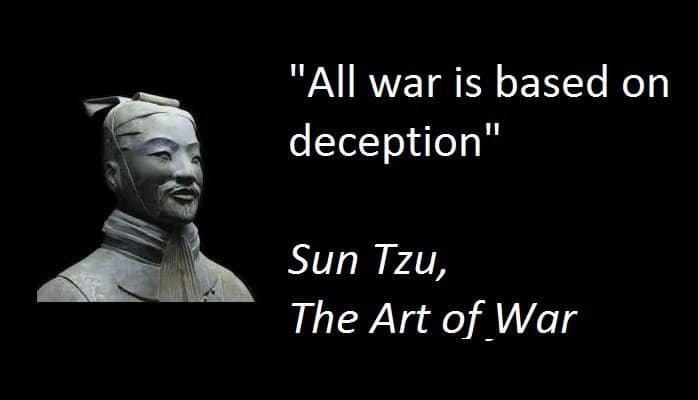
Some may argue that since war is deception then it’s permitted to enter a land with a visa and then renegade on that based on an incorrect understanding of a hadith by Ka’b ibn Malik who reported that when the Prophet ﷺ intended to set out on a military expedition, he would pretend to go somewhere else. The Prophet would say, الْحَرْبُ خُدْعَةٌ “War is deception.”[1]

This misconception shows the importance of understanding the Arabic language and the principles of Islamic jurisprudence (usul al-fiqh) before issuing Islamic edicts. We cannot read a hadith in English and apply the meaning of the word ‘deception’ in English and extract a ruling. There is a clear difference between deception (خُدْعَة) and treachery (خِيانَة) in Islam and even in the English language.

Deception (خُدْعَة) in war is related to battle tactics and all militaries since wars began have used deceptive tactics against each other. During WWII Britain hatched an ingenious plan to deceive the Germans called Operation Mincemeat which used a corpse and false papers to disguise the 1943 Allied invasion of Sicily.

Treachery (خِيانَة) on the other hand in war or at any time is not permitted in Islam.

The hadith “War is deception.”[2] forms part of the laws of war (ahkam al-jihad) so is not applicable to those who reside in a country as citizens or as a musta’min (visa holder and resident), even if that country is perpetuating or supporting horrific crimes against Muslims. Taking up arms against a country and its people that has provided an Aman (security covenant) is treason, and the antithesis of the Islamic sharia related to good conduct.

Al-Nawawi says,

الْعُلَمَاءُ عَلَى جَوَازِ خِدَاعِ الْكُفَّارِ فِي الْحَرْبِ وَكَيْفَ أَمْكَنَ الْخِدَاعُ إِلَّا أَنْ يَكُونَ فِيهِ نَقْضُ عَهْدٍ أَوْ أَمَانٍ فَلَا يَحِلُّ

The scholars have agreed upon the permissibility of deceiving the disbelievers during war when or however the deception is possible to accomplish, unless it relates to the breaching of an ‘Ahd (covenant) or Aman (security), as that is not Halal.”[3]

Indirect speech (التَّعْرِيضِ) is a form of deception if misapplied, such as selling a defective car or attempting to circumvent visa requirements. Al-Nawawi says in relation to this,

فَفِيهِ دَلِيلٌ عَلَى جَوَازِ التَّعْرِيضِ وَهُوَ أَنْ يَأْتِيَ بِكَلَامٍ بَاطِنُهُ صَحِيحٌ وَيَفْهَمُ مِنْهُ الْمُخَاطَبُ غَيْرَ ذَلِكَ فَهَذَا جَائِزٌ فِي الْحَرْبِ وَغَيْرِهَا مالم يَمْنَعْ بِهِ حَقًّا شَرْ

“This provides evidence for the permissibility of indirect speech, which is when one utters words whose underlying meaning is correct, but the listener understands something else from them. This is permissible in war and other situations, as long as it does not prevent the fulfillment of a legitimate right.”[4]

Muhammad Al-Yaqoubi says, “Deception and treachery are not permissible for Muslims who live in Western countries, such as the U.S. or Canada, or in the Far East in China or Japan, or anywhere else in the world, such as Brazil, Scandinavia, or Australia. It is impermissible for them to go against their contract. They must respect the law of the lands in which they live, as was the case of the Companions of the Prophet ﷺ when they migrated from Mecca to Abyssinia and lived many years under the shade of a just Christian king. They found security with him despite the fact that his people were Christians who opposed their faith.”[5]

Salafi Manhaj says, “There is a big difference in the Divine Legislation between breaking an agreement (treachery) and deception. The first is prohibited according to consensus and as for the second (i.e. deception) it is permitted during warfare by consensus. Deception is not

breaking an agreement rather it is putting something forward and not doing or implementing it, deceiving the combatants. So whoever equalized the two has equalized between what the Divine Legislation has separated and making an analogy (qiyas) between the two is corrupt due to it being an error in its very basis and due to it opposing the Divine Legislation from another aspect, the Qur’anic verses and multiple narrated Prophetic hadeeth about fulfilling trusts.”[6]

What about the incident of Ka’b Ibn Al-Ashraf?

Ka’b Ibn Al-Ashraf, was a member of the Jewish tribe Banu Nadir in Medina and used to incite the Meccans against the Prophet ﷺ so the Prophet ordered him to be killed for treason. Some Jihadi-Salafis say the Prophet’s companions provided Ka’b with a false Aman in order to gain his trust, and then used it to lure him out of his house at night and kill him.

Yasir Qadhi answers this point where it is clear that Ka’b had already broken the treaty of Medina (Sahifa).

“This event is often cited as being controversial, as some criticise it as an extrajudicial assassination. In reality, Kaʿb’s secret alliance and plot against the Prophet was clear grounds for capital punishment, as it was a threat of treason. Moreover, Kaʿb was consistent in inciting hatred towards Allah and His Messenger, going as far as sexually enticing the men of Medina towards the female Companions. The Banū Naḍīr had already violated the Treaty of Medina in the Battle of Sawīq by assisting Abū Sufyān. It is not clear whether Kaʿb physically participated, though it is possible, considering their secret alliance shortly after.

This event is described as extrajudicial because Kaʿb was assassinated without proper proceedings. This requires a broader commentary of the political norms of 7 century Arabia and the danger of imposing contemporary norms onto a society which holds inherently different legal mechanisms and societal understandings. The Prophet’s leadership was religious, political, and legal; therefore, his order was inherently judicial. The Prophet did not order such attacks in Mecca, but in Medina, he was the ruler with executive power, and thus his commands were given with legal authority. Kaʿb’s own wife stated, “You are a man at war”, even though he was not in a physical battle, because it was understood as per the norm of the time that his engagements were of a hostile nature.”[7]

Notes


[1] Sunan Abi Dawud 2637, https://sunnah.com/abudawud:2637

[2] Sunan Abi Dawud 2637, https://sunnah.com/abudawud:2637

[3] An-Nawawi, Sharh of Saheeh Muslim: 7/320, https://shamela.ws/book/1711/2613

[4] An-Nawawi, Sharh of Saheeh Muslim, https://shamela.ws/book/1711/2727#p1

[5] Muhammad Al-Yaqoubi, ‘Refuting ISIS: A Rebuttal Of Its Religious And Ideological Foundations Paperback,’ Sacred Knowledge, 2015, p.31

[6] Salafi Manhaj, ‘The clear proofs for refuting the doubts of the people of takfeer and bombing,’ p.57

[7] Yasir Qadhi, ‘The Sirah of the Prophet ﷺ,’ The Islamic Foundation, 2023, The Killing of Kaʿb ibn al-Ashraf

War and Peace in Islam: Treachery is not jihad

Continuing our series on war and peace in Islam, Islam categorically forbids treachery whether in peace or war. The Caliphate is not a treacherous state despite the attempts to malign Islamic history and the Islamic religion itself by the criminal acts of a tiny proportion of Muslims who contradicted the clear-cut rules of law in Islam.

  1. What are Treason and Treachery?
    1. Al-Ghadrah
    2. Al-Khiyanah
    3. English Law
    4. Crime
  2. Allah orders Muslims to fulfil their covenants
  3. The Battle of Badr – Not allowing two Muslim soldiers to fight
  4. The Treaty of Hudaibiyah – Refusing asylum to a believer
  5. Expedition to Khaybar – The Black Shepherd
  6. The illegal occupation of Samarkand
  7. Notes

The Islamic civilisation flourished for over 1300 years with the caliphate and Islamic governance playing a pivotal role in this. This civilisation could not have remained in power for such a long period of time if it was known for treachery, injustice and tyranny. If the Islamic state had conducted itself in the same way as the hated western colonial powers, then its peoples would have rebelled en mass against Islamic rule which never occurred. In fact, all the internal rebellions against the caliphal governments ended up implementing the exact same system albeit with a different ruling family. This is because the rebellion was about “who” should rule, not “what” should be implemented.

Islamic Spain is a stark example of this. Although it formally split from the Abbasid Caliphate in the mid-eighth century, it ruled by Islam, and the Islamic civilisation flourished producing some of the greatest scholars in history. Hugh Kennedy describes this, “Its rulers and administrators were always keenly aware that their land was part of a wider Muslim commonwealth and it was to this commonwealth, rather than to their northern neighbours[1], that they looked for contacts and political ideas.”[2]

International trade and the silk road would have ended if Muslim traders had the reputation of being dishonest and treacherous. In fact, the opposite occurred and these traders built outposts and mosques where they conducted their trade. This then led to the expansion of Islam within those societies. The largest Muslim population in the world today is in Indonesia which converted to Islam over the centuries primarily due to interactions with Arab Muslim traders.

What are Treason and Treachery?

In Arabic there are two words for treason and treachery: الغَدْرة (Al-Ghadrah) and الخِيانَة (Al-Khiyanah). Both are found in the Qur’an and Sunnah, and have similar meanings.

Al-Ghadrah

The root of الغَدْرة (Al-Ghadrah) is غدر which means water that remains behind i.e. a pool or pond (الغَدِير). “The core meaning is a fluid or loose residue from the source or origin that extends, i.e., remains: like those water pools and ponds.”[3] The reason one of its meanings is treachery is because “breaking the covenant (العَهْد) is nothing but abandonment and lack of adherence, as if it were falling behind in keeping up, and in it is also the laxity of negligence and lack of firmness – which is the truthfulness of the promise or oath, or the right of companionship.”[4]

Allah (Most High) says,

وَيَوْمَ نُسَيِّرُ ٱلْجِبَالَ وَتَرَى ٱلْأَرْضَ بَارِزَةًۭ وَحَشَرْنَـٰهُمْ فَلَمْ نُغَادِرْ مِنْهُمْ أَحَدًۭا

˹Beware of˺ the Day We will blow the mountains away, and you will see the earth laid bare. And We will gather all ˹humankind˺, leaving none behind (نُغَادِرْ).[5]

The Messenger of Allah ﷺ said,

إِنَّ الْغَادِرَ يُنْصَبُ لَهُ لِوَاءٌ يَوْمَ الْقِيَامَةِ، فَيُقَالُ هَذِهِ غَدْرَةُ فُلاَنِ بْنِ فُلاَنٍ

“Indeed, a flag (liwaa’) will be raised for the traitor (الْغَادِرَ) on the Day of Resurrection, and it will be said: This is the treachery (غَدْرَةُ) of so-and-so, son of so-and-so.”[6]

Al-Khiyanah

The root of الخِيانَة (Al-Khiyanah) is خون which means weakness and deficiency. Even in English it is said, his legs betrayed him and he was unable to walk. “The core meaning is a serious deficiency—whether subtle or subtle—in something internal or in a possession: such as the loss of sharpness of vision, strength in the legs or ropes, the loss of meat and fat from a camel, or the theft of money… Its meaning includes betrayal of covenants (العُهُود) and pacts (المَواثِيق), for failure to fulfil is a deficiency, just as completing the measure is fulfilment.”[7]

Allah (Most High) says,

وَلَا تُجَـٰدِلْ عَنِ ٱلَّذِينَ يَخْتَانُونَ أَنفُسَهُمْ ۚ إِنَّ ٱللَّهَ لَا يُحِبُّ مَن كَانَ خَوَّانًا أَثِيمًۭا

Do not argue for those who betray their own souls: Allah does not love anyone given to treachery (خَوَّانًا) and sin.[8]

The Messenger of Allah ﷺ used to make the following du’a:

اللَّهُمَّ إِنِّي أَعُوذُ بِكَ مِنَ الْجُوعِ فَإِنَّهُ بِئْسَ الضَّجِيعُ وَأَعُوذُ بِكَ مِنَ الْخِيَانَةِ فَإِنَّهَا بِئْسَتِ الْبِطَانَةُ

“O Allah, I seek refuge in Thee from hunger, for it is an evil bed-fellow; and I seek refuge in Thee from treachery (الخِيانَة), for it is an evil hidden trait.”[9]

Treachery is a major sin in Islam, and it is not tolerated from anyone residing in an Islamic state, Muslim country, non-Muslim country or even on the battlefield with an enemy in an active war (فِعْلاً).

English Law

In English law, “Treason was redefined by the Treason Act 1795 and the principal forms now include:

(1) compassing the death or serious injury of the sovereign or his (or her) spouse or eldest son;

(2) levying war against the sovereign in his (or her) realm, which includes any insurrection against the authority of the sovereign or of the government that goes beyond *riot or *violent disorder;

(3) giving aid or comfort to the sovereign’s enemies in wartime. The penalty for treason (fixed by law) was formerly death but is now life imprisonment.”[10]

Treachery in English law means, “Conduct that assists an enemy. This was defined under the Treachery Act 1940 as an offence relating to World War II, which was punishable by death. There is now, however, no specific crime of treachery: acts of this sort are usually dealt with under the Official Secrets Acts or, in some cases, as treason.”[11]

Due to the widening of the definition of terrorism to a point where even wearing a sticker[12] or saying remaining silent[13] makes you a terrorist, then there is a strong argument for dealing with first degree terrorism as treason. This is how an Islamic State would categorise such vile acts.

Crime

Violating the law of the land and not paying taxes whether in an Islamic state or outside is considered a criminal act and punished according to that country’s penal code. While crime is a serious matter and major sin in Islam with crimes such as murder and ‘terrorism’ being capital crimes in an Islamic state, they are not considered treason because the criminal is still a citizen of the country. This is why a dhimmi (non-Muslim citizen of an Islamic State) does not violate their dhimmah (covenant) by not paying the Jizyah tax, but would violate it if they took up arms against the state and rebelled.

Muhammad Khayr Haykal discusses this point, “abstaining from the Jizyah or refraining from submitting to the Islamic rule which are legitimate justifications for the Muslims to fight the Ahlu-dh-Dhimmah as was understood from the Averse of Al-Jizyah mentioned earlier, does not lead to the breaching of the ‘Ahd if the abstaining was not accompanied by taking up of arms or rebelling against the authority. This is because the Islamic authority by way of force can compel them to fulfil what their contract of Dhimmah committed them to just as it can compel Muslims by force to abide by what they are have been committed to perform or pay.

However, in the case where the Ahlu-dh-Dhimmah take up arms whilst abstaining from that which they have committed to, then the issue has become the Qitaal (fighting) of the Ahlu-dh-Dhimmah against the Muslims and the Islamic authority. In regards to this the Fuqahaa have agreed that their ‘Ahd is breached in this circumstance and case in which they possess Quwwah (power) and Man’ah (prevention) due to their taking up of arms and their fighting against the Sultah (authority).”[14]

The focus of this series with regards to treachery is war and peace. The issue of crime and criminal acts is dealt with elsewhere on the site.

Allah orders Muslims to fulfil their covenants

Allah (Most High) orders Muslims to fulfil their contracts and covenants,

يَـٰٓأَيُّهَا ٱلَّذِينَ ءَامَنُوٓا۟ أَوْفُوا۟ بِٱلْعُقُودِ

“O believers! Honour your covenants.”[15]

The definite article (alif-lam) on the word العُقُود (covenants) is mutlaq (unrestricted) which means it includes all types of contracts and covenants, such as citizenship and residency, employment and business and so on.

Al-Alusi comments on this verse, “Some commentators (mufasireen) have chosen to interpret this verse as encompassing all that Allah Almighty has obligated His slaves to do, including religious duties and rulings, and the contracts of trusts, transactions, and the like that they enter into among themselves, which must be fulfilled or are considered religiously good. The command is understood as an unrestricted (Mutlaq) request, whether recommended or obligatory, and it includes avoiding forbidden and disliked things. This is because [the command] is more in line with the generality of the expression, since it [العُقُود] is a plural noun with the definite article (alif-lam), and more complete in terms of the generality of the benefit.” [16]

The Prophet ﷺ said:

مَنْ قَتَلَ مُعَاهَدًا لَمْ يَرَحْ رَائِحَةَ الْجَنَّةِ، وَإِنَّ رِيحَهَا تُوجَدُ مِنْ مَسِيرَةِ أَرْبَعِينَ عَامًا

“Whoever kills a person with whom a covenant has been made (mu’ahid) will not smell the fragrance of Paradise, even though its fragrance can be found from a distance of forty years’ journey.”[17]

Al-Hafiz Ibn Hajar (d.1449) comments on the above hadith:

والمراد به من له عهد مع المسلمين سواء كان بعقد جزية أو هدنة من سلطان أو أمان من مسلم

“This refers to someone who has a covenant (‘ahd) with the Muslims, whether it be through a jizya contract, legal protection (dhimma) from a sultan, or a guarantee of safety (aman) from a Muslim.”[18]

The Prophet ﷺ said:

أَدِّ الأَمَانَةَ إِلَى مَنِ ائْتَمَنَكَ وَلاَ تَخُنْ مَنْ خَانَكَ

“Fulfill your trust (Al-Amanah) to those who entrusted you with it, and do not betray those who betrayed you.”[19]

The Prophet ﷺ also said:

وَالْمُسْلِمُونَ عَلَى شُرُوطِهِمْ إِلاَّ شَرْطًا حَرَّمَ حَلاَلاً أَوْ أَحَلَّ حَرَامًا

“Muslims are bound by their conditions, except for a condition that makes halal what is haram or makes haram what is halal.”[20]

Therefore, compliance with the terms and conditions of any contract including a citizenship contract and residency visa is obedience to Allah.

What follows are some examples from the life of the Prophet Muhammad ﷺ which prove beyond a shadow of a doubt that treason and treachery have no place in the religion of Islam.

The Battle of Badr – Not allowing two Muslim soldiers to fight

Hudhaifa bin al-Yaman said: “Nothing prevented me from being present at the Battle of Badr except this incident. I came out with my father Husail (to participate in the Battle), but we were caught by the disbelievers of Quraish. They said: “Do you intend to go to Muhammad?” We said: “We do not intend to go to him, but we wish to go back to Medina.” So they took from us a covenant in the name of Allah that we would turn back to Medina and would not fight on the side of Muhammad ﷺ. So, we came to the Messenger of Allah ﷺ and related the incident to him. He ﷺ said: “Both, of you proceed (to Medina); we will fulfil the covenant (‘ahd) made with them and seek Allah’s help against them.”[21]

The Muslim army at the Battle of Badr was severely outnumbered by a ratio of 3:1. Loosing two soldiers was a big material loss yet the Prophet ﷺ fulfilled the ‘ahd. It is a well-established maxim in sharia that any masalaha (benefit) not in accordance with the Islamic texts is null and void.

The Treaty of Hudaibiyah – Refusing asylum to a believer

After the signing of the Treaty of Hudaibiyah in 6 Hijri, Abu Basir, who was one of the Muslims imprisoned in Makkah managed to escape and sought refuge in Dar al-Islam (Medina). The treaty between the Islamic State of Medina and the Quraysh in Makkah, “stipulated that anyone [men] from Quraysh who came to Muhammad without the permission of his guardian would be returned to them, and anyone who came to Quraysh from among those with Muhammad would not be returned to him.”[22]

Quraysh sent a man from Banu Amir ibn Lu’ayy, along with his freed slave (mawla) to Medina seeking the return of Abu Basir. When the delegates arrived in Medina, the Prophet ﷺ handed Abu Basir back to them. This is not obedience to the disbelievers, rather this is obedience to Allah, Who orders compliance with ALL contracts and treaties as long as they do not involve sin and disobedience to Him.

The Messenger of Allah ﷺ said to Abu Basir: “O Abu Basir, we have given these people what you know, and treachery (الغَدْر) is not permissible in our religion. Allah will surely grant you and those with you who are oppressed relief and a way out. So go back to your people.” He said, “O Messenger of Allah, will you return me to the polytheists so they may tempt me away from my religion?” He said, “O Abu Basir, go, for Allah Almighty will surely grant you and those with you who are oppressed relief and a way out.”[23]

Obedience to Allah will undoubtedly lead to good outcomes.

On their way back to Makkah, they stopped at Dhu al-Hulayfah and Abu Basir managed to kill one of his captors – the man from Banu Amir ibn Lu’ayy. The other captor – the freed slave escaped back to Medina. “The freed slave quickly went to the Messenger of Allah ﷺ while he was sitting in the mosque. When the Messenger of ﷺ saw him approaching, he said, “This man has seen something terrifying.” When he reached the Messenger of Allah ﷺ, he said, “Woe to you! What is the matter?” He replied, “Your companion has killed my companion.” By Allah, he had not left when Abu Basir appeared, sword drawn, and stood before the Messenger of Allah ﷺ. He said, “O Messenger of Allah, you have fulfilled your treaty (dhimmah), and Allah has rewarded you. You handed me over to the people, and I have protected myself from being tempted by my religion.” The Messenger of Allah ﷺ said: “Woe to his mother! He is a fierce warrior! If only he had men with him!”[24]

Abu Basir then established a ‘state’ along with 70 Muslims who managed to escape Makkah, at al-Ays, near Dhu al-Marwa, on the coastal route which Quraysh used for their caravans to Syria. This was an independent ‘state’ not under the authority of the Prophet’s ﷺ state in Medina, and not bound by the Treaty of Hudaibiyah. In fact, it was forbidden for this ‘state’ to join Medina due to the treaty. Abu Basir’s ‘state’ then began attacking the caravans of Quraysh and seizing their wealth causing huge damage to the Makkan economy. It was then that Quraysh wrote to the Prophet ﷺ pleading with him to take them back to Medina so they were under his authority which he ﷺ did.[25] As with any contract or treaty, they can be renegotiated on terms acceptable to both sides.

Ibn Qudamah al-Hanbali (d.1223CE) comments on this story saying, “It is therefore permitted for the one who had embraced from the disbelievers to isolate themselves in an area and to fight whom they can from the disbelievers, take their wealth (or property) and to not be included within the treaty. Then if the Imam was to join them to him with the permission of the disbelievers, they would then enter under the terms of the treaty and killing the disbelievers and taking their wealth would become Haram upon them.[26]

Something similar occurred when pirates from the North African Barbary States (Algiers, Tripoli, Tunis) began attacking American and European ships in the Mediterranean. After a series of wars America signed a series of treaties with these states to bring the pirates under their control. A ‘Commerce and navigation’ treaty was also signed with the Ottoman Caliphate in 1830 to protect American ships in Ottoman waters.[27]

In 1899 Secretary of State John Hay approached Oscar Straus, the American ambassador to the Ottoman Caliphate to try and convince Abdul-Hamid II to use his religious authority as caliph to discourage Filipino Muslims from joining the rebellion against American rule. Abdul-Hamid II drafted a letter addressed specifically to the Moro Muslims of the Sulu Sultanate, directing them to submit to American authority and abstain from hostilities against U.S. forces which they did.[28]

Expedition to Khaybar – The Black Shepherd

In the year 7 Hijri, after the signing of the Treaty of Hudaibiyah, the Prophet ﷺ was able to finally deal with the treachery and danger of the belligerent tribes based in Khaybar. These tribes had been signatories to the Treaty of Medina (Sahifa) but had reneged on it time and time again.

“After the Prophet secured peace with the Quraysh, he could finally turn his attention inwards once more. A group of the previously expelled Banū Qaynuqāʿ and Banū Naḍīr still posed a constant and immediate threat that the Prophet could not address until now. After their expulsion, they relocated to Khaybar and organised the biggest army Medina ever faced in the Battle of the Trench. The Treaty of Ḥudaybiyyah allowed the Prophet to organise his efforts towards these belligerent tribes.

Immediately after Ḥudaybiyyah, the Prophet launched a pre-emptive attack on Khaybar before they had a chance to organise another attack on Medina. The Muslims marched continuously from Medina to Khaybar and camped overnight out of sight. They marched towards Khaybar after Fajr, catching them completely off-guard. Khaybar was comprised of a number of fortresses even more magnificent and imposing in stature than those of Medina. The vast fortresses were spread across acres of lush farmland. As they approached the first fortress, the inhabitants were leaving with their farming tools, preparing for the day’s work. When they saw the Muslim army, they scrambled back inside the fortress, yelling, “Muhammad and his army have arrived!” Despite launching a surprise attack, their response clearly indicates a level of expectation; a retaliation for their prior aggressions was foreseen.”[29]

There was a black Abyssinian slave who lived in Khaybar caring for sheep belonging to his master. When he saw that the people of Khaybar were taking up their weapons, he asked them, “What are you going to do?” They replied, “We are going to do battle with that man who claims to be a prophet.”

This reference to a prophet had an impact upon him and he took his sheep and approached the Messenger of Allah ﷺ, asking him, “To what do you invite?” He replied, “I invite you to Islam, to hear witness that there is no god but Allah, that I am the Messenger of Allah, and that you will not worship any other than Allah.” The slave then asked, “What will I get if I hear witness to that and believe in Allah?” The Messenger of Allah ﷺ replied, “Paradise, if you die believing that.”

The slave accepted Islam and said, “Prophet of Allah, these sheep I have is my trust (amanah).” The Messenger of Allah ﷺ said, “Drive them out of our camp and throw pebbles at them, for Allah will fulfill your amanah.” He did so, and the sheep returned to their Jewish master, who realized that his slave had accepted Islam. The Messenger of Allah ﷺ then arose and addressed his men.[30]

Even though Khaybar was Dar al-Harb Fi’lan (Land of active war), the Prophet ﷺ still followed the laws of war jus in bello and ordered the Muslims to fulfil their trusts. If the sheep had come to them after they had conquered the town through force, then they would be considered ghanima (war booty).[31] In the end Khaybar surrendered and made a treaty to give 50% of their produce to the Islamic state. The Muslims therefore did gain a huge amount of wealth but through halal means i.e. treaty and not through breaking a trust.

The Messenger of Allah ﷺ clearly outlined the stages of war in a famous hadith narrated by Buraida. “Fight in the name of Allah in the cause of Allah. Fight those who disbelieve in Allah. Fight, but do not commit treason (Ghadrah), do not mutilate, and do not kill a child. And when you meet your enemy from among the polytheists, call them to three courses of action. If they respond, accept them and refrain from attacking them.

1- Invite them to (accept) Islam; if they respond to you, accept it from them and desist from fighting against them. Then invite them to migrate from their lands to the land of the Muhajireen and inform them that, if they do so, they shall have all the privileges and obligations of the Muhajireen.

If they refuse to migrate, tell them that they will have the status of Bedouin (أَعْراب) Muslims and will be subjected to the Commands of Allah like other Muslims, but they will not get any share from the ghanima or Fai’ (spoils without fighting) except when they actually fight with the Muslims (against the disbelievers).

2- If they refuse to accept Islam, demand from them the Jizya. If they agree to pay, accept it from them and hold off your hands.

3- If they refuse to pay the tax, seek Allah’s help and fight them.”[32]

These were followed during the battle of Khaybar with the leaders agreeing to point two i.e. to pay jizya.

The illegal occupation of Samarkand

Qutaybah bin Muslim was the Amir (Campaign Commander) in Central Asia who conquered Samarkand in the year 711-12CE under the Umayyad Caliph Al-Walid.[33] Instead of following the methodology of the Prophet ﷺ outlined above, he simply invaded the city and turned it in to a garrison town.

When Umar bin Abdul-Aziz became the caliph, the people of Samarkand saw an opportunity to gain justice so they met with the Central Asian governor Sulayman Abi as-Sarri and said, “Qutaybah has betrayed and wronged us by seizing our town. Allah has shown us justice and equity, therefore if we are allowed, we would like to send a delegation to the Amir al-Mu’minin to complain of our injustices and if we are within our rights, he will address our needs.”

Sulayman granted their request and a delegation of men represented their case to the Caliph. After speaking with the delegation Umar bin Abdul-Aziz wrote to Sulayman saying, “Indeed, the people of Samarkand have come complaining to me of the injustices inflicted upon them, stating that Qutaybah has unjustifiably stationed his army in the town in their midst and forced them to leave. Therefore, when my letter reaches you, appoint a tribunal to judge and settle the dispute between Qutaybah and the people of Samarkand. If the judgment of the tribunal goes against the army chief and his men are asked to vacate, they must do so at once and the people may return to the way they were before Qutaybah appeared on the scene.”

Sulayman appointed Jumay’a bin Hadir as the Qadi Mazalim over the case. Jumay’a ruled in favour of the people of Samarkand saying, “Sudden attack on them without warning was unlawful,” and the Muslim army had to withdraw. After witnessing this justice, Samarkand and neighbouring Soghd decided against fighting a war with the Muslims and agreed to live side by side with them under Islamic rule. Their influential scholars said, “We have mixed and lived side by side with those people. They are peaceful with us and we are with them. Should you decide that we are to return to war, it would be futile and we do not know whom the victory will belong to. We would only be bringing hostility upon ourselves.”[34]

The Islamic State is not a utopia, and there is no doubt that incidents will occur in an Islamic society which are not in accordance with sharia law. This has been true throughout Islamic history, starting with the first Islamic state established and ruled by the Prophet Muhammad ﷺ.

What is important is to have effective state mechanisms in place to deal with any grievances (Al-Maẓālim المَظالِم) that may occur, and provide adequate redress and compensation to the victims, so they feel they have received justice.

Notes


[1] Christian Kingdoms

[2] Hugh Kennedy, ‘Muslim Spain and Portugal: A Political History of Al-Andalus,’ Routledge, 2014, xiv

[3] Muhammad Hassan Hassan Jabal, ‘The etymological dictionary of the words of the Holy Qur’an,’ https://tafsir.app/ishtiqaqi/%D8%BA%D8%AF%D8%B1

[4] Ibid

[5] Holy Qur’an, Surah Al-Kahf, ayah 47

[6] Sahih al-Bukhari 6178, https://sunnah.com/bukhari:6178

[7] Muhammad Hassan Hassan Jabal, ‘The etymological dictionary of the words of the Holy Qur’an,’ https://tafsir.app/ishtiqaqi/%D8%AE%D9%88%D9%86

[8] Holy Qur’an, Surah Al-Nisaa’, ayah 107

[9] Sunan Abi Dawud 1547, https://sunnah.com/abudawud:1547

[10] Jonathan Law, ‘A Dictionary of Law (Oxford Quick Reference),’ 10th edition, 2022

[11] Ibid

[12] https://www.bbc.co.uk/news/uk-england-london-68286945

[13] Under Schedule 7 of the Terrorism Act 2000, individuals stopped at UK borders have no right to remain silent. You are legally required to answer questions, produce documents, and provide passwords for electronic devices. Refusal to comply is a criminal offence, punishable by up to three months in prison or a fine. 

[14] Dr. Muhammad Khayr Haykal, ‘Al-Jihad wa’l Qital fi as-Siyasa ash-Shar’iyya’

[15] Holy Qur’an, Surah Al-Ma’ida, verse 1

[16] Al-Alusi, Ruh Al-Ma’ani, https://tafsir.app/alaloosi/5/1 Note, this is paraphrased not an exact translation.

[17] Ṣaḥīḥ al-Bukhārī 3166, https://sunnah.com/bukhari:3166

[18] Fath al-Bari 12/259, https://shamela.ws/book/1673/7246

[19] Sunan Abi Dawud 3534, https://sunnah.com/abudawud:3534

[20] Jami’ at-Tirmidhi 1352, https://sunnah.com/tirmidhi:1352

[21] Sahih Muslim 1787, https://sunnah.com/muslim/32/121

[22] Ibn Hisham, https://shamela.ws/book/23833/1054

[23] Ibn Hisham, https://shamela.ws/book/23833/1060

[24] Ibn Hisham, https://shamela.ws/book/23833/1061#p1

[25] Ibid

[26] Ibn Qudamah, Al-Mughni, 10/525, https://shamela.ws/book/8463/4215

[27] https://archive.org/details/ldpd_11015515_000

[28] https://www.turkiyetoday.com/culture/when-ottoman-empire-helped-us-avoid-religious-conflict-in-philippines-3205061

[29] Yasir Qadhi, ‘The Sirah of the Prophet ﷺ,’ The Islamic Foundation, 2023, The Battle of Khaybar

[30] Ibn Kathir, Al-Bidiyah wa Al-Nihiyah, https://shamela.ws/book/23708/1229#p1

[31] https://ar.wikipedia.org/wiki/%D8%BA%D9%86%D9%8A%D9%85%D8%A9_(%D8%A5%D8%B3%D9%84%D8%A7%D9%85)

[32] Sahih Muslim 1731a, b, https://sunnah.com/muslim:1731a

[33] Al-Tabari, ‘The History of Al-Tabari’, State University of New York Press, Volume 24, p.94

[34] Dr. Ali Muhammad As-Sallabi, ‘Umar bin Abd al-Aziz,’ Darussalam, p.149

War and Peace in Islam: Martyrdom

Continuing our series on war and peace in Islam, the seeking of shahada (martyrdom) is something all Muslims would love to achieve due to the high status and honour given to the shaheed in the next life. However, martyrdom has conditions in order to be accepted. Attempting to gain martyrdom through disobeying Allah such as by treachery, would negate the honour of receiving the shahada.

  1. No martyrdom without correct intention and action
  2. The first to be judged on the Day of Resurrection
  3. Disobeying the commander at Khaybar
  4. The man who stole from the state funds (war booty)
  5. Notes

The Prophet Muhammad ﷺ said,

إِنَّمَا الْأَعْمَالُ بِالنِّيَّاتِ

“Verily, actions are only [accepted] by intentions.”[1]

“This is one of the most comprehensive hadith of the Prophet ﷺ. It touches upon almost every deed of Islam…Imam AbuDawood stated that this hadith is one-half of Islam; that is, Islam compriseswhat is apparent, the deeds of Islam, as well as what is not apparent, theintention behind the deeds.

Al-Shafi’i also said that it encompasses half ofknowledge, meaning that the religion concerns both what is external and whatis internal. The deeds are the external aspect and the intention behind them isthe internal aspect.”[2]

Rumi (d.1273CE) narrates a famous story of Ali ibn Abi Talib where he stopped fighting an enemy soldier because he wanted to purify his niyyah (intention), in order to ensure he was fighting for the right reasons and not out of revenge. “Ali, the “Lion of Allah,” was once engaged in conflict with a Magian chief, and in the midst of the struggle the Magian spat in his face. ‘Ali, instead of taking vengeance on him, at once dropped his sword, to the Magian’s great astonishment. On his inquiring the reason of such forbearance, ‘Ali informed him that the “Lion of Allah” did not destroy life for the satisfaction of his own vengeance, but simply to carry out Allah’s will, and that whenever he saw just cause, he held his hand even in the midst of the strife, and spared the foe.”[3]

The intention behind any action is hidden in someone’s heart (mind) and so may not be obvious even to the person performing the action. This is why constant vigilance and self-accountability is required especially when it comes to mu’amilat (dealings with people) to ensure someone doesn’t act upon hate and revenge leading to injustice. We need to be careful that grievances and life’s test such as losing a job, home, relative, failed marriage, illness etc which are all part of the dunya (worldly life) and affect believers and disbelievers alike, do not become a catalyst for undertaking un-Islamic and ultimately treasonous acts.

Allah (Most High) clearly says,

وَلَا يَجْرِمَنَّكُمْ شَنَـَٔانُ قَوْمٍ عَلَىٰٓ أَلَّا تَعْدِلُوا۟

Do not let the hatred of a people lead you to injustice.[4]

He also says,

وَإِذَا حَكَمْتُم بَيْنَ ٱلنَّاسِ أَن تَحْكُمُوا۟ بِٱلْعَدْلِ

And when you judge between people, judge with justice.[5]

Ibn Ashur (d.1973) comments on this verse, “Some laws were established out of anger and selfishness, and thus contained egregious errors, such as the laws imposed by revolutionaries in anger against those who had ruled before them, and some laws stemmed from fantasies and illusions, like the laws of the pre-Islamic era and nations deeply rooted in paganism.

We find that the laws enacted by wise men are more effective in achieving the benefits of justice, such as the laws of Athens and Sparta. The highest laws are the divine laws because they are suitable for the circumstances of those for whom they were legislated. The greatest of these is the Islamic law (sharia) because it is based on pure or preponderant interests, and it disregards the whims of nations and misguided customs, for it does not concern itself with selfishness and desires, nor with corrupt customs. It is not built on the interests of a particular tribe or country, but rather on the interests of humankind, its improvement, and its guidance to the right path.”[6]

The endless wars in pre-Islamic Arabia over the most trivial of matters, are examples of what happens when hate becomes deeply embedded in a society. In modern times Nazi Germany, the holocaust, ethnic cleansing in Bosnia, and the genocide in Gaza are all examples of pathological hate which ends in the deaths of millions.

No martyrdom without correct intention and action

There is no doubt that the martyr (shaheed) in Islam is one of the highest statuses in the next life. The reward of a shaheed is immense and seeking martyrdom is what drove the Islamic armies to achieve incredible almost miraculous victories. How do you fight an army that loves death more than the enemy loves life?!

The Messenger of Allah ﷺ said:

لِلشَّهِيدِ عِنْدَ اللَّهِ سِتُّ خِصَالٍ يُغْفَرُ لَهُ فِي أَوَّلِ دَفْعَةٍ وَيَرَى مَقْعَدَهُ مِنَ الْجَنَّةِ وَيُجَارُ مِنْ عَذَابِ الْقَبْرِ وَيَأْمَنُ مِنَ الْفَزَعِ الأَكْبَرِ وَيُوضَعُ عَلَى رَأْسِهِ تَاجُ الْوَقَارِ الْيَاقُوتَةُ مِنْهَا خَيْرٌ مِنَ الدُّنْيَا وَمَا فِيهَا وَيُزَوَّجُ اثْنَتَيْنِ وَسَبْعِينَ زَوْجَةً مِنَ الْحُورِ الْعِينِ وَيُشَفَّعُ فِي سَبْعِينَ مِنْ أَقَارِبِهِ

“The shaheed has six privileges with Allah: he is forgiven with the first flow of blood, he sees his place in Paradise, he is protected from the torment of the grave, he is safe from the Great Terror, a crown of dignity is placed on his head, a single ruby ​​of which is better than the world and all that is in it, he is married to seventy-two wives from among the houris, and he intercedes for seventy of his relatives.”[7]

Martyrdom (shahada) is a very seductive goal and is marketed by takfiri groups as a shortcut to jannah (paradise). Who wouldn’t want to press a button and end up in eternal bliss?! There are conditions however, which must be met for someone to receive the honour and reward of martyrdom. Intention (niyyah) plays a pivotal role here. If someone believes shahada is a way out of life’s problem by undertaking “suicide by cop” through treacherous actions, then they are sadly mistaken as the next three hadith highlight. Of course, a soldier dying in a legitimate war, abiding by the regulations of the sharia will achieve the high status of shahada by the permission of Allah, but the discussion here is addressing the issue of treason and treachery of those who believe they are undertaking lawful acts.

The first to be judged on the Day of Resurrection

The Prophet Muhammad ﷺ said,

إِنَّ أَوَّلَ النَّاسِ يُقْضَى يَوْمَ الْقِيَامَةِ عَلَيْهِ رَجُلٌ اسْتُشْهِدَ فَأُتِيَ بِهِ فَعَرَّفَهُ نِعَمَهُ فَعَرَفَهَا قَالَ فَمَا عَمِلْتَ فِيهَا قَالَ قَاتَلْتُ فِيكَ حَتَّى اسْتُشْهِدْتُ ‏.‏ قَالَ كَذَبْتَ وَلَكِنَّكَ قَاتَلْتَ لأَنْ يُقَالَ جَرِيءٌ ‏.‏ فَقَدْ قِيلَ ‏.‏ ثُمَّ أُمِرَ بِهِ فَسُحِبَ عَلَى وَجْهِهِ حَتَّى أُلْقِيَ فِي النَّارِ

“The first person to be judged on the Day of Resurrection will be a man who was martyred. He will be brought forth, and Allah will remind him of His favors, and he will acknowledge them. Allah will say, “What did you do with them?” He will reply, “I fought for Your sake until I was martyred.” Allah will say, “You have lied. You fought so that it would be said, ‘He is brave.’ And it has been said.” Then he will be ordered to be dragged on his face until he is thrown into the Fire.”[8]

Disobeying the commander at Khaybar

The Prophet ﷺ during the military expedition to Khaybar, forbade fighting on a particular day and said:

لَا تَحِلُّ الْجَنَّةُ لِعَاصٍ

“Jannah (paradise) is not halal for the one who disobeys.”[9]

In relation to this hadith, the following was stated in ‘As-Siyar Al-Kabeer’: “He ﷺ commanded that it [this command] be proclaimed on the day of Khaybar when he forbade them from fighting, and it was said to him ﷺ: “So-and-so has been martyred.” So he ﷺ said: “Did I not forbid fighting after that?” They said: “Yes.” So he said:

لَا تَحِلُّ الْجَنَّةُ لِعَاصٍ

“Jannah is not halal for the one who disobeys.”[10]

So, despite the rank of martyrdom, he said what he said about him to clarify that disobedience in matters where the error of the Amir is not certain, is not permissible under any circumstances.”[11]

The context of this discussion is obedience to the army commander in carrying out his orders even if the soldier disagrees with them. This is unless a clear-cut violation of the sharia rules has been ordered such as torture, rape and deliberate targeting of civilians.

The man who stole from the state funds (war booty)

It is narrated that Abu Hurayrah said: “We were with the Messenger of Allah in the year of Khaibar, and we did not get any spoils of war (ghaneema) except for wealth, goods and clothes. Then a man from Banu Ad-Dubaib, who was called Rifa’ah bin Zaid, gave the Messenger of Allah a black slave who was called Mid’am. The Messenger of Allah set out for Wadi Al-Qura. When we were in Wadi Al-Qura, while Mid’am was unloading the luggage of the Messenger of Allah, an arrow came and killed him. The people said: “Congratulations! You will go to Paradise,” but the Messenger of Allah ﷺ said: “No, by the One in Whose hand is my soul! The cloak that he took from the spoils of war on the Day of Khaibar is burning him with fire.” When the people heard that, a man brought one or two shoelaces to the Messenger of Allah and the Messenger of Allah ﷺ said: “One or two shoelaces of fire.”[12]

We can extrapolate from all of these incidents that attempting to gain martyrdom through disobeying Allah such as by treachery, would negate the honour of receiving the shahada.

Notes


[1] Muttafaqun Alayhi (authenticity agreed upon). Sahih Muslim 1907a, https://sunnah.com/muslim:1907a ; Sahih al-Bukhari 6953, https://sunnah.com/bukhari:6953

[2] Jamaal al-Din M. Zarabozo, ‘Commentary on the Forty Hadith of al-Nawawi,’ Vol.1, p.98

[3] Masnavi i Ma’navi, Teachings of Rumi The Spiritual Couplets of Maulana Jalalu-’d-din Muhammad i Rumi Translated and abridged by E.H. Whinfield, M.A. Omphaloskepsis, 2001, Story XVI, p.83

[4] Holy Qur’an, Surah Al-Ma’ida, ayat 7-8

[5] Holy Qur’an, Surah Al-Nisaa’, verse 58

[6] Ibn Ashur, Tahrir wa Tanwir, https://tafsir.app/ibn-aashoor/4/58

[7] Jami’ at-Tirmidhi 1663, https://sunnah.com/tirmidhi:1663

[8] Sahih Muslim 1905a, https://sunnah.com/muslim:1905a

[9] Al-Hakim, Al-Mustadrak, https://www.islamweb.net/ar/library/content/74/2526/%D8%A5%D9%86-%D8%A7%D9%84%D8%AC%D9%86%D8%A9-%D9%84%D8%A7-%D8%AA%D8%AD%D9%84-%D9%84%D8%B9%D8%A7%D8%B5

[10] Al-Hakim, Al-Mustadrak, https://www.islamweb.net/ar/library/content/74/2526/%D8%A5%D9%86-%D8%A7%D9%84%D8%AC%D9%86%D8%A9-%D9%84%D8%A7-%D8%AA%D8%AD%D9%84-%D9%84%D8%B9%D8%A7%D8%B5

[11] Sharh As-Siyar Al-Kabeer: 1/63-64. https://shamela.ws/book/5434/63

[12] Sunan an-Nasa’i 3827, https://sunnah.com/nasai:3827

War and Peace in Islam: Issuing Islamic edicts (fatawa)

Continuing our series on war and peace in Islam, the justifications Jihadi-Salafi groups give for their attacks that breach well-established Islamic rules on covenants and treaties are based on their issuing of erroneous Islamic edicts (fatawa).

  1. Issuing fatawa is only for qualified scholars
  2. Misunderstanding the reality causes erroneous fatawa
    1. Citizenship and residency visas are valid Islamic Contracts
    2. Analogy of a historical reality with a new reality
  3. No one should blindly follow any fatwa
  4. Severity of sinning by oppressing the people
  5. Notes

Issuing fatawa is only for qualified scholars

Ijtihad (اِجْتِهاد) is derived from the root word Jahada (جهد). Linguistically, it means striving or self-exertion in any activity, which entails a measure of hardship. The great scholars of Usul such as Abu al-Husayn Ali otherwise known as Al-Amidi (d.631 AH) and Mohammad bin Ali Al-Shawkani (d.1255 AH) defined it as, “the total expenditure of effort made by a jurist in order to infer, with a degree of probability, the rules of Shariah from their detailed evidence in the sources.”[1]

Extracting Islamic edicts (fatawa) from the Qur’an and Sunnah via ijtihad is only for those who are qualified. If someone is seriously ill, they will go to a doctor to diagnose their illness and prescribe medicine. If they went to an unqualified person, then they may end up losing their life due to being misdiagnosed and prescribed the wrong medicine. The Messenger of Allah ﷺ said,

مَنْ تَطَبَّبَ وَلَمْ يُعْلَمْ مِنْهُ طِبٌّ قَبْلَ ذَلِكَ فَهُوَ ضَامِنٌ

Whoever practices medicine without any prior knowledge of medicine will be held liable.[2]

This is similar to issuing fatawa. If an unqualified person issues an erroneous fatwa related to social interactions (mu’amilat) such as family, politics and war then it can lead to disastrous consequences for society. The death and destruction left in the wake of the attacks by Jihadi-Salafi groups like ISIS and Al-Qaeda is a stark example of this.

The Prophet ﷺ severely rebuked some of the sahaba who gave an incorrect fatwa which led to someone’s death. Jabir narrated that “We went out on a journey, and a stone struck one of our men, injuring his head. Then he had a wet dream and asked his companions, ‘Do you find any dispensation (rukhsa) for me to perform tayammum?’[3] They said, ‘We do not find any dispensation for you, as you have access to water.’ He performed ghusl (bath) and died. When we came to the Prophet ﷺ he was informed of this and he said, ‘They killed him, may Allah kill them! Why did they not ask when they did not know? For the cure for ignorance is asking. It would have been sufficient for him to perform tayammum and squeeze out a bandage (or to bandage. Musa was uncertain) He should have placed a cloth over his wound, then wiped over it and washed the rest of his body.’[4]

This is why the Prophet ﷺ said,

أَجرَؤكم على الفُتْيا أجْرؤُكم على النَّارِ

“Your taking of a risk with issuing Fatawa is like taking a risk with the hellfire.”[5]

Marc Sageman says, “People assume that the jihadis are well educated in religion. That is not the case. A few religious scholars exist in their midst, but theirs is a very untraditional interpretation of the scriptures. The majority of terrorists come to their religious beliefs through self-instruction. Their religious understanding is limited; they know about as much as any secular person, which is to say, very little. Often, they have not started reading the Quran seriously until they are in prison, because then it is provided to them and they have lots of time to read it.”[6]

Muhammad Al-Yaqoubi says, “Saudi Arabia strictly follows the Hanbali school, so its Salafism is limited to theology while recognizing the other three schools of law. ISIS, on the other hand, rebels against all of the schools of Islamic law, and against most Salafi interpretations, while adhering to Ibn Taymiyya in his theological views. This lack of an authority in legislation, coupled with the absence of a major reference or manual of law in the hands of ISIS’ judges and Shariah personnel, has led almost every fighter placed in charge of a situation to present a contrived legal ruling based on his own understanding of the Quran and Tradition, most often selecting the quotes which seemingly validate their vengeful ill will. The brutality, savagery, and barbarity we have witnessed from this group is a testimony to the inherent danger of giving ignorant fanatics the authority to do the job of the great independent legal authorities (mujtahids), a status which even great figures such as al-Ghazali and al-Nawawi could not claim.”[7]

Misunderstanding the reality causes erroneous fatawa

Misunderstanding the reality (manat) of an issue is the main area where most of these Jihadi-Salafi fatawa break down.

Citizenship and residency visas are valid Islamic Contracts

Citizenship and residency visas are the modern equivalents of the classical sharia concept of Al-Amān (الأَمان) which are security covenants. Fulfilling security covenants is a well-established rule, that was codified by the imams of the classical schools of thought and applied throughout Islamic history. In the Qur’an, Allah (Most High) orders Muslims to fulfil their contracts and covenants:

يَـٰٓأَيُّهَا ٱلَّذِينَ ءَامَنُوٓا۟ أَوْفُوا۟ بِٱلْعُقُودِ

“O believers! Honour your covenants.”[8]

The definite article (alif-lam) on the word العُقُود (covenants) is mutlaq (unrestricted) which means it includes all types of contracts and covenants, such as citizenship and residency, employment and business and so on.

Some of those born into citizenship as opposed to naturalised citizens, or those on residency visas may say “I didn’t sign or say any pledge!” Compliance with the pledge for those born in the country is known through custom (‘urf), so in reality both types of citizens are bound by the pledge and oath. This is based on the well-known sharia maxim:

المعروف عرفا كالمشروط شرطا

What is known by custom (‘urf) is like what is stipulated by a condition (shart).[9]

Muhammad Hassan Abdul Ghaffar, explains the meaning of this maxim. “If a prevailing custom is agreed upon by people regarding something, it is considered in Islamic law (sharia) as a condition (shart). It is mentioned in some traditions that Muslims are bound by their conditions. These conditions are qualified by the Prophet’s ﷺ saying: إِلاَّ شَرْطًا حَرَّمَ حَلاَلاً أَوْ أَحَلَّ حَرَامًا “Except for a condition that makes halal what is haram or makes haram what is halal.”[10] This is because the Prophet ﷺ said, every condition that is not in the Book of Allah is invalid, even if there are a hundred such conditions.[11] He ﷺ said,

 مَنِ اشْتَرَطَ شَرْطًا لَيْسَ فِي كِتَابِ اللَّهِ فَلَيْسَ لَهُ، وَإِنِ اشْتَرَطَ مِائَةَ شَرْطٍ

“Whoever stipulates a condition that is not in the Book of Allah, it is not valid for him, even if he stipulates a hundred conditions.”[12]

“Therefore, if people agree upon something or if it is a custom among them, it is considered a condition, and this condition must be fulfilled.”[13]

Imam Al-Shafi’i (d.820CE) said in Al-Umm:

فإن أمنوه أو بعضهم وأدخلوه في بلادهم بمعروف عندهم في أمانهم إياه وهم قادرون عليه فإنه يلزمه لهم أن يكونوا منه آمنين وإن لم يقل ذلك

“If they [disbelievers] grant him or some of them security and admit him into their land with a guarantee of safety, and they are capable of providing it, then it is incumbent upon them to be safe from him, even if they do not explicitly state this.” [14]

Former Al-Qaeda ideologue Sayyed Imam Al-Sharif aka Dr. Fadl criticised the 9/11 attacks in a pamphlet written while in an Egyptian prison and serialised in two Arab newspapers in 2007. Specifically, Dr. Fadl accused the hijackers of violating the terms of their visa, which he interpreted it as a form of Amān.[15]

In 2012, a former member of al-Qaeda’ s Shura Council Mahfouz Ould Al-Walid, stated in an interview with al-Jazeera:

“such operations [9/11] violate the pact we made. Anybody who enters the U.S. uses an entrance visa, which we consider, from a religious perspective, to be a binding treaty of protection. Anybody who is protected by the enemy should not harm the enemy. He is prohibited from breaching this treaty of protection.”[16]

Bin Laden and the former Al-Qaeda leader al-Zawahiri disagreed, however, and distinguished between acquired citizenship – which involves taking an oath (‘ahd) – and a visa or citizenship by birth, which do not. While their interpretations differ, it is testament to the strength of the Islamic obligation to honour an oath that senior Al-Qaeda figures view perceived transgressions with such severity.”[17]

As mentioned, there is no difference contractually between a natural born citizen or naturalised citizen due to custom (‘urf). The purchase of a short-term or long-term residency visa is a valid Islamic contract (‘aqd), consisting of two contracting parties, with offer and acceptance over a subject matter of entering the host’s country.[18]

Analogy of a historical reality with a new reality

A vivid example of this is when one Muslim British citizen Shaykh Abu Safiyyah attempted to travel to Afghanistan to fight with the Taliban against coalition forces which included British forces. This is clear cut treason to fight the armies of your host country, but in his own words he explains his mistake. This is the mark of a true believer who is brave and honest enough to admit their mistakes, and willingly to do this publicly so that others do not fall into the same trap as he did. He says, “coupled with my emotions and stuff, as I said I read a few books, read a few fatawas which were written what 20, 30 years ago and I said you know what this definitely applies to today that’s it. Afghanistan under the Soviet Union is the same now and that was it for me. So what I did was qiyas upon qiyas. I took a fatwa from one time and I applied with qiyas to another time, which is according to the majority of the ‘usuliyyun[19] if not all of them, is completely haram.”[20]

Of course, this does not apply to the Afghans who have lived in those lands for thousands of years, and who are legitimately resisting the invasion and occupation of their country. This is why the Afghan Taliban has never been a proscribed terrorist group under the UK’s Terrorism Act 2000 because they are referred to as insurgents and not terrorists. However, any British resident offering material support or encouraging them to kill British troops in Afghanistan would be considered a terrorist. Islamically such people have also contradicted their Amān (covenant) of citizenship or residency.

It should be noted that this is not an endorsement of the occupation. Legal opposition to the war and lobbying the UK government to withdraw its troops, is perfectly acceptable behaviour both morally and ethically. General Michael Rose in relation to the invasion of Iraq in 2003 said, “the determination of America and Britain to enforce their fundamental view on the world through military action inevitably brings them into armed confrontation with those who follow the path of Islam, for Islam also demands that Muslims defend their faith when it is threatened.”[21]

No one should blindly follow any fatwa

Imam Nawawi in his famous 40 hadith book quotes the following narration:

Wabisah b. Ma’bad said: I came to the Messenger of Allah ﷺ who said to me: “Come close O Wabisah” So I drew closer to him until my knee was touching his knee. He said: “O Wabisah, shall I tell you what you have come to ask me about?” Wabisah said: “Tell me O Messenger of Allah ﷺ.” He said: “You want to question me on the subject of virtue and sin?” “Yes,” I replied, and he went on, “Question your heart. Virtue is that by which the soul enjoys repose and the heart tranquillity. Sin is what introduces trouble into the soul and tumult into man’s bosom, whatever fatwas people may give you.[22]

This doesn’t mean the intellect (heart) determines what is husn (halal action) and what is qubh (haram action). Rather it means using the mind to research and assess any legal ruling to ensure it conforms to the Islamic texts. For the majority of people this will be by asking those who are knowledgeable and qualified in this field i.e. the scholars. This is even more vital when someone is issuing fatawa which results in treachery and the deaths of thousands of innocents. The Prophet ﷺ said, فَإِنَّمَا شِفَاءُ الْعِيِّ السُّؤَالُ “The cure for ignorance is asking questions.”[23]

Severity of sinning by oppressing the people

The Messenger of Allah ﷺ said, “Do you know who are bankrupt?” They said, “The one without money or goods is bankrupt.” The Prophet said, “Verily, the bankrupt of my nation are those who come on the Day of Resurrection with prayers, fasting, and charity, but also with insults, slander, consuming wealth, shedding blood, and beating others. The oppressed will each be given from his good deeds. If his good deeds run out before justice is fulfilled, then their sins will be cast upon him and he will be thrown into the Hellfire.”[24]

This is why Sufyan al-Thawri (d.778CE) said,

إِنْ لَقِيتَ اللَّهَ تَعَالَى بِسَبْعِينَ ذَنْبًا فِيمَا بَيْنَكَ وَبَيْنَ اللَّهِ تَعَالَى أَهْوَنُ عَلَيْكَ مِنْ أَنْ تَلْقَاهُ بِذَنْبٍ وَاحِدٍ فِيمَا بَيْنَكَ وَبَيْنَ الْعِبَادِ

 “For you to meet Allah Almighty with seventy sins between you and Allah would be easier on you than to meet Him with a single sin between you and His servants.”[25]

Allah (Most High) is All-Forgiving and All-Merciful and forgives all sins except shirk. The people however are not so forgiving and merciful and want justice for the wrong committed against them. The Prophet ﷺ said, “The first of matters to be judged between people [on qiyamat] will be cases of murder.”[26]

Therefore, great care needs to be taken when undertaking actions related to people, family and society. Fatawas which justify treachery and the breaking of convenants, even if they are based on some tenuous justification from the Islamic texts are to be rejected.

“Your taking of a risk with issuing Fatawa is like taking a risk with the hellfire.”[27]

Notes


[1] Abu Tariq Hilal/Abu Ismael al-Beirawi, ‘Understanding Usul Al-Fiqh,’ Revival Publications, 2007, p.138; Amidi, Ihkam, IV, 162; Shawkani, Irshad, p. 250.

[2] Sunan Ibn Mājah 3466, https://sunnah.com/ibnmajah:3466 Hasan (fair) according to Al-Albani

[3] Tayammum is the Islamic method of dry purification using clean earth, sand, or stone in place of water

[4] Sunan Abi Dawud 336, https://sunnah.com/abudawud:336

[5] Musnad of Ad-Daarami 69/1, Kanz ul-‘Amaal 28961. Al-Haafizh said that the Musnad of Ad-Daarami is not of a lesser level than the books of the Sunan and if it was included with the five (books) then it would be preferred to the Sunan of Ibn Maajah

[6] Marc Sageman, ‘Leaderless Jihad Terror Networks in the Twenty-First Century,’ University of Pennsylvania Press, 2008, p.51

[7] Muhammad Al-Yaqoubi, ‘Refuting ISIS: A Rebuttal of Its Religious And Ideological Foundations Paperback,’ Sacred Knowledge, 2015, p. xiii

[8] Holy Qur’an, Surah Al-Ma’ida, verse 1

[9] Muhammad Hassan Abdul Ghaffar, The Book of Legal Maxims: Between Originality and Guidance, https://shamela.ws/book/37692/58

[10] Jami’ at-Tirmidhi 1352, https://sunnah.com/tirmidhi:1352

[11] Muhammad Hassan Abdul Ghaffar, The Book of Legal Maxims: Between Originality and Guidance, https://shamela.ws/book/37692/58

[12] Sahih al-Bukhari 2735, https://sunnah.com/bukhari:2735

[13] Muhammad Hassan Abdul Ghaffar, The Book of Legal Maxims: Between Originality and Guidance, https://shamela.ws/book/37692/58

[14] Al-Shafi’i, Al-Umm, https://shamela.ws/book/1655/1117

[15] Rashad Ali and Hannah Stuart, ‘A Guide to Refuting Jihadism: Critiquing radical Islamist claims to theological authenticity,’ p.90

[16] Al-Jazeera interview with Mahfouz Ould Al-Walid, 17 and 19 October 2012. 

[17] Rashad Ali and Hannah Stuart, ‘A Guide to Refuting Jihadism: Critiquing radical Islamist claims to theological authenticity,’ p.90

[18] Wael b. Hallaq, ‘Sharia: Theory, Practice, Transformations,’ Cambridge University Press, 2009, p.239

[19] Scholars of the fundamentals of Islamic jurisprudence (usul al-fiqh)

[20] 5Pillars, Jihad with the Taliban | Blood Brothers #4, https://www.youtube.com/watch?v=6fz15sCyPV8

[21] Michael Rose, ‘Washington’s War: From Independence To Iraq,’ Weidenfeld & Nicolson, 2007, p.16

[22] Al-Munziri said: Ahmad has narrated this hadith with a hasan chain. An-Nawawi said: the hadith is hasan and has been reported by Ahmad and ad-Daarimi in both their Musnads.

[23] Sunan Abi Dawud 336, https://sunnah.com/abudawud:336

[24] Sahih Muslim 2581, https://sunnah.com/muslim:2581

[25] Tanbīh al-Ghāfilīn 1/380

[26] Ṣaḥīḥ al-Bukhārī 6864, Ṣaḥīḥ Muslim 1678

[27] Musnad of Ad-Daarami 69/1, Kanz ul-‘Amaal 28961. Al-Haafizh said that the Musnad of Ad-Daarami is not of a lesser level than the books of the Sunan and if it was included with the five (books) then it would be preferred to the Sunan of Ibn Maajah

War and Peace in Islam: Jihadi-Salafis

Continuing our series on war and peace in Islam, we discuss the modern phenomenon of Jihadi-Salafism which post 9-11 has dominated the world scene as part of America’s war on terror.

  1. A brief history
  2. Neo-Kharijites
  3. Legitimate Opposition groups are not Kharijites
  4. Jihad-Salafis invent a new jihad
  5. The Caliph manages military affairs
  6. Notes

A brief history

In the latter part of the 20th century, a number of Jihadi-Salafi groups emerged in the Muslim world. These groups were established as a reaction to the deaths and destruction inflicted upon Muslims in a number independence wars starting primarily with the Soviet invasion and occupation of Afghanistan (1979-1989). The resistance to the Soviet invasion was undertaken by Afghan mujahideen who had lived in the land for thousands of years, and who followed the Hanafi-Deobandi school of thought (mathhab). Throughout the 1980s many Arab volunteers who followed Salafism came to assist the Afghans bringing with them money from the Gulf countries who were rich in oil wealth. One of the most famous in this regard is Osama bin Laden whose family to this day are billionaires. The mujahideen were openly supported by America and the CIA who were actively training them as part of their proxy wars against the Soviet Union. U.S. President Ronald Reagan said in 1983, “To watch the courageous Afghan freedom fighters battle modern arsenals with simple hand-held weapons is an inspiration to those who love freedom.”[1]

In 1988, Osama bin Laden along with many of the Arab volunteers who followed Salafism, established Al-Qaeda in Peshawar, Pakistan.

After its invasion of Iraq in 1991, America imposed punishing sanctions on the country which had no effect on Saddam Hussein and his regime, but which devastated the lives of ordinary Iraqis. Madeline Albright, the former US Secretary of State’s infamous statement that the deaths of half a million Iraqi children due to US sanctions were in her words a price worth paying,[2] epitomised everything wrong with American foreign policy at the time and which continues to this day. America’s unwaivable support for Israel no matter how many horrific atrocities it committed against the Muslims, also became a rallying call among the Jihadi-Salafis. It should be noted however, that Salafism never took hold in Palestine and there are no Jihadi-Salafi groups operating there.

It’s within this context that the ‘World Islamic Front’ issued a fatwa (Islamic edict) in 1998 declaring ‘Jihad Against the Jews and Crusaders.’ This fatwa was signed among others by Al-Qaeda’s Osama bin Laden and Ayman al-Zawahiri. Those groups who signed the fatwa are known by various names such as Jihadi-Salafis, Global Jihadists and Salafi Takfiris, even though mainstream Salafism has rejected their ideas and refuted them.

Yasir Qadhi says, “There are, of course, Muslims who prefer not to have the Islamic institution of jihad sullied through an association with terrorist violence that is antithetical to normative jihad or the Pious Predecessors. They consider the phrase ‘Jihadi-Salafism’ to be part of a regime of nefarious propaganda about Islam and terrorism, and would prefer that the groups under discussion are simply called ‘terrorists’ (irhabiyyun), Khārijites, ‘deviants’ (munharifun), or members of ‘the misled sect’ (al-fi’a al-dhalla). However, the term Jihadi-Salafism retains a usefulness and sense of accuracy in describing an aspiration to perform jihad with adherence to Salafi foundations and principles, even if there is an element of imperfection in its use, as is the case with the related term ‘Islamism.’ People who are often deemed to be Jihadi-Salafis, like Abu Muhammad al-Maqdisi, have come to adopt this label for themselves, particularly after 9/11, despite its questionable origins.”[3]

The second invasion of Iraq in 2003 mobilised the Jihadi-Salafi movement once again after their base in Afghanistan was destroyed. Iraq then became the new front for Al-Qaeda under the leadership of Abū Muṣʻab al-Zarqāwī in 2004, but al-Zarqāwī went to such extremes, declaring open war against Shi’ites and massacring civilians, that even Al-Qaeda’s leadership formally rebuked him. After his death in 2006, the Islamic State of Iraq (ISI) was formed under Abu Umar Al-Baghdadi. This group then become the Islamic State of Iraq and Syria (ISIS) in 2013, and in 2014 ISIS declared itself as a caliphate with Al-Baghdadi its ‘caliph’.

Neo-Kharijites

The intolerance and extremism of Jihadi-Salafis and ISIS in particular, and their complete disregard for human life, has its origins in the Khawarij (Kharijites) who broke away from Ali ibn Abi Talib’s army in 37H / 657CE accusing the Caliph of apostasy!

The Khawarij are – in the words of Muhammad Al-Yaqoubi – “a sect which appeared in the first century of Islam and have manifested throughout the centuries since. It deviated from mainstream Islam and was known for killing Muslims under allegations of takfir, which means accusing a Muslim of becoming an apostate. This sect was described in numerous Prophetic Traditions (hadith)…According to the words of Prophet Muhammad ﷺ, the followers of the Khawarij are described as “the dogs of Hell,” and “the worst of both men and animals.”[4] Although the historical sect of the Khawarij does not exist today, we have clear proofs in the Prophetic Traditions that it would emerge at various times throughout the centuries of Islam. The comparison between the crimes and practices of ISIS and the description of the Khawarij mentioned in the words (hadith) of the Prophet proves my conclusion that ISIS is the modern-day Khawarij, implying that its followers are deviators and that fighting them is obligatory.”[5]

Yasir Qadhi says, “Jihadi-Salafis reject the label ‘Kharijites,’ stating that the Kharijites declared people to be disbelievers for committing sins, while they only declare people to be disbelievers for engaging in acts of disbelief. These ‘acts of disbelief’ according to the Jihadis include ruling by a law other than Islamic law; supporting a government that rules by man-made laws; working for a government that implements man-made laws; allying with disbelievers; and not supporting their jihad. They declare people to be disbelievers and apostates based on these issues, thus justifying the targeting and murder of such people in the name of jihad.”[6]

‘Acts of disbelief’ to Jihadi-Salafis are actually major sins to mainstream normative Islam. Therefore, these groups are clearly following in the footsteps of the Kharijites.

One incident in particular from the time of the Caliphate of Ali ibn Abi Talib sums up their fanaticism, and from which we can draw many parallels with their modern equivalents in Iraq and Syria known as ISIS, an offshoot of Al-Qaeda.

In 37H / 657CE while Ali “was preparing to invade Syria, news reached him that the Kharijites had spread corruption throughout the land, shedding blood, blocking roads, and violating what was forbidden. Among those they killed was Abdullah ibn Khabbab, a companion of the Messenger of Allah ﷺ. They captured him and his pregnant wife. They asked him, “Who are you?” He replied, “I am Abdullah ibn Khabbab, a companion of the Messenger of Allah ﷺ. You have terrified me.” They said, “You are safe. Tell us what you heard from your father.” He said: I heard my father say: I heard the Messenger of Allah ﷺ say:

ستكون فتنة القاعد فيها خير من القائم ، والقائم خير من الماشي ، والماشي خير من الساعي

“There will be a tribulation (fitna) in which the one who sits will be better than the one who stands, the one who stands will be better than the one who walks, and the one who walks will be better than the one who runs.”[7]

So they led him by the hand. While he was walking with them, some of them came across a pig belonging to one of the dhimmis (non-Muslim citizens), and one of them struck it with his sword, tearing its skin. Another said to him: “Why did you do this? It belongs to a dhimmi!” So ​​he went to that dhimmi, asked his forgiveness, and appeased him. While he was with them, a date fell from a palm tree, and one of them picked it up and put it in his mouth. Another said to him: “Without permission or payment?” So he spat it out of his mouth.

Despite this, they brought forward Abdullah ibn Khabbab and slaughtered him. Then they came to his wife, and she said: “I am a pregnant woman! Do you not fear Allah, the Exalted and Glorified?” They slaughtered her and ripped open her belly to remove her child. When the people learned of this, they feared that if they went to Syria and engaged in fighting, these people would leave their families and homes behind and do the same. They feared their treachery and advised Ali.”[8]

The Khawarij said to Abdullah “you are safe” and then they killed him, his wife and unborn baby. Treachery, lying, breaking covenants and horrific injustices are the hallmarks of such groups. This is why Ibn Kathir said, “If the Khawarij ever gained power, they would corrupt the entire land, Iraq and Syria. They would not leave alone a boy or a girl or a man or a woman, for in their view the people have become so corrupt that they cannot be reformed but by mass killing.”[9]

The Messenger of Allah ﷺ said, “There will be division and sectarianism in my ummah, and a people will come with beautiful words and evil deeds. They will recite the Quran, but it will not pass beyond their throats. They will leave the religion as an arrow leaves its target, and they will not return to it as the arrow does not return to its bow. They are the worst of the creation. Blessed are those who fight them and are killed by them. They call to the Book of Allah, but they have nothing to do with it. Whoever fights them is better to Allah than them.”[10]

Legitimate Opposition groups are not Kharijites

An important to note, is that corrupt regimes whether today or in the past will always label opposition movements as Khawarij even if they have legitimate demands. This was clearly seen during the Umayyad Caliphate where anyone opposing the hereditary rule of the caliphs was labelled as a Kharijite.

Tabari narrates that in 719CE/100H the Kharijites rebelled in Iraq under the leadership of Bistam. Umar bin Abdul-Aziz wrote to Bistam requesting that he comes and discuss the reasons for his revolt with him. It is reported that Bistam sent two men to debate with Umar. They engaged him in debate, saying, “Tell us about Yazid. Why do you acknowledge him to be your successor as caliph?” ‘Umar replied, “Someone else appointed him as my successor.” They said, “Consider the following case: Suppose you were administering some property that belonged to someone else and you then entrusted it to someone who was unreliable. Do you think that you would have conveyed the trust to its owner?” ‘Umar said, “Give me three days,” and the two men left.

The Banu Marwan were afraid that ‘Umar would confiscate the properties that they owned and administered and that he would renounce Yazid; therefore, they had someone poison his drink. He died less than three days after the two men left him.[11]

Bughāh (rebellion) against just and unjust regimes, based on legitimate or illegitimate causes is a reality that has existed throughout Islamic history. Even in the time of the sahaba a civil war broke out between Mu’awiya, the governor of Ash-Sham (Greater Syria), and Ali ibn Abi Talib who was the caliph, with sahaba on both sides. We don’t label either side as khawārij, because both were acting upon an ijtihad (Islamic opinion), although its well-established that Ali held the correct and legitimate position, and Mu’awiya was incorrect in what he did. Ahmed Al-Dawoody says, “A few jurists confuse the bughāh with the khawārij, but one of the main differences between them is that the bughāh fight only against the ruler and his army, unlike the khawārij, who indiscriminately attack all Muslims, civilians or otherwise.” footnote it.[12]

To err is human, and Allah (Most High) has described in the Qur’an a situation where two groups of Muslims fight each other labelling both as ‘believers’, and the course of action that should be taken to resolve it.

وَإِن طَآئِفَتَانِ مِنَ ٱلْمُؤْمِنِينَ ٱقْتَتَلُوا۟ فَأَصْلِحُوا۟ بَيْنَهُمَا ۖ فَإِنۢ بَغَتْ إِحْدَىٰهُمَا عَلَى ٱلْأُخْرَىٰ فَقَـٰتِلُوا۟ ٱلَّتِى تَبْغِى حَتَّىٰ تَفِىٓءَ إِلَىٰٓ أَمْرِ ٱللَّهِ ۚ فَإِن فَآءَتْ فَأَصْلِحُوا۟ بَيْنَهُمَا بِٱلْعَدْلِ وَأَقْسِطُوٓا۟ ۖ إِنَّ ٱللَّهَ يُحِبُّ ٱلْمُقْسِطِينَ

And if two groups of believers fight each other, then make peace between them. But if one of them transgresses against the other, then fight against the transgressing group until they ˹are willing to˺ submit to the rule of Allah. If they do so, then make peace between both ˹groups˺ in all fairness and act justly. Surely Allah loves those who uphold justice.[13]

Jihad-Salafis invent a new jihad

Yasir Qadhi says, “The problems with the JS (Jihadi-Salafis) understanding of jihad in light of normative formulations of Islamic law are many.

Firstly, they elevate it into the greatest act of worship.

Secondly, they view it as a perpetual act that must be carried out all the time, with peace not being an option.

Thirdly, they view it as an individual obligation on every believer.

Fourthly, the killing of citizens and bystanders is deemed by them to be permissible.

Fifthly, it is held that their notion of jihad demarcates between faith and disbelief; hence anybody who supports their jihad is a believer, and all those who oppose them are disbelievers.

Sixthly, the functions of states, borders, and treaties with non-Muslim lands, allies or otherwise, is altogether disqualified despite modern Muslim jurisprudence in the traditions of the existing legal schools recognizing their legitimacy in the modern world within an Islamic law framework.

This new understanding of jihad did not exist even half a century ago. It is a post-modernist understanding that was invented out of desperation, due to the current tyranny, wars, and oppression that are carried out against Muslims in various parts of the world. Unable to see any way for the Muslim world to overcome its humiliation and oppression, many young people turn to this theory of jihad as a desperate solution. Yet, the results have been catastrophic, causing even more problems for Muslims across the globe than before.”[14]

The Caliph manages military affairs

In a future caliphate based on normative Islam, imbuing the principles of a balanced and just nation (أُمَّةً وَسَطًا), it is only the caliph as commander-in-chief who has sole responsibility over military affairs within the domains of the Islamic state. No individual or group is permitted to undertake any military actions or initiate war unless in a defensive manner, without permission of the caliph. This is the position of any state in the world where the government has a “monopoly of the legitimate use of physical force.”[15] This is a well-established position from the time of the Prophet Muhammad ﷺ and throughout Islamic history.

In regards to the activities of the Jihadi-Salafis, Yasir Qadhi says, “This new understanding of jihad did not exist even half a century ago. It is a post-modernist understanding that was invented out of desperation, due to the current tyranny, wars, and oppression that are carried out against Muslims in various parts of the world. Unable to see any way for the Muslim world to overcome its humiliation and oppression, many young people turn to this theory of jihad as a desperate solution. Yet, the results have been catastrophic, causing even more problems for Muslims across the globe than before.”[16]

With regards to the role of the caliph in military affairs, Al-Mawardi (d.1058CE) says, “If the territorial authority of this type of amir (governor) lies adjacent to a border he may not initiate a jihad except with the Caliph’s permission, although he must wage war on them and repulse them if they initiate the attack, without the Caliph’s permission, as this forms part of his duty to protect and defend what is inviolable.”[17]

In a unitary state, the armed forces are all unified under the caliph who is the Commander-in-Chief. He has the sole power to declare war and despatch the military. Philip Hitti (d.1978) says, “The army was the ummah, the whole nation, in action. Its amir or commander in chief was the caliph in al-Madinah, who delegated the authority to his lieutenants or generals.”[18]

Muhammad Haykal says, “For the management and disposal to belong to the Imam represents the ‘Asl (original position) in relation to the Qitaal (fighting) of the enemies, when he exists, and it is obligatory to obey him in accordance to the speech of Allah (Most High):

يَـٰٓأَيُّهَا ٱلَّذِينَ ءَامَنُوٓا۟ أَطِيعُوا۟ ٱللَّهَ وَأَطِيعُوا۟ ٱلرَّسُولَ وَأُو۟لِى ٱلْأَمْرِ مِنكُمْ

“O believers! Obey Allah and obey the Messenger and those in authority among you.”[19]

…Based upon this understanding, the one entitled to dispose of the affairs of Al-Qitaal is only the Imam and consequently obedience to the Imam is obligatory in respect to the matters related to managing the matter or affairs of Al-Qitaal.”[20]

Notes


[1] U.S. President Ronald Reagan, ‘Message on the Observance of Afghanistan Day,’ March 21, 1983, https://web.archive.org/web/20101116103312/http://www.reagan.utexas.edu/archives/speeches/1983/32183e.htm

[2] https://www.aljazeera.com/opinions/2022/3/25/lets-remember-madeleine-albright-as-who-she-really-was

[3] Yasir Qadhi, ‘Understanding Salafism: Seeking the Path of the Pious Predecessors,’ Oneworld Academic, 2025, p.336

[4] Abu Ghalib narrated that Abu Umamah said:

 يَقُولُ شَرُّ قَتْلَى قُتِلُوا تَحْتَ أَدِيمِ السَّمَاءِ وَخَيْرُ قَتْلَى مَنْ قَتَلُوا كِلاَبُ أَهْلِ النَّارِ قَدْ كَانَ هَؤُلاَءِ مُسْلِمِينَ فَصَارُوا كُفَّارًا ‏.‏ قُلْتُ يَا أَبَا أُمَامَةَ هَذَا شَىْءٌ تَقُولُهُ قَالَ بَلْ سَمِعْتُهُ مِنْ رَسُولِ اللَّهِ ـ صلى الله عليه وسلم

“(The Khawarij) are the worst of the slain who are killed under heaven, and the best of the slain are those who were killed by them. Those (Khawarij) are the dogs of Hell. Those people were Muslims but they became disbelievers.” I said: “O Abu Umamah, is that your opinion?” He said: “Rather I heard it from the Messenger of Allah.” [Sunan Ibn Majah 176, https://sunnah.com/ibnmajah:176 ]

[5] Muhammad Al-Yaqoubi, ‘Refuting ISIS: A Rebuttal of Its Religious And Ideological Foundations Paperback,’ Sacred Knowledge, 2015, p. xvii

[6] Yasir Qadhi, ‘Understanding Salafism: Seeking the Path of the Pious Predecessors,’ Oneworld Academic, 2025, p.260

[7] Sunan Ibn Majah 3961, https://sunnah.com/ibnmajah:3961

[8] Ibn Kathir, al-Bidāyah wal-Nihāyah 10/584, https://www.islamweb.net/ar/library/content/59/855/%D8%B0%D9%83%D8%B1-%D8%AE%D8%B1%D9%88%D8%AC-%D8%A7%D9%84%D8%AE%D9%88%D8%A7%D8%B1%D8%AC-%D9%85%D9%86-%D8%A7%D9%84%D9%83%D9%88%D9%81%D8%A9-%D9%88%D9%85%D8%A8%D8%A7%D8%B1%D8%B2%D8%AA%D9%87%D9%85-%D8%B9%D9%84%D9%8A%D8%A7-%D8%B1%D8%B6%D9%8A-%D8%A7%D9%84%D9%84%D9%87-%D8%B9%D9%86%D9%87-%D8%A8%D8%A7%D9%84%D8%B9%D8%AF%D8%A7%D9%88%D8%A9-%D9%88%D8%A7%D9%84%D9%85%D8%AE%D8%A7%D9%84%D9%81%D8%A9

[9] Ibid

[10] Sunan Abī Dāwūd 4765, https://sunnah.com/abudawud:4765

[11] Al-Tabari, ‘The History of Al-Tabari’, State University of New York Press, Volume XXIV, p.78

[12] Ahmed Al-Dawoody, ‘The Islamic Law of War: Justifications and Regulations,’ Palgrave Macmillan, 2011, p.151

[13] Holy Qur’an, Surah Al-Hujurat, ayah 9

[14] Yasir Qadhi, ‘Understanding Salafism: Seeking the Path of the Pious Predecessors,’ Oneworld Academic, 2025, p.343

[15] Weber, Max (1978). Roth, Guenther; Wittich, Claus (eds.). Economy and Society. Berkeley: University of California Press. p.54

[16] Yasir Qadhi, ‘Understanding Salafism: Seeking the Path of the Pious Predecessors,’ Oneworld Academic, 2025, p.343

[17] Abu l-Hasan al-Mawardi, The Laws of Islamic Governance, translation of Al-Ahkam as-Sultaniyah, Ta Ha Publishers, p.52

[18] Philip K. Hitti, ‘History of the Arabs,’ London, 10th edition, 1970, p.173

[19] Holy Qur’an, Surah Al-Nisaa’, ayah 59

[20] Muhammad Khayr Haykal, ‘Al-Jihad wa’l Qital fi as-Siyasa ash-Shar’iyya,’ vol.1, Chapter: The Tenth Study: Qitaal Al-Ghaarah (fighting by raids or attacks) for the purpose of seizing the property of the enemy

War and Peace in Islam: What is jihad?

This is the first of a new series of articles addressing some misconceptions surrounding the issues of war and peace in Islam. It will focus primarily on the subject of Muslims living in non-Muslim countries who can face a moral dilemma with regards to split loyalties when their host country goes to war with a Muslim country.

  1. Definition of jihad
  2. Every state has an army
  3. Terrorism is not Jihad
  4. The Islamic Conquests
  5. Rules of Jihad – Jus in bello
  6. Conquest of Makkah – Where will we stay?
  7. Notes

The Takfiri[1]Jihadi-Salafi groups in particular have attempted to influence Muslims across the world with their extreme misinterpretation of Islamic texts in order to justify treacherous actions, both in Muslim and non-Muslim countries. While their impact has been miniscule in comparison to other criminal acts, and blown out of all proportion by those interest groups who have nefarious agendas against the Islamic religion, their arguments still need to be addressed in order to remove any confusion that may arise in someone’s mind regarding such conduct. In most cases, as with any intolerant and extreme views, whether Muslim or not, other sociological and psychological factors are in fact the real motivations behind many of these despicable acts.

Definition of jihad

The linguistic meaning of jihad in Arabic is exertion and struggle. “The core meaning is the depletion of something’s strength and its inner substance, causing it to dry up and wither, like barren land that has lost its fertility and dried up, or like someone emaciated by illness, etc. or like someone who exhausted his wealth.”[2]

In its linguistic meaning, jihad may apply to any struggle and perseverance over hardship, whether in war or within oneself – struggling with one’s desires i.e. jihad an-nafs. Imam Sulayman bin Umar Al-Jamal says, “Al-Jihad: It is the Sabr (perseverance) over the hardship; it could be in war and it could be within the Nafs (self).”[3]

In its sharia meaning, jihad means fighting the disbelievers to make Allah’s word the highest i.e. that justice is established by implementing the Islamic sharia in the lands it governs. When the Prophet Muhammad ﷺ was asked, who fights in the way of Allah? He ﷺ replied, مَنْ قَاتَلَ لِتَكُونَ كَلِمَةُ اللَّهِ هِيَ الْعُلْيَا فَهُوَ فِي سَبِيلِ اللَّهِ “Whoever fights so that the word of Allah may be supreme is fighting in the cause of Allah.”[4]

The famous Maliki scholar Muhammad ‘Ulaysh says, “Al-Jihad: It means the Muslim fighting the Kafir who does not have a covenant, to raise the word of Allah (Most High), or his attendance to it (i.e. to fight), or his entering into its land (i.e. the land of the Kafir) for it (i.e. the fighting). This is what Ibn ‘Arafah said.”[5]

Yasir Qadhi says, “The concept of jihad, which entails the military struggle to protect Islam and expand its borders, is not exclusive to the jihadist movements of the twentieth and twenty-first centuries. It has been a part of mainstream Islam from the earliest times and is held to be an integral part of Islamic law.”[6]

Every state has an army

Every state must have an army to protect its interests at home and abroad, and the Islamic State is no different in this regard. Although the word jihad has become a controversial term nowadays due to the west and its media equating it with terrorism, no one can dispute that fighting to make Allah’s word the highest i.e. that the systems and laws in the land are based on sharia is a major part of the Islamic religion, and two billion of the world’s population would not be Muslim today if it wasn’t for these conquests that took place over the centuries. The Prophet ﷺ said,

 رَأْسُ الأَمْرِ الإِسْلاَمُ وَعَمُودُهُ الصَّلاَةُ وَذِرْوَةُ سَنَامِهِ الْجِهَادُ

“The head of the matter is Islam, and its pillar is the prayer, and its hump[7] is Jihad.”[8]

Allah (Most High) says,

ٱلَّذِينَ أُخْرِجُوا۟ مِن دِيَـٰرِهِم بِغَيْرِ حَقٍّ إِلَّآ أَن يَقُولُوا۟ رَبُّنَا ٱللَّهُ ۗ وَلَوْلَا دَفْعُ ٱللَّهِ ٱلنَّاسَ بَعْضَهُم بِبَعْضٍۢ لَّهُدِّمَتْ صَوَٰمِعُ وَبِيَعٌۭ وَصَلَوَٰتٌۭ وَمَسَـٰجِدُ يُذْكَرُ فِيهَا ٱسْمُ ٱللَّهِ كَثِيرًۭا ۗ وَلَيَنصُرَنَّ ٱللَّهُ مَن يَنصُرُهُۥٓ ۗ إِنَّ ٱللَّهَ لَقَوِىٌّ عَزِيزٌ

˹They are˺ those who have been expelled from their homes for no reason other than proclaiming: “Our Lord is Allah.” Had Allah not repelled ˹the aggression of˺ some people by means of others, destruction would have surely claimed monasteries, churches, synagogues, and mosques in which Allah’s Name is often mentioned. Allah will certainly help those who stand up for Him. Allah is truly All-Powerful, Almighty.[9]

In the first two centuries of Islamic history, the life of the Prophet Muhammad ﷺ – sīrah – was more commonly known as maghāzī (military expeditions). The earliest sīrah book we have is Kitab al-Maghāzī[10] by the Tabi’i scholar Musa ibn ‘Uqbah (d.758CE).

John Saunders says, “Once and once only, did the tide of nomadism flow vigorously out of Arabia. Bedouin raids on the towns and villages of Syria and Iraq had been going on since the dawn of history, and, occasionally an Arab tribe would set up a semi-civilized kingdom on the edge of the desert, as the Nabataeans did at Petra or the Palmyrenes at Tadmur, but conquests only occurred at the rise of Islam.”[11]

Fred Donner says, “In any case there can be no doubt that, from the very beginning, the Islamic state not only had a clearly identified sovereign (whatever he was called), but also seems to have had a clear concept of sovereignty which articulated the idea that the state should establish a properly righteous public order under the direction of the Believers, guided especially by the Qur’an, and that expansion of the state into new areas was a legitimate—indeed, an obligatory—endeavour. (However, it should be noted that this is not the same as demanding that everyone embrace the new faith.) Blankinship observes that the drive ‘to establish God’s rule in the earth’ through jihad, or active struggle, made the early Islamic state more ideological than any state that had existed before it, and has aptly called it the ‘jihad state’.”[12]

Terrorism is not Jihad

Who is a terrorist? US President George W. Bush famously said after 9/11, “Either you are with us, or you are with the terrorists.”[13] America and the other major world powers want free reign to plunder the resources of the earth, and will not hesitate in bombing, invading and massacring the inhabitants of resource-rich countries in order to achieve this. Anyone who dares to physically strive against their cruel campaigns is labelled a terrorist, unless the aims of these fighters happen to coincide with the interests of a particular world power. Samuel Huntington said, “The West won the world not by the superiority of its ideas or values or religion (to which few members of other civilizations converted) but rather by its superiority in applying organized violence. Westerners often forget this fact; non-Westerners never do.”[14]

Even though America and its allies are signatories to the UN resolutions legalising armed resistance to occupation, they still continue to label any fighters who don’t conform to their foreign policy interests as terrorists especially surrounding Palestine.

In 1982, UNGA Resolution 37/43 affirmed the legitimacy of the struggle for independence, territorial integrity, national unity, and liberation from foreign domination and foreign occupation by all available means, including armed struggle. This resolution openly recognized the right to use force against foreign illegal occupation, which it considers a serious threat to international peace and security, recalling the cases of Namibia and Palestine.

“Reaffirms the legitimacy of the struggle of peoples for independence, territorial integrity, national unity and liberation from colonial and foreign domination and foreign occupation by all available means, including armed struggle.”[15]

The Additional Protocol 1 to the Geneva Conventions (1977), to which Palestine acceded in 2014 (joining over 160 countries), in its Article 1(4), classifies conflicts in which peoples are fighting against alien occupation and racist regimes as armed conflicts. Individuals engaging in such “fighting,” if captured, should be afforded the status of prisoners of war, meaning their fighting is legitimate.

Article 1(4) provides that armed conflicts in which peoples are fighting against colonial domination, alien occupation or racist regimes are to be considered international conflicts.”[16]

As the saying goes, “one man’s terrorist is another man’s freedom fighter.” U.S. President Ronald Reagan in reference to the Afghan Mujahideen fighting the Soviets said in 1983, “To watch the courageous Afghan freedom fighters battle modern arsenals with simple hand-held weapons is an inspiration to those who love freedom.”[17] Twenty years later and the Afghan freedom fighters became the first target of America’s global war on terror.

Compare Trump’s dealings with Syrian President Ahmed al-Shara who is a former member of Al-Qaeda that has killed American civilians, to that of Hamas and the Muslim Brotherhood who have never killed American civilians (unlike Israel), shows the hypocrisy in the language of terrorism. “I had a great conversation with the highly respected president of Syria, and all of the things having to do with Syria and that area,” Trump told reporters. “It’s working out very well, so we’re very happy about it,” the US president said.[18]

Although the west and its media equate jihad with terrorism as part of their domestic and foreign policy objectives, the Jihadi-Salafi groups have also contributed towards this maligning of jihad, by contradicting the clear commandments in the Qur’an and Sunnah related to what is permitted and not permitted in warfare. These strict rules of engagement especially with regards to non-combatants were enacted for over a millennium during the Islamic conquests. The Muslim armies did not commit genocides or wanton destruction of the peoples they conquered, because the objective of jihad is not to kill people or plunder their country’s resources. Jihad has a very clear objective which is to make Allah’s word the highest i.e. that justice is established by implementing the Islamic sharia in the lands it governs.

The Islamic Conquests

Montgomery Watt (d.2006) says, “Islamic ideology alone gave the Arabs that outward-looking attitude which enabled them to become sufficiently united to defeat the Byzantine and Persian empires. Many of them may have been concerned chiefly with booty for themselves. But men who were merely raiders out for booty could not have held together as the Arabs did.”[19]

While abuses, mistakes and collateral damage occurred during these battles, since these are human armies not armies of angels, on the whole “rule of law at the height of war” became a mantra of the Islamic conquests. If this had not been the case, then the conquered peoples would have rid themselves of the Muslim occupiers as soon as they were able to. In fact, the opposite occurred. Many of these ‘conquered’ peoples – especially outside the Middle East – embraced Islam and then spread Islam from their territories. The Muslim general Tariq bin Ziyad who conquered Spain in 711CE was not an Arab, he was a convert to Islam from a Berber tribe in what is now Algeria.

John Saunders compares the Arab and Mongol Conquests. He says, “In consequence the Mongols remained strangers in these lands, hated alien conquerors, an army of occupation, putting down no roots, and winning no loyalty.”[20] He then contrasts the Arab and Mongol conquests of Persia, “The contrast cannot be more strongly pointed than by considering the case of Persia, which was conquered both by the Arabs and the Mongols. The Arab conquest transformed the whole life and ethos of Iran, a clean break was made with the Sassanid and Zoroastrian past, the nation began its history afresh, its ancient language was submerged and when it later revived was choked with Arabic words which modern patriotism has scarcely managed wholly to expel. The Mongol conquest roared over Persia like a hurricane, yet when it had passed, the character of the nation had undergone little change. The Persians had accepted the Arab religion, but the Mongols accepted the Persian religion. Cultural continuity was maintained, despite enormous physical damage, and the Persian language was not only almost unaffected by Mongol but actually rose to be virtually the official language of the Mongol Empire.”[21]

Thomas Arnold, an orientalist and a Christian makes an observation of Islamic rule with regards its non-Muslim citizens (dhimmi): “But of any organised attempt to force the acceptance of Islam on the non-Muslim population, or of any systematic persecution intended to stamp out the Christian religion, we hear nothing.

Had the Caliphs chosen to adopt either course of action, they might have swept away Christianity as easily as Ferdinand and Isabella drove Islam out of Spain, or Louis XIV made Protestantism penal in France, or the Jews were kept out of England for 350 years.

The Eastern Churches in Asia were entirely cut off from communion with the rest of Christendom, throughout which no one would have been found to lift a finger on their behalf, as heretical communions. So that the very survival of these churches to the present day is a strong proof of the generally tolerant attitude of the Muhammadan governments towards them.”[22]

Rules of Jihad – Jus in bello

Shiraz Maher says, “Although jihadist violence is often characterised by nihilistic brutality it is neither whimsical nor irrational. Instead, there is a broad framework of laws which govern the rules of jihad, constituting the jus in bello[23] of Islamic war. The framework is broad and overarching, protecting the lives of civilians, the weak, elderly, women, non-combatants, animals, livestock, and woodland. This is well established in normative Islamic law and is also underscored by the consensus of the Prophet Muhammad’s companions, known as ijma’ al-Sahaba—a source of law in Sunni jurisprudence. When the first Caliph, Abu Bakr al-Siddiq, dispatched an army to Syria shortly after the Prophet’s death he codified a series of rules for combat which were universally agreed upon by his contemporaries. Soldiers fighting on his behalf were told: Stop, oh people, that I may give you ten rules for your guidance in the battlefield. Do not commit treachery or deviate from the right path. You must not mutilate dead bodies. Neither kill a child, nor a woman, nor an aged man. Bring no harm to the trees, nor burn them with fire, especially those which are fruitful. Slay not any of the enemy’s flock, save for your food. You are likely to pass by people who have devoted their lives to monastic services, leave them alone.”[24]

Yasir Qadhi comments on the Jihad-Salafi’s invention of new rules relating to jihad that never existed in normative classical Islamic fiqh (jurisprudence). “This new understanding of jihad did not exist even half a century ago. It is a post-modernist understanding that was invented out of desperation, due to the current tyranny, wars, and oppression that are carried out against Muslims in various parts of the world. Unable to see any way for the Muslim world to overcome its humiliation and oppression, many young people turn to this theory of jihad as a desperate solution. Yet, the results have been catastrophic, causing even more problems for Muslims across the globe than before.”[25]

Conquest of Makkah – Where will we stay?

In the seerah of the Prophet Muhammad ﷺ we find “rule of law at the height of war” in every battle where treaties and covenants were honoured, civilian lives protected and prisoners of war treated in an equitable manner.

When the Prophet Muhammad ﷺ entered Makkah during the eighth year of the Hijra with 10,000 soldiers, he ﷺ did not enter as a conqueror, or enact revenge on the people who had driven him and the Muslims out. Everyone was given immunity except nine people who had committed severe crimes and treachery against Islam. Even then only four were actually executed with the others forgiven for their crimes.

The Prophet ﷺ had nowhere to stay in Makkah because his old house had been sold after he left the city. He ﷺ abided by the contract of sale that had transferred ownership of his old house to someone else prior to Islamic rule.[26]  Abiding by the contracts, agreements and judicial judgements conducted before an Islamic State governs a land is a general principle that will be applied in a future Islamic State.

The Prophet’s ﷺ cousin ‘Aqil ibn Abi Talib had, according to the laws of Quraish, inherited the houses of his relatives that embraced Islam and emigrated. He had disposed of them and sold them, including the house of the Messenger of Allah ﷺ. So Usamah bin Zaid asked during the Conquest of Makkah: “O Messenger of Allah, will you stay in your house in Makkah?” He said: Did ‘Aqil leave us any houses or dwellings?‘Aqil and Talib inherited from Abu Talib, but Ja’far and Ali did not inherit anything because they were Muslims, while Aqil and Talib were disbelievers.[27]

The Prophet ﷺ said, “We shall encamp in the valley of Banu Kinanah where the Quraish took an oath[28] upon disbelief, that is, Al Muhassab.”[29]

This means the Prophet Muhammad ﷺ did not return to his old house or confiscate it even though he was now the ruler of Makkah and had full authority to do whatever he wished with the people and their property.

Such levels of justice are only found among the prophets and those who follow in their footsteps.

Notes


[1] Takfir means declaring a Muslim as a kafir (disbeliever) or murtad (apostate). These groups label the current Muslim governments and those who are linked to them in any way, even casting a vote, as apostates whose blood is halal to spill.

[2] Muhammad Hassan Hassan Jabal, ‘The etymological dictionary of the words of the Holy Qur’an,’ https://tafsir.app/ishtiqaqi/%D8%AC%D9%87%D8%AF

[3] Imam Sulayman Bin Umar Al-Jamal, Hashiyat Al-Jamal, 3/441

[4] Sahih Muslim 1904b, https://sunnah.com/muslim:1904b

[5] Muhammad ibn Ahmad ‘Illaysh, Manh al-Jalil, 3/135

[6] Yasir Qadhi, ‘Understanding Salafism: Seeking the Path of the Pious Predecessors,’ Oneworld Academic, 2025, p.334

[7] Abdul Mohsen Al-Abbad (b.1935) explains the meaning of hump (سَنام): “Jihad is called the pinnacle of the hump of Islam because in it is the elevation of Islam, its appearance and strength of the Muslims, and their superiority over the disbelievers and their victory over them.” [Explanation of Nawawi’s Forty Hadiths, https://shamela.ws/book/36944/723 ]

[8] Jami’ at-Tirmidhi 2616, https://sunnah.com/tirmidhi:2616

[9] Holy Qur’an, Surah Al-Hajj, ayah 40

[10] Musa ibn ‘Uqbah, ‘The Maghāzī of Sayyidunā Muhammad ﷺ,’ Imam Ghazali Publishing, 2004, https://imamghazali.co.uk/products/maghazi-ebook

[11] Fred M. Donner, ‘The Expansion of the Early Islamic State,’ 2008, Routledge, p.39; John J Saunders, ‘The Nomad as Empire Builder: A Comparison Of The Arab And Mongol Conquests’ 

[12] Fred Donner, ‘The Articulation of Early Islamic State Structures,’ Routledge, 2012, p.xviii

[13] George W. Bush, ‘Address to a Joint Session of Congress and the American People,’ 20 September 2001, https://georgewbush-whitehouse.archives.gov/news/releases/2001/09/20010920-8.html

[14] Samuel Huntington, ‘The Clash of Civilizations and the Remaking of World Order,’ p.51

[15] https://digitallibrary.un.org/record/40572?ln=en&v=pdf

[16] https://ihl-databases.icrc.org/en/ihl-treaties/api-1977

[17] U.S. President Ronald Reagan, ‘Message on the Observance of Afghanistan Day,’ March 21, 1983, https://web.archive.org/web/20101116103312/http://www.reagan.utexas.edu/archives/speeches/1983/32183e.htm

[18] https://www.aljazeera.com/news/2026/1/28/trump-praises-syrian-president-al-sharaa-after-offensive-against-sdf

[19] W. Montgomery Watt, “Economic and Social Aspects of the Origin of Islam,” Islamic Quarterly, 1, 1954.

[20] Fred M. Donner, ‘The Expansion of the Early Islamic State,’ 2008, Routledge, p.51; John J Saunders, ‘The Nomad as Empire Builder: A Comparison Of The Arab And Mongol Conquests’ 

[21] Ibid 

[22] Thomas W. Arnold, ‘The Preaching of Islam,’ Second Edition, Kitab Bhavan Publishers, New Delhi, p.72

[23] Latin for “law in war”

[24] Shiraz Maher, ‘Salafi-Jihadism: The History of an Idea,’ Oxford University Press, 2016, p.46

[25] Yasir Qadhi, ‘Understanding Salafism: Seeking the Path of the Pious Predecessors,’ Oneworld Academic, 2025, p.343

[26] Makkah and the Haram are considered ‘ushri lands which have different rules to those of kharaj lands. Al-Mawardi says, “There is a difference of opinion as to whether he entered Makkah, the year of the Conquest, by force or peacefully, although they are agreed that he did not take any of their wealth and did not take any captives.

Abu Hanifah and Malik consider that he did enter by force and that he renounced the booty and set the captives free: thus when an Imam conquers a town by force, he may renounce the booty and set the captives free.

Ash-Shafi’i considers that he entered peacefully, having made a treaty with Abu Sufyan which stipulated that, “those who closed their doors would be safe and those who clung to the covering of the Ka’bah would be safe and those entering the house of Abu Sufyan would be safe,” — all that is, except for six persons who would be put to death even if they did cling to the covering of the Ka’bah, and they have been mentioned above. It was because of this peace treaty that no booty and no captives were taken. The Imam may not, if he has conquered a town by force, renounce the booty or free the captives — because of Allah’s claim in the matter and that of the booty-takers.

Thus Makkah and the Haram, as they were not taken as booty, are treated as ‘ushr lands, if they are cultivated; it is not permitted for the kharaj to be imposed on them.” [Abu l-Hasan al-Mawardi, The Laws of Islamic Governance, translation of Al-Ahkam as-Sultaniyah, Ta Ha Publishers, p.235]

[27] Sunan Ibn Majah 2730, https://sunnah.com/ibnmajah:2730

[28] The oath was that Banu Kinanah concluded a pact with the Quraish against Banu Hashim “they would have no marital relationship with them, nor would give them accommodation nor would have any commercial ties with them.”

[29] Sunan Abi Dawud 2010, https://sunnah.com/abudawud:2010