Latest Posts

What happened when Khalid ibn al-Walid broke the laws of war with Banu Jadheemah?

A controversial expedition took place after the conquest of Makkah, when Khalid ibn al-Walid was sent on a mission to Banu Jadheemah (بنو جذيمة) to call them to Islam. When the Messenger of Allah ﷺ was informed of the events that unfolded there, he ﷺ became angry, raised his hands towards the sky, and said, اللَّهُمَّ إِنِّي أَبْرَأُ إِلَيْكَ مِمَّا صَنَعَ خَالِدٌ “O Allah, I do indeed absolve myself of what Khaalid did!”[1]

It should be kept in mind when analysing this event, that Khalid was a new Muslim who had only converted to Islam a few months prior to the conquest of Makkah. It’s also important to note that the companions are human beings who can sin and make mistakes, which is why their human struggles and how they overcame them, make them an excellent example for us to follow. The Messenger of Allah ﷺ said:

أَصْحَابِي كَالنُّجُومِ بِأَيِّهِمْ اقْتَدَيْتُمْ اهْتَدَيْتُمْ

“My companions are like stars, whichever of them you use as a guide, you will be rightly guided.”[2]

The Islamic State is not a utopia, and there is no doubt that incidents will occur in an Islamic society which are not in accordance with sharia law. This has been true throughout Islamic history, starting with the first Islamic state established and ruled by the Prophet Muhammad ﷺ.

What is important is to have effective state mechanisms in place to deal with any grievances (Al-Maẓālim المَظالِم) that may occur, and provide adequate redress and compensation to the victims, so they feel they have received justice.

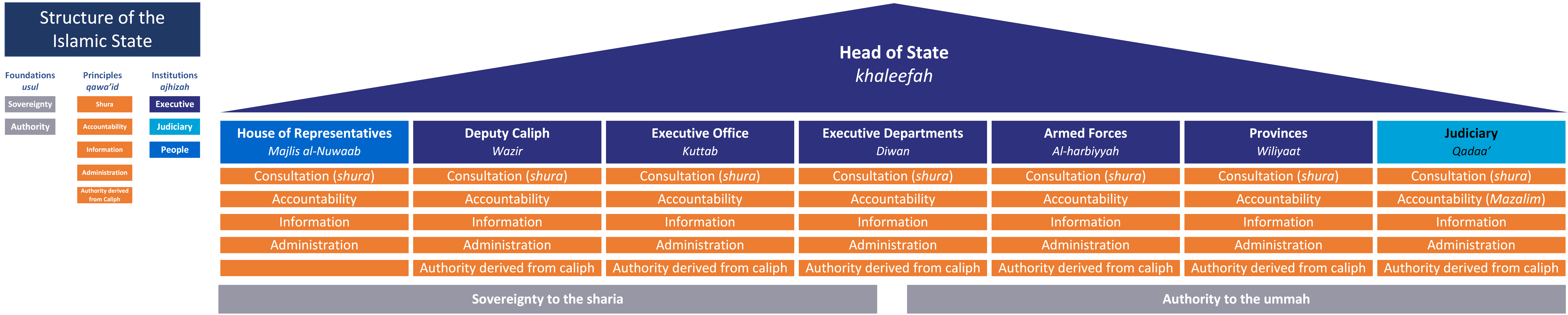
In a future khilafah (caliphate) the institution responsible for investigating and passing judgement on such matters is the Mazalim Court. The principle (qa’ida قاعِدَة) underpinning this court i.e. redressing grievances (Al-Maẓālim) existed from the time of the Prophet ﷺ as we shall see shortly when discussing the Banu Jadheemah expedition. As a formal institution (jihaz جِهاز) however, this wasn’t introduced until the Abbasid Khilafah, and later the Seljuk and Mamluk sultanates which housed the Mazalim Court in a separate building called the Dar ul-‘Adl (House of Justice).

Dr As-Sallabi narrates the events surrounding the expedition: “The Messenger of Allah ﷺ sent Khaalid ibn Al-Waleed to the Banu Jadheemah (بنو جذيمة) tribe and instructed him to invite its people to Islam [not to fight]. This mission took place in the month of Shawwaal, in the year 8H, prior to the Hunain Expedition. Khaalid had with him men from Banu Saleem, Mudlaj, the Ansaar, and the Muhaajiroon; in total, his unit consisted of 350 men.

When the people of Banu Jadheemah saw the approaching army, and more particularly, when they saw that Khaalid was leading it, they took to their weapons. Khaalid said, “Put down your weapons, for indeed, the people (i.e., the Quraish and many others) have embraced Islam.”

One of the men of Banu Jadheemah, whose name was Jahdar, stood up and said, “Woe upon you, O people of Banu Jadheemah; he is indeed Khaalid! By Allah, the only thing that will follow our laying down of our weapons is imprisonment; and the only things that will follow that will be the striking of our necks. By Allah, I will never lay down my weapons.” His people continued to try to calm him down until he was left with no choice but to lay down his weapons.

Khaalid then ordered for their hands to be tied behind their backs [combatants not women and children]; this command having been carried out, he once again invited them to Islam. They did not properly say, “We have embraced Islam (أَسْلَمْنَا‏)”; instead, they said, “We have changed our religion. We have changed our religion (صَبَأْنَا)” Khaalid began to kill some of them; meanwhile, some of the Muslim soldiers objected vehemently to Khaalid’s actions.

Khaalid then placed each prisoner under the custody of one of his men; one day later, Khaalid ordered for each Muslim to kill his prisoner. Some of the Muslims [Banu Saleem] obeyed Khaalid’s order; others [Muhajirun and Ansar], such as Abdullah ibn ‘Umar refused to carry out his order. The latter group, upon returning to the Messenger of Allah informed him about what had happened. The Messenger of Allah ﷺ became angry, raised his hands towards the sky, and said, اللَّهُمَّ إِنِّي أَبْرَأُ إِلَيْكَ مِمَّا صَنَعَ خَالِدٌ  “O Allah, I do indeed absolve myself of what Khaalid did!”

An argument broke out between Khaalid and Abdur-Rahmaan ibn ‘Auf regarding the topic of what was done to some of the tribesmen of Banu Jadheemah, and harsh words were spoken between the two. Abdur-Rahmaan feared that Khaalid was motivated by the desire to exact revenge on behalf of his uncle Al-Faakaih ibn Al-Mugheerah, who was killed by Jadheemah during the pre-Islamic days of ignorance.

Perhaps this was the argument that was referred to in Saheeh Muslim and other Hadeeth compilations, in a narration which states the following: There was some tension between Khaalid ibn Al-Waleed and ‘Abdur-Rahmaan ibn ‘Auf, and as a result, Khaalid swore at ‘Abdur-Rahmaan. The Messenger of Allah ﷺ then said,لاَ تَسُبُّوا أَصْحَابِي فَوَالَّذِي نَفْسِي بِيَدِهِ لَوْ أَنَّ أَحَدَكُمْ أَنْفَقَ مِثْلَ أُحُدٍ ذَهَبًا مَا أَدْرَكَ مُدَّ أَحَدِهِمْ وَلاَ نَصِيفَهُ “Do not curse anyone from my Companions; for indeed, were one of you to spend the equivalent of Mount Uhud in gold, it would not be equal to the Mudd (two handfuls) of what one of them gives, nor half that amount.”[3]

The Messenger of Allah ﷺ then sent Ali ibn Abi Talib to pay blood money (compensation) for the men of Banu Jadheemah who were killed; he ﷺ gave even more than the normal amount in order to console the people of Banu Jadheemah for their dead relatives.”[4]

Dr As-Sallabi concludes, “Khaalid acted based on what he thought was right; he performed Ijtihaad[5], which is to say that he tried to do what was right based on the knowledge that was available to him, and his Ijtihaad turned out to be wrong. When a qualified person performs Ijtihaad, he gets two rewards if he is correct, and one if he is wrong; and Khaalid was qualified, since he was the appointed leader of the unit. That he performed a valid, albeit incorrect, Ijtihaad is proven by the fact that the Prophet ﷺ did not punish him for his actions,”[6] although as mentioned, he ﷺ compensated the victim’s families which is the well-known ruling for unlawful killing which doesn’t reach the level of first-degree murder.[7]

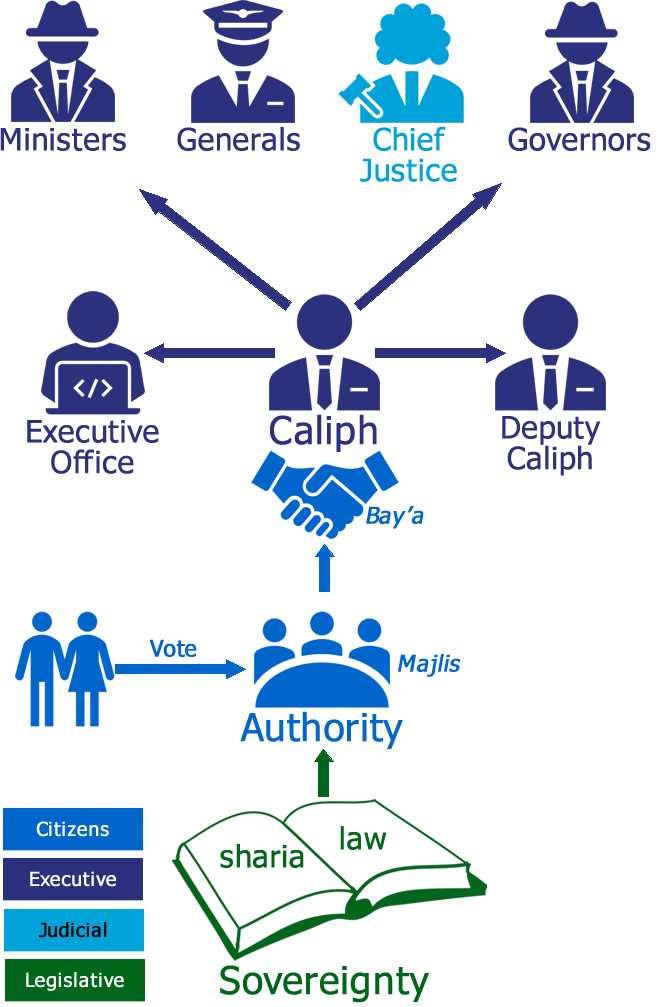
There is an important lesson to note from this incident which is that obedience to “those in authority” (أُولِي الْأَمْرِ)[8] is NOT absolute because the khaleefah, his ministers and commanders are not sovereign. Sovereignty (siyadah سِيادَة) in an Islamic State is not to the ruler, or the state but rather to the sharia alone. Sheikh Al-Massari says, “The majority of Islamic thinkers from the scholars of usul (principles of jurisprudence) and others, have explicitly stated that the Siyadah is completely, absolutely and exclusively restricted to the Sharia alone.”[9]

It is the sharia which underpins all the branches of government and their respective institutions including the khaleefah himself. Wael Hallaq says, “Whereas the modern state rules over and regulates its religious institutions, rendering them subservient to its legal will, the Sharīʿa rules over and regulates, directly or through delegation, any and all secular institutions. If these institutions are secular or deal with the secular, they do so under the supervising and overarching moral will that is the Sharīʿa.

Therefore, any political form or political (or social or economic) institution is ultimately subordinate to the Sharīʿa, including the executive and judicial powers.” [10]

This leads to the well-known sharia maxim where the Prophet ﷺ said, عَنْ عَلِيٍّ رَضِيَ اللَّهُ عَنْهُ عَنْ النَّبِيِّ صَلَّى اللَّهُ عَلَيْهِ وَسَلَّمَ قَالَ لَا طَاعَةَ فِي مَعْصِيَةٍ إِنَّمَا الطَّاعَةُ فِي الْمَعْرُوفِ “There is no obedience to anyone if it is disobedience to Allah. Verily, obedience is only in good conduct.”[11]

This is a fundamental principle in Islamic political thought, which prevents the rulers in an Islamic State from overstepping the limits of their executive power. Coupled with the Mazalim court, these form powerful accountability mechanisms in a future state.

Notes


[1] Sahih al-Bukhari 4339, https://sunnah.com/bukhari:4339

[2] Ibn Qudama, Al-Mughni

[3] Sunan Ibn Majah 161 https://sunnah.com/ibnmajah:161

[4] Dr. Ali Muhammad Al-Sallabi, ‘The Noble Life of the Prophet Muhammad ﷺ,’ p.1716

[5] Ijtihaad is where an Islamic legal expert (mujtahid) expends maximum effort in deriving a divine rule from the Qur’an and Sunnah and the sources they allude to such as consensus (ijma) of the companions and analogy (qiyas). There are a multitude of other sources which may also play a role depending on which school of thought (mazhab) the mujtahid adheres to.

[6] Dr. Ali Muhammad Al-Sallabi, Op.cit., p.1717

[7] even in first degree murder the family can opt to accept compensation (blood money) rather than punish the murderer

[8] Holy Qur’an, Surah An-Nisaa, ayah 59

[9] Dr. Muhammad Abdullah Al-Massari, ‘Al-Hakimiyah Wa Siyadah Ash-Shar’i,’ Committee for the Defence of Legitimate Rights, First Edition, 1423 H /2002 CE

[10] Wael B. Hallaq, ‘The Impossible State: Islam, Politics, and Modernity’s Moral Predicament,’ Columbia University Press, p.51

[11] Agreed Upon. Ṣaḥīḥ al-Bukhārī 7257, https://sunnah.com/bukhari:7257 ; Ṣaḥīḥ Muslim 1840, https://sunnah.com/muslim:1840a

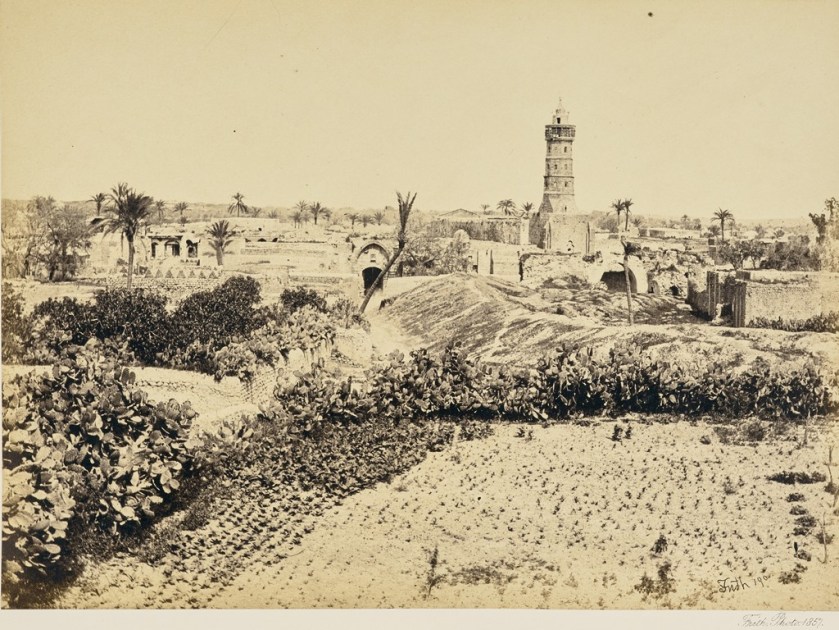
400 years of peace: Palestine under Ottoman rule

This has been reproduced from the Daily Sabah.

Ruling the Palestine region for more than 400 years, the Ottomans fought fiercely to keep the ancient lands during World War I but eventually lost them to the British

Palestine, which has witnessed many conflicts throughout history, came under Ottoman rule in the 16th century. When Yavuz Sultan Selim defeated the Mamluk ruler Kansu Gavri in the Battle of Marj Dabiq in 1516, Syria and Palestine joined the Ottoman lands. Yavuz Sultan Selim entered Jerusalem on Dec. 29, 1516.

Under Ottoman rule, the Palestinian territory was organized into three states, Jerusalem, Gaza and Nablus, all linked to the Damascus Province. Palestine, in the last period of the Ottoman Empire, was first linked to the state of Sidon, later to Syria and then to Beirut, which was founded in the last period.

The Ottomans ruled in Palestine for 401 years. Palestine was and still is a region of great importance for Muslims, Christians and Jews. In particular, the sacred places in Jerusalem could not be shared. Even the various denominations of Christianity were in conflict with each other. After the conquest of the region, the Ottoman Empire also applied its own administrative methods in Palestine and the Ottoman regime dominated the region. When Western forces invaded the region in the 19th century, a never-ending chaos began in Palestinian and other regions of the Middle East. In 1917, the war was going on at all fronts in World War I. However, Ottoman forces had begun to retreat, losing many places in the southern front. On March 11, 1917, Baghdad fell. Tuncay Yılmazer, who studied on the Palestinian front following Çanakkale, describes in detail the wars in Palestine in his articles.

Gaza Battles

The key target for the British was Jerusalem. Ottoman troops were trying to block the British by holding the Gaza-Beersheba line. Conflicts intensified in Gaza.

The Ottoman army stopped the British by winning the first Gaza battle in March 1917 and the second Gaza battle in April 1917.

Then the British sent Edmund Allenby, an important commander who had fought on the Western front.

In August 1917, the Ottoman administration strengthened its armies in the region with German battalions and established the Yıldırım (Thunderbolt) Army Group.

Erich von Falkenhayn, who had fought on the Western front, was appointed head of the group. There were many important commanders on the Palestinian front such as Mustafa Kemal Atatürk, Fevzi Çakmak, İsmet İnönü, Refet Bele, Ali Fuat Cebesoy and Fahrettin Altay.

Many troops that had fought in Çanakkale were also present on this front.

The Ottoman military force was weak against the enemy in terms of numbers and equipment and the limited Ottoman military power had already been severely weakened by the Sarıkamış and Canal attacks. Against the advancing enemy, Enver Pasha could not decide where to concentrate his troops. While the southern fronts were falling one by one, there were still Ottoman troops on the European front. Due to strategic and tactical mistakes, the Ottomans were caught weak on the Palestinian front. There was also a division of views between German and Turkish commanders. The report sent by Mustafa Kemal Pasha to Enver, Talat and Cemal Pashas in September 1917 clearly reveals those and more troubles.

Gen. Edmund Allenby of the Egyptian Expeditionary Force tried to open the way to Jerusalem by ceaselessly operating after his arrival in Cairo in June, eventually breaking down the Ottoman defenses.British Prime Minister Lloyd George gave the order to take Jerusalem by Christmas of that year.

While the Ottomans were expecting an attack in Gaza, the British took Beersheba on Oct. 31, 1917.

The attacks by the Ottoman forces to take back Beersheba were not effective.

The British intensified their bombing and turned Gaza into rubble. Refet Bele Pasha chose to take a stand instead of retreating. However, the Ottomans from Gaza on Nov. 6-7, 1917 with hundreds of causalities. As the Ottoman units retreated, they lost the majority of their equipment as well as suffering significant human losses. The British won the third Gaza battle, opening the way to Jerusalem.

The Fall of Jerusalem

Allenby did not allow the formation of a new line of defense by taking a hard line with the retreating Ottoman forces. British land and naval artillery and aircraft relentless bombarded the Turkish troops. The Turkish forces, struggling with hunger and disease as well as the intense fire of the British, lost despite their heroism. In particular, the troops of the 57th regiment and the 77th regiment from Çanakkale showed exceptional heroism on this front.

The courage and calmness of the Ottoman officers, such as Asım Gündüz and Hüseyin Erkilet, prevented a great defeat. The heroic soldiers fought with their bayonets fearlessly, making the enemy to pay a huge cost for the victory.

Falkenhayn believed that he could defend Jerusalem, but successive defeats weakened the resistance of the Ottoman commanders. By the end of November, the British captured Ismail Hill near the city. Offensive attempts to retrieve the hill failed. Ottoman forces built a 20-kilometer defense line. However, when the British captured some of the Turkish positions, the defensive line broke.

The British were not able to advance immediately because their forces were not reinforced even though they got through the defense line.

However, the Ottoman forces withdrew from the city due to their psychological state and their determination to not let the city be destroyed. Ottoman troops abandoned Jerusalem on the night of Dec. 8, 1917.

In the morning of Dec. 9, 1917, Mayor Al-Husseini stepped outside the city walls to deliver the city’s symbolic key and the delivery document. The first people they met were two cooks. Then came more soldiers of different ranks. Nobody knew what to do. In the end, 60th Division Cmdr. Shea got the city on behalf of Allenby.

Crusade

Gen. Allenby walked on foot to the Jaffa gate on Dec. 11, 1917. Illustrations published in Europe depicted Allenby as entering the city in the presence of angels. The fall of Jerusalem was likened to the Crusades in the British press, and Allenby to Godfrey of Bouillon who occupied Jerusalem during the first Crusade.Allenby completed the unfinished crusade of Richard the Lionheart, the English king who set out for crusade and failed centuries ago. From Oct. 31, 1917 to Dec. 8, 1917, until the fall of Jerusalem, the Ottoman military saw a total of 25,000 casualties, including martyrs, the wounded and captives. The are remembered up until today as heroes of great courage and strong character.

BY ERHAN AFYONCU


Imam Ghazali says, “a sultan is necessary for achieving well-ordered worldly affairs, and well-ordered worldly affairs are necessary for achieving well-ordered religious affairs, and well-ordered religious affairs are necessary for achieving happiness in the hereafter, which is decidedly the purpose of all the prophets.”[1] He also says, “religion and authority are twins” (الدين والسلطان توأمان Ad-deen was-sultan tawaman),[2] and concludes his argument with, “Therefore, the obligation of appointing an imam is among the essential requirements of the law (ضروريات الشرع) – a requirement that by no means can be ignored, so take heed of that!”[3]

Notes


[1] Al-Ghazali’s Moderation in Belief: Al-Iqtiṣād fi al-I‘tiqād, translated by A M Yaqub, University of Chicago Press, Chicago and London, 2013, p.229

[2] Ibid

[3] Ibid, p.234

Liberation of Jerusalem: Salahudeen’s mercy towards the Crusaders

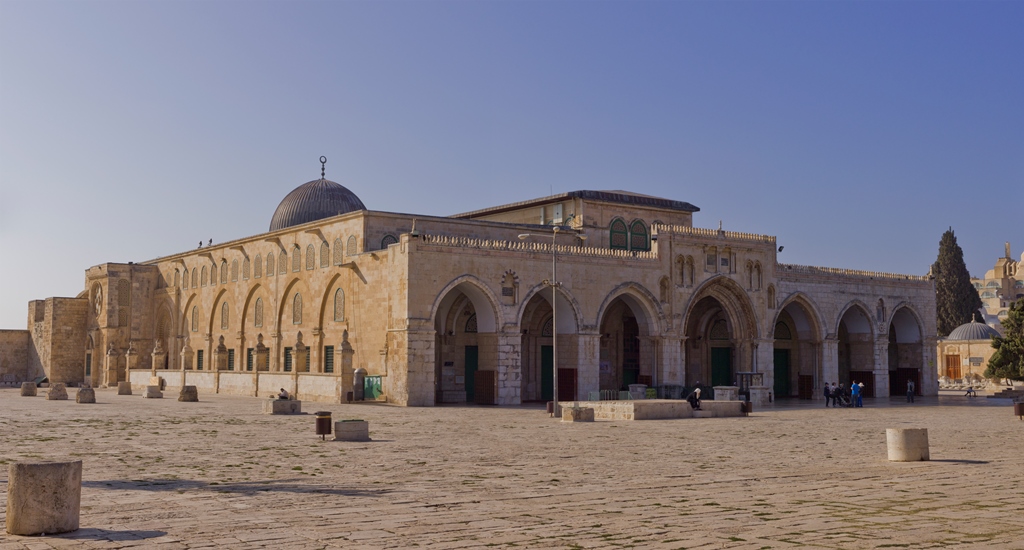
Salahudin Ayubi liberated Jerusalem (Al-Quds) on Friday 27 Rajab 583 AH/12 October 1187 CE after Lord Balian of Ibelin, the crusader commander in charge of Jerusalem, surrendered the city. This marked an end to nearly 100 years of crusader occupation and the liberation of Masjid Al-Aqsa.

When the crusaders first entered Jerusalem in 1099, they massacred the Muslim and Jewish inhabitants, yet Salahudin on retaking the city never enacted revenge on them for this, nor the subsequent atrocities they had committed over the past century. He followed in the footsteps of the Prophet Muhammad ﷺ who on entering Makkah did not enact revenge on Quraish who had persecuted him and the Muslims for over 20 years. This was the because the character of the Prophet ﷺ was the Qur’an.[1] Allah ta’ala says,

يَـٰٓأَيُّهَا ٱلَّذِينَ ءَامَنُوا۟ كُونُوا۟ قَوَّٰمِينَ لِلَّهِ شُهَدَآءَ بِٱلْقِسْطِ ۖ وَلَا يَجْرِمَنَّكُمْ شَنَـَٔانُ قَوْمٍ عَلَىٰٓ أَلَّا تَعْدِلُوا۟ ۚ ٱعْدِلُوا۟ هُوَ أَقْرَبُ لِلتَّقْوَىٰ ۖ وَٱتَّقُوا۟ ٱللَّهَ ۚ إِنَّ ٱللَّهَ خَبِيرٌۢ بِمَا تَعْمَلُونَ

O believers! Stand firm for Allah and bear true testimony. Do not let the hatred of a people lead you to injustice. Be just! That is closer to righteousness. And be mindful of Allah. Surely Allah is All-Aware of what you do.[2]

Salahudin agreed to grant safety to the crusaders and their families and let them leave the city for a ransom which was set at:

  • 10 dinars per man, rich or poor alike
  • 5 dinars per woman
  • 4 dinars for boys
  • 1 dinar for infants
  • 30,000 dinars lump sum paid for by Balian for the remaining poor and destitute.

Salahudin gave Balian a time limit of forty days. Whoever paid their ransom within this time would be allowed to leave, and whoever was left after that would become a slave.[3]

Dr As-Sallaabi describes the events after the surrender of the city, ‘Salah ad-Deen fulfilled his promise to allow whoever paid a set amount to leave; at every gate he allocated an emir, one of the senior commanders, to keep track; whoever paid the ransom was allowed to leave.

Despite the small amount that Salah ad-Deen stipulated in return for allowing them to leave Jerusalem and guarantee them safe passage to their destination, a great many of them were unable to pay this sum for themselves, so after forty days had passed they became prisoners of the Muslims. Not one of the rich crusaders did anything to ransom the poor. The Patriarch Heraclius left Jerusalem with his great wealth, not paying attention to anyone else. It seems that this was due to the lack of family or other ties among the Crusaders at that time. The prisoners were a mixture of different European ethnic groups and peoples, and western mercenaries who had travelled to the east in order to escape the serfdom that was prevalent in European society.

To sum up, this disgraceful attitude on the part of the senior Crusaders and the chivalry and tolerance displayed by Salah ad-Deen compelled one English writer to express his admiration for Salah ad-Deen when he wrote, after criticizing the Patriarch, “This was an opportunity for the Muslim king to teach the Christians the meaning of tolerance.”

Salah ad-Deen and other Muslim emirs confirmed this attitude of tolerance and chivalry when thousands of Crusader civilians who could not pay the stipulated ransom became the captives of Salah ad-Deen, and al-Malik al-‘Adil sent word to his brother, the sultan Salah ad-Deen, asking him to give him one thousand of those poor Crusaders so that he could release them for the sake of Allah.

Salah ad-Deen responded to this request. This humane action on the part of al-Malik al-‘Adil moved the Patriarch and Balian, and they came to Salah ad-Deen and asked him to do likewise, so Salah ad-Deen gave them what they asked for and let them go.

When he ordered his guards to call out in the streets of Jerusalem that he would release any of the Crusaders who could not pay the ransom because of old age, and that this group should go to the rear gate of the city so that they could be released from sunrise until nightfall. No sooner was the proclamation made but innumerable Crusaders made their way to that gate.

The emir of Bira requested the release of around five hundred Armenians, telling Salah ad-Deen that they were from his Land and that they had come to Jerusalem to worship there. The emir Muzaffar ad-Deen ‘Ali Koojak also requested the release of around a thousand Armenians, claiming that they were from Edessa, and Salah ad-Deen responded to that and let them go.

Muslim tolerance was not limited only to the actions of Salah ad-Deen, his brother al-Malik al-‘Adil and the senior emirs; it extended to the Muslim common folk too.

Salah ad-Deen showed a great deal of tolerance and good treatment towards the Crusader captives in Jerusalem. Salah ad-Deen’s generosity and gallantry extended to the wives and daughters of the Crusader knights who had been killed or captured during their battles with Salah ad-Deen. They gathered before Salah ad-Deen, weeping. He asked about their situation and what they wanted, and he was told that they were pleading for mercy. Salah ad-Deen felt sorry for them and allowed anyone whose husband was still alive to point him out, then he released them and allowed them to go wherever they wanted. As for the women and girls whose husbands and fathers had been killed, Salah ad-Deen ordered that they be given, from his personal wealth, enough to sustain them according to their position, and he gave to them until they began to pray for him.”[4]

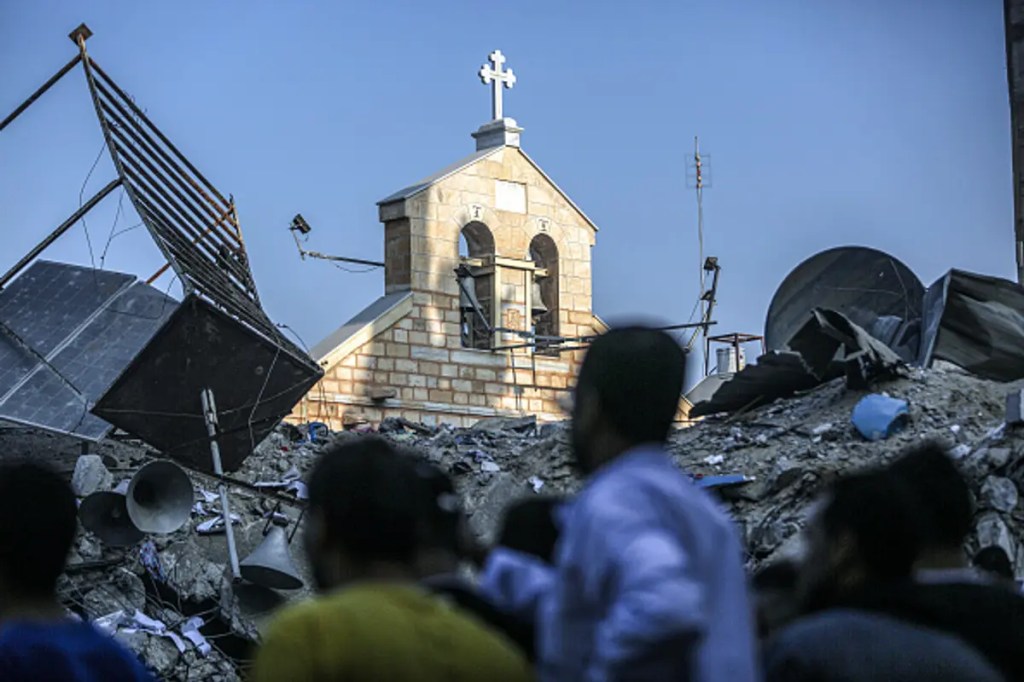
Saint Porphyrius, the world’s third oldest church, bombed by Israel killing 18 Christian Palestinians

Allah ta’ala says,

ٱلَّذِينَ أُخْرِجُوا۟ مِن دِيَـٰرِهِم بِغَيْرِ حَقٍّ إِلَّآ أَن يَقُولُوا۟ رَبُّنَا ٱللَّهُ ۗ وَلَوْلَا دَفْعُ ٱللَّهِ ٱلنَّاسَ بَعْضَهُم بِبَعْضٍۢ لَّهُدِّمَتْ صَوَٰمِعُ وَبِيَعٌۭ وَصَلَوَٰتٌۭ وَمَسَـٰجِدُ يُذْكَرُ فِيهَا ٱسْمُ ٱللَّهِ كَثِيرًۭا ۗ وَلَيَنصُرَنَّ ٱللَّهُ مَن يَنصُرُهُۥٓ ۗ إِنَّ ٱللَّهَ لَقَوِىٌّ عَزِيزٌ

˹They are˺ those who have been expelled from their homes for no reason other than proclaiming: “Our Lord is Allah.” Had Allah not repelled ˹the aggression of˺ some people by means of others, destruction would have surely claimed monasteries, churches, synagogues, and mosques in which Allah’s Name is often mentioned. Allah will certainly help those who stand up for Him. Allah is truly All-Powerful, Almighty.[5]

Notes


[1] Sahih Muslim 746a, https://sunnah.com/muslim:746a

[2] Holy Qur’an, Surah Al-Maidah, ayah 8

[3] Dr Ali M. Sallaabi, ‘Salah ad-Deen Al-Ayubi, ‘The Battle of Hattin, the Conquest of Jerusalem and the Third Crusade,’ Vol.3, International Islamic Publishing House, p.68

[4] Ibid, p.70

[5] Holy Qur’an, Surah Al-Hajj, ayah 40

A Poem on Muslim Unity by Sheikh Ibrahim an-Ni’mah

Sheikh Ibrahim an-Ni’mah was born in Mosul, Iraq, in 1361H/1942CE. His family lineage is related to the scholar Abdul Rahman bin Al-Jawzi, who died in the year 597H, who is related in lineage to Abu Bakr Al-Siddiq, the companion of the Messenger of Allah ﷺ.

This poem is taken from his book, al-Wahdah al-Islamiyah bayna al-Ams wal Yawm (Islamic Unity between Yesterday and Today).

لو اشتكى مسلٌم في الصين أرّقني … أو اشتكى مسلم في الهند أبكاني

فمصر ريحانتي والشام نرجستي … وفي الجزيرة تاريخي وعنواني

وفي العراق أكف المجد ترفعني … عن كل باغ ومأفون وخّوان

ويسكن المسجد الأقصى وقبته … في القلب لا شك أرعاه ويرعاني

أرى بخارى بلادي وهي نائية … وأستريح إلى ذكرى خراسان

شريعة الله لمت شملنا وبنت … لنا مقاماً بإحسان وإيمان

If a Muslim complains in China, a Muslim in India will feel pain and weep.

Egypt is my sweet basil, Syria is my narcissus[1], and Arabia is my history and homeland.

In Iraq I see my glorious past which makes me look down on every treacherous aggressor.

Al-Masjid al-Aqsa and its dome reside in my heart; No doubt I care for it and it cares for me.

I think of Bukhara as my homeland although it is so far away, and I am cheered when Khorasan is mentioned.

The Sharia of Allah has brought us together, and raised our status through sincerity and faith.[2]


[1] A flower

[2] Sheikh Ibrahim Al-Ni’mah, al-Wahdah al-Islamiyah bayna al-Ams wal-Yawm, Matba’ah az-Zahra’ al-Hadithah, 1425H/2004CE, p.23

Islamic Conquest of Damascus: Rule of law at the height of war

ذِمَّةُ اَلْمُسْلِمِينَ وَاحِدَةٌ يَسْعَى ِبهَا أَدْنَاهُمْ

“The protection granted by one Muslim is like one given by them all, and this right is extended to the humblest of them.”[1]

The Qur’anic character of the companions (sahaba) and early Muslims lead to their extraordinary restraint in the height of war, something virtually unheard of in modern warfare. The ‘civilised’ west, with all their talk of the rule of law, human rights and the Geneva convention have perpetrated according to Dr Gideon Polya a “Post-9/11 Muslim Holocaust & Muslim Genocide” where 30 million Muslims have been killed in avoidable deaths due to western, or western backed military intervention. There is no clearer example of this than the horrific ongoing genocide in Gaza, which America and its allies are actively financing, arming and providing cover for at the United Nations with their right of veto. As Samuel Huntington said, “The West won the world not by the superiority of its ideas or values or religion (to which few members of other civilizations converted) but rather by its superiority in applying organized violence. Westerners often forget this fact; non-Westerners never do.”[2]

The Islamic conquest of Damascus in Sept 634CE is an outstanding example of the rule of law at the height of war, where one of the corp commanders Abu Ubaydah ibn al-Jarrah made a dhimma (covenant of protection) with the Christians of Damascus in return for them peacefully surrendering the city. Khalid ibn al-Walid, who according to Al-Waqidi was the overall campaign commander, was not aware of Abu Ubaydah’s treaty and so continued fighting to conquer the city. Both commanders met in the middle of Damascus at the main Cathedral and Khalid ibn al-Walid, even though he outranked Abu Ubaydah in this battle, was forced to accept Abu Ubaydah’s dhimma and the conditions agreed with the Christians. Khalid’s conduct is based on the hadith of the Prophet ﷺ,

ذِمَّةُ اَلْمُسْلِمِينَ وَاحِدَةٌ يَسْعَى ِبهَا أَدْنَاهُمْ

“The protection granted by one Muslim is like one given by them all, and this right is extended to the humblest of them.”[3]

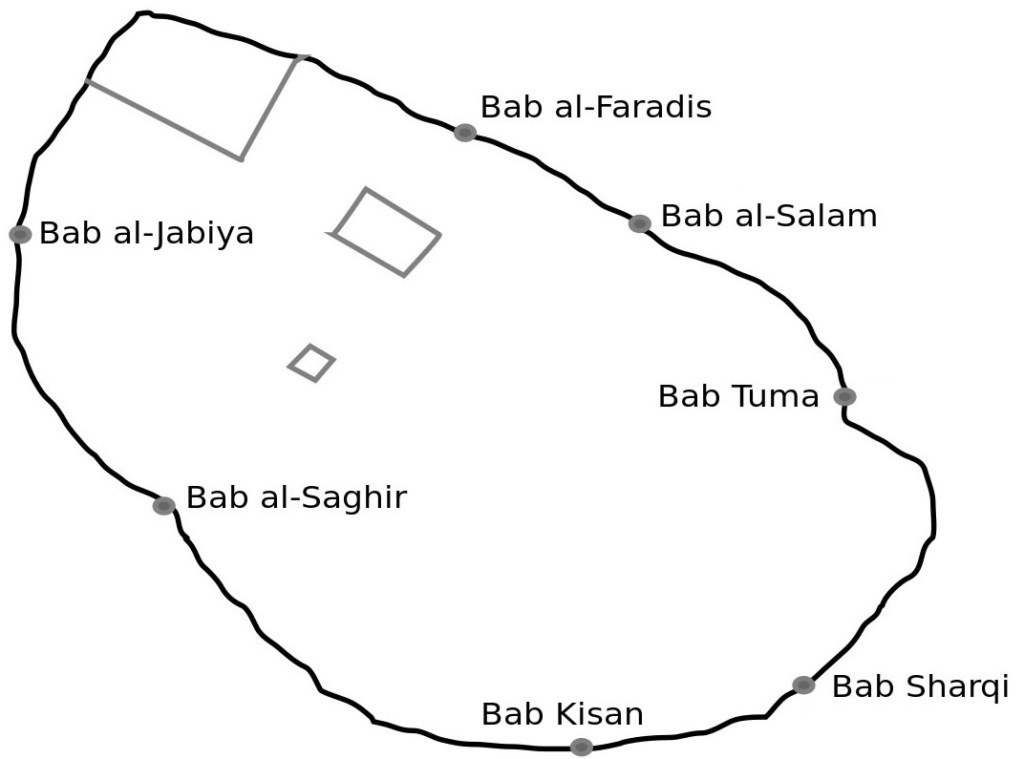
Al-Waqidi narrates the events, “I (al-Waqidi) have been informed that when Abu ‘Ubaydah entered the city of Damascus through the al-Jabiyah Gate with his companions, the monks and priests walked ahead of them, raising the Bible and burning incense of aloe-wood, amergis, musk and frankincense. Khalid did not know because he was launching an attack.

A Roman priest named Jonah, son of Murcius, lived a house attached to the city wall joining the Eastern Gate where Khalid was. Jonah possessed the Prophecies of Daniel (as) wherein it was written, “Allah Most High will conquer the lands through the sahabah and their deen will triumph over every other religion.” That night he dug a hole from his house (to the outside of the city) and unknown to his family, went to the Muslim camp. He told Khalid, “I have come out of my house and dug a hole (under the city wall). I want a guarantee of safety for myself, my family and children.” Khalid agreed and sent with him 100 men, mostly Himyaris, and said, “When you enter the city go to the gate, break the locks and remove the chains so that we can enter if Allah wills.” So they followed Jonah and entered his house via the hole where they put on their armour and made preparations. Then they emerged and went to the gate where they raised cries of “Allahu Akbar!” When the Christians heard, they became alarmed. The sahabah broke the locks and cut the chains. Khalid and the Muslims entered and began killing and capturing the Romans until they reached the Church of Mary.

Khalid’s army met Abu Ubaydah’s army at the church. Aby Ubaydah’s men were walking, with the monks walking in front of them. When Abu Ubaydah saw Khalid’s amazement at them having their swords sheathed, he said, “O Abu Sulayman, Allah has peacefully conquered the city through me. Allah suffices the Muslims in battle. Peace has been made.”

Khalid said, “What peace? May Allah never rectify their condition. How can they have a peace agreement when I have conquered them by the sword and the Muslims’ swords drip with their blood and I have taken their children as slaves and seized their wealth?!”

Abu Ubaydah said, “O commander, I entered through peaceful surrender.”

Khalid said, “You were always so unaware. I entered with the sword through conquest and they had no defence left!”

Abu Ubaydah said. “Fear Allah, O commander. By Allah! I have accepted their surrender and implemented it. I have given them a written agreement.”

Khalid said, “You make peace with them without my instructions when I am your commander-in-chief? I will not remove my sword from them until I have finished off every last one of them!”

Abu Ubaydah said, “By Allah! I did not think that you would oppose me when I made the agreement. I held an opinion and Allah is in control of my affairs. I have spared all their lives and guaranteed them the safety of Allah and Rasulullah ﷺ. All the Muslims with me were satisfied with that and treachery does not become us.”

The argument intensified with everyone looking on. Abu Ubaydah saw that Khalid was not shifting and that those sahabah who were with him were Arab bedouins, adamant on killing the Romans and seizing their wealth. He called out, “Alas, by Allah! I gave them protection and it has been violated.” He pointed at the bedouins, once to the left and once to the right and said, “O Muslims, I take oath on behalf of Rasulullah ﷺ that you will not do what you are doing until Khalid and I come to an agreement.”

The killing and looting stopped and the horsemen, flag-bearers and generals went to meet at the church. Amongst them were Mu’ath bin Jabal, Yazid bin Abi Sufyan, ‘Amr bin al-‘As, Shurahbil bin Hasanah, Rabi’ah bin ‘Amir, ‘Abdullah bin ‘Umar bin al-Khattab and others. A party which included Mu’ath and Yazid said, “We feel that Abu ‘Ubaydah’s treaty should be implemented and the killing halted. All the cities have not yet been conquered and Heraclius is still in Antioch. If they find out about the surrender and its betrayal, then not a single city will surrender, whereas surrendering to you is better than killing them. (0 Khalid), you keep what you have taken by the sword while Abu Ubaydah administers for you his area. In the meantime, the two of you can write to the Khaleefah (Umar) for arbitration and we will do whatever he says.”

Khalid said, “I accept and grant them all temporary safety except for Thomas and Herbius[4].”

Abu Ubaydah said, “Those two were the first to enter into the pact, so do not break my word, may Allah have mercy on you.”

Khalid said, “Were it not for your word I would have killed them, but they will have to leave the city. May Allah curse them wherever they may go.”

Abu Ubaydah said, “Then on these terms is their surrender.”

Thomas and Herbius observed the argument and feared their destruction so they went with a translator to Abu Ubaydah and said, “What is that other one saying?”

The translator said, “What are you and your friend saying? Your friend intends treachery whereas we and the citizens have entered into a pact with you and he breaks it, which does not become you. So permit me and my companion to leave and go wherever we want to go to.”

Abu Ubaydah said, “At the moment you are under my protection.”

The Translator said, “We remain your responsibility for three days, in whatever direction we go in. After three days your responsibility is over. Then, whoever of you meet us after three days and overcomes us can kill us or capture us as he desires.”

Khalid said, “We accept that, but you will not carry away with you anything except your food.”

Abu Ubaydah said, “That condition will contravene the treaty because it allows them to leave with all their men and wealth.”

Khalid said, “Then I will allow it, except for weapons of which I will not let them take anything.”

Thomas said, “We need weapons for the journey to defend ourselves until we reach our lands. Otherwise, we are now in your hands, decide what you will.”

Abu Ubaydah said, “Let each man take one weapon only – sword or spear or knife or bow.”

Thomas said, “We are pleased with that. We do not want more than one weapon each. But I fear that man, Khalid, so I want this agreement in writing.”

Abu Ubaydah said, “May your mother be bereft of you! It is not our Arab way to betray or lie. Abu Sulayman’s[5] word is his word and his promise is his promise and he only speaks the truth.”[6]i will

Was the conquest of Damascus achieved by means of a treaty or by force?

As-Sallabi answers this question, “The scholars differ as to whether Damascus was conquered by means of a treaty or by force. Most of the scholars are of the view that the matter was settled by means of a peace deal, because they are not sure which came first: was it conquered by force and then the Byzantines agreed to a peace deal, or was one part conquered by means of a peace deal, then the other side was taken by force? Some suggested that half of it was conquered by means of a peace deal and the other half by force. This is more likely to be the case because what the sahabah did in the case of the main church which was the largest place of worship, when they took half of it and left the other half. And Allah knows best.”[7]

Notes


[1] Agreed Upon, Narrated by Ali ibn Abi Talib, https://sunnah.com/bulugh/11/43

[2] Samuel Huntington, ‘The Clash of Civilizations and the Remaking of World Order,’ p.51

[3] Agreed Upon, Narrated by Ali ibn Abi Talib, https://sunnah.com/bulugh/11/43

[4] Thomas had appointed Herbius as sub-governor of half the city since he took power.

[5] Khalid ibn al-Walid

[6] al-Imam al-Waqidi, ‘The Islamic Conquest of Syria,’ a translation of Futuhusham, Translated by Mawlana Sulayman al-Kindi, Ta-Ha Publishers Ltd, p.133

[7] Dr Ali Muhammad Sallabi, ‘Umar bin al-Khattab, His life and Times,’ Vol. 2, International Islamic Publishing House, p.280

What is the meaning of “Allah prevents by the authority (sultan) what He does not prevent by the Qur’an”? 

إن الله يزع بالسلطان ما لا يزع بالقرآن

Allah prevents by the authority (sultan) what He does not prevent by the Qur’an

Sheikh Bin Baz answers this question: “This is a well-known narration on the authority of Uthman (ra) and it is proven on the authority of Uthman bin Affan, the third rightly-guided caliph (ra). It is also narrated on the authority of Umar (ra)…It means, Allah ta’ala prevents the committing of forbidden acts through the authority (sultan), more than what He prohibits by the Qur’an.

Since some people are weak in faith (iman), the Qur’an’s prohibitions do not affect them. Rather, they resort to forbidden things and do not care. However, when they learn that there is a punishment from the authority, they become deterred and fear the authority’s punishment. The meaning of Allah punishes through the authority is that the authority’s punishments, punish some criminals more than what Allah punishes them through the Qur’an.

Due to the weakness of their faith and their lack of fear of Allah ta’ala they fear the Sultan lest he imprison them, beat them, fine them, or exile them from the country. They fear those punishments and are thus prevented from some of the evils due to the fear of the Sultan’s punishments.”[1]

Imam Ghazali echoes this point when discussing the importance and obligation of the Imamate (caliphate). He says, “a sultan is necessary for achieving well-ordered worldly affairs, and well-ordered worldly affairs are necessary for achieving well-ordered religious affairs, and well-ordered religious affairs are necessary for achieving happiness in the hereafter, which is decidedly the purpose of all the prophets.”[2] He also says, “religion and authority are twins” (الدين والسلطان توأمان Ad-deen was-sultan tawaman),[3] and concludes his argument with, “Therefore, the obligation of appointing an imam is among the essential requirements of the law (ضروريات الشرع) – a requirement that by no means can be ignored, so take heed of that!”[4]

This is why the Prophet ﷺ said:

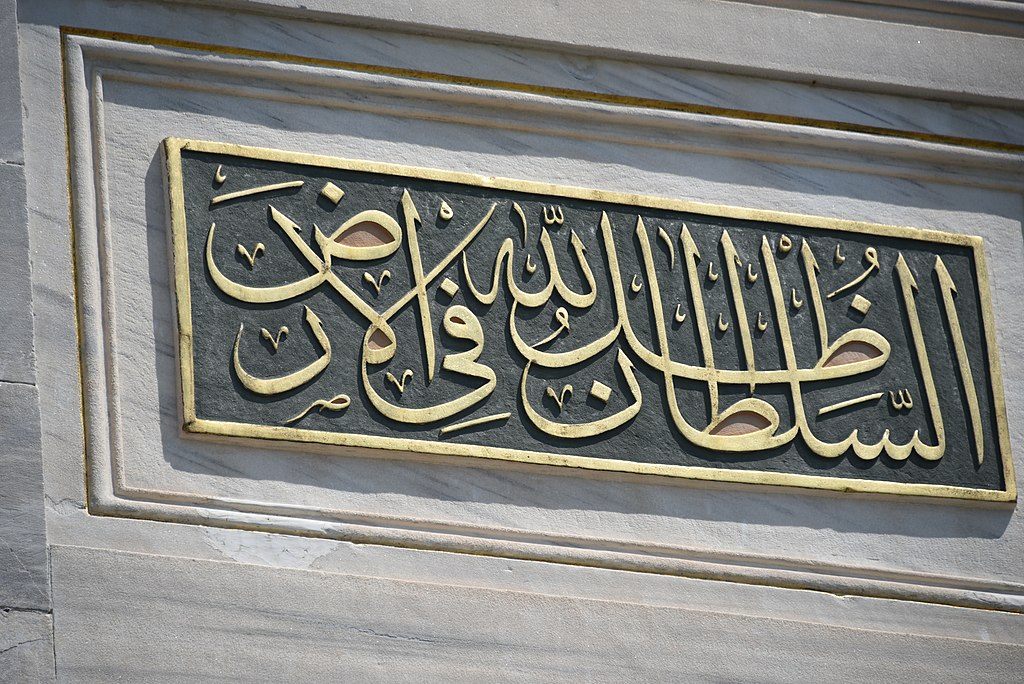
السلطان ظل الله في الأرض فمن أكرمه أكرمه الله ومن أهانه أهانه الله الطبراني والبيهقي عن أبي بكرة

“The Sultan is the shadow of Allah on earth, so whoever honors him (the Sultan), Allah will honor him, and whoever despises him, Allah will despise him.”[5]

The Imperial Gate, Topkapi Palace, Istanbul, Turkiye.

Notes


[1] Fatawa of Sheikh Bin Baz

[2] Al-Ghazali’s Moderation in Belief: Al-Iqtiṣād fi al-I‘tiqād, translated by A M Yaqub, University of Chicago Press, Chicago and London, 2013, p.229

[3] Ibid

[4] Ibid, p.234

[5] At-Tabaraani & Al-Bayhaqi. Narrated by Abu Bakrah. Al-Albani classified the hadith through this chain as hasan.

Gaza: Cruel Zionism, Past and Present with Professor Avi Shlaim

This has been reproduced from The Thinking Muslim.

Today, we are confronting nothing short of a campaign of ethnic cleansing of the Palestinians of Gaza, not seen since the Nakba or Catastrophe of 1948. Yet many in the Western world are silent about the suffering. Much of what justifies Israel and its actions in the West is premised on history, and many European and American historians have been ready to present a compelling argument for Zionism and the case for Israel in the heart of the Middle East.

This historical justification, based on persecution and antisemitism, gives the story of Israel a potency that has for many years served to find acceptance in the West – of impunity to act without restraint – that is not offered to any other state. At the same time, the Palestinian story has been undermined by these same historians. They were a Bedouin community, readily able to vacate their land – it is said. Palestinians, according to leading Israeli politicians, are a mythical people.

Today, we are honoured to have Professor Avi Shlaim with us to untangle historical facts from fiction. Avi Shlaim is an eminent historian. He is an Emeritus Professor of International Relations at Oxford University and the author of The Iron Wall: Israel and the Arab World (2014) and Israel and Palestine: Reappraisals, Revisions, Refutations (2009). Professor Shlaim is a dual Israeli British citizen who lived in the country as a child. His family originated from Iraq and migrated to the newly founded state in 1950.

Late Ḥanafī Authorities on the Imamate

BY ASIM AYUB. This has been reproduced from Ummatics.

This article presents four annotated translations of excerpts on Sharīʿa governance from “late” (post-7th century Hijri) classical Ḥanafi works in rational theology (kalām) and spiritual psychology (taṣawwuf).1 A previous piece was dedicated to earlier authorities in the school.2 Collectively, these excerpts are representative of the Ḥanafi position that the imamate, or caliphate, is a communal obligation of utmost importance. They express the reasoning for this—including an assessment of opposing heterodox views—as well as articulating the roles, benefits, and significance of the imamate.

Most of the scholarly reflection on the imamate, despite it being a matter of positive law (fiqh), is found in theological works. For the Ḥanafīs, this means in works of Māturīdī theology. Our first passage, in turn, is from one such work by Kamāl al-Dīn al-Andakānī (d. 726/1325) in which he presents consensus as the textual proof for the obligation of imamate as well as a rational proof tied to its fulfilment of sociopolitical roles necessary for the Umma.

The next two extracts exemplify the synthesis of the Maturīdī and Ashʿarī theological schools as embodiments of the Sunnī kalām tradition. The first is from Ibn al-Humām’s (d. 861/1457) al-Musāyara. Straddling both schools with his ability to independently verify legal and theological opinions, Ibn al-Humām’s text is provided here with the commentary of his student, Ibn Abī Sharīf al-Maqdisī (d. 906/1500), a Shāfiʿī Ashʿarī scholar. Despite its synthetic approach to theology, this passage is quoted verbatim in arguably the most authoritative late legal text in Ḥanafī Fiqh, the Radd al-Muḥtār of Ibn ʿĀbidīn al-Shāmī (d. 1252/1836).

Along with this Shāfiʿī commentary, in the third passage we have also provided the commentary of the same section of the Musāyara from Qāsim ibn Quṭlūbughā (d. 861/1457), an incredibly close student of Ibn al-Humām who not only studied this book with him but is also considered to be an authoritative scholar in the school by later Ḥanafīs. His extract, albeit largely lifted from Ṣʿad al-Dīn al-Taftāzānī’s (d. 792/1390) Sharḥ al-ʿAqāʾid al-Nasafiyya, stands out due to its succinct responses to various important questions and contentions: why the Imām requires general authority across the Islamic regions (as opposed to multiple authorities in different regions), whether actual political authority suffices, even if not held by the Imām, and how to understand the universal obligation of the caliphate vis-à-vis the notion that it ended thirty years after the Prophet ﷺ.

Found neither in a legal manual nor a theological treatise, the final passage is taken from the Ṭarīqa Muḥammadiyya of the Ottoman spiritual reformer and Ḥanafi scholar, Mehmed Birgivī (d. 981/1573), along with the commentary of ʿAbd al-Ghanī al-Nābulsī (d. 1143/1731), a later Ottoman polymathic Sufi master. Exemplifying the grand synthesis of the late Ottoman tradition, Nābulsī quotes extensively from the Jawharat al-Tawḥīd of the famous Mālikī Ashʿarī Ibrahīm al-Laqqānī (d. 1041/1631). Our closing extract, then, is the commentary of a Sufi Akbarian on a Maturīdī Ḥanafī text on spiritual exhortation, using passages from a Mālikī Ashʿarī. This is representative of the fact that when it comes to the fundaments of Sharīʾa governance and the basics of the imamate, scholars across various legal, theological, and spiritual strains stand in broad consensus.

1. Kamāl al-Dīn al-Andakānī3 (d. 726/1325), Ṣidq al-Kalām

قال أهل السنة والجماعة: يُفرَض على الناس أَن  يَختَارُوا في كلِّ عصر للإمامة من يصلح للقيام بتنفيذ الأحكام؛ وتَمْشِيَة الأمور، وسدِّ الثُغُور، وتجهيز الجيوش، وتَدبِير الحروب، وقسمة ما أفاء الله تعالى عليهم من الغنائم بين المُقاتَلَة وأخذ الصدقات وصرْفها إلى مَصارفها، وإقامة الجُمَع والأعياد، وإنكاح الصغار والصغائر إذا لم يكن لهم وليٌّ، وقطع موادّ الشر المتوقّع من المتلصّصَة والمتغلبة والبُعَاة وقُطَّاع الطرق، وإقامة الحدود والقِصَاص وفَصلِ المنازعات التي لو دامت لأَفضَت إلى التَّقَاتُل والتَّفانى، فَمَا أصدقَ قوله تعالى: {وَلَكُمْ فِي ٱلْقِصَاصِ حَيَوٰةٌ يَـٰٓأُو۟لِى ٱلْأَلْبَـٰبِ لَعَلَّكُمْ تَتَّقُونَ‏} [البقرة: 114] لِيكونَ مطاعًا مفترضَ الطَّاعة؛ فيتَمَكَّن مِن القيام بهذه الأمور، إلَّا أنَّ هَذا مِن فروض الكفاية إذا قام به البعض سَقَطَ عن الباقِين.

The people of the Sunna and the Community state: It is obligated upon the people in every age to select for the imamate one who is capable of carrying out its duties, which include: enforcing legal rulings [of the Sharīʿa], managing the collective affairs, protecting the borderlands, planning war efforts, distributing the wealth of Muslims—both war booty to soldiers and alms to those deserving of them—establishing the Friday and ʿĪd congregational prayers, facilitating the marriage of those with no guardian, and preventing the spread of corruption from thieves, gangs, rebels and brigands. He is also expected to establish penal and retaliatory punishments, and to solve disputes that, if left to fester, would lead to violence and devastation. How true are the words of Allah: “There is (security of) life for you in (the law of) retaliation, O people of reason, so that you may become mindful of Allah.”4 The selection and appointment of such an imām [along with his capability to carry out these duties] make him rightfully and obligatorily obeyed on part of the people. However, this obligation of appointing the Imām is a communal obligation of sufficiency that if carried out by some of the community is absolved of the rest.

والدليل على الوجوب المذكور الإجماعُ والمعقول. أما الإجماع فهو أن الصحابة اشتغَلوا عقيبَ وفاةِ رسول الله ﷺ بتعيِيْن الإمام قَبلَ دفنه؛ كما ستَقِفُ على تفَاصِيله في إمامة أبي بكر إن شاء الله تعالى؛ وقدَّموه على سائر الفرائض مِن قتالِ الكُفَّار والكسبِ وغيرِ ذلك، فلو لم يكن ذلك واجبًا عليهم لما اهتمُّوا بتقديمه على سائر الفرائض. وأما المعقول فهو أن قطع المنازعات، ودفع شر السُعاة في الأرض بالفساد، والانتصاف في المظالم والحقوق لا يتأتَّى إلَّا بفَيصَلٍ مُطاعٍ وهو الإمام؛ وفي إهماله ضررٌ ظاهر عام وهو تفاني النُّفوس؛ ودفعُ الضرر عن النفس واجبٌ، فيَجِب عليهم ذلك. ومِمّا ذكرنا ثبت أن نصب الإمام واجب على الخلق سمعًا وعقلاً وهو مذهبنا.

The proof for the aforementioned obligation is consensus and reason. As for the consensus, the Companions immediately preoccupied themselves with selecting the Imām after the passing of the Prophet ﷺ, even before his burial. This will be explained in more detail in the discussion of the Imamate of Abū Bakr, Allah willing. The Companions gave this selection process preference over other important obligations such as military duties, economic obligations and the like. Had it not been an obligation for them, they would not have dedicated themselves to this single obligation above all others. As for the rational proof, it is that the resolution of disputes, tackling crime and corruption, and establishing justice and rights does not occur except through a legitimate authority who is obeyed and has the final decision—this is the Imām. In his absence, there would be apparent and general harm, namely, loss of lives.5 Preventing this type of harm is obligatory. Hence, appointing the Imām is also obligatory. It is thus clear from what we have mentioned that appointing the Imām is obligatory on the people by revelation and reason, and this is our position.6

2. Kamāl Ibn al-Humām7 (d. 861/1457) and al-Maqdisī8 (d. 906/1500), al-Musāmara fī Tawḍīḥ al-Musāyara

الإمامة (استحقاقُ تَصَرُّفٍ عامٍّ على المسلمين)؛ وقوله: على المسلمين متعلِّق بقوله تصرُّفٍ، لا بقوله استحقاق، إذ المستحَقّ عليهم طاعةُ الإمام، لا تصرُّفه؛ ولا بقوله عامٍّ إذ المتعارف أن يقال عامٌّ لكذا، لا عامٌّ على كذا. وقد عرَّف صاحب «المواقف» «وشرحه» الإمامة بأنها «خلافةُ الرسول في إقامة الدين، وحفظ حوزة الملة بحيث يَجب اتّباعُه على كافّة الأمّة». وفي «المقاصد» نحوه، فإنه قال: «هي رياسة عامّة فِي الدين والدنيا خلافةٌ عن النبيg»؛ وبهذا القيد خَرَجَتِ النبوّة، وبقَيد العموم خَرَج مثل القضاء والإمارة في بعض النواحي، ولَمّا كانتِ الرياسة والخلافة عند التحقيق ليستا إلَّا استحقاق التصرّف؛ إذ معنى نصب أهلِ الحل والعقد الإمامَ ليس إلا إثبات هذا الاستحقاق له، عَبَّر المصنف بالاستحقاق. فإنْ قيل التعريف صادق بالنبوَّة لأنّ النبيّ ﷺ يملك هذا التصرّف العامّ؟ قلنا النبوّة في الحقيقة بِعثة بشرع كما علِم من تعريف النبيّ؛ واستحقاق النبيّ هذا التصرّف العامّ إمامة متَرَتَّبَة على النبوّة؛ فهي داخلة في التعريف دونَ ما تُرُتِّبَت عليه؛ أعني النبوّة.

The Imamate is “the right of general authority over the Muslims.”9 ‘Over the Muslims’ here [as a prepositional phrase] is grammatically linked to ‘authority’, not to ‘right’—because the right upon the people (that is, their duty) is to obey the Imām, not to wield authority—nor to ‘general’, because the conventional usage is to say ‘general to such-and-such’ not ‘general over such-and-such’.10

The author of al-Mawāqif and its commentary define the imamate as, ‘Succession of the Prophet ﷺ in the establishment of religion and defending the territories such that obedience (of the Imām) is obligatory on the entire Umma.’11 A similar definition is found in al-Maqāṣid, ‘It is general authority in religious and worldly affairs in succession of the Prophet ﷺ.’12 With this qualification [of succession], prophethood is excluded.13 With the qualification of generality, restricted roles of authority such as the judiciary and governorship are excluded. Political leadership and the caliphate, on scrutiny, are but the established right to govern, since the influential people appointing an imām means naught but their establishing this right for him. Hence, the author defines leadership in terms of the ‘established right’ [to govern].

If it is said that this definition also applies to prophethood because the prophet bears general authority, the reply is that prophethood, in reality, is being sent with a revealed law, as is known from standard definitions of a prophet. The established right of a prophet to general authority is [a form of] leadership consequent to prophethood, so it is included in the definition [of imamate] and not vice-versa.14

(ونصبُ الإمام) بعد انقراض زمن النبوّة (واجبٌ) على الأمّة عندنا مطلقًا (سمعًا لا عقلًا)، أي واجب من جِهَة السمع لا من جهة العقل (خلافاً للمعتزلة) حيث قال بعضهم واجب عقلًا، وبعضهم كالكعبي وأبي الحسين عقلًا وسمعًا. وأما أصل الوجوب فقد خالَفَ فيه الخوارج فقالوا هو جائز ومنهم من فضَّل، فقال فريق من هؤلاء يَجب عند الأمن دونَ الفتنة، وقال فريق بالعكس، أي: يجب عند الفتنة دون الأمن. وأما كون الوجوبِ على الأمّة فخالف فيه الإماميّة والإسماعيليّة فقالوا لا يجب علينا، بل يجب على الله — تعالى عَمّا يقولون علوّاً كبيراً — إلَّا أنّ الإماميةَ أوجَبوه عليه تعالى لحفظ قوانين الشرع عن التغيير بالزيادة والنقصان، والإسماعيلية أوجبوه ليكونَ معرِّفا للّه وصفاته. أما عدم وجوبه عندنا على الله تعالى وعدم وجوبه علينا عقلا فقد استَغنى المصنِّف عن الاستدلال له بِما قدَّمه مع دليله من أنه لا يَجِب عليه تعالى شيءٌ ومِن أنه لا حكمَ للعقل في مثل ذلك. وأما وجوبه علينا سمعًا فلأنه قد تواتر إجماع المسلمين في الصدر الأوّل عليه حتَّى جعلوه أهمَّ الواجبات، وبدأوا به قبلَ دفنِ الرسول ﷺ.

“The appointment of the Imām” after the period of prophethood “is obligatory” upon the Umma in all circumstances according to us, “as a matter of revelation, not reason”, that is, it is obligatory based on revelation, not reason, “contrary to the Muʿtazila”, some of whom held it to be obligatory based on reason while others, like al-Kaʿbī and Abū al-Ḥussain, held that it is obligatory based on both reason and revelation. On the ruling of obligation itself, the Khawārij opposed this, holding that appointing the Imām is merely permissible, while some of them deemed the ruling contingent. Some of these latter held that it is obligatory in times of peace but not in periods of turmoil, while others held the opposite, that is, it is obligatory in times of turmoil, but not when peace prevails.

On the obligation being on the Umma, the Imāmī Shīʿa and Ismāʿilīs opposed this, holding that it is not obligatory upon us, but on Allah—Allah is exalted far beyond what they say. However, [they did so for different reasons:] the Imāmī Shīʿa obligate it upon Allah, the exalted, to secure the preservation of the Sacred Law from change, addition, and subtraction. The Ismāʿilīs obligate it on Allah so that he [the Imām] may be a means of knowing Allah and His attributes.15 As for its not being an obligation upon Allah according to us, and its not being an obligation established by reason alone, the author suffices giving any evidence here for these positions with what he has already shown earlier, with evidence, that nothing is obligated upon Allah and that reason does not adjudicate in the like of this matter.16 As for its being a revelation-based obligation, the reason for this is the mass-transmitted consensus of the early Muslims on this, to the extent that they [the Companions] made it the most important duty, starting with it before the Prophet’s ﷺ burial.17

3. Ibn Quṭlūbughā18 (d. 879/1474), Sharḥ al-Musāyara

(الإمامة استحقاقُ تصـرُّفٍ عـامٍّ على المسلمين ونصْبُ الإمام واجبٌ سمعًا) هذا قول جُـمهور أهل السنّة وأكـثر الـمعتزلة (لا عقــلاً خلافــًا للمعتزلــة) إنـمــا قــال هــذا بعــض المعتزلــة. قــال النَكْســاري هذا قول الـجاحظ وأبي الـحسين البصري والكعبي وأتباعهم. وقــال أكثــر الـخـــوارج وأبـــو بـكــر الأصـــمّ مــن المعتزلــة لا يَجب علـى الله تعالــى ولا علـى الـخلــق. ولأهل الـحقّ ثلاثةُ مطالب: الأوّل وجوب نصب الإمام، والثاني شروطه، والثالث تعيينه. والـمصنّف ذكَر الأوّل بغير دليل، وقد استُدلّ له في «شرح العقائد» بقوله ﷺ: “من مات ولم يَعرف إمامَ زمانِه مات مِيتةً جاهليّةً”. ولأحمد والطبراني: “مـن مـات ولـيـس في عُنقِه بيعةٌ مـات مِـيـتـةً جاهلـيّـةً” خرّجاه من حديث معاوية. ولـمُسلـم في صـحيحه عن ابن عمر سمعت رسولَ الله ﷺ یقول: “مَن خَلَعَ يداً من طاعةِ الله لَقِيَ اللهَ يومَ القيامةِ لا حُجَّةَ له، ومَن مات وليس في عُنقِهِ بَيْعَةٌ مات مِيتةً جاهليّةً”.

ولأنّ الأمّة قد جعلوا أهمَّ الـمهمّات بعد وفاة النّبي ﷺ نصبَ الإمام على ما في الصّحيحين من حديث سَقيفة بني ساعِدة وكذا بعد موت كلّ إمام. ولأنّ كـثيـراً من الواجبات الشّرعية تتوقّف عليه؛ كتنفيذ الأحكام، وإقامة الحدود، وسدّ الـثّـغور، وتـجهيز الـجيوش، وقسمة الـغنائم، وقهر الـمتغلّبة والـمتلصّصة وقُطّاع الطرق، وقطع الـمنازعات الـواقعة بـيـن العـباد، وقبول الشهادات القائمة على الحقوق، وإقامة الـجُمَع والأعيـاد، وتزويـج الـصّـغـار والـصّـغـائر الـذيـن لا أولـيـاء لـهم، ونـحو ذلك من الأمور التـي بـيـن آحاد الأمّة.

“The Imamate is the right of general authority over the Muslims, and the appointment of the Imām is obligatory based on revelation, not reason, contrary to the position of the Muʿtazila.” This is the position of the vast majority of the Sunni theologians along with most of the Muʿtazila. Only a few of the Muʿtazila held the latter position [that it is obligatory based on reason]. Al-Naksārī19 says that this is the position of al-Jāḥiẓ, Abū al-Ḥussain al-Baṣrī, al-Kaʿbī and their followers. Most of the Khawārij and Abū Bakr al-Aṣṣam from the Muʿtazila held that it is not obligatory at all, neither upon Allah ﷻ nor on the people. The people of Truth (ahl al-ḥaqq) have three main objectives [to discuss on the topic of the imamate]: first, the obligation of appointing the Imām; second, the conditions [required for the Imām]; and third, the process of choosing the Imām. The author [Ibn al-Humām] mentions the first of these without evidence. It is evidenced in [Taftāzānī’s] Sharḥ al-ʿAqāʾid by his ﷺ saying: “Whosoever dies without recognising the Imām of his age has died a jāhilī death.” Aḥmad and Ṭabarānī both narrate from Muʿāwiya [the following similar ḥadīth], ‘Whosoever dies without having given allegiance [to the Imām] has died a jāhilī death.’20 Muslim also narrates from Ibn ʿUmar, “I heard the Prophet of Allah ﷺ saying, “Whosoever pulls his hand away from the obedience of Allah, he will meet Allah on the Day of Judgement with no proof for him. And whosoever dies without having given allegiance [to the Imām] has died a jāhilī death.”21

A further proof is that the Umma took the appointment of an Imām as their most important task after the passing of the Messenger of Allah ﷻ as indicated in the ḥadīth of the roofed shelter of Banū Sāʿida related in the two Ṣaḥiḥ collections.22 This [same urgency to appoint a successor] was also the case after the death of every caliph. Another proof is that many of the legal obligations of the Sacred Law depend on the Imām, such as enacting the law, establishing penal punishments, protecting the borders, preparing the armies, distributing the war-booty, subduing the brigands and highway robbers, settling disputes between people, accepting testimony in cases where people’s rights are at stake, establishing the Friday and ʿĪd prayers, marrying young people without guardians, and others such matters pertaining to the [social] relations of individuals in the Umma.

فإنْ قيل لـمَ لا يـجوز أن يكتفى بذي شوكةٍ في كلّ ناحية، ومن أين يـجب نصب من له الريـاسة العامّة، قلنا لأنّه يؤدّي إلـى منازعات ومـخاصمات مُفضية إلـى اختلال أمر الدين والدنيا، كما نشاهد في زماننا. فإنْ قيل فَلْيُكتفِ بذي شوكةٍ له الرّياسة العامّة إماماً كان أو غير إمامٍ، فإنّ انتظام الأمر يـحصل بذلك، كما في عهد الأتراك، قلنا نعـم يـحصل بعض النِّظام في أمر الدنيا، لكنْ يـختلّ أمر الدّين وهو الـمقصود الأهمّ والعُمدة العظمى. فإن قيل فَعلى ما ذكرتـم مِن أنّ مدّة الـخلفاء ثلاثون سنة، يكون الزّمان بعد الـخلفاء الراشدين خاليــاً عن الإمام، فتعصى الأمّة كلّهم وتكون مِيتتهم جاهليةً. قلنا الـمـراد الـخلافة الكاملة، ولـو سُـلّـم فَلعلّ دور الـخلافة ينقضي دون دور الإمامـة، والله تعالـى أعلم.

If it is said: why is it not sufficient to appoint a ruler in every region, or why is it obligatory to appoint one who has the general authority [across all regions]? We say: because that would lead to conflict and animosity, which would lead to corruption of the religious and worldly affairs, as we witness in our own times. If it said: in that case, a powerful leader with full authority should suffice, whether he is the Imām or not; the collective affairs can be managed by such as a person, as in the era of the Turks.23 We say: yes, we saw some stability in the worldly affairs, but the religious affairs were negatively affected, and they are the most important of all ends and the central pillar of all else.24 If it is said: based on what you have mentioned that the period of rule for the [rightly guided] Caliphs was 30 years, the period of rule after them was bereft of the Imām, rendering the whole Umma sinful and their deaths jāhilī. We say: the intent is of the complete caliphate, and if your point is conceded, it could be said that the age of the caliphate finished, but not the age of the imamate.25 Allah ﷻ knows best.26

4. ʿAbd al-Ghanī al-Nābulsī27 (d. 1143/1731) commenting on Birgivi28 (d. 981/1573), Al-Ḥadīqa al-Nadiyya Sharḥ al-Ṭarīqa al-Muḥammadiyya29

(والمسلمون لا بُدَّ لهم مِن إمام) أي سلطان يَقمَع هوى أنفسهم بإلزامهم الحقّ قهراً عنهم، (قادر على تنفيذ الأحكام) الشريعة فيهم لِعِلمه بذلك وقوّته عليه بالشجاعة والجنود، (مسلم) إذ لا ولاية لكافر على المسلم، (حُرُّ) لأنّ العبد لا ولايةَ له، (مكلَّف) أي عاقل بالغ (ظاهر) غير مُختفٍ ليُمكِّنَ كلّ أحدٍ مِن الرعيَّة الوصول إليه عند الاحتياج، (قُرَشِيّ) أي من قرَيش وهو اسمٌ لأولاد النضْر بن كِنانة. (ولا يشترط أن يكون هاشمياً) أي منسوباً إلى هاشم وهو أبو عبد المطلب جَدّ رسول الله ﷺ.

“It is necessary for the Muslims to have an Imām,” that is, a ruler who is able to curb their base impulses by holding them to the truth by force [if necessary]; “capable of executing the rulings,” of the Sharīʿa among the people due to his knowledge of it and his ability to do this through courage and material force. He must be “Muslim,” because a disbeliever can have no sovereignty over a Muslim; “free,” because a slave has no agency of his own; “legally responsible,” that is, sane and mature; “apparent,” not hidden [in occultation] so that the people under his guardianship can reach him when they need to; and “Qurayshī,” that is, from the clan of Quraysh, which is a name for the progeny of Naḍr ibn Kināna.30 “There is no requirement that he be Hashimī,” that is, from the progeny of Hāshim, who was the father of ʿAbd al-Muṭṭalib, the grandfather of the Prophet ﷺ31.

Suggested citation:

Asim Ayub, “Late Ḥanafī Authorities on the Imamate,” Ummatics, Dec 26, 2023, https://ummatics.org/papers/late-ḥanafi-authorities-on-the-imamate.

Notes

  1. I want to thank the following for their assistance on various aspects of this paper: Shaykh Dr. Sohail Hanif, Shaykh Shams Tameez, Shaykh Dr. Salman Younas, Mufti Zameelur Rahman, and Shaykh Dr. Zeeshan Chaudhri. I especially want to thank Dr. Uthman Badar for his diligent editorial work on the translations and footnote annotations and for being a helpful mentor.
  2. The use of “early” and “late” here is merely a heuristic device used to organise Ḥanafī authorities across thirteen centuries into two roughly equal periods. Otherwise, the Ḥanafī school has been periodized in various ways. If we take the standard dichotomy of early and late (mutaqaddimūn and mutaʾakhirūn), anyone who does not meet the three founding Imāms (Abū Ḥanīfa, Abū Yūsuf and Muḥammad) is considered late—the third/ninth century serving as a classifying point. All other periodizations appear to agree on a formative period ending around the fourth/tenth century with the advent of the Mukhtaṣarāt literature—the Mukhtaṣār of Qudūrī (d. 428/1037) being the most seminal. More detailed later periodization seems to be relative and found primarily in the attempt to demarcate typologies of jurists within the school—the Ṭabaqāt of ibn Kamāl Pāshā (d. 943/1536) became a prominent battleground in this dispute. See Talal Al-Azem, Rule-Formulation and Binding Precedent in the Madhhab-Law Tradition (Leiden: Brill, 2017), pp. 50-88; Sohail Hanif, “A Theory of Early Classical Ḥanafism,” PhD dissertation, University of Oxford, 2017; and Aḥmad al-Naqīb, al-Madhhab al-Ḥanafī, (Riyadh: Maktabat al-Rashīd, 2001), 1:327.
  3. Kamāl al-Dīn al-Andakānī is a relatively unknown Central Asian Maturīdī theologian of the 8th century Hijri. His only extant work is a creedal text entitled Sidq al-Kalām fī ʿIlm al-Kalām [The Truthful Word in the Science of Rational Theology] in which he generally lays out the standard Māturīdī position on theological issues, with some unique opinions and methodologies used.
  4. Qurʾān, al-Baqara: 114.
  5. Part of the reason why discussions of the imamate ended up in books of rational theology (kalām), according to the likes of Abū al-Muʿīn al-Nasafī, is the debate around what the obligation is grounded in. If we hone in on the two schools of theology that are predominantly Ḥanafī in legal practice—the Māturīdis (as a whole), and the Muʾtazila (as a majority)—we find this to be a debated issue that has implications beyond the imamate. The crux of the issue is the Muʾtazilī assertion that good (husn) and evil (qubh) are known by reason, and that their normative moral value is also established by reason (ʿaql). The Māturīdis, as opposed to their more stringent Ashʿarī divine command theorist counterparts, recognise that the moral rulings of some acts can be known by reason, but insist that their normative moral value can only be established by revelation. The Maturīdi position is fairly restrictive on the role of reason, utilising it as a tool or an expositor (kāshif) of empirical moral knowledge, rather than the Muʾtazilī position of reason as an obligator (mūjib) of normative moral values. The upshot of this in the debate of imamate’s obligation is that some of the more rationally inclined Muʿtazila make arguments only from rational necessity, the Ashʿaris from revelation, and the Māturidīs (and most Muʿtazila) from rational combined with textual proofs. There are also some nuances between the Samarqandī and Būkhāran schools of Māturīdī creed. For more on this, see Al-Ālūsī, Nahj al-Salāma, 135-137 and ʿAwwād Sālim, al-Madrassa al-Kalāmiyya al-Maturīdiyya (Cairo: Dār al-Īmām al-Rāzī, 2022), 413-425.
  6. Kamāl al-Dīn al-Andakānī, Ṣidq al-Kalām fī ʿIlm al-Kalām, ed. Ḥāfiẓ ʿĀshūr Ḥāfiẓ (Amman: Maktaba al-Ghānim, 2022), 697-698.
  7. Kamāl al-Dīn Muḥammad ibn Humām al-Dīn ʿAbd al-Wāḥid ibn Ḥamīd al-Dīn ʿAbd al-Ḥamīd al-Siwāsī al-Qāhirī al-Ḥanafī was an Egyptian Ḥanafī polymath of Turkic origin. Born in Alexandria, he studied primarily in Cairo and Syria with notable scholars such as Badr al-Dīn al-ʿAynī (d. 855/1453). His students were numerous, including Shams al-Dīn al-Sakhāwī (d. 902/1497) who lists some eighteen Islamic sciences in which Ibn al-Humām had attained mastery. Considered by later Ḥanafīs such as Ibn ʿĀbidīn and al-Lakhnāwī as an authoritative independent scholar (mujtahid) within the Ḥanafī school, he authored a prominent commentary on the Hidāya named Fatḥ al-Qadīr, along with a theological text that pursues the sequence of Imām al-Ghazali’s tract on dogmatic theology, al-Risala al-Qudsiyya; hence, the name al-Musāyara (the Pursuit).
  8. Kamāl al-Dīn Abū al-Maʿālī Muḥammad ibn al-Amīr Nāṣir al-Dīn Muḥammad al-Maqdisī was a Palestinian Shāfīʿī jurist and theologian. His studies began in al-Quds (Jerusalem) and culminated in Egypt where he studied under the likes of Ibn Ḥajar and Zayn al-Dīn al-Zarkashī, both of whom issued him licences in Ḥadīth. He eventually returned to al-Quds where he was appointed to various teaching posts by the Mamluk Sultān and where he later passed away.
  9. That is, the right of general disposal over the Muslims, or the universal (unrestricted) authority—as opposed to the qualified, derivative authority of a wālī or amīr, which is restricted to a particular place or domain—to manage the collective affairs of the Muslims. Reflecting his inclination to, and ability for, independent scholarship, Ibn al-Humām provides an explicit and original definition of the imamate. While not the first Ḥanafī scholar to provide a formal definition—Shams al-Dīn al-Samarqandī (d. 710/1310) in al-Ṣaḥāʾif al-Ilāhiyya (ed. Aḥmad ʿAbd al-Raḥmān al-Sharīf, Kuwait: Maktabat al-Falāḥ, 1985, 473) and Abu al-Barākāt al-Nasafī in al-I’timād fi al-Iqtiṣād (ed. Abdallah Muhammad Ismail, Cairo: al-Maktaba al-Azhariyya li al-Turath, 2012, 475) precede him in this respect—his, unlike theirs, is original with respect to preceding Shāfīʿī definitions. And reflecting his authoritativeness for later scholars, this definition, with minor variations, subsequently becomes standard in the Ḥanafī school. It is quoted by no less than Ibn Nujaym (d. 970/1563) in al-Bahr al-Rāʾiq (ed. Zakariyyā Umairāt, 9 vols., Beirut: Dar al-Kutub al-ʿIllmiyya, 1997, 6: 462) where he explicitly references Ibn al-Humām as “al-Muhaqqiq”, the verifying scholar; al-Haskafī (d. 1088/1677) in al-Durr al-Mukhtār—and duly elaborated by Ibn ʿĀbidīn in Radd al-Muhtār (ed. ʿAdil Aḥmad ʿAbd al-Mawjūd and ʿAlī Muḥammad Muʿawwaḍ, 14 vols., Riyāḍ: Dār ʿĀlam al-Kutub, 2003, 2: 276-278) where he reproduces verbatim the commentary of al-Maqdisī here—and Ibn ʿĀbidīn in Minhat al-Khāliq (printed with the same edition of al-Bahr al-Rā’iq cited above, 1: 601).
  10. Because the prepositional phrase “ʿalā al-muslimīn” follows three consecutive nouns (istiḥqāq, tasurruf, āmm) any of which it could technically attach to, the commentator is clarifying, as a point of grammar, that it attaches to the second of these, because attaching to the first benefits the wrong meaning and attaching to the third is incorrect usage.
  11. The reference is to Kitāb al-Mawāqif fī ʿIlm al-Kalām by ʿAḍad al-Dīn ʿAbd al-Raḥmān al-ʾĪjī (d. 756/1355) and al-Sayyid al-Sharīf al-Jurjānī’s (d. 816/1414) commentary on this, Sharḥ al-Mawāqif.
  12. The reference is to Saʿd al-Dīn al-Taftāzānī’s (d. 793/1390) al-Maqāṣid fī ʿIlm al-Kalām.
  13. The idea that the Imām serves as a deputy of the Prophet ﷺ is a common acknowledgment across all schools of Islamic thought, an interesting juxtaposition with Christian or secular notions of leadership.
  14. This is a response to the hypothetical contention that the definition of imamate is not exclusive (mānʿi) because it applies to prophets as well since they also have general authority to manage the affairs of people. The commentator concedes that prophethood is a form of imamate but is a special form; thus every prophet is an imām but not every imām is a prophet.
  15. The idea here is that if Allah appoints the Imām he is divinely protected [maʿṣūm] and in turn can definitively secure the preservation of the Sharia and/or be a definitive means to knowing Allah, as is the case with prophets. It is not difficult to see, however, that Allah can secure these ends through human means. For Allah, both means are equally possible and easy.
  16. The reference is to a previous discussion in the same text (al-Musāmara, ed. Ṣāliḥ al-Ghursī, Amman: Dār al-Fatḥ, 2018, 423-443) about whether it is obligatory on Allah ﷻ to do that which is aṣlah (what is best/most beneficial for creation). The Imāmī Shīʿa, along with their Muʾtazilī counterparts, held that Allah ﷻ was obliged to do what was best for the welfare of his creation, debating the ramifications of this with regard to the imamate. The Māturidis amd Ashʿaris hold that Allah ﷻ has no obligations upon Him and does what He wills. This debate is an offshoot of a more foundational discussion in moral epistemology on taḥsīn and taqbiḥ—how does one come to know moral goodness and evil. For more on aṣlaḥ, see ʿAwwād Sālim, al-Madrassa al-Kalāmiyya al-Māturidiyya, 426-430. For more on taḥsīn and taqbiḥ, see note 5 above.
  17. Kamāl al-Dīn al-Maqdisī, al-Musāmara, ed. Ṣāliḥ al-Ghursī (Amman: Dār al-Fatḥ, 2018), 597-599.
  18. Zayn al-Dīn Abū al-ʿAdl Qāsim ibn Quṭlūbughā ibn ʿAbd Allāh al-Miṣrī, famously known as ʿAllāma Qāsim al-Ḥanafī al-Sūdūnī, was an Egyptian Ḥanafī jurist and ḥadīth master of Circassian descent. Growing up an orphan, he was taken under the wing of the Chief Judge of Baghdād, al-ʿIzz ibn Jamāʿa from whom he took many ijāzāt. He also studied under the likes of Ibn Ḥajar al-ʿAsqalānī in Cairo who praised him as “the authority, the learned, the Ḥadīth scholar, the jurist, and the prolific memorizer.” However, his most famous teacher was Ibn al-Humām, under whom he studied every book taught in his circle, gaining such a closeness that when Ibn al-Humām was asked who would take his seat after him, he responded, “Allāma Qāsim ibn Quṭlūbughā.” Despite his prolific writing, he did not manage to procure many students, due to his brittle nature—the most famous of those we know is the famous ḥadīth master Shams al-Dīn al-Sakhāwī.
  19. Muḥammad ibn Ibrāhīm ibn Ḥasan al-Naksārī al-Rūmī (d. 910/1505) was a well-known Ottoman scholar who studied with the son of the great Mulla Fenārī and taught at the Ismāʿīl Medresse in Qustumonū. He wrote on many sciences, but his expertise was tafsīr, which he taught as a regular public lesson in the Aya Sofia, completing the Qurʾān just before his passing. He has a commentary on the ʿUmdat al-ʿAqāʾid of Abū al-Barakāt al-Nasafī in Māturīdī creed, which is quoted by both Quṭlūbughā and Maqdisī in their commentaries on the Musāyara, despite the fact he was their contemporary. For the quote from Naksārī, see Muḥammad ibn Ibrāhīm al-Naksārī, Sharḥ ʿUmdat ʿAqāʾid Ahl Al-Sunna wa al-Jamāʿa, ed. Akram Ismāʿīl (Amman: Maktabat al-Ghānim, 2022), 333.
  20. This narration is found with slightly different wordings in Ṣaḥīḥ Muslim, 1851; Musnad Aḥmad, 16876; Ṣaḥīḥ Ibn Ḥibbān, 4573; Mustadrak al-Ḥākim, 259; Musnad Abū Yaʿlā, 7375; and Ṭabarānī (al-Awsaṭ), 769, 910. A “jāhilī death”, as Ibn Hajar explains, is to die in a state of disobedience (not disbelief) that resembles the death of the people of the Pre-Islamic period (Jāhiliyya) in a state of being astray and without an imām who is obeyed (Fatḥ al-Bārī, ed. Muhibb al-Dīn al-Khatīb, 13 vols., Beirut: Dar al-Maʿrifa, 1379, 13:7).
  21. From this point onwards, the entirety of the extract is lifted by Ibn Quṭlūbughā almost verbatim from Taftāzānī’s discussion on the obligation of the caliphate in his Sharḥ al-ʿAqāʾid al-Nasafiyya (Karachi: Maktabat al-Bushra, 2011, 355-356).
  22. The Saqīfa Banī Sāʿida is a roofed shelter or pergola attached to the properties of Banū Sāʿida, a Khazrajī clan, in which the people of Madina would gather. It is the place in which the Companions رض gathered after the death of the Prophet ﷺ to elect and appoint his successor. The fullest account of this event in Bukhārī is the ḥadīth of Ibn ʿAbbas رض (6830) which relates a khutba of ʿUmar ibn al-Khattab رض wherein he speaks of the event in detail after mention of other matters. The same ḥadīth is reported by Muslim (1691) but restricted to one of these other matters. The Saqīfa event is not mentioned here or elsewhere in Ṣaḥiḥ Muslim.
  23. As noted above, this paragraph is taken from Taftāzāni, for whom, writing in the late eighth century Hijri, “the Turks” could be a reference to Tamerlane and the early Mamluks, as Ovamir Anjum suggests (“Who Wants the Caliphate?,” Yaqeen Institute for Islamic Research, Oct 19, 2019, 27-28), or it could be referring to the inability of any Turkic empire at that time to have full control of all the lands of Islam, as suggested by al-Bājūrī (Ḥāshiyat al-Bājūrī ʿalā Sharh al-ʿAqāʾid al-Nasafiyya, ed. Anas al-Sharfāwī and Ḥussām Ṣāliḥ, Damascus: Dār al-Taqwā, 2020, 736). Another reading takes these words to be repeated here by Ibn Quṭlūbughā, writing in the mid-ninth century, due to their truth in this period. In that case, Ibn Quṭlūbughā is likely referencing the Mamluk Sultanate, a Sunni Turkic empire based primarily in Egypt and Syria, under whose rule he lived his entire life. Even though there was technically an Abbasid Caliph present in Cairo from 1261-1517 AH, this was mostly a ceremonial position without real power, which instead rested with the Mamluk Sultan of the time. Ibn Quṭlūbughā’s point about the absence of a viable Caliphate leading to religious regression may be influenced by the fact that many of the Cairo-based Caliphs supported religious endowments, religious festivals, and, at times, became highly qualified scholars of Islam. However, the absence of any real power and authority meant their attempts would always be limited, though they were highly popular with the ʿulamāʾ class. For an overview of the Abbasid Caliphate in the lifetime of Ibn Quṭlūbughā, see Mustafa Banister, The Abbasid Caliphate of Cairo, 1261-1517: Out of the Shadows (Edinburgh: Edinburgh University Press, 2021), 141-192. For attempts to build a coherent Sunnī political theory in the absence of a powerful Caliph, see Mohamad El-Merheb, Political Thought in the Mamluk period: The Unnecessary Caliphate (Edinburgh: Edinburgh University Press, 2022).
  24. “The upshot is that the Imām does not refer to someone with political power (sulṭān) alone. Political power organises worldly affairs, while the Imām organises both worldly and otherworldly affairs (al-maʿāsh wa al-maʿād). Indeed, the otherworldly affairs are the most important reason for his appointment because he is a representative of the Prophet ﷺ in the propagation of the sacred law, the elevation of the word of Allah, and the maintenance of the community (milla).” Muḥammad Ḥasan al-Sunbhulī, Naẓm al-Farāʾid ʿalā Sharḥ al-ʿAqāʾid (Karachi: Maktabat al-Bushrā, 2021), 518.
  25. Some aḥadīth mention that the caliphate will last for only thirty years and be followed by “biting rule/kingdom” (mulk ʿāḍ/ʿaḍūḍ)—for example, Aḥmad, 18406, 21919; Tirmidhī, 2226. Others indicate that it will last much longer, enumerating “twelve caliphs” (Bukhārī, 7222; Muslim, 1821) or describing the caliphs to come after the Prophet ﷺ as “many” (Bukhārī, 3455; Muslim, 1842). The standard reconciliation of this apparent conflict is to distinguish between a complete or ideal (kāmil) caliphate and a deficient caliphate, where completeness is measured in terms of following the prophetic path in ruling (minhāj al-nubuwwa). The former lasts thirty years and is followed by the latter. This answer is proffered by Taftāzānī earlier as well as here, but he also mentions here another potential response. This response relies on a distinction between caliphate and imamate—unlike the former view on which the two are synonymous—whereby imamate is rule over the Muslims, on the prophetic model or otherwise, while the caliphate is rule over the Muslims on the prophetic model. Taftāzāni finds this second reading weaker, however, because this distinction is not found among the scholars of Ahl al-Sunna.
  26. Qāsim ibn Qutlūbughā, Sharḥ al-Musāyara, ed. Akram Ismāʿīl (Amman: Maktaba al-Ghānim, 2022), 342-345.
  27. ʿAbd al-Ghanī al-Nābulsī (or al-Nābulusī) was an Ottoman polymath who descended from a line of prominent Ḥanafī and Shāfiʿī scholars, including Badr al-Dīn ibn Jamāʿa, the Shāfiʿī Chief Judge of the Mamluk Sultanate. His father having switched to the Ḥanafī school, ʿAbd al-Ghanī continued along the same path, learning a variety of other Islamic sciences along with his mastery of fiqh. However, his most famous writings concern tasawwuf and particularly the school of Ibn ʿArabī (d. 637/1240), the great Andalusian mystic. He authored over 200 works in various Islamic disciplines. Though he taught primarily in Damascus, he travelled the breadth of the Ottoman lands, passing away at the age of 90 and being buried near the grave of Ibn ʿArabī in Damascus.
  28. Zayn al-Dīn Muḥammad ibn Pīr ʿAlī Taqī al-Dīn al-Rūmī al-Birgivī was an Ottoman Ḥanafī jurist and theologian. Starting off as a teacher in Ottoman madāris, he took a spiritual turn, spending time in isolation with the ṣūfī Shaykh, ʿAbd Allāh al-Bayrāmī, before returning to teaching. Social-spiritual exhortation (waʿẓ) was an important part of his activism, attracting the ire of many jurists who saw some of his critiques as an attack on their vocation, especially his writings on the Cash Waqf, which were responded to by arguably the greatest Ottoman Shaykh al-Islam, Ebū Suʿūd Effendi. He gained some recognition in his life, but really came to the fore with the rise of the Kadızadele movement in the 17th century, a Ṣūfī reform movement that managed to get the ear of Sultan Mehmet IV and was heavily influenced by the writings of Birgivī.
  29. Al-Nābulsī, an ardent Ashʿarī, comments in this work on Birgivī’s Mātūrīdī text. Despite some epistles he wrote in defence of the Ashʿarī creed from attacks by various Maturīdī quarters, al-Nābulsī generally considered both schools to be holders of the same theology and blamed any divergence on factors like anti-Arab prejudice. Staying on the theme of synthesis, a recent study has shown that Ashʿarīs were generally more accommodating towards their Mātūrīdī peers in the late Ottoman context, which is why Nābulsī could comfortably not just praise Birgivī, but also assert their similarity in creed. See Haidar, Yahya Raad, The Debates between Ash’arism and Māturīdism in Ottoman Religious Scholarship: A Historical and Bibliographical Study, PhD thesis (Australian National University, 2016).
  30. In the paragraphs following this one, Nābulsī cites Laqqāni for several other conditions for the Imām: He must be upright (ʿadl), male, courageous, an independent jurist (mujtahid), and skilled statesman (dhā raʾy fī tadbīr al-umūr). These last three, he notes however, have not been deemed a requirement by some scholars to the extent that the Imām can seek assistance for others with the relevant skills or expertise. See Ibrāhīm al-Laqqānī, Hidāyat al-Murīd li Jawharat al-Tawhīd ed. Marwān Hussein al-Bajāwī, 2 vols. (Cairo: Dār al-Baṣāʾir, 2009), 2: 1283-1284. More generally in terms of the conditions required for the Imām, it is worth noting that there is significant difference of opinion among the scholars. For example, there are reports from Abū Ḥanīfa himself, along with writings from other prominent scholars that being Qurayshī is not a necessity, though it may be preferred. An interesting framework, presented by the contemporary scholar, Ṣalāh Abu al-Ḥājj, sees certain conditions, such as being Qurayshī, as historically necessary, but not universal. As long as it was needed for political stability, it was mandated. With the rise of non-Arab Islamic powers like the Ottomans, it was abandoned. Other conditions are non-negotiable, like Islam. For Abū al-Ḥājj, Ḥanafī political theory revolves around three major principles: avoiding discord, public welfare, and context-specific pragmatism. See Taqī Usmānī, Islam and Politics (London: Turath Publishing, 2018), 60-66; and Ṣalāḥ Abū al-Ḥājj, al-Siyāsat al-Rāshida fī al-Dawlat al-Mājida, 106-129
  31. ʿAbd al-Ghanī al-Nābulsī, al-Ḥadīqa al-Nadiyya Sharḥ al-Ṭarīqa al-Muḥammadiyya, ed. Maḥmūd Naṣṣār, 5 vols. (Beirut: Dār al-Kutub al-Ilmiyya), 2: 58-60.

Asim Ayub

Maulana Asim Ayub is a graduate of Darul Uloom Bury where he completed the traditional ʿĀlimiyya program. He also completed a BSc in Economics and MSc in Economic History from Brunel University and the London School of Economics, followed by a PGCE from Brunel. He has studied Islamic Theology with expert scholars like Shaykh Shams Tameez and Shaykh Abdurrahman Mihrig. He is a resident instructor at the Karima Foundation in the UK.


Jews in the Ottoman Caliphate

This article has been reproduced from caliphate1.com

In 1492, when Spain’s rulers (Ferdinand II of Aragon and Isabella I of Castile) expelled its Jewish population as a result of the Spanish Inquisition and the Alhambra Decree, Sultan Bayazid II sent out the Ottoman Navy under the command of admiral Kemal Reis to evacuate them safely to Ottoman lands. He sent out proclamations throughout the Caliphate that the refugees were to be welcomed. He granted the Jews permission to settle in the Ottoman State and become Ottoman citizens and issued a firman (decree) to the governors of his European provinces to give them a friendly and welcome reception. “You venture to call Ferdinand a wise ruler,” he said to his courtiers, “he who has impoverished his own country and enriched mine!” [The Jewish Encyclopaedia – Vol. 2, Isadore Singer and Cyrus Adler, Funk and Wagnalls, 1912, p. 460]

Bernard Lewis, in his scholarly overview entitled The Jews of Islam, documents how Jews lived, worked and flourished under Ottoman rule. For example, many Jews were experts in medicine:

“The prominence of Jews in the medical profession in Turkey did not begin with the arrival of the Sephardim from Spain and Portugal, but is well attested during the fifteenth century. A Jew from Italy, Giacomo of Gaeta, served as personal physician to Sultan Mehmed II the Conqueror…By the sixteenth century there were so many Jewish physicians at the Ottoman court that the records of the palace establishment show two separate corps of physicians, one of Muslims, the other of Jews. It may be assumed that the first treated their patients according to the rules of Galen and Avicenna, the latter according to the European practice of the time…

Besides treating patients, these refugee Jewish doctors from Europe also produced some medical literature, translating medical books into Turkish and even writing a few original works, including what must be one of the earliest treatises on dentistry.” [Lewis, op. cit., p. 130]

Another “Jewish contribution to Ottoman life that we may count as cultural was the introduction of printing. This too was something Jews had brought from Europe. Jews began printing in Istanbul, Salonika, and elsewhere before the end of the fifteenth century.” [Ibid., p. 131]

“The Jewish contribution appears far more important when we turn our attention from cultural to economic life…

From the late fifteenth century both Ottoman and European documents show Jews engaged in commerce, and playing an important, at times even a predominant, role in the textile trade, particularly in woollen cloths. In addition to serving as middlemen between European, local, and Eastern merchants, they also seem to have been the pioneers of an Ottoman textile industry. The records for Salonika and Safed, two important centres of textile manufacture, indicate that these were entirely Jewish in their origins and largely Jewish in their operations. A third textile manufacturing centre, in Istanbul, also seems to have been at least partly Jewish. In the fifteenth and sixteenth centuries Jews were strongly established as traders and manufacturers, and some of them attained great wealth…” [Ibid., pp. 131-132]

At a relatively early date, Jewish merchants from Salonika established a special relationship with the corps of janissaries. The janissaries employed a functionary who had the title of ocak bazirgani, merchant of the corps, and acted as a kind of private enterprise quartermaster. His task was to arrange supplies for the corps of janissaries, and, like so many things in the Ottoman Empire, this office and function became hereditary. Specifically, it became the hereditary possession of a small group of Jewish families in Istanbul and Salonika…A large proportion of the uniforms worn by the janissaries were supplied by the Jewish textile manufacturers of Salonika. On the evidence of Ottoman account books, the amount of woollen cloth delivered to the government purchasing agent in Salonika rose from 96,000 ells (61,280 metres) at the beginning of the sixteenth century to 280,000 ells (178,733 metres) by the end of the century…” [Ibid., p. 133]

“Of special importance in the Ottoman provinces were the ‘men of business’ of the pashas. A pasha appointed to the governorship of a province, on leaving Istanbul to take up his appointment, would normally have with him a ‘man of business’ to handle his affairs, these being beneath the notice and often beyond the competence of any self-respecting pasha. Some of these ‘men of business’ who accompanied the pashas to their provinces were Sephardic Jews. Nuclei of Spanish speaking Jews from the capital emerged in places such as Damascus, Cairo, and Baghdad. They had come in the first instance in the suite of the Ottoman pashas who were sent to govern these cities, and joined the small groups of local Jews who were employed in government service.” [Ibid., p. 133-134]

“Another contribution the Jewish newcomers from Europe may have brought to their new masters was in the arts of war. Neither the Turkish nor the Jewish sources have much to say about this, and on the face of it one would not expect the Jews—a very unmilitary element in Renaissance Europe—to have much to offer. They seem, however, to have possessed some skills in weaponry and related technology, and contemporary European Christian travellers speak with bitterness of the gain to Turkey, and the consequent injury to Christendom, resulting from such a transfer of technology. Thus the well known traveller Nicholas de Nicolay who visited Turkey in 1551, writes of the Marranos ‘not long since banished and driven from Spain and Portugal, who, to the great detriment and damage of Christendom, have taught the Turk several inventions, artifices and machines of war, such as how to make artillery, arquebuses, gunpowder, cannonballs and other weapons.’

A Spanish visitor, writing a few years later, says much the same thing: ‘Here at Constantinople are many Jews, descendants of those whom the Catholic King Don Ferdinand ordered to be driven forth of Spain, and would that it had pleased God that they be drowned in the sea in coming hither! For they taught our enemies the most of what they know of the villanies of war, such as the use of brass ordnance and of firelocks.’ These and similar statements by other travellers, some of whom accuse the Jews of instructing the Turks in the mounting of field ordnance, probably exaggerate the Jewish contribution to an art in which the Turks were already highly proficient, and no doubt reflect the views of anxious as well as hostile observers. However, the Jewish role in the transfer of knowledge in weaponry, as in printing and medicine, may have been of some significance.

A question of obvious importance concerns the Turkish attitude towards the Jews. How did the Turks regard their Jews? How did they see the place of Jews in the life of the Ottoman Empire? Jewish reports on Turkish behaviour and Turkish attitudes are almost uniformly favourable. Perhaps the earliest statement on this subject is the famous Edirne letter, probably written some time in the first half of the fifteenth century by a writer who describes himself as a French Jew born in Germany and settled in Edirne [in northwestern Turkey]. In this letter he invites his coreligionists to leave the torments they are enduring in Christendom and to seek safety and prosperity in Turkey:

 ‘I have heard the afflictions, more bitter than death, that have befallen our brethren in Germany – of the tyrannical laws, the compulsory baptisms and the banishments, which are of daily occurrence. I am told that when they flee from one place a yet harder fate befalls them in another … on all sides I learn of anguish of soul and torment of body; of daily executions levied by merciless oppressors. The clergy and the monks, false priests that they are, rise up against the unhappy people of God … for this reason they have made a law that every Jew found upon a Christian ship bound for the East shall be flung into the sea. Alas! How evil are the people of God in Germany entreated; how sad is their strength departed! They are driven hither and thither, and they are pursued even unto death … Brothers and teachers, friends and acquaintances! I, [Rabbi] Isaac Zarfati, though I spring from a French stock, yet I was born in Germany, and sat there at the feet of my esteemed teachers. I proclaim to you that Turkey is a land wherein nothing is lacking, and where, if you will, all shall yet be well with you … Is it not better for you to live under Muslims than under Christians? Here every man may dwell at peace under his own vine and fig tree. Here you are allowed to wear the most precious garments. In Christendom, on the contrary, you dare not even venture to clothe your children in red or in blue, according to our taste, without exposing them to the insult of being beaten black and blue, or kicked green and red, and therefore are ye condemned to go about meanly clad in sad coloured raiment … and now, seeing all these things, O Israel, wherefore sleepest thou? Arise! And leave this accursed land forever!’

More than a century later Samuel Usque, a Portuguese Jew who wrote a famous book called The Consolation for the Tribulations of Israel, expresses a similar view. Usque sets forth these consolations in two categories, the one human, the other divine. Among the human consolations the most signal is great Turkey, a broad and spacious sea which God opened with the rod of His mercy as He opened the Red Sea at the time of the exodus … here the gates of liberty are always open for the observance of Judaism. This must have come as a considerable surprise to a traveller from sixteenth-century Portugal.

Certainly, great numbers of Jews from Europe found a refuge from persecution in Turkey, and a few of them, in the fifteenth and still more in the sixteenth centuries, rose to greatness. Among such were the famous Dona Gracia Mendes and her nephew João Miques, better known as Don Joseph Nasi. Portuguese Marranos, they established an international banking and trading house that for a while, in the third quarter of the sixteenth century, played a role of some importance in the affairs of the empire. It was thanks to the influence of such figures that the sultans were on occasion willing to extend their protection not only to Jews in their own realms, but even to their Jewish subjects and protégés abroad.  A noteworthy example was the Ancona incident of 1556. This seaport, which formed part of the states of the church, was an important centre of the eastern trade, and had attracted a number of former Marranos who now openly reverted to Judaism. Pope Paul IV, who reorganized the Inquisition and gave it a new militancy, found this intolerable. The Jews were arrested, their property seized, and their lives declared forfeit unless they repented and returned to Christianity. Only the direct intervention of Sultan Süleyman secured a reprieve – and then only for those who had come from Turkey and could thus claim Turkish protection. The remaining accused, who had never left Christendom and who refused to recant, were duly burned at the stake.” [Ibid., pp. 134-137]

INFOGRAPHIC: Structure of the Islamic State

The Islamic State (al-dowlah al-Islamiyyah الدولة الإسلامية) consists of a distinct form (shakl شَكْل) and structure (tanzeem تَنْظِيم) of government that is unlike any other ruling system. It is unique in terms of the foundations (usul أُصُول) upon which it is built, and the principles (qawa’id قَواعِد) which underpin its institutions (ajhizah أَجْهِزَة) and systems (anzimah أَنْظِمَة).

Abdul-Qadeem Zallum says, “The Islamic ruling system is distinct from all other existing ruling systems in the world. It is unique in terms of the basis upon which it is built. As a result it is distinct in the thoughts, concepts, criteria and laws by which it looks after the affairs, the constitution and laws which it implements and executes, and in the shape by which the state is represented and distinguished from all other shapes of ruling in the whole world.”[1]

Principles of the Ruling System

Having said this, the Islamic ruling system will inevitably share characteristics with other forms of government, since the top-level institutions such as having a ruler, judiciary, military, police, executive departments and so forth are the same for all ruling systems. What distinguishes them is the underlying ideology and foundations upon which the state is built, which in the case of an Islamic State is the sharia (شريعة). Ann Lambton says, “The basis of the Islamic state was ideological, not political, territorial or ethnical and the primary purpose of government was to defend and protect the faith, not the state.”[2]

Government Officials and Derivation of Authority

Sayyid Qutb says, It may happen, in the development of human systems, that they coincide with Islam at times and diverge from it at others. Islam, however, is a complete and independent system and has no connection with these systems, neither when they coincide with it nor when they diverge from it. For such divergence and coincidence are purely accidental and in scattered parts. Similarity or dissimilarity in partial and accidental matters is also of no consequence. What matters is the basic view, the specific concept from which the parts branch out. Such parts may coincide with or diverge from the parts of other systems but after each coincidence or divergence Islam continues on its own unique direction.”[3]

The Islamic State Structural Tree

Ayatollah Khomeini says, “Islamic government does not correspond to any of the existing forms of government. For example, it is not a tyranny, where the head of state can deal arbitrarily with the property and lives of the people, making use of them as he wills, putting to death anyone he wishes, and enriching anyone he wishes by granting landed estates and distributing the property and holdings of the people.

The Most Noble Messenger ﷺ, the Commander of the Faithful (‘a), and the other caliphs did not have such powers. Islamic government is neither tyrannical nor absolute, but constitutional. It is not constitutional in the current sense of the word, i.e., based on the approval of laws in accordance with the opinion of the majority. It is constitutional in the sense that the rulers are subject to a certain set of conditions in governing and administering the country, conditions that are set forth in the Noble Qur’an and the Sunnah of the Most Noble Messenger ﷺ. It is the laws and ordinances of Islam comprising this set of conditions that must be observed and practiced. Islamic government may therefore be defined as the rule of divine law over men.”[4]

Notes


[1] Abdul-Qadeem Zallum, ‘The Ruling System in Islam,’ translation of Nizam ul-Hukm fil Islam, Khilafah Publications, Fifth Edition, p.30

[2] Ann K. S. Lambton, ‘State and Government in Medieval Islam,’ Routledge Curzon, 1981, p.13

[3] Sayed Khatab, ‘The Power of Sovereignty-The Political and Ideological Philosophy of Sayyid Qutb,’ Routledge, 2006, p.35

[4] Imam Khomeini, ‘Governance of the Jurist,’ translation of Velayat-e-Faqeeh, Iran Chamber Society, https://www.iranchamber.com/history/rkhomeini/books/velayat_faqeeh.pdf p.29