
The early Islamic conquests have always perplexed western historians. How was it possible for the desert Arabs, who were viewed by the Persian and Byzantine empires as insignificant, and posing no threat to them, to rise up and within a few years destroy their longstanding empires?
George Hourani, a maritime historian who has researched the early Muslim navy discusses “the problem of the earliest Arab ventures on the Mediterranean: how could they be successfully carried out in such a surprisingly short time?
The decisive event is the battle of Dhaat al-Sawaari (Battle of the Masts). To fight a naval battle, many resources were required: naval bases, including docks, shipbuilding yards, building materials and skilled shipbuilders; [and] warships with their complements of trained sailors, marines and officers.”[1]
The power of Islam is derived from its aqeeda (belief) which forms the intellectual basis upon which all thoughts, actions and systems are based. This aqeeda motivated the early and later Muslims to accomplish astonishing feats, especially with regards to the Islamic conquests. When studying these events however, many focus solely on the strength of the sahaba’s iman or supernatural events such as the angels of Badr, while neglecting other actions they undertook to achieve their victories. This results in many important lessons being missed which we can learn from and follow today.
David Nicolle, a military historian who wrote a book studying the Battle of Yarmouk says: “It is also difficult to separate fact from pious myth. Today, however, the ‘pendulum of credibility’ has swung back from the almost total disbelief of early 20th century Western historians to what might be described as a ‘twilight’ of historical reality.”[2] He then discusses the military tactics used by General Khalid ibn Walid, and the Muslim army which helped achieve this decisive victory.
Dhaat Al-Sawaari (Battle of the Masts) 654 CE
The Byzantines were rapidly losing territory in North Africa and the Mediterranean, so Constantine the son of Heraclius (Constans II) assembled a navy of 500-600 ships and set out to Alexandria to avenge their loses. Ibn Khaldoon says: “Then Ibn Abi’l-Sarh sent out detachments and they subjugated many lands, and they obeyed him and he went back to Egypt. When Ibn Abi’l-Sarh had achieved what he achieved in North Africa and gone back to Egypt, Constantine the son of Heraclius set out to attack Alexandria with six hundred ships.”[3]

Abdullah ibn Sa’d ibn Abi Sarh, head of the Egyptian navy, set off from Alexandria with his ships and met up with Bisr ibn Artah, head of the Ash-Sham navy in order to confront the Byzantine threat. Abdullah ibn Sa’d was in overall command of the Muslim fleet and Constans was in command of the Byzantine fleet, which outnumbered the Muslims nearly 3 to 1. The two fleets faced off against each other, off the coast of Egypt to the west of Alexandria near the city of Marsi Matrooh.[4]
Malik ibn Aws ibn al-Hadathaan, who was one of the naval officers present at the battle, narrates how events unfolded. He said: “I was with them at Dhat Al-Sawari. We met in battle on the sea, and we looked at their ships and had never seen anything like them. The wind was against us – i.e., it was in the favour of the Byzantine ships – so we dropped anchor for a while and they dropped anchor near us.
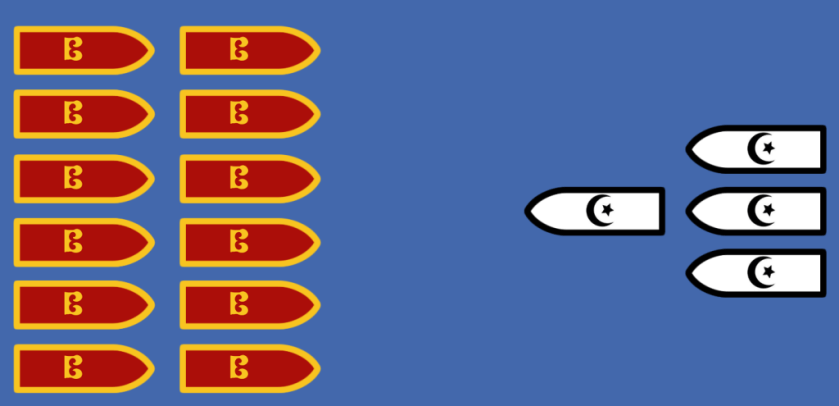
Then the wind dropped, and we said to the Byzantines: ‘Let us make peace between us and you.’ They said: ‘We will give you that, and in return we want peace.’ The Muslims also said to the Byzantines: ‘If you wish, we will go to the coast and fight there until victory is decreed for one of us, or if you wish, we will fight on the sea.’ Maik ibn Aws said: They all shouted as one: ‘No, on the sea!’
Thus it seemed to us that they were putting their trust in their naval experience and hoping for victory because of their skills and experience at sea, as they were used to it and its climate, so they hoped for a victory at sea, especially since they knew that the Muslims were new in this field.”[5]
Peace wasn’t an option because it would mean the Byzantines submitting to the Islamic authority. Thus with war inevitable, the Byzantines who had been seafarers for centuries and whose ships outnumbered the Muslims nearly 3 to 1, had the upper hand. Similar to Quraysh in the Battle of Badr, they believed their numbers and military superiority would gain them victory. How wrong they were!
The Muslim navy spent the night in dhikr and tahajjud seeking the help of Allah in what seemed an impossible mission. After leading the Muslims at Fajr, Abdullah ibn Sa’d gathered his senior officers for counsel. The Muslim’s strength was in fighting on land in hand-to-hand combat, so they devised a brilliant plan which would play to their advantage.
Abdullah ibn Sa’d ordered his ships to get as close as possible to the Byzantine ships which is why this was called Battle of the Masts due to the closeness of the masts. Some Muslim marines then jumped in the water and tied the ships together creating one large land mass on the sea. The battle then became hand-to-hand combat. Hourani mentions, “The tactics employed made it resemble a land battle, with the opposing vessels locked together and the men fighting with arrows and swords. This method of combat suited the Arab warriors.”[6]
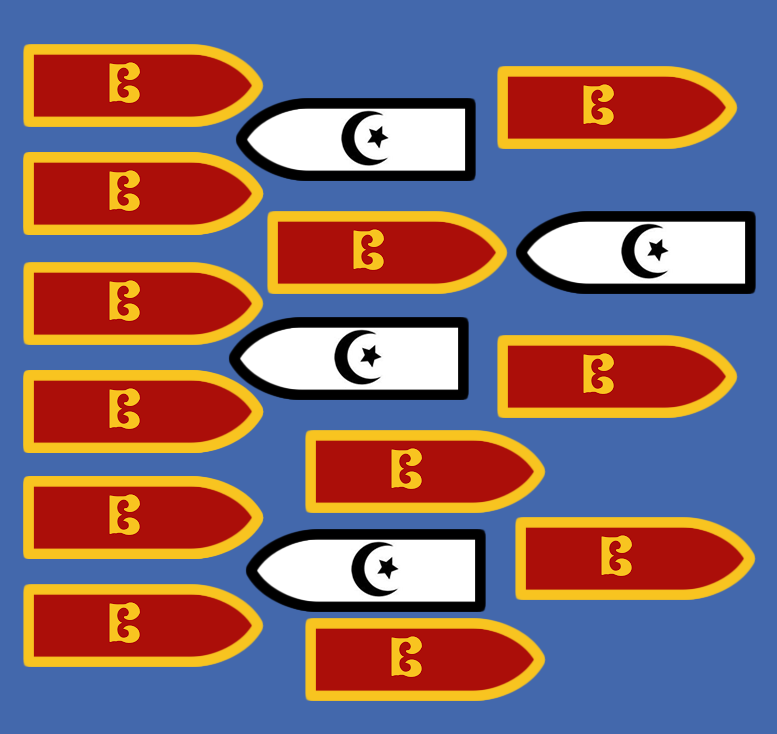
This was a fierce and chaotic battle which as Tabari described, “There was more blood than water in this battle.”[7] The Byzantines tried to isolate the Fleet Admiral’s ship by tying ropes to it and attempting to tow it away. A brave marine named ‘Ilqimah ibn Yazeed al-Ghutayfi sacrificed himself by jumping on the ropes and cutting them, saving Abdullah ibn Sa’d and the command ship.[8]
The Byzantine navy was finally defeated, with its ships destroyed and sailors laying dead in the water. Constans, seeing this destruction fled the battle and ended up in Sicily. When the local population found out about his defeat they said, “Christianity and its men are destroyed! If the Muslims want to invade, they will not find anyone to repel them!” They then killed him. Sicily became one of many Mediterranean islands that came under the authority of the Islamic State after this battle.
Aftermath
The Byzantine historian Theophanes the Confessor said, ‘This battle was a second Yarmouk for the Byzantines.’[9] This is because the battle of Yarmouk wiped out Byzantine dominance in Ash-Sham, and Dhaat Al-Sawaari wiped out Byzantine dominance in the Mediterranean.
The navy of the Islamic state then began conquering the Mediterranean islands one by one. Cyprus, Crete, Corsica, Sardinia and the Balearic Islands all fell to the Muslims.
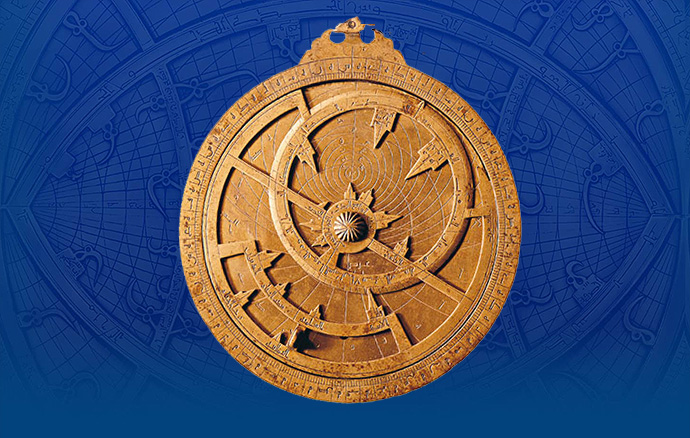
Muslim naval dominance of the Mediterranean continued for centuries and Muslim sailors became renowned for their naval expertise. They excelled in cartography and navigation and are credited with enhancing many naval inventions such as the Astrolabe and the lateen sail.
This is an extract from the article below.
Notes
[1] George Hourani, ‘Arab Seafaring in the Indian Ocean in Ancient and Early Medieval Times,’ Octagon Books, New York 1975, p.57
[2] David Nicolle, ‘The Muslim Conquest of Syria,’ Osprey Military, 1988, p.7
[3] Tareekh ibn Khaldoon, 2/468
[4] As-Sallabi, ‘The Biography of Uthman bin Affan,’ p.298
[5] Ibid
[6] Hourani, Op.cit., p.58
[7] Tareekh at-Tabari, 5/293 (Arabic original)
[8] As-Sallabi, ‘The Biography of Uthman bin Affan,’ p.300
[9] Ibid, p.299
 Islamic Civilization