All posts filed under: Caliphate

Liberation of Jerusalem: Salahudeen’s mercy towards the Crusaders

Salahudin Ayubi liberated Jerusalem (Al-Quds) on Friday 27 Rajab 583 AH/12 October 1187 CE after Lord Balian of Ibelin, the crusader commander in charge of Jerusalem, surrendered the city. This marked an end to nearly 100 years of crusader occupation and the liberation of Masjid Al-Aqsa. When the crusaders first entered Jerusalem in 1099, they massacred the Muslim and Jewish inhabitants, yet Salahudin on retaking the city never enacted revenge on them for this, nor the subsequent atrocities they had committed over the past century. He followed in the footsteps of the Prophet Muhammad ﷺ who on entering Makkah did not enact revenge on Quraish who had persecuted him and the Muslims for over 20 years. This was the because the character of the Prophet ﷺ was the Qur’an.[1] Allah ta’ala says, يَـٰٓأَيُّهَا ٱلَّذِينَ ءَامَنُوا۟ كُونُوا۟ قَوَّٰمِينَ لِلَّهِ شُهَدَآءَ بِٱلْقِسْطِ ۖ وَلَا يَجْرِمَنَّكُمْ شَنَـَٔانُ قَوْمٍ عَلَىٰٓ أَلَّا تَعْدِلُوا۟ ۚ ٱعْدِلُوا۟ هُوَ أَقْرَبُ لِلتَّقْوَىٰ ۖ وَٱتَّقُوا۟ ٱللَّهَ ۚ إِنَّ ٱللَّهَ خَبِيرٌۢ بِمَا تَعْمَلُونَ O believers! Stand firm for Allah and bear true testimony. Do not let …

A Poem on Muslim Unity by Sheikh Ibrahim an-Ni’mah

Sheikh Ibrahim an-Ni’mah was born in Mosul, Iraq, in 1361H/1942CE. His family lineage is related to the scholar Abdul Rahman bin Al-Jawzi, who died in the year 597H, who is related in lineage to Abu Bakr Al-Siddiq, the companion of the Messenger of Allah ﷺ. This poem is taken from his book, al-Wahdah al-Islamiyah bayna al-Ams wal Yawm (Islamic Unity between Yesterday and Today). لو اشتكى مسلٌم في الصين أرّقني … أو اشتكى مسلم في الهند أبكاني فمصر ريحانتي والشام نرجستي … وفي الجزيرة تاريخي وعنواني وفي العراق أكف المجد ترفعني … عن كل باغ ومأفون وخّوان ويسكن المسجد الأقصى وقبته … في القلب لا شك أرعاه ويرعاني أرى بخارى بلادي وهي نائية … وأستريح إلى ذكرى خراسان شريعة الله لمت شملنا وبنت … لنا مقاماً بإحسان وإيمان If a Muslim complains in China, a Muslim in India will feel pain and weep. Egypt is my sweet basil, Syria is my narcissus[1], and Arabia is my history and homeland. In Iraq I see my glorious past which makes me look down on every treacherous aggressor. …

Islamic Conquest of Damascus: Rule of law at the height of war

ذِمَّةُ اَلْمُسْلِمِينَ وَاحِدَةٌ يَسْعَى ِبهَا أَدْنَاهُمْ “The protection granted by one Muslim is like one given by them all, and this right is extended to the humblest of them.”[1] The Qur’anic character of the companions (sahaba) and early Muslims lead to their extraordinary restraint in the height of war, something virtually unheard of in modern warfare. The ‘civilised’ west, with all their talk of the rule of law, human rights and the Geneva convention have perpetrated according to Dr Gideon Polya a “Post-9/11 Muslim Holocaust & Muslim Genocide” where 30 million Muslims have been killed in avoidable deaths due to western, or western backed military intervention. There is no clearer example of this than the horrific ongoing genocide in Gaza, which America and its allies are actively financing, arming and providing cover for at the United Nations with their right of veto. As Samuel Huntington said, “The West won the world not by the superiority of its ideas or values or religion (to which few members of other civilizations converted) but rather by its superiority …

What is the meaning of “Allah prevents by the authority (sultan) what He does not prevent by the Qur’an”? 

إن الله يزع بالسلطان ما لا يزع بالقرآن Allah prevents by the authority (sultan) what He does not prevent by the Qur’an Sheikh Bin Baz answers this question: “This is a well-known narration on the authority of Uthman (ra) and it is proven on the authority of Uthman bin Affan, the third rightly-guided caliph (ra). It is also narrated on the authority of Umar (ra)…It means, Allah ta’ala prevents the committing of forbidden acts through the authority (sultan), more than what He prohibits by the Qur’an. Since some people are weak in faith (iman), the Qur’an’s prohibitions do not affect them. Rather, they resort to forbidden things and do not care. However, when they learn that there is a punishment from the authority, they become deterred and fear the authority’s punishment. The meaning of Allah punishes through the authority is that the authority’s punishments, punish some criminals more than what Allah punishes them through the Qur’an. Due to the weakness of their faith and their lack of fear of Allah ta’ala they fear the Sultan …

Late Ḥanafī Authorities on the Imamate

BY ASIM AYUB. This has been reproduced from Ummatics. This article presents four annotated translations of excerpts on Sharīʿa governance from “late” (post-7th century Hijri) classical Ḥanafi works in rational theology (kalām) and spiritual psychology (taṣawwuf).1 A previous piece was dedicated to earlier authorities in the school.2 Collectively, these excerpts are representative of the Ḥanafi position that the imamate, or caliphate, is a communal obligation of utmost importance. They express the reasoning for this—including an assessment of opposing heterodox views—as well as articulating the roles, benefits, and significance of the imamate. Most of the scholarly reflection on the imamate, despite it being a matter of positive law (fiqh), is found in theological works. For the Ḥanafīs, this means in works of Māturīdī theology. Our first passage, in turn, is from one such work by Kamāl al-Dīn al-Andakānī (d. 726/1325) in which he presents consensus as the textual proof for the obligation of imamate as well as a rational proof tied to its fulfilment of sociopolitical roles necessary for the Umma. The next two extracts exemplify the synthesis of the …

Jews in the Ottoman Caliphate

This article has been reproduced from caliphate1.com In 1492, when Spain’s rulers (Ferdinand II of Aragon and Isabella I of Castile) expelled its Jewish population as a result of the Spanish Inquisition and the Alhambra Decree, Sultan Bayazid II sent out the Ottoman Navy under the command of admiral Kemal Reis to evacuate them safely to Ottoman lands. He sent out proclamations throughout the Caliphate that the refugees were to be welcomed. He granted the Jews permission to settle in the Ottoman State and become Ottoman citizens and issued a firman (decree) to the governors of his European provinces to give them a friendly and welcome reception. “You venture to call Ferdinand a wise ruler,” he said to his courtiers, “he who has impoverished his own country and enriched mine!” [The Jewish Encyclopaedia – Vol. 2, Isadore Singer and Cyrus Adler, Funk and Wagnalls, 1912, p. 460] Bernard Lewis, in his scholarly overview entitled The Jews of Islam, documents how Jews lived, worked and flourished under Ottoman rule. For example, many Jews were experts in medicine: “The prominence …

Conditions of the Caliph: The Caliph must be capable of ruling

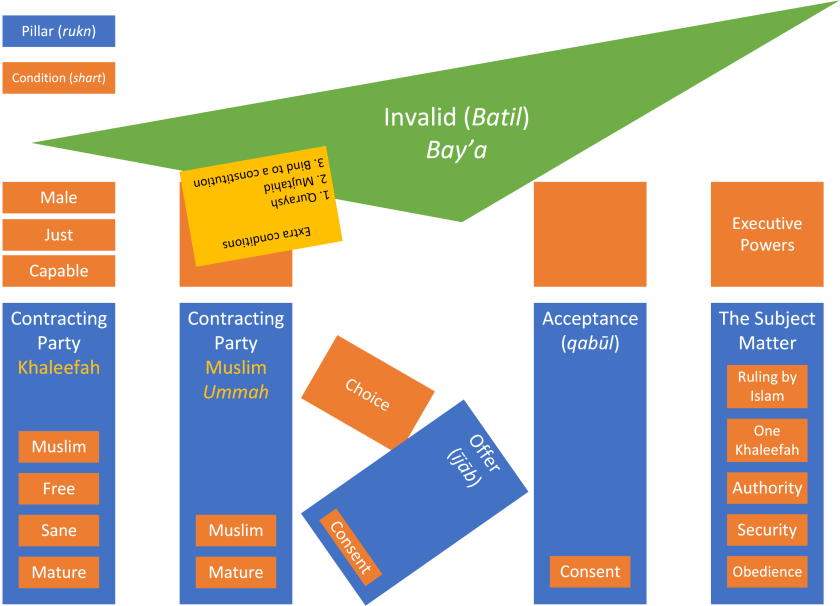
Al-Kifāyah الكِفايَة (competency or capability) is a condition (shart) of the bay’ah[1] because “Imamate is prescribed to succeed prophethood as a means of protecting the deen and of managing the affairs of this world,”[2] and the one contracted with this great responsibility must be capable of fulfilling the task. Although kifāyah is a general term which may apply to many areas of competency, in the context of the bay’ah, and as a condition of the Khaleefah, the scholars such as al-Mawardi, al-Ghazali and al-Juwayni all mentioned it in terms of capability to rule i.e. having a ruling mentality and disposition, and free from any disability which may affect his ability to fulfil the task of discharging people’s affairs. Other conditions related to kifāyah such as sanity, being free, mujtahid and brave were mentioned as separate conditions and pillars[3], even though they are all linked to the reality of the Khaleefah’s ability to run the state. Mona Hassan says, “The caliph’s ability to actually do so, termed kifāyah, is all that remains after al-Juwaynī’s process of …

The 10 principles of justice by Shehu Uthman Dan Fodio

Shehu Uthman Dan Fodio, (1754-1817) is the founder of the Sokoto Sultanate[1] which was established in 1804 in West Africa. This is an extract from his book Usul al-‘Adl ‘The Foundations of Justice for Legal Guardians, Governors, Princes, Meritorious Rulers, and Kings.’ Notes [1] The Sokoto Sultanate is also referred to as the Sokoto Caliphate, but since the Ottoman Caliphate was in existence and it’s prohibited to have more than one Caliph, Sultanate is a more appropriate term for the reality of this state, even if the term Caliphate was used. [2] Sahih Muslim 1826, https://sunnah.com/muslim:1826 [3] Holy Qur’an, Surah Al-i-‘Imran, ayah 159 [4] Sahih Muslim 1828a, https://sunnah.com/muslim:1828a [5] Sunan Abi Dawud 2948, https://sunnah.com/abudawud:2948 [6] Aisha Abdurrahman Bewley, ‘Democratic Tyranny and the Islamic Paradigm,’ Diwan Press, 1st edition, 2018, Kindle Edition, p.85

Uthman bin Affan’s bay’a: Binding the Caliph to a constitution

The bay’a is a contract and so it’s permitted to add additional conditions to the contract, as long as these conditions do not contradict the sharia. If the khaleefah agrees to these conditions then he cannot break them without agreement from those who contracted the bay’a to him from the Ahlul hali wal-aqd (people’s electoral representatives) on behalf of the ummah. Allah (Most High) says,يَـٰٓأَيُّهَا ٱلَّذِينَ ءَامَنُوٓا۟ أَوْفُوا۟ بِٱلْعُقُودِ “O you who believe, fulfil your contracts.”[1]

Does حُكْم (hukm) mean judging or ruling or both?

The term حُكْم (hukm) and its derivatives appear more than 250 times[1] in the Qur’an. Allah (Most High) says, إِنَّ ٱللَّهَ يَأْمُرُكُمْ أَن تُؤَدُّوا۟ ٱلْأَمَـٰنَـٰتِ إِلَىٰٓ أَهْلِهَا وَإِذَا حَكَمْتُم بَيْنَ ٱلنَّاسِ أَن تَحْكُمُوا۟ بِٱلْعَدْلِ Allah commands you to return to their owners the things you hold on trust and, when you judge between people, to judge with justice.[2] يَـٰدَاوُۥدُ إِنَّا جَعَلْنَـٰكَ خَلِيفَةًۭ فِى ٱلْأَرْضِ فَٱحْكُم بَيْنَ ٱلنَّاسِ بِٱلْحَقِّ وَلَا تَتَّبِعِ ٱلْهَوَىٰ فَيُضِلَّكَ عَن سَبِيلِ ٱللَّهِ Oh Dawud! We have made you a khaleefah on the earth, so judge between people with truth and do not follow your own desires, letting them misguide you from the Way of Allah.[3] وَمَنْ لَمْ يَحْكُمْ بِمَا أَنْزَلَ اللَّهُ فَأُولَٰئِكَ هُمُ الْكَافِرُونَ “Those who do not judge by what Allah has sent down, such people are disbelievers (kafirun).”[4] In most English translations as you can see, hukm is translated as judgement because the Arabic dictionary definition of hukm includes القَضاء (al-qadaa’) which means to issue a decree or judge. In Lisan al-Arab (1290CE):  والحُكْمُ: العِلْمُ وَالْفِقْهُ وَالْقَضَاءُ بِالْعَدْلِ، وَهُوَ مَصْدَرُ …