Latest Posts

Administrative Divisions of the Prophet’s ﷺ State in Medina

  1. The 12 Naqibs
  2. Sahifat al-Medina
  3. Al-Aws and Al-Khazraj (Ansar)
  4. Jewish Tribes
  5. The First Major Province
  6. Notes

The sunnah consists of the speech, actions and consent of the Prophet ﷺ. It is a fundamental source of Islamic Law (sharia) from which we guide our actions.[1] The sunnah is not just restricted to ‘ibadat (worships) but covers all aspects of life, state and society. Allah ta’ala says,

وَمَآ ءَاتَىٰكُمُ ٱلرَّسُولُ فَخُذُوهُ وَمَا نَهَىٰكُمْ عَنْهُ فَٱنتَهُوا۟

“Whatever the Messenger gives you, take it. And whatever he forbids you from, leave it.”[2]

The relative pronoun (مَا) is ‘aam (general) and means “whatever” so we do not restrict the sunnah to one sphere of life only. Today siyasa sharia (Islamic politics) is a neglected sunnah and an area which requires greater scrutiny and study to guide us through the maze of modern political life.

In regards to the Islamic ruling system, the speech and actions of the Prophet ﷺ in Medina related to government are a divine evidence (شَرْع دَلِيل  shara’ daleel) for us to follow.

The 12 Naqibs

When the Prophet Muhammad ﷺ first established the state in Medina, the existing tribal structure was used to administer the state. The Aws and Khazraj tribes whom Islam united together as the Ansar (helpers), were sub-divided into various clans who managed their own administrative affairs as devolved ‘mini-provinces’.

The chiefs (naqibs) of these clans were not appointed by the Prophet ﷺ, but rather ‘elected’ by the tribes themselves on his ﷺ orders. Ka’b ibn Malik narrates that the Prophet ﷺ said,

أَخْرِجُوا إلَيَّ مِنْكُمْ اثْنَيْ عَشَرَ نَقِيبًا، لِيَكُونُوا عَلَى قَوْمِهِمْ بِمَا فِيهِمْ. فَأَخْرَجُوا مِنْهُمْ اثْنَيْ عَشَرَ نَقِيبًا، تِسْعَةً مِنْ الْخَزْرَجِ، وَثَلَاثَةً مِنْ الْأَوْسِ.

أَسَمَاءُ النُّقَبَاءِ الِاثْنَيْ عَشَرَ وَتَمَامُ خَبَرِ الْعَقَبَةِ

“Bring out to me from among you twelve chiefs (naqibs), so that they may be in charge of their people and whatever is in them.” So they brought out from among them twelve chiefs, nine from the Khazraj, and three from the Aws.[3]

He ﷺ said to the Naqibs:

أنتم على قومكم بما فيهم كفلاء ككفالة الحواريين لعيسى بن مريم، وأنا كفيل على قومي

“You are responsible for your people and what is in them, just as the disciples were responsible for Jesus, son of Mary. I am responsible for my people.”[4]

“The Naqib means: عريفُ القوم يتعرف أخبارهم وينقب “the leader (‘arif) of the people who learns their news and investigates.”[5]

Al-Asamm (d. 852 CE) says,

هُمُ المَنظُورُ إلَيْهِمْ والمُسْنَدُ إلَيْهِمْ أُمُورُ القَوْمِ وتَدْبِيرُ مَصالِحِهِمْ

“They (naqibs) are the ones who are looked to and entrusted with the affairs of the people and the management of their interests.”[6]

The 12 Naqibs[7]

No.NameTribeService to Islam
1Abu Umama As’ad bin ZuraraKhazrajDied before Badr. One of the original six who became Muslim at hajj one year before.
2Rafi’ bin MalikKhazrajOne of the original six who became Muslim at hajj one year before.
3Ubada ibn al-SamitKhazrajCommander at Badr. Teacher and Judge in Ash-Sham under Umar ibn Al-Khattab.
4Sa’d bin al-Rabi’KhazrajBattle of Badr, martyred at Uhud
5Abd Allah bin RawahaKhazrajBattles of Badr, Uhud, Khandaq. Commander of the Battle of Mu’tah where he was martyred.
6al-Bara’ bin Ma’rurKhazrajFirst to give 2nd bay’ah of Aqaba. He died before the arrival of the Prophet ﷺ in Medina.
7Abd Allah bin ‘Amr bin HaramKhazrajBattle of Badr, martyred at Uhud
8Sa’d ibn UbadahKhazrajCandidate for post of Caliph at the Saqifah of his clan after Prophet’s ﷺ death.
9al-Mundhir bin ‘AmrKhazrajBattles of Badr, Uhud. Commander at Bi’r Ma’una where he was martyred.
10Usaid bin HudairAwsCommander of Aws at Uhud, Hunayn and Tabuk. Part of bay’ah contract to Abu Bakr at the Saqifah.
11Sa’d ibn KhaithamahAwsMartyred at Badr
12Rifa’ah ibn ‘Abd al-Mundhir ibn ZunayrAwsBattle of Badr

Sahifat al-Medina

Early in the formation of the state, the Prophet ﷺ drew up a charter called the Sahifat al-Medina, which was similar to a modern-day constitution. This document defined the relationships and responsibilities of the various tribes in Medina who made up the Islamic society. Muhammad Al-Massari says, “We also observe, through a mere reading of the Sahifa, that it represents, in its sum, constitutional texts which regulate the relationship between the different groups of a society which has been formed upon a tribal basis, where tribes represent important units and each tribe is equivalent to a state.”[8]

The Sahifa treaty “mentioned 40 subtribes or clans by name, and stated that each tribe will carry the responsibilities of its members; they will oversee their own blood-money disputes, prisoners of war, and the poor and needy.”[9] In other words the Prophet ﷺ devolved some ruling powers to these clans a process known in modern times as devolution.

An example of one of these clauses is Banu Sa‘ida, a sub-tribe of Khazraj headed by Sa’d ibn Ubadah, where the famous bay’ah to Abu Bakr was conducted after the Prophet’s ﷺ death. The Sahifa stated:

“Banu Sa‘ida shall be responsible for their own ward (مَعاقِلهم), and shall pay their blood-money in mutual collaboration and every group shall secure the release of its own prisoners by paying their ransom from themselves, so that the dealings between the believers be in accordance with the principles of goodness and justice.”[10]

It is clear from the Sahifa and the command of the Prophet ﷺ: أَخْرِجُوا إلَيَّ مِنْكُمْ اثْنَيْ عَشَرَ نَقِيبًا، لِيَكُونُوا عَلَى قَوْمِهِمْ بِمَا فِيهِمْ “Bring out to me from among you twelve chiefs (naqibs), so that they may be in charge of their people and whatever is in them,” that these naqibs had full powers over their clans as indicated by the relative pronoun (مَا) which is ‘aam (general) and means “whatever”. This is an evidence (شَرْع دَلِيل  shara’ daleel) for elected governors as we will discuss in due course.

Since these naqibs were only amirs of a clan (district in modern speak), their powers would exclude anything to do with policies related to the common security and well-being of the state such as taxation and military expeditions. The sub-tribes would assist in these common issues such as participation in the battles as the Sahifa constitution of Medina outlined, but they would have no autonomy to pursue their own agendas separate to that of the Prophet ﷺ. No military expedition ever took place without the direct command and consent of the Prophet ﷺ who was the commander-in-chief, except that of Abu Basir who was outside the authority and jurisdiction of the Prophet’s ﷺ state at the time. The Sahifa states:

وَإِنَّهُمْ يَنْصُرُونَ بَعْضُهُمْ بَعْضًا عَلَى مَنْ دَهَمَ يَثْرِبَ

“And they (the signatories) support one another against whoever attacks Yathrib [Medina].”[11]

Al-Aws and Al-Khazraj (Ansar)

Prior to Islam, Sa’d ibn Mu’adh and Usaid bin Hudair were the chiefs (sayyid) of Banu Abd Al-Ashhal, a sub-tribe of Al-Aws.[12] Although Usaid bin Hudair was the ‘elected’ Naqib of Banu Abd Al-Ashhal, Sa’d ibn Mu’adh was the overall leader of Al-Aws. Sa’d ibn Ubadah, the Naqib of Banu Sa‘ida was the overall leader of Al-Khazraj[13], and both Sa’ds would represent the opinions of the Ansar as a whole. After the Prophet ﷺ passed away the Ansar’s candidate for the caliphate was Sa’d ibn Ubadah, and the bay’ah took place at his Saqifa (portico) because Sa’d ibn Mu’adh had passed away after the Battle of Khandaq in 5 Hijri.

At the Battle of Badr, Sa’d ibn Mu’adh carried the flag (liwaa’) of Al-Aws and since Sa’d ibn Ubadah was back in Medina protecting the city, Sa’d ibn Mu’adh represented the opinion of the entire Ansar, both Al-Aws and Al-Khazraj. Before the battle the Prophet ﷺ said to the sahaba, “Advise me, people!” When the Messenger of Allah ﷺ said that, Sa’d ibn Mu’adh said to him: “By Allah, it seems that you mean us [Ansar], O Messenger of Allah?” He ﷺ said: “Yes.”[14]

After the expedition of al-Muraysī’ in 627CE (5 AH), the munafiqun (hypocrites) concocted a malicious slander (ifk) against ‘Aisha (ra), the mother of the believers, and beloved wife of the Prophet ﷺ. The head of the munafiqun was Abd Allah ibn Ubayy ibn Salul, who was one of the prominent members of Al-Khazraj. The Prophet ﷺ gathered the Muslims in the Masjid and delivered a sermon exposing Abd Allah ibn Ubayy’s lies. Sa’d ibn Mu’adh of Al-Aws, stood up and said if he was from his tribe i.e. Al-Aws then he would execute him. However, if he was from another tribe (state) in this case Al-Khazraj, then he would need permission to do that since he had no authority over Al-Khazraj. This is an indication of the administrative setup and devolved powers of the various tribes of Medina.

‘Aisha narrates that the Messenger of Allah ﷺ addressed the sahaba in the Masjid saying, “O group of Muslims, who will excuse me from a man who has harmed my family? I have been informed about him. By Allah, I have never known anything about my family except good. They have mentioned a man about whom I have never known anything except good, and he never enters upon my family except with me.” She said, then Sa’d ibn Muadh, the brother of Banu Abd al-Ashhal, said: “O Messenger of Allah, I excuse you. If he is from Al-Aws, I will strike his neck, and if he is from our brothers from Al-Khazraj, you order us and we will do what you order.”[15]

Jewish Tribes

The tribes of Medina were not just Muslim. There were a number of Jewish tribes, and they also managed their own affairs except in matters of common security and disputes with the Muslims. “The treaty clarified that the Jewish nation is responsible for all its internal affairs, such as internal disputes, blood-money, and the poor and needy, as aforementioned. However, if there are disputes between the two nations (i.e., the Jews and Muslims), it will be deferred to the judgement of the Prophet ﷺ. The Jews therefore enjoyed semi-independent statehood within the Islamic state.”[16]

The Prophet ﷺ did not appoint separate Amirs over the Jewish tribes, or establish mosques within them, or force Muslims to move and live among them. This clearly shows that there was no agenda to dilute or pressure these communities to ‘Islamicise’ in a religious and cultural sense. Only in relation to the common security and overarching interests of the state, were they obliged to obey the Prophet ﷺ, something they renegaded on time after time jeopardising the security of Medina and leading to their eventual expulsion from Hejaz. The Sahifa states:

وَإِنَّ الْيَهُودَ يُنْفِقُونَ مَعَ الْمُؤْمِنِينَ مَا دَامُوا مُحَارَبِينَ

“And the Jews spend with the believers as long as they are at war.”[17]

This independence of the dhimmi (non-Muslim citizens) in their religious and communal matters continued throughout the caliphate’s history, and old churches and synagogues can still be seen to this day in the Christian and Jewish quarters of many Muslim countries.

This use of the tribal structure to administer the state on a local level continued throughout the lifetime of the Prophet ﷺ.

The First Major Province

After the Treaty of Hudaibiyah (628CE/6Hijri), the state dramatically expanded, and the city-state model transformed into an ‘empire’ model where vast regions of Arabia became part of the Islamic State. The first of these new territories was Yemen under Bādhān ibn Sāsān the former Persian governor. Yemen was the first major province (wiliyah) of the state with Bādhān its first appointed governor (wali). The Wali or Amir as he was more commonly known, would be the top-level official in the province with the tribal chiefs operating at a local level beneath him. The Amir would never interfere in the local affairs of the tribes or appoint their heads. It was left to the members of the tribe to ‘elect’ or consent to whomever they wished to be their tribal chief.

Notes


[1] Muhammad Hussein Abdullah, ‘Al-Waadih Fee Usool ul-Fiqh,’ 1995, First Translated English Edition 2016, p.94

[2] Holy Qur’an, Surah Al-Hashr, ayah 7

[3] Ibn Hisham, narrated by Ka’b ibn Malik, https://shamela.ws/book/23833/466

[4] Ibn Kathir, Al-Bidaya wa l-Nihaya, https://shamela.ws/book/23708/855

[5] Muhammad Hassan Hassan Jabal, ‘The etymological dictionary of the words of the Holy Qur’an,’  https://tafsir.app/ishtiqaqi/%D9%86%D9%82%D8%A8

[6] https://tafsir.app/alrazi/5/12

[7] Ibn Hisham, narrated by Ka’b ibn Malik, https://shamela.ws/book/23833/466

[8] Dr Muhammad Al-Massari, ‘The Prophetic Constitution of Madinah,’ Hizb Al-Tajdeed, p.163

[9] Yasir Qadhi, ‘The Sirah of the Prophet ﷺ,’ The Islamic Foundation, 2023, Treaty of Medina

[10] Ibn Hisham, https://shamela.ws/book/23833/525#p1

[11] Ibn Hisham, https://shamela.ws/book/23833/527

[12] Ibn Hisham, https://shamela.ws/book/23833/459#p1

[13] Sahih al-Bukhari 4141, https://sunnah.com/bukhari:4141

[14] Ibn Hisham, https://shamela.ws/book/23833/638

[15] Sahih al-Bukhari 4141, https://sunnah.com/bukhari:4141

[16] Yasir Qadhi, ‘The Sirah of the Prophet ﷺ,’ The Islamic Foundation, 2023, Treaty of Medina

[17] Ibn Hisham, https://shamela.ws/book/23833/527
Devolution in the Islamic State of Prophet Muhammad ﷺ

The devolving of the ruler’s executive powers to the provinces while keeping others with the central government, has its origins in the first Islamic State of the Prophet ﷺ.

We already mentioned the Sahifa and the ‘election’ of 12 Naqibs who managed the subtribes of the Ansar as mini-provinces. The Sahifa “mentioned 40 subtribes or clans by name, and stated that each tribe will carry the responsibilities of its members; they will oversee their own blood-money disputes, prisoners of war, and the poor and needy.”[1] This is one evidence.

As the state expanded most notably to Yemen, after the former Persian governor Bādhān ibn Sāsān embraced Islam, he ﷺ appointed separate judges and new governors of the districts. Ali ibn Abi Talib was appointed as Qadi (judge) for Yemen. It was narrated that ‘Ali ibn Abi Talib said:

عَنْ عَلِيٍّ، رَضِيَ اللَّهُ عَنْهُ قَالَ بَعَثَنِي رَسُولُ اللَّهِ صَلَّى اللَّهُ عَلَيْهِ وَسَلَّمَ إِلَى الْيَمَنِ فَقُلْتُ إِنَّكَ تَبْعَثُنِي إِلَى قَوْمٍ وَهُمْ أَسَنُّ مِنِّي لِأَقْضِيَ بَيْنَهُمْ فَقَالَ اذْهَبْ فَإِنَّ اللَّهَ سَيَهْدِي قَلْبَكَ وَيُثَبِّتُ لِسَانَكَ

“The Messenger of Allah ﷺ sent me to Yemen. I said: ‘You are sending me to people who are older than me for me to judge between them.’ He said: ‘Go, for Allah will guide your heart and make your tongue steadfast.’[2]

After the death of Yemen’s central governor Bādhān ibn Sāsān, the Prophet ﷺ split Yemen in to two provinces and appointed a sahabi over each. It seems that this was to teach the sahaba the skills of ruling because one large province would be too much for an inexperienced ruler to govern. Abu Burda narrates,

عَنْ أَبِي بُرْدَةَ، قَالَ بَعَثَ رَسُولُ اللَّهِ صلى الله عليه وسلم أَبَا مُوسَى وَمُعَاذَ بْنَ جَبَلٍ إِلَى الْيَمَنِ، قَالَ وَبَعَثَ كُلَّ وَاحِدٍ مِنْهُمَا عَلَى مِخْلاَفٍ قَالَ وَالْيَمَنُ مِخْلاَفَانِ

“The Messenger of Allah ﷺ sent Abu Musa and Mu’adh bin Jabal to Yemen. He sent each of them to administer a province (مِخْلاَفٍ) as Yemen consisted of two provinces.”[3]

Farwah ibn Musaik, was a former senior figure in the powerful Kinda tribe in Yemen. After accepting Islam, the Prophet ﷺ appointed him as a governor (‘amil) of three Yemeni tribes (districts) – Murad, Zubayd, and Madhhij, but appointed a separate official – Khalid ibn Sa’id – in charge of taxation.[4] Ibn Hisham narrates,

وَاسْتَعْمَلَهُ النَّبِيُّ صَلَّى اللهُ عَلَيْهِ وَسَلَّمَ عَلَى مُرَادَ وَزُبَيْدٍ وَمَذْحِجٍ كُلِّهَا، وَبَعَثَ مَعَهُ خَالِدَ بْنَ سَعِيدِ بْنِ الْعَاصِ عَلَى الصَّدَقَةِ

“The Prophet ﷺ appointed him [Farwah ibn Musaik] over Murad, Zubayd, and Madhhij, and sent Khalid ibn Sa’id ibn al-‘As with him to collect the saqadah.”[5]

In the 9th year of the Hijra known as the “Year of Delegations” (عَامُ الوُفُود – ʻĀm al-Wufūd), the Prophet ﷺ sent a letter to the Christians of Najrān who were part of the tribe Banū al-Ḥārith ibn Kaʿb in Yemen inviting them to Islam, and if they refuse then to pay the jizya tax and live as a semi-autonomous community within the Islamic State but subject to the law of the land in mu’amilat (transactions) and common security.

In the letter sent from the Prophet ﷺ to the Christians of Najrān detailing the conditions of the dhimmah treaty, he wrote:

“This is the document of security (dhimmah) from Muhammad the Prophet of Allah to the people of Najrān, for their persons, their religion, their land, their property, and their community, those who are present among them and those who are absent, and their bishops and monks, and all that they possess, small or great.

They shall not be forced from their religion, nor their rights diminished, nor their priests removed from their offices. No oppression shall befall them.

They are obliged to pay what has been agreed upon as tribute (jizyah): two thousand garments every year — one thousand in the month of Rajab, one thousand in the month of Ṣafar — along with thirty coats of armor, thirty horses, thirty camels, and thirty weapons, to be delivered when war breaks out in Yemen.

In return, they are under the protection of Allah and His Prophet Muhammad. No bishop or monk shall be removed, nor shall they be compelled to abandon their faith, nor shall their rights be altered.

No usurer shall be allowed among them, and no interest (ribā) shall be taken in dealings with them.”[6]

This treaty states that they are subject to the law of the land with regard to the absolute prohibition of interest (riba) and their military affairs are managed by the Prophet ﷺ as commander-in-chief who will protect them. When war breaks out, they will contribute to the war effort (common security) by armour, horses, camels and weapons. Also they will not allow a foreign army to enter their province as this would affect the common security of the state.[7]

This is similar to how the Prophet ﷺ dealt with the Jewish tribes within and outside Medina when he first established the state as detailed in the Sahifa.

Although the majority of Najrān’s residents remained Christian, a sizeable portion converted to Islam. The Prophet ﷺ therefore appointed Amr ibn Hazm al-Ansari as the governor of Najrān to manage the religious affairs of the Muslims there. “After the delegation of the Banū al-Ḥārith ibn Kaʿb returned, the Messenger of Allah sent Amr ibn Hazm al-Ansari and later someone from the Band al-Najjar[8] to instruct them in religion, to teach them the sunnah and the requirements of Islam, and to collect alms from them.”[9]

The Prophet ﷺ gave him a written document (ṣaḥīfah) outlining instructions on religious duties, legal rulings, zakat, inheritance, blood money (diyah), and other matters. This document is often called “Ṣaḥīfat Amr ibn Hazm” and is considered one of the earliest recorded legal documents in Islamic history. In terms of devolved powers Amr ibn Hazm would be considered a Wali ‘Amm having control of taxation, judiciary and education, but not the military as this power was never devolved to the provinces.

These are clear evidences (daleel) from the sunnah for devolution.

Notes


[1] Yasir Qadhi, ‘The Sirah of the Prophet ﷺ,’ The Islamic Foundation, 2023, Treaty of Medina

[2] Musnad Ahmad 1342, https://sunnah.com/ahmad:1342

[3] Sahih al-Bukhari 4341, 4342, https://sunnah.com/bukhari:4341

[4] In Yemen, the state only levied taxes on trading goods and agricultural produce. These are known as ‘ushr which is zakat, and falls under the general heading of saqadah.

[5] Ibn Hisham, https://shamela.ws/book/23833/1320

[6] Ibn Hishām, al-Sīrah al-Nabawiyyah, vol. 1, p. 575–577 (ed. Suhayl Zakkār).

[7] This part of the treaty is mentioned in other sources such as Abu Ubayd, Kitab Al-Amwal, https://shamela.ws/book/12999/465 

[8] Amr ibn Hazm was also from Banu Al-Najjar

[9] Abu Ja`far Muhammad b. Jarir al-Tabari, ‘The History of Al-Tabari’, translation of Ta’rikh al-rusul wa’l-muluk, State University of New York Press, Vol.14, p.85

Devolution in an Islamic State: Judiciary

As the Islamic State of the Prophet ﷺ expanded, new officials of state were appointed to manage the ever-growing tasks especially in the new provinces. Once Yemen had joined the state under Bādhān ibn Sāsān, the Prophet ﷺ appointed separate judges to the province notably Ali ibn Abi Talib and Mua’th ibn Jabal. The judiciary was therefore a centralised institution in the time of the Prophet ﷺ, a situation which continued throughout the time of the Rightly Guided Caliphs and beyond although sometimes this was devolved to the governor if he was qualified. Al-Sallabi says, “Among these [governors] were some whom ‘Umar [ibn a-Khattab] kept as judges as well as appointing them as governors, as he did with Mu‘awiyah, and some from whom he took away the role of judge and limited them to their role as governor, as he did with al-Mugheerah and Abu Moosa al-Ash‘ari.”[1]

This appointment of judges by the central government does not mean judicial independence was absent from the state. Sovereignty in an Islamic State is to the sharia, so judges would settle disputes according to the law, and not through political pressure from either the caliph or any other Amir.

Noah Feldman describes this situation, “It [the law] was analyzed, discussed, applied, discovered, and (an outsider would say) made by the members of a distinct social-political grouping known as the scholars, or in Arabic ‘ulama. From this scholarly class came not only theologians and other intellectuals but the appointed judges who decided concrete cases and independent jurists who opined as to the meaning of the law. Through their near monopoly on legal affairs in a state where God’s law was accepted as paramount, the scholars-especially those of them who focused on law-built themselves into a powerful and effective check on the ruler.”[2]

During the caliphate of Mu’awiya, Usaid bin Zubair[3] Al-Ansari, was the governor (‘Amil) of Al-Yamamah, and Marwan wrote to him saying that Mu’awiyah had written to him, saying that any man who had something stolen from him had more right to it wherever he found it. Then Marwan wrote saying that to me (Usaid).

I wrote to Marwan saying that the Prophet had ruled that if the one who bought it from the one who stole it is not guilty of anything (and did not realize that it was stolen goods), then the owner has the choice: If he wishes, he may buy it from the one who bought it from the thief, or if he wishes he may go after the thief. Abu Bakr, ‘Umar and ‘Uthman also passed judgment along these lines.

Marwan sent my letter to Mu’awiyah, and Mu’awiyah wrote to Marwan (saying): “Neither you nor Usaid are in a position to tell me what to do, rather I am the one who tells you what to do because I am superior in rank to you, so do what I tell you.” Marwan sent the letter of Mu’awiyah to me, and I said: “I will not judge according to Mu’awiyah’s opinion as long as I am the governor.”[4]

The most famous example of judicial independence is that of Shurayh (d.78 AH/697 CE), the chief justice of Kufa who was first appointed by Umar ibn Al-Khattab. Shurayh was kept in his position until he died. He was the judge under the reign of Uthman, Ali, Hasan, Mu’awiya, Yazid, Al-Mukhtar, Abdullah ibn Al-Zubayr and Abdul-Malik ibn Al-Marwan. Across the political spectrum and under multiple caliphs they kept him in his position because it was an established precedent that the ‘ulema should maintain their independence as Feldman mentions.

Qadi Shurayh famously ruled against Ali ibn Abi Talib when he was caliph in the case of the Jewish man who stole Ali’s armour. The Jew said, “The Amir al-Mu’minin brought me before his Qadi, and his Qadi gave judgement against him. I witness that this is the truth, and I witness that there is no god but Allah and I witness that Muhammad is the Messenger of Allah, and that the armour is your armour.”[5]

Notes


[1] Al-Sallabi, ‘Umar ibn al-Khattab, his life and times,’ vol.1, p.496

[2] Noah Feldman, ‘The Fall and Rise of the Islamic State,’ Princeton University Press, 2008, p.6

[3] The hadith mentions the name as Usaid ibn Hudair but this is a mistake as Al-Albani points out in his book As-Silsilah As-Sahihah https://shamela.ws/book/9442/1108#p1

[4] Sunan an-Nasa’i 4680, https://sunnah.com/nasai:4680

[5] Jalal ad-Din as-Suyuti, ‘History of the Khalifahs who took the right way,’ translation of ‘Tarikh al-Khulafa,’ Ta Ha Publishers, p.139

Devolution in an Islamic State: Finance

State revenues and expenditure were always centralised even if the governor had full devolved powers over the collection and distribution of funds, because he was expected to send the tax revenues to the central caliphal government. From the time of Mu’awiya, a central Diwan Al-Kharaj (ministry of taxation) was established headed by a secretary (sahib). Ibn Khaldun describes this institution:

“The ministry of taxation is an office that is necessary to the royal authority (mulk). It is concerned with tax operations. It guards the rights of the dynasty in the matters of income and expenditure. It takes a census of the names of all soldiers, fixes their salaries, and pays out their allowances at the proper times. In this connection recourse is had to rules set up by the chiefs of (tax) operations and the stewards of the dynasty. They are all written down in a book which gives all the details concerning income and expenditure. It is based upon a good deal of accounting, which is mastered only by those who have considerable skill in (tax) operations. The book is called the diwân. At the same time, (the word dîwân) designates the place where the officials concerned with these matters have their offices.

One person is in charge of this office. He supervises all the operations of this kind. Each branch has its own supervisor. In some dynasties supervision of the army, of military fiefs, of keeping count of allowances, and of other (such) things, is constituted as separate offices.”[1]

The main taxes which existed from the time of the Prophet ﷺ and Rightly Guided Caliphs were: ZakahGhaneemah (war booty), Fai’ (spoils of war), Jizya (head tax on non-Muslim men), Kharaj (land tax), ‘Ushr (zakah land tax) and Maks (customs duty).

We can see from the Prophet’s ﷺ state in Medina that he appointed separate tax collectors (‘ummal) to collect the funds from the various provinces and tribes.

After his conversion to Islam, Al-Ḥārith ibn Abī Ḍirār, who was the leader of Banu al-Muṣṭaliq, collected the zakat from the Muslim members of his tribe and waited for the Prophet ﷺ to send an ‘amil to collect them. The Messenger of Allah ﷺ sent al-Walid ibn Uqbah to Al-Harith to collect the Zakah, but after Al-Walid had travelled some distance, he became disoriented, and returned back to the Messenger of Allah ﷺ and lied saying: “O Messenger of Allah, Al-Harith has prevented me from paying Zakat and wants to kill me!” This led to the Messenger of Allah ﷺ sending a delegation to bring Al-Ḥārith to him to explain himself. The Messenger of Allah ﷺ said: “You withheld the zakat and wanted to kill my messenger?” Al-Ḥārith said: “No, by the One Who sent you. In truth, I did not see him, nor did he come to me. I did not come until the messenger of the Messenger of Allah ﷺ detained me. I feared that it was the wrath of Allah, the Almighty, and His Messenger.”[2] This led to the verse in Surah Al-Hujurat being revealed:

يَـٰٓأَيُّهَا ٱلَّذِينَ ءَامَنُوٓا۟ إِن جَآءَكُمْ فَاسِقٌۢ بِنَبَإٍۢ فَتَبَيَّنُوٓا۟ أَن تُصِيبُوا۟ قَوْمًۢا بِجَهَـٰلَةٍۢ فَتُصْبِحُوا۟ عَلَىٰ مَا فَعَلْتُمْ نَـٰدِمِينَ

O believers, if an evildoer brings you any news, verify ˹it˺ so you do not harm people unknowingly, becoming regretful for what you have done.[3]

When Abu Bakr became the caliph, he faced widespread rebellion from various provinces and tribes over their refusal to pay zakah to the central government. Abu Bakr then prepared to fight them until they came back to the jama’ah (authority) of the Muslims. This is known as the Ridda Wars. Abu Bakr famously said in justifying his policy of fighting the breakaway provinces:

فَقَالَ وَاللَّهِ لأُقَاتِلَنَّ مَنْ فَرَّقَ بَيْنَ الصَّلاَةِ وَالزَّكَاةِ، فَإِنَّ الزَّكَاةَ حَقُّ الْمَالِ، وَاللَّهِ لَوْ مَنَعُونِي عَنَاقًا كَانُوا يُؤَدُّونَهَا إِلَى رَسُولِ اللَّهِ صلى الله عليه وسلم لَقَاتَلْتُهُمْ عَلَى مَنْعِهَا‏

“By Allah, I will fight whoever differentiates between prayer and zakat, for zakat is a right due from wealth. By Allah, if they withhold from me a young camel which they used to give to the Messenger of Allah ﷺ I will fight them for withholding it.”[4]

This shows that Zakah is collected and distributed by the state through its official tax collectors in the province, in the same way as the other taxes.[5]

Zakah is a special type of tax, which is restricted in its distribution to eight categories only and cannot be used for the general finances of the state. As the state expanded the ‘ulema generally favoured local distribution of the zakah revenues rather than sending them centrally like the other taxes. This was especially true since much of the zakah would be in the form of crops and livestock which could not be transported across vast differences. Sheikh Haitham comments on this: “The four main schools of thought have given preference to distributing Zakat within the vicinity of where it is collected. The basis for this is the well-known instruction of the Prophet ﷺ to his companion Mu’āth b. Jabal (Allāh be pleased with him), when he sent him to Yemen. He said to him that once they establish the prayer, inform them that Allāh has commanded that there is an amount of charity to be taken from their wealthy people and given to their poor people.[6] The scholars took from the phrase “to their poor” that it should be given to the people who live in the vicinity of the wealth. They defined this to be those who live within a distance beyond which a person travelling is considered technically a Musāfir (traveler whose prayers are shortened).

However, proximity is just one consideration. All scholars agreed that if the need in an area far away is greater, it is better to give it where the need is more dire.  This is a profound example of how jurists consider multiple dimensions when issuing rulings on such matters.”[7]

With regards to the other taxes, it is narrated that Abu Hurayrah said: “We were with the Messenger of Allah in the year of Khaibar, and we did not get any spoils of war (ghaneema) except for wealth, goods and clothes. Then a man from Banu Ad-Dubaib, who was called Rifa’ah bin Zaid, gave the Messenger of Allah a black slave who was called Mid’am. The Messenger of Allah set out for Wadi Al-Qura. When we were in Wadi Al-Qura, while Mid’am was unloading the luggage of the Messenger of Allah, an arrow came and killed him. The people said: “Congratulations! You will go to Paradise,” but the Messenger of Allah ﷺ said: “No, by the One in Whose hand is my soul! The cloak that he took from the spoils of war on the Day of Khaibar is burning him with fire.” When the people heard that, a man brought one or two shoelaces to the Messenger of Allah and the Messenger of Allah ﷺ said: “One or two shoelaces of fire.”[8]

Ghaneema (money, weaponry, goods, provisions, etc. from the place of war) is a revenue of the Islamic State. Stealing from the state funds like the rulers do today entails a severe punishment. Mid’am ordinarily would have been a shaheed (martyr) which is why the sahaba congratulated him, but instead he was punished in the grave for stealing from the state funds. This created an atmosphere where another Muslim came forward giving up two shoelaces voluntarily once he heard of the punishment.

Therefore, a person cannot take it upon themselves to appropriate state funds and distribute them without authorisation from the Amir.

Notes


[1] Ibn Khaldun, ‘The Muqaddimah – An Introduction to History,’ Translated by Franz Rosenthal, Princeton Classics, p.311

[2] Musnad Ahmed 18,459, https://shamela.ws/book/25794/14978

[3] Holy Qur’an, Surah Al-Hujurat, ayah 6

[4] Sahih al-Bukhari 1399, 1400, https://sunnah.com/bukhari:1399

[5] The ‘ulema differed on whether one should still pay zakat to the state if it was corrupt. Ibn Taymiyyah said: “As for what the rulers (wulah) of Muslims take from the tithe (‘ushr), zakat on livestock, trade, and other things, this is waived from its owner if the imam is just and spends it on its legitimate expenditures, according to the consensus of scholars. If he is an oppressor and does not spend it in its legitimate ways, then the person who gave it should not pay the zakat to him, but rather he should spend it himself on those who are entitled to it. If he is forced to pay it to the oppressor, such that if he did not pay it to him, he would be harmed, then it is sufficient for him in this case according to most scholars.” [Ibn Taymiyyah, Majmūʿ al-Fatāwā, https://shamela.ws/book/7289/12529 ]

[6] Sunan Ibn Majah 1783, https://sunnah.com/ibnmajah:1783

[7] Sheikh Haitham Al-Hadad, https://www.islam21c.com/islamic-law/sh-haitham-on-zakat-local-vs-abroad/

[8] Sunan an-Nasa’i 3827, https://sunnah.com/nasai:3827

Devolution in an Islamic State: The Armed Forces

Al-Mawardi says, “If the territorial authority of this type of amir (Wali Khass) lies adjacent to a border he may not initiate a jihad except with the Caliph’s permission, although he must wage war on them and repulse them if they initiate the attack, without the Caliph’s permission, as this forms part of his duty to protect and defend what is inviolable.”[1]

In a unitary state, the armed forces are all unified under the caliph who is the Commander-in-Chief. He has the sole power to declare war and despatch the military. Philip Hitti (d.1978) says, “The army was the ummah, the whole nation, in action. Its amir or commander in chief was the caliph in al-Madinah, who delegated the authority to his lieutenants or generals.”[2]

Muhammad Haykal says, “For the management and disposal to belong to the Imam represents the ‘Asl (original position) in relation to the Qitaal (fighting) of the enemies, when he exists, and it is obligatory to obey him in accordance to the speech of Allah ta’ala:

يَـٰٓأَيُّهَا ٱلَّذِينَ ءَامَنُوٓا۟ أَطِيعُوا۟ ٱللَّهَ وَأَطِيعُوا۟ ٱلرَّسُولَ وَأُو۟لِى ٱلْأَمْرِ مِنكُمْ

“O believers! Obey Allah and obey the Messenger and those in authority among you.”[3]

…Based upon this understanding, the one entitled to dispose of the affairs of Al-Qitaal is only the Imam and consequently obedience to the Imam is obligatory in respect to the matters related to managing the matter or affairs of Al-Qitaal.”[4]

Case Study: The First Crusade

At the time of the First Crusade (1096–1099 CE), the Caliphate was a confederation and the Abbasid Caliph Al-Mustazhir (r.1094-1118 CE) had no army. It was the Seljuk Sultanate which had the military power. After the death of Sultan Malik-Shah I in 1092 CE, the Seljuk Sultanate fragmented, leading to internal conflicts and a breakdown of centralized authority, which created a power vacuum in Ash-Sham. This internal instability allowed local governors, known as Atabegs, to become independent rulers of their respective territories. The most prominent atabeg dynasty in Syria was the Zengid dynasty, founded by Imad ed-Din Zengi in 1127 CE, who consolidated power in northern Syria and Iraq and eventually captured the crusader County of Edessa in 1144 CE.

Imad ed-Din’s son Nur ad-Din Zengi, was atabeg of Aleppo and it was through him and one of his famous generals Salahudin Ayyubi which managed to turn the tide against the crusaders.

Clearly infighting among the Seljuks, especially on a district (atabeg) level allowed for the crusaders to make local alliances and occupy the holy lands for nearly a century. Eric Hanne mentions, “After the relatively “cohesive” reigns of Tughril Bek, Alp Arslan, and Malikshah, the central Islamic lands experienced almost a century of constant warfare among the rival claimants to the Saljuq sultanate.”[5]

Carole Hillenbrand says, “At the time of the First Crusade the first focus for any call to jihad was the Sunni caliph in Baghdad; it was certainly he who was expected to be involved in a jihad and it was he who had the legitimate right to promote jihad against the Franks. This is the clear implication of the various delegations that made their way to Baghdad in the wake of the First Crusade, as we have already noted in Chapter 1. Although the Seljuq sultans restricted the caliphs’ movements, preferring them to be mere figureheads and not to meddle in the politics of the time, the Syrian religious leaders who went to Baghdad to summon support against the Franks seem to have believed that the caliphs were their principal recourse. Despite these expectations, there were no independent military undertakings sponsored by the caliphs, although the sources make it clear that some of the caliphs, such as al-Mustarshid and al-Rashid, did take the field with their own armies.”[6]

Having said this, if a strong regional state emerges like the Ottomans and Seljuks then as we saw with the crusades, they should have the ability to mount a successful campaign to repel the aggressors even if this isn’t ordered by the central caliphal government.

The Islamic civilisation flourished and many of the greatest victories of Islam took place when the caliphate was fragmented politically, but where each of the states was ruled by Islam which is the key overriding objective that must be maintained at all costs.

Notes


[1] Abu l-Hasan al-Mawardi, The Laws of Islamic Governance, translation of Al-Ahkam as-Sultaniyah, Ta Ha Publishers,p.52

[2] Philip K. Hitti, ‘History of the Arabs,’ London, 10th edition, 1970, p.173

[3] Holy Qur’an, Surah Al-Nisaa’, ayah 59

[4] Muhammad Khayr Haykal, ‘Al-Jihad wa’l Qital fi as-Siyasa ash-Shar’iyya,’ vol.1, Chapter: The Tenth Study: Qitaal Al-Ghaarah (fighting by raids or attacks) for the purpose of seizing the property of the enemy

[5] Eric J. Hanne, ‘Putting the Caliph in His Place: Power, Authority, and the Late Abbasid Caliphate,’ 2007, Fairleigh Dickinson University Press, p.205

[6] Carole Hillenbrand, ‘The Crusades: Islamic Perspectives,’ Chapter: The Evolution of the Phenomenon of Jihad in Crusader Times, Edinburgh University Press, 1999

Areas of Devolution in an Islamic State

  1. Islamic Society is Devolved
  2. Areas of Devolution
  3. Notes

Islamic Society is Devolved

The Islamic state is not a communist state where the regime is in control over all aspects of social, political and economic life. The governing authority in Islam certainly plays a major role in society, but it does not intrude into the individual and family affairs of people unless people are facing abuse and harm in these spheres and need protection. In essence an Islamic society is already devolved in terms of its responsibilities. The family plays a pivotal role in looking after its members both young and old, not just in terms of financial support but also with regards the children, educating them and bringing them up to be functioning members of the society.

Communities and neighbourhoods are simply a collection of families and so will manage their affairs in a similar manner. The Islamic charitable endowment known as Waqf where an individual or institution permanently donates assets, such as land or money, for religious, charitable, or social purposes to benefit the community, meant that many local projects such as new mosques, schools, hospitals, guilds, homes, wells, orchards etc were developed and supported separate to the state. This tradition continues to this day and is known as Sadaqa Jariya, a charity that continues to give reward even after one’s death.

In western countries the benefits bill in terms of social care, pensions and other social security handouts is huge. In the UK it accounts for around 25% of the total government spend which in 2022-2023 equated to £300 billion.[1] The Islamic policy in origin is for the families to manage this. Instead of taxing working age adults in order to pay the money back to them in the form of pensions when they are old or out of work, this financial burden will be on the family. Since they pay less tax, then they have greater disposal income to support this. No doubt such a system requires a very different kind of society to the individualistic liberal societies of the west.

Areas of Devolution

When examining the devolved powers to the governors we find three main areas in which the governors generally had no control, although there were exceptions as we will come to. These areas are the army, finance (taxation) and judiciary. Limiting the powers of the governor in any of these fields would mean that the power is not devolved and hence is centralised under the central caliphal government via a separate army commander, ‘Amil (tax collector) and Qadi (judge). In modern times this is via separate government departments headed by a minister or secretary.

The central caliphal government in principle can centralise or devolve any of its executive powers as it deems fit for the time, and is not limited to just the army, finance and judiciary. Education was always the preserve of the ‘ulema and their respective madhhabs (schools of thought) where scholars graduated through a system of ijaza (authorisation).[2]

The Abbasids did establish hospitals but generally local doctors and healers would administer health care to the tribes and community. The caliphs would have their own personal physicians and in many cases these weren’t Muslim. Moses Hamon, for example, who after fleeing Spain with his father, became the physician for the Ottoman Caliph – Suleiman the Magnificent.

Recently, the thinktank ‘Labour Together’ produced a report outlining a policy of devolving powers over education, health and some aspects of criminal justice to local mayors which was endorsed by the UK government’s local government secretary Steve Reed.[3]

In terms of collective ibadat (worship) Al-Mawardi says, “Some say that leading the prayers on Fridays and the Eid days is the responsibility of the judiciary rather than that of the amir, and this is the most convincing opinion for the followers of ash-Shafi’i, although it has also been said that the amirs are more entitled to it, and this is the most convincing view for the Hanafis.”[4] The ‘ulema who made up the judiciary generally had this responsibility through the entire Islamic State. They were effectively an independent institution who managed their own affairs and madrassas unless appointed as official judges or professors by the state.

Notes


[1] https://ifs.org.uk/taxlab/taxlab-key-questions/what-does-government-spend-money

[2] The ijaza (إجازة) system in Islam is a traditional method of granting authorization to transmit religious knowledge—particularly the Qur’an, Hadith, and other Islamic sciences.

[3] https://www.theguardian.com/politics/2025/sep/22/ministers-could-give-mayors-control-of-schools-and-hospitals-in-devolution-shake-up

[4] Abu l-Hasan al-Mawardi, The Laws of Islamic Governance, translation of Al-Ahkam as-Sultaniyah, Ta Ha Publishers, p.52

The Two types of Governor in an Islamic State

  1. Devolved Powers of the Provinces
  2. Fully Devolved Powers (Wali ‘Amm)
  3. Partially devolved powers (Wali Khass)
  4. The Categorisation of the Provinces by the Historians
  5. Centralisation vs Decentralisation
  6. Notes

Devolved Powers of the Provinces

Al-Mawardi says, “If the caliph appoints an amir over a district (إِقْلِيم  iqleem) or a town(بَلَد balad), his emirate may be one of two kinds, either general (عامَّة ‘amma) or particular (خاصَّة khassa).”[1]

A general emirate is one where the governor has full devolved powers over all aspects of his province including the army[2], finance, judiciary, education and so on. This type of governor is known as a (والِي عامّ) Wali ‘Amm. This is a decentralised model and in Al-Mawardi’s structure where he assigns devolved powers to the military, is more akin to a confederation than a unitary state. In the general emirates of the Prophet ﷺ and the Rightly Guided Caliphs, the provinces never had powers over the army independent of the commander-in-chief i.e. the head of state.

A governor can also be appointed with limited devolved powers over his province while the central caliphate government controls the rest. Historically, separate judges, finance officials, police chiefs and teachers were appointed over some of the provinces at the discretion of the caliph. This type of governor is known as a (والِي خاصّ) Wali Khass. This is a more centralised model in line with the traditional notion of a unitary state.

Both of these types of governor were appointed by the Prophet ﷺ and the Rightly Guided Caliphs after them.

Fully Devolved Powers (Wali ‘Amm)

Al-Mawardi says, “As for emirate which has been specifically and freely assigned, it comprises a clearly defined task and a clearly determined jurisdiction: the caliph delegates the emirate of a country or province to the person appointed for this task and accords the right of governance over all its people together with jurisdiction over the customary acts of his office: he thus assumes a general responsibility for a particular territory and for specific and clearly defined  tasks, and his corresponding jurisdiction covers seven matters:

1- The ordering of the armies, assigning them to various territories and apportioning their provisions, unless the caliph has fixed the amount of provision in which case the amir has only to ensure its payment to them.

2- Application of the law and the appointment of judges (الْقُضَاةِ) and magistrates (الْحُكَّامِ).

3- Collection of the kharaj and zakah taxes, appointment of collectors, and distribution of what is collected to those entitled to it.

4- Protection of the deen, defence of what is inviolable and the guarding of the deen from modification and deviation.

5- Establishment of the hadd-punishments both with respect to Allah’s rights and those of people.

6- Imamate of the Juma’h gatherings and prayer assembly, he himself acting as Imam or his substitute.

7- Facilitating the passage of hajjis from his territory or those of other territories such that he affords them protection.

8- If this province is a border territory adjacent to the enemy, an eighth matter becomes obligatory, that is jihad against the neighbouring enemy, and distribution of the booty amongst the fighters after a fifth has been taken for those entitled to it.

The conditions considered in this emirate are the same as those applicable in the ministry of delegation (Wizarah Al-Tafwid) as the only difference between the two is that there is specific authority (الولاية) in the former but a general one in the latter, there being no difference in the conditions applicable to specific or general authorities.”[3]

Partially devolved powers (Wali Khass)

In origin, the caliph can devolve any of his executive powers to the governors. Al-Mawardi says, “The Specific Emirate refers to that in which the amir is restricted to organisation of the army, establishment of public order, defence of the territory and protection of what is inviolable; it is not, however, up to him to undertake responsibility for the judiciary and the rulings of jurisprudence, or for the kharaj and zakah.”[4]

The Categorisation of the Provinces by the Historians

The historians such as Al-Tabari (d.923CE) and Al-Kindi (d.961CE) referred to a governor with full powers over his province (Wali ‘Amm) as a Wali Al-Salah wa Al-Kharaj (Governor of prayer and tax) where salah (prayer) is a metaphor (كِنايَة  kiniya) for the deen (religion) i.e. implementation of Islam[5] and kharaj (tax) is a metaphor for control of the treasury (Bait ul-Mal) and the funds of the state.

Al-Kindi in the introduction to his book Kitab Al-Wulah wa Kitab Al-Qudah (The Book of Governors and the Book of Judges) says, “This is a book naming the governors (وُلاة  Wulah) of Egypt, and those who were in charge of prayer (والِي الصَلاَة  Wali Al-Salah), and those who were in charge of war and the police (ولِيَ الحرب والشُّرطة  Wali Al-Harb wa Al-Shurta)[6] since it was conquered until our time, and those for whom prayer and tax were combined (والِي الصَلاَة والخَراج  Wali Al-Salah wa Al-Kharaj) in the name of Allah and with His help, and may Allah’s prayers be upon Muhammad and his family.”[7]

Al-Tabari narrates that in the year 66H/685CE Abdullah ibn Al-Zubayr appointed Abdullah ibn Muti’ as his governor over Kufah in Iraq. He appointed him as an Amir with general jurisdiction over his province: وأقام ابن مطيع على الكوفة على الصلاة والخراج “Ibn Mut’i’ was appointed governor of Kufa to oversee the salah and the kharaj.”[8]

It was known by convention from the time of the Prophet ﷺ that leading the salah implied more than simply praying. Allah (Most High) says,

قَالُوا۟ يَـٰشُعَيْبُ أَصَلَوٰتُكَ تَأْمُرُكَ أَن نَّتْرُكَ مَا يَعْبُدُ ءَابَآؤُنَآ أَوْ أَن نَّفْعَلَ فِىٓ أَمْوَٰلِنَا مَا نَشَـٰٓؤُا۟ ۖ إِنَّكَ لَأَنتَ ٱلْحَلِيمُ ٱلرَّشِيدُ

They said, ‘Shuayb, does your prayer (salah) tell you that we should abandon what our forefathers worshipped and refrain from doing whatever we please with our own property? Indeed you are a tolerant and sensible man.’[9]

Al-Razi (d.925CE) comments on this verse and mentions one of the opinions of the ‘ulema is that salah is a metaphor (كِنايَة  kiniya) for the deen.

المُرادُ مِنهُ الدِّينُ والإيمانُ؛ لِأنَّ الصَّلاةَ أظْهَرُ شِعارِ الدِّينِ، فَجَعَلُوا ذِكْرَ الصَّلاةِ كِنايَةً عَنِ الدِّينِ

“What is meant by it [salah] is deen and iman, because prayer is the most obvious symbol of the deen, so they made the mention of prayer a metaphor for the deen.”[10]

This is based on the hadith of the Prophet ﷺ where he said, الصلاة عمود الدين “Prayer is the pillar of the deen.”[11] In another narration, أْسُ الأَمْرِ الإِسْلاَمُ وَعَمُودُهُ الصَّلاَةُ وَذِرْوَةُ سَنَامِهِ الْجِهَادُ “The head of the matter is Islam, and its pillar is the prayer, and its peak is Jihad.”[12]

Abdullah ibn Mas’ud narrates that, when the Messenger of Allah ﷺ died, the people of the Ansar said, “Let there be two rulers: one that will be chosen from among us (the Ansar), and one that will be chosen from among you (i.e., from among the Muhajirun).” Umar went to them and said, “O people of the Ansar, don’t you know that the Messenger of Allah ﷺ ordered Abu Bakr to lead the people in prayer. So which one of you would be pleased with himself if he were to be placed ahead of Abu Bakr (in ranking or status)?” The people of the Ansar responded, “We seek refuge from being placed ahead of Abu Bakr.”[13] Umar used Abu Bakr’s imamate of salah as an argument in favour of him becoming the Imam of the Islamic State i.e. the caliph.

Centralisation vs Decentralisation

The sharia permits both types of governors to be appointed – one with general powers i.e. decentralised and one with restricted powers. Determining which type to appoint is a balancing act dependent on the reality of the time, and falls under the general remit of Islamic politics (siyasa sharia). There are pros and cons for both, and it all depends on the size and location of any country which decides to transform itself into a caliphate. As general rule, within the current nation-state borders of this future state, a centralised, unitary model of governance would be implemented with limited devolved powers to the provinces. In other words, the appointment or election of a Wali Khass.

In the countries which decide to join a union with this country under the general banner of a caliphate, then a more decentralised, devolved or even federal model would be more appropriate. In other words, the appointment or election of a Wali ‘Amm and even leaving the current rulers in place if the people agreed to that. Muhammad Haikal says, “it is a duty upon the rest of the Islamic regions, once the validity of the Bay’ah of contract of the caliph has been realised, to present the Bay’ah of obedience to him and to join the caliphate state as Wilayat (provinces) of it. As for the people in authority (i.e. the existing rulers) in those lands and regions, then they will remain in their positions as long as they fulfil what is required for them to be able to maintain them. That is like what the Messenger of Allah ﷺ used to do in respect to the people in authority in those regions which were joined to the Islamic state, in the case where the maslahah (benefit) dictated that.”[128]

In some cases, such as the relationship with Iran, an even looser confederation or commonwealth would be required since Iran would never formerly join any type of centralised caliphate.

Notes


[1] Abu l-Hasan al-Mawardi, The Laws of Islamic Governance, translation of Al-Ahkam as-Sultaniyah, Ta Ha Publishers, p.48;  https://shamela.ws/book/22881/57

[2] The army was always under the authority of the caliph as commander-in-chief in the unitary state. In the confederation model (post mid-10th century CE) then the Amirs and Sultans were the commander-in-chiefs of their respective emirates and sultanates.

[3] Al-Mawardi, Op.cit., p.48;  https://shamela.ws/book/22881/57

[4] Al-Mawardi, Op.cit., p.51

[5] Without control of the funds and military

[6] Al-Mawardi refers to this post as an Amir ul-Jihad

[7] Muhammad ibn Yusuf al-Kindi, Kitab Al-Wulah wa Kitab Al-Qudah (The Book of Governors and the Book of Judges), https://shamela.ws/book/12831/1

[8] Abu Ja`far Muhammad b. Jarir al-Tabari, ‘The History of Al-Tabari’, translation of Ta’rikh al-rusul wa’l-muluk, State University of New York Press, Vol. 20, p.186 https://shamela.ws/book/9783/3090

[9] Holy Qur’an, Surah Hud, ayah 87

[10] Al-Razi, https://tafsir.app/alrazi/11/87

[11] There is ikhtilaf (difference of opinion) on the isnad (chain) here but its meaning matches other ahadith. A full explanation of all the chains can be read here: https://alsunniah.com/book/22157/1#page=32

[12] Jami’ at-Tirmidhi 2616, https://sunnah.com/tirmidhi:2616

[13] Al-Hakim, Al-Mustadrak, 3/67

The Travels of Ibn Battuta

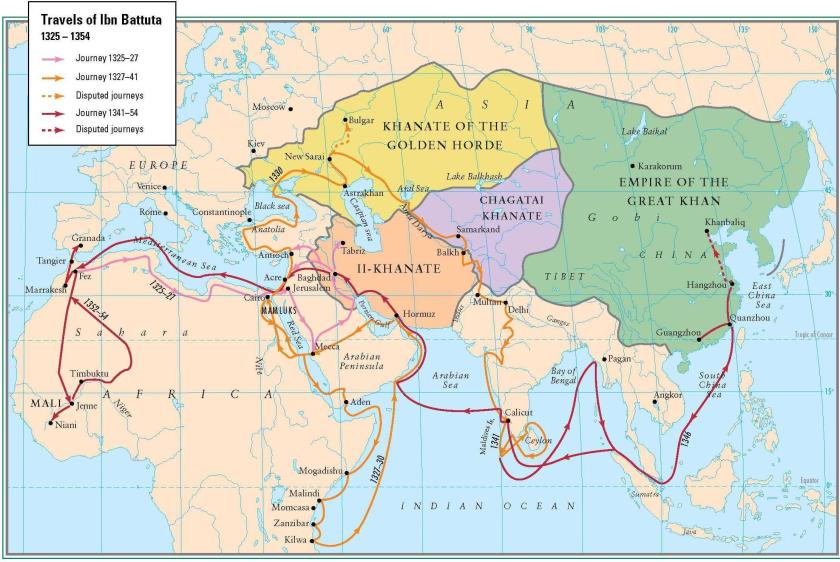
The famous Morrocco traveller, explorer and scholar – Ibn Battuta (d.1369) chronicled his travels from 1325-1354 at a time when the Abbasid Caliphs in Cairo (1261-1517) were mere figureheads and the entire Muslim world was split into separate sultanates and emirates. Despite this political fragmentation, Ibn Battuta had no problem travelling throughout the lands of Islam from his home under the Marinid Dynasty in Morrocco, to the Emirate of Granada in Spain, across the Mamluk Sultanate which housed the Abbasid Caliphs in Cairo and on to the Delhi Sultanate in India and the Sultanate of the Maldives. On his return journey to Morrocco, he stopped off in the Mali Sultanate in sub-Saharan Africa.

In all the places he visited he was welcomed and honoured as a Muslim scholar despite not being a ‘citizen’ of that particular emirate. In fact, Ibn Battuta was appointed to various posts on his travels including a Qadi, Chief Qadi, teacher, ambassador and government advisor. This shows that as long as the underlying principle upon which the emirates and sultanates are based is the Islamic ‘aqeeda, then even in the irregular situation of self-appointed Amirs and different states there will still be a level of unity and cooperation which achieves justice and great achievements for the deen.

Timeline of Ibn Battuta’s Positions

1325–1332 (North Africa, Middle East, Mecca)

  • Role: Pilgrim & Student
  • Traveled for Hajj and studied Islamic law in Mecca and other learning centers (Cairo, Damascus).
  • Gained reputation as a scholar.

1333–1340 (Delhi, India)

  • Role: Qāḍī (Judge)
  • Appointed by Sultan Muhammad bin Tughluq as a judge in Delhi.
  • Held position for several years, enjoyed court life but also faced political intrigue.

1340–1344 (Maldives & Sri Lanka)

  • Role: Chief Judge of the Maldives
  • Enforced Islamic law in the Maldives, though he often clashed with local customs.
  • Married several local women (as was common for visitors of status).
  • In Sri Lanka, acted as a respected religious guest, visiting Adam’s Peak.

1345–1346 (China mission attempt)

  • Role: Ambassador/Diplomat
  • Appointed by Sultan of Delhi to lead a mission to the Mongol Yuan Dynasty in China.
  • The mission was delayed, and he traveled by sea through Southeast Asia before reaching China.
  • In China, he visited ports and was received as an honored foreign dignitary.

1349–1353 (Return to Morocco & West Africa)

  • Role: Scholar & Adviser
  • Back in Morocco, shared knowledge of Islamic law and his experiences.
  • Later traveled to the Mali Empire (Timbuktu, Gao, Mali), where he served as an adviser and legal authority to Mansa Suleyman.

1354 (Final Years in Morocco)

  • Role: Author (via dictation)
  • At the request of the Marinid Sultan of Morocco, Ibn Battuta dictated his memoirs to the scholar Ibn Juzayy in Fez.
  • This became the famous “al-Riḥla” (The Journey), documenting ~30 years of travel.

Job Timeline Summary

1325–1332Pilgrim, Student, Scholar.
1333–1340Judge in Delhi.
1340–1344Chief Judge in Maldives, Religious Guest in Sri Lanka.
1345–1346Diplomat/Ambassador (China mission).
1349–1353Scholar, Adviser in Mali.
1354Author of Rihla

Notes

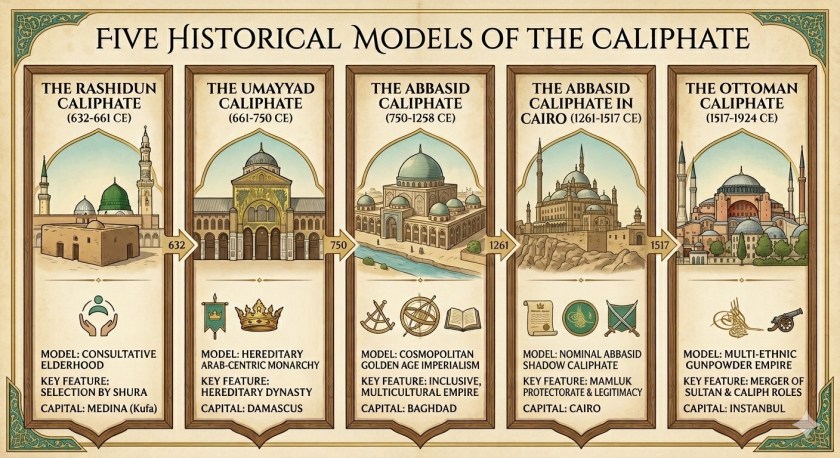
Five Historical Models of the Caliphate

For most of Islamic history the Caliphate was a decentralised confederation, with executive power held by the various Islamic emirates and sultanates who recognised the caliph through a nominal bay’ah.

Al-Radhi (r.934-940CE) was the last independent Abbasid caliph after the rise of the Buwahids (Buyids) in 934CE, and the establishment of their emirate over Iraq, and central and southern Iran. This reduced the caliph’s executive power to the Dar ul-Khilafah which was a section of Baghdad that housed the Caliphal palace. Al-Khatib (d. 463H,1071CE) mentions that Al-Radhi was “the last of the Caliphs who undertook the sole direction of the army and the finances.”[1] After Al-Radhi, his brother Al-Muttaqi (r.940-944CE) became the caliph and Al-Suyuti says about him that “He had nothing of authority but the name.”[2]

Dr. Ovamir Anjum says, “This third model (940-1517CE) has been called classical Islamic constitutionalism.[3] It is important because, with the exception of the first couple of centuries, it is what the caliphate has actually looked like throughout most of Islamic history.”[4]

Time periodDatesLength
Rightly Guided Caliphate11-41H / 632-661   30 years
Umayyads, Abbasids until Al-Radi41-239H / 661-940 288 years
Abbasids – Al‐Radi onwards329-923H / 940-1517600 years
Ottomans923-1326H / 1517-1908403 years
20th Century Ottomans (Young Turks)1326-1342H / 1908-1924  16 years
Time periodFeatures
Rightly Guided CaliphateReligious and political authorities were not systematically distinguished 
Umayyads, Abbasids until Al-RadiThe caliphate became a primarily political office, and religious authority gradually came to be shared between the caliph and the scholars (ʿulamāʾ).   The caliph’s powers had never been absolute in practice, but the ʿulamāʾ began to theorize such limits and functions starting in the fourth/tenth century.  
Abbasids – Al‐Radi onwardsThe caliph was primarily a symbolic and spiritual authority; the actual rulers of various provinces were often local governors or invading military commanders who, lacking inherent legitimacy, paid homage to the caliph.   These societies were largely self-governed by the Law of Islam as administered by local rulers and scholars. The kings or sultans served as ‘butlers’ or, more grandiosely, as the executive branch, who were important for defense and upkeep of the Law but nevertheless disposable.   This third model has been called “classical Islamic constitutionalism”. With the exception of the first couple of centuries, it is what the caliphate has actually looked like throughout most of Islamic history. 
OttomansThe Ottoman sultans (who took on the title “caliph” after defeating the Mamluks in Cairo), upheld the Shariʿa Law that was expounded and administered by the scholars as muftis and judges.   The caliph-sultan’s powers, therefore, were limited. We have cases of sultans who were deposed because of the verdict of the chief qadi (judge). 
20th Century Ottomans (Young Turks)Western style constitutional caliphate  

Notes


[1] Jalal ad-Din as-Suyuti, ‘History of the Caliphs,’ a translation of Tarikh al-Khulufa’ by Major H. S. Jarrett, 1881, p.411

[2] Ibid, p.413

[3] Noah Feldman, ‘The Fall and Rise of the Islamic State,’ Princeton University Press, 2008, p.28

[4] https://yaqeeninstitute.org/read/paper/who-wants-the-caliphate

Ikhtilaf (difference) and Iftiraq (division) in Islam

An Islamic society is not a one-party communist totalitarian society where differences and individuality are expunged. Human beings differ in their colours, languages, tastes, interests and intellectual capacity. In themselves these differences are not a problem unless they are used to cause dissent and division. Allah ta’ala clearly says in the Qur’an:

يَـٰٓأَيُّهَا ٱلنَّاسُ إِنَّا خَلَقْنَـٰكُم مِّن ذَكَرٍۢ وَأُنثَىٰ وَجَعَلْنَـٰكُمْ شُعُوبًۭا وَقَبَآئِلَ لِتَعَارَفُوٓا۟ ۚ إِنَّ أَكْرَمَكُمْ عِندَ ٱللَّهِ أَتْقَىٰكُمْ ۚ إِنَّ ٱللَّهَ عَلِيمٌ خَبِيرٌۭ

O humanity! Indeed, We created you from a male and a female, and made you into peoples (شُعُوب) and tribes (قَبائِل) so that you may ˹get to˺ know one another. Surely the most noble of you in the sight of Allah is the most righteous among you. Allah is truly All-Knowing, All-Aware.[1]

We need to distinguish between two Arabic words in relation to Islamic unity. They are Ikhtilaf (difference) and Iftiraq (division) which are both found in the Qur’an and Sunnah.

Allah ta’ala says,

وَلَا تَكُونُوا۟ كَٱلَّذِينَ تَفَرَّقُوا۟ وَٱخْتَلَفُوا۟ مِنۢ بَعْدِ مَا جَآءَهُمُ ٱلْبَيِّنَـٰتُ ۚ وَأُو۟لَـٰٓئِكَ لَهُمْ عَذَابٌ عَظِيمٌۭ

“And do not be like those who split (تَفَرَّقُوا) ˹into sects˺ and differed (اِخْتَلَفُوا) after clear proofs had come to them. It is they who will suffer a tremendous punishment.”[2]

Ibn Ashur (d.1973) comments on this splitting and division (الاِفْتِراق):

وفِيهِ إشارَةٌ إلى أنَّ الِاخْتِلافَ المَذْمُومَ والَّذِي يُؤَدِّي إلى الِافْتِراقِ، وهو الِاخْتِلافُ في أُصُولِ الدِّيانَةِ الَّذِي يُفْضِي إلى تَكْفِيرِ بَعْضِ الأُمَّةِ بَعْضًا، أوْ تَفْسِيقِهِ، دُونَ الِاخْتِلافِ في الفُرُوعِ المَبْنِيَّةِ عَلى اخْتِلافِ مَصالِحِ الأُمَّةِ في الأقْطارِ والأعْصارِ، وهو المُعَبِّرُ عَنْهُ بِالِاجْتِهادِ. ونَحْنُ إذا تَقَصَّيْنا تارِيخَ المَذاهِبِ الإسْلامِيَّةِ لا نَجِدُ افْتِراقًا نَشَأ بَيْنَ المُسْلِمِينَ إلّا عَنِ اخْتِلافٍ في العَقائِدِ والأُصُولِ، دُونَ الِاخْتِلافِ في الِاجْتِهادِ في فُرُوعِ الشَّرِيعَةِ.

“The reprehensible differences (الِاخْتِلاف) that leads to division (الاِفْتِراق) is the differences in the fundamentals of religion (usul ad-deen) that leads to some members of the ummah declaring others disbelievers (kafir) or transgressors (fasiq), unlike the differences in the branches (furu’) based on the differences in the interests of the ummah in different countries and eras, which is expressed by ijtihad. If we examine the history of Islamic Schools of Thought (madhāhib), we will not find any division that arose among Muslims except due to differences in ‘aqeeda and usul. We only find differences in ijtihad in the branches of Sharia.”[3]

The Prophet ﷺ said,

افْتَرَقَتِ الْيَهُودُ عَلَى إِحْدَى وَسَبْعِينَ فِرْقَةً فَوَاحِدَةٌ فِي الْجَنَّةِ وَسَبْعُونَ فِي النَّارِ وَافْتَرَقَتِ النَّصَارَى عَلَى ثِنْتَيْنِ وَسَبْعِينَ فِرْقَةً فَإِحْدَى وَسَبْعُونَ فِي النَّارِ وَوَاحِدَةٌ فِي الْجَنَّةِ وَالَّذِي نَفْسُ مُحَمَّدٍ بِيَدِهِ لَتَفْتَرِقَنَّ أُمَّتِي عَلَى ثَلاَثٍ وَسَبْعِينَ فِرْقَةً فَوَاحِدَةٌ فِي الْجَنَّةِ وَثِنْتَانِ وَسَبْعُونَ فِي النَّارِ ‏”‏ ‏.‏ قِيلَ يَا رَسُولَ اللَّهِ مَنْ هُمْ قَالَ ‏”‏ الْجَمَاعَةُ

“The Jews split (اِفْتَرَقَت) into seventy-one sects, one of which will be in Paradise and seventy in Hell. The Christians split into seventy-two sects, seventy-one of which will be in Hell and one in Paradise. I swear by the One Whose Hand is the soul of Muhammad, my nation will split into seventy-three sects, one of which will be in Paradise and seventy-two in Hell.” It was said: “O Messenger of Allah, who are they?” He said: “The main body of the ummah (الْجَمَاعَةُ).”[4]

The concept of division (الاِفْتِراق) in the Qur’an often has a negative connotation, referring to divisions, sects, or discord that leads to people straying from the straight path. While the root of the word can also mean “to separate” or “to divide” in a neutral sense (as in the word furqan, meaning criterion or distinction), when used in contexts of human society and religion, it usually implies a fragmentation that is discouraged by Allah. 

Ibn ‘Abbas said: “The Aws and the Khazraj had a feud in the pre-Islamic period. One day, they mentioned to each other what had happened in that period and this led them to brandish their swords at each other. Upon being informed of what was happening, the Messenger of Allah ﷺ went to them and these verses were revealed:

وَكَيْفَ تَكْفُرُونَ وَأَنتُمْ تُتْلَىٰ عَلَيْكُمْ ءَايَـٰتُ ٱللَّهِ وَفِيكُمْ رَسُولُهُۥ ۗ وَمَن يَعْتَصِم بِٱللَّهِ فَقَدْ هُدِىَ إِلَىٰ صِرَٰطٍۢ مُّسْتَقِيمٍۢ

يَـٰٓأَيُّهَا ٱلَّذِينَ ءَامَنُوا۟ ٱتَّقُوا۟ ٱللَّهَ حَقَّ تُقَاتِهِۦ وَلَا تَمُوتُنَّ إِلَّا وَأَنتُم مُّسْلِمُونَ

وَٱعْتَصِمُوا۟ بِحَبْلِ ٱللَّهِ جَمِيعًۭا وَلَا تَفَرَّقُوا۟ ۚ وَٱذْكُرُوا۟ نِعْمَتَ ٱللَّهِ عَلَيْكُمْ إِذْ كُنتُمْ أَعْدَآءًۭ فَأَلَّفَ بَيْنَ قُلُوبِكُمْ فَأَصْبَحْتُم بِنِعْمَتِهِۦٓ إِخْوَٰنًۭا وَكُنتُمْ عَلَىٰ شَفَا حُفْرَةٍۢ مِّنَ ٱلنَّارِ فَأَنقَذَكُم مِّنْهَا ۗ كَذَٰلِكَ يُبَيِّنُ ٱللَّهُ لَكُمْ ءَايَـٰتِهِۦ لَعَلَّكُمْ تَهْتَدُونَ

How can you disbelieve when Allah’s revelations are recited to you and His Messenger is in your midst? Whoever holds firmly to Allah is surely guided to the Straight Path.

O believers! Be mindful of Allah in the way He deserves, and do not die except in ˹a state of full˺ submission ˹to Him˺.

And hold firmly together to the rope of Allah and do not be divided. Remember Allah’s favour upon you when you were enemies, then He united your hearts, so you—by His grace—became brothers. And you were at the brink of a fiery pit and He saved you from it. This is how Allah makes His revelations clear to you, so that you may be ˹rightly˺ guided.[5][6]

While Allah severely condemns this division which nearly led to fighting, they were not reprimanded for remaining in their respective tribes and clans. In fact the Aws and the Khazraj would compete with each other in the good deeds based on the command: فَٱسْتَبِقُوا۟ ٱلْخَيْرَٰتِ “So compete with one another in doing good.”[7]

Ibn Ishaq narrates, “Among the things that Allah did for His Messenger ﷺ was that these two tribes of the Ansar, the Aws and the Khazraj, would compete with the Messenger of Allah ﷺ like two stallions competing. The Aws would not do anything that would please the Messenger of Allah ﷺ except that the Khazraj would say: ‘By Allah, you will not lose any advantage over us by doing this in the eyes of the Messenger of Allah ﷺ and in Islam.’  He said: So they would not stop until they had done something similar. Whenever the Khazraj did something, the Aws would say the same.”[8]

Differences (الِاخْتِلاف) is a general term and in Islamic fiqh has a positive connotation meaning the legitimate differences of opinion that emerge among the ‘ulema when extracting Islamic rules through ijtihad as Ibn Ashur mentioned above.

Therefore, different provinces and states in an Islamic State are all fine, but division, fitna, separation and civil war are all unacceptable red-lines in the sharia. The Ummah must remain unified upon the Islamic ‘aqeeda and the agreed upon principles emanating from it. Al-Mawardi lists 10 duties and responsibilities on the caliph the first of which is:

  حِفْظُ الدِّينِ عَلَى أُصُولِهِ الْمُسْتَقِرَّةِ، وَمَا أَجْمَعَ عَلَيْهِ سَلَفُ الْأُمَّةِ

“Preserving the deen on its established principles (‘usul) and what the predecessors (salaf) of the ummah have consented upon (‘ijma).”[9]

Notes


[1] Holy Qur’an, Surah Al-Hujurat, ayah 13

[2] Holy Qur’an, Surah Al-i-Iman, ayah 105

[3] https://tafsir.app/ibn-aashoor/3/104

[4] Sunan Ibn Majah 3992, https://sunnah.com/ibnmajah:3992

[5] Holy Qur’an, Surah Ali-‘Imran, ayaat 101-103

[6] Asbāb al-Nuzūl By: Alī ibn Ahmad al-Wāhidī translated by Mokrane Guezzou, 2008 Royal Aal al-Bayt Institute for Islamic Thought, p.39

[7] Holy Qur’an, Surah al-Baqara, ayah 148

[8] Ibn Hisham, https://shamela.ws/book/23833/1010

[9] Al-Mawardi, Al-Ahkam as-Sultaniyah, https://shamela.ws/book/22881/35