

The Prophet Muhammad ﷺ in his role as a ruler-prophet and head of state in Medina led many of the battles himself since he was the Commander-in-Chief. A battle or expedition that he ﷺ led directly is referred to in the Islamic history books as a ghazwa. Those expeditions where he appointed a sahabi to command are referred to as a sariyya.
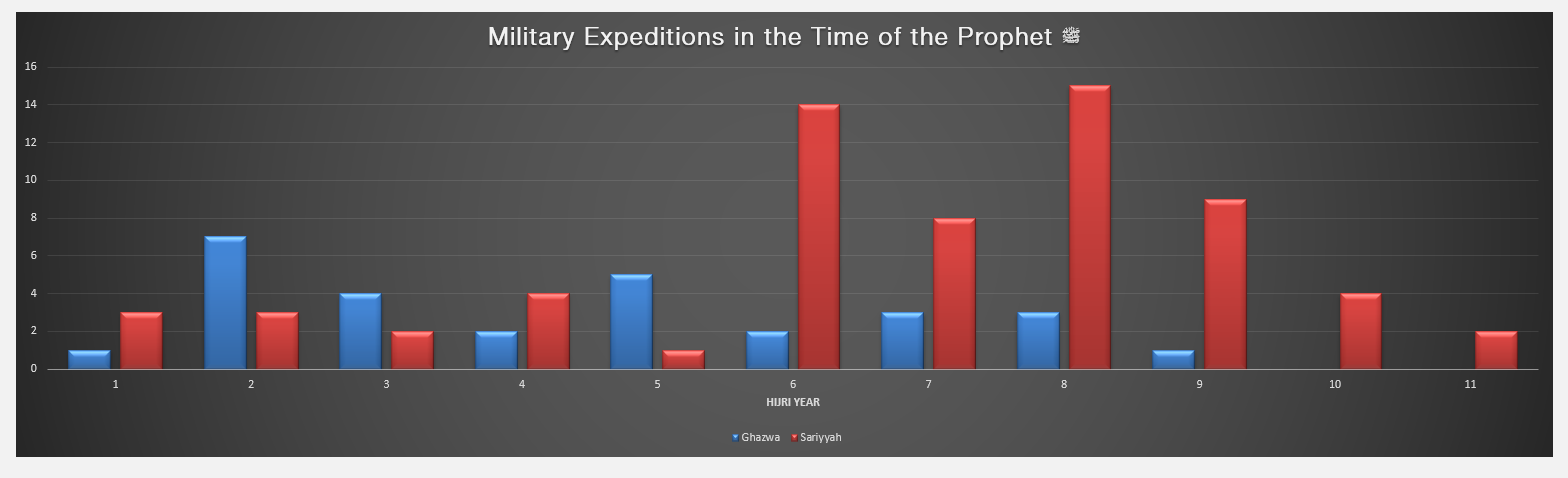
We can see from the data that the number of expeditions led directly by the Prophet ﷺ decreased over time as the sahaba took a more leading role after their training at the hands of the Messenger ﷺ.
The Prophet ﷺ appointed a total of 43 different sahaba as commanders so they all gained experience in this role. After his ﷺ death these commanders played a vital role in the Islamic conquests such as Khalid ibn Al-Walid, Amr ibn al-Aas and Abu Ubaidah ibn al-Jarrah.
Three of the Rightly Guided Caliphs were appointed as military commanders namely, Abu Bakr, Umar and Ali. This experience was important for their future roles as Commanders-in-chief of their respective armies.
We can see a practical example at the Battle of Badr of how the Messenger of Allah ﷺ managed the military training of the sahaba. He ﷺ asked them:
كَيْفَ تُقَاتِلُونَ الْقَوْمَ إِذَا لَقِيتُمُوهُمْ
“How will you fight the people [enemy] when you meet them?”
So Asim bin Thabit stood up and said:
يَا رَسُولَ اللهِ إِذَا كَانَ الْقَوْمُ مِنَّا حَيْثُ يَنَالُهُمُ النَّبْلُ، كَانَتِ الْمُرَامَاةُ بِالنَّبْلِ، فَإِذَا اقْتَرَبُوا حَتَّى يَنَالَنَا وَإِيَّاهُمُ الْحِجَارَةُ، كَانَتِ الْمُرَاضَخَةُ بِالْحِجَارَةِ، فَأَخَذَ ثَلَاثَةَ أَحْجَارٍ فِي يَدَهِ وحَجَرَيْنِ فِي حِزْمَتِهِ، فَإِذَا اقْتَرَبُوا حَتَّى يَنَالَنَا وَإِيَّاهُمُ الرَّمَّاحُ، كَانَتِ الْمُدَاعَسَةُ بِالرِّمَاحِ، فَإِذَا انْقَضَتِ الرِّمَاحُ، كَانَتِ الْجِلَادُ بِالسُّيُوفِ
“O Messenger of Allah, when the people [enemy] are where the arrows will reach them, then the shooting will be with arrows. But when they come close until the stones reach us and them, then the fighting will be with stones. So he took three stones in his hand and two stones in his bundle. When they come close until the spears reach us and them, then the fighting will be with spears, and when the spears are destroyed, the fighting will be with swords.”
Then the Messenger of Allah ﷺ said,
بِهَذَا أُنْزِلَتِ الْحَرْبُ، مَنْ قَاتَلَ فلْيُقَاتِلْ قِتَالَ عَاصِمٍ
“With this war was revealed. Whoever fights, let him fight as Asim fights.”[1]
Being the Commander-in-Chief, doesn’t mean the caliph has to lead the armies directly, or even get involved in the day-to-day military training and planning activities, although he has the authority to do this. Once the Islamic state expanded to an ‘empire’ encompassing lands spanning multiple continents, it was not feasible or even wise for the caliph to perform this task.
It is related that ‘Aishah said, “My father went out with his sword unsheathed; he was mounted on his riding animal, and he was heading towards the valley of Dhil-Qissah ‘Ali ibn Abi Talib came, took hold of the reins of Abu Bakr’s riding animal, and said, “Where are you going, O Caliph of the Messenger of Allah?” The question was rhetorical, for ‘Ali knew very well that Abu Bakr planned to lead his army into battle. “I will say to you what the Messenger of Allah ﷺ said on the Day of Uhud,” ‘Ali went on. By this statement, ‘Ali was referring to what had happened on the Day of Uhud: When Abu Bakr wanted to engage in a duel-to-the-death with his son ‘Abdur-Rahman (who was still a disbeliever), the Prophet ordered him to draw back his sword and to return to his place. ‘Ali went on to say, “Draw back your sword and do not bring upon us the tragedy of your death. For by Allah, if we become bereaved of you, (the nation of) Islam will not have an organized system of rule (rather, due to the apostate problem, chaos will break out).” Abu Bakr acquiesced to ‘Ali’s demand and returned to Al-Medina.”[2]
Samuel Huntington describes the US situation: “The intention and the expectation of the Framers and of the people was that the President could, if he so desired, assume personal command in the field. Early presidents did not hesitate to do this. Washington personally commanded the militia called out to suppress the Whiskey Rebellion. James Madison took a direct hand in organizing the ineffectual defense of Washington in 1814. During the Mexican War, President Polk, although he did not command the army in the field, nonetheless personally formulated the military strategy of the war and participated in a wide range of exclusively military matters. The last instance of a President directly exercising military functions was Lincoln’s participation in the direction of the Union armies in the spring of 1862. The President personally determined the plan of operations, and, through his War Orders, directed the movement of troop units. It was not until Grant took over in Virginia that presidential participation in military affairs came to an end. No subsequent President essayed the direction of military operations, although Theodore Roosevelt in World War I argued conversely that his previous experience as Commander in Chief proved his competence to command a division in France.”[3]
Nowadays, due to the existence of professional standing armies, and the complexity of executive rule, the caliph will inevitably take a more back-seat role in terms of hands-on military, even though he would have been a military commander before coming to office. He does however need to keep a hands-on role in terms of the chain of command, and the appointment and dismissal of the generals and campaign commanders. This ensures the loyalty of the top brass to the caliph and not to the Chief of Staff, or any other body or individual minister.
Samuel Huntington describes the Commander-in-Chief role of the US President vis-à-vis the military command: “This unified hierarchy began to break up as the military function became professionalized. The President was no longer qualified to exercise military command, and even if he were qualified by previous training, he could not devote time to this function without abandoning his political responsibilities. The political functions of the Presidency became incompatible with the military functions of the Commander in Chief. Nor were the civilian politicians appointed Secretaries of War and the Navy competent to exercise military command. On the other hand, the emergence of the military profession produced officers whose experience had been exclusively military, who were quite different types from the politician secretaries, and who were technically qualified to command. The constitutional presumption that the President exercised command still remained, however, and complicated the relations among President, secretary, and military chief.[4]
Winston Churchill in WWII outlined his policy with regards to the supervision of the military. “It is my practice to leave the Chiefs of Staff alone to do their own work, subject to my general supervision, suggestion and guidance.” He continues, “Each of the three Chiefs of Staff has, it must be remembered, the professional executive control of the Service he represents.”[5]
This policy will be adopted by the head of an Islamic state who keeps just enough control to prevent the independence of the military, and ensure they work to achieve the interests of Islam alone, since the sharia is sovereign, and not any individual including the caliph himself.
Notes
[1] Al-Tabarani, Al-Mu’jam al-Kabir 4513 https://shamela.ws/book/1733/5457
[2] Al-Bidaayah Wan-Nihaayah (2/319) quoted in Al-Sallabi’s Biography of Abu Bakr Siddiq, p.380
[3] Samuel Huntington, ‘The soldier and the state: The theory and politics of civil-military relations,’ p.185
[4] Ibid
[5] Hansard, War Situation, Volume 378: debated on Tuesday 24 February 1942, https://hansard.parliament.uk/Commons/1942-02-24/debates/02dd8f21-e6ac-46fa-a5ee-bcf707b9bfee/WarSituation
 Islamic Civilization