
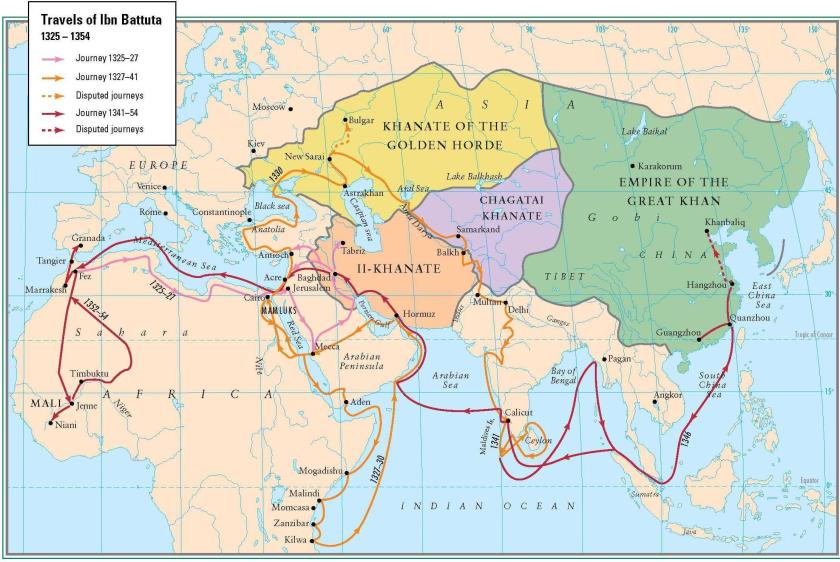
The famous Morrocco traveller, explorer and scholar – Ibn Battuta (d.1369) chronicled his travels from 1325-1354 at a time when the Abbasid Caliphs in Cairo (1261-1517) were mere figureheads and the entire Muslim world was split into separate sultanates and emirates. Despite this political fragmentation, Ibn Battuta had no problem travelling throughout the lands of Islam from his home under the Marinid Dynasty in Morrocco, to the Emirate of Granada in Spain, across the Mamluk Sultanate which housed the Abbasid Caliphs in Cairo and on to the Delhi Sultanate in India and the Sultanate of the Maldives. On his return journey to Morrocco, he stopped off in the Mali Sultanate in sub-Saharan Africa.
In all the places he visited he was welcomed and honoured as a Muslim scholar despite not being a ‘citizen’ of that particular emirate. In fact, Ibn Battuta was appointed to various posts on his travels including a Qadi, Chief Qadi, teacher, ambassador and government advisor. This shows that as long as the underlying principle upon which the emirates and sultanates are based is the Islamic ‘aqeeda, then even in the irregular situation of self-appointed Amirs and different states there will still be a level of unity and cooperation which achieves justice and great achievements for the deen.
Timeline of Ibn Battuta’s Positions
1325–1332 (North Africa, Middle East, Mecca)
- Role: Pilgrim & Student
- Traveled for Hajj and studied Islamic law in Mecca and other learning centers (Cairo, Damascus).
- Gained reputation as a scholar.
1333–1340 (Delhi, India)
- Role: Qāḍī (Judge)
- Appointed by Sultan Muhammad bin Tughluq as a judge in Delhi.
- Held position for several years, enjoyed court life but also faced political intrigue.
1340–1344 (Maldives & Sri Lanka)
- Role: Chief Judge of the Maldives
- Enforced Islamic law in the Maldives, though he often clashed with local customs.
- Married several local women (as was common for visitors of status).
- In Sri Lanka, acted as a respected religious guest, visiting Adam’s Peak.
1345–1346 (China mission attempt)
- Role: Ambassador/Diplomat
- Appointed by Sultan of Delhi to lead a mission to the Mongol Yuan Dynasty in China.
- The mission was delayed, and he traveled by sea through Southeast Asia before reaching China.
- In China, he visited ports and was received as an honored foreign dignitary.
1349–1353 (Return to Morocco & West Africa)
- Role: Scholar & Adviser
- Back in Morocco, shared knowledge of Islamic law and his experiences.
- Later traveled to the Mali Empire (Timbuktu, Gao, Mali), where he served as an adviser and legal authority to Mansa Suleyman.
1354 (Final Years in Morocco)
- Role: Author (via dictation)
- At the request of the Marinid Sultan of Morocco, Ibn Battuta dictated his memoirs to the scholar Ibn Juzayy in Fez.
- This became the famous “al-Riḥla” (The Journey), documenting ~30 years of travel.
Job Timeline Summary
| 1325–1332 | Pilgrim, Student, Scholar. |
| 1333–1340 | Judge in Delhi. |
| 1340–1344 | Chief Judge in Maldives, Religious Guest in Sri Lanka. |
| 1345–1346 | Diplomat/Ambassador (China mission). |
| 1349–1353 | Scholar, Adviser in Mali. |
| 1354 | Author of Rihla |
Notes
 Islamic Civilization