
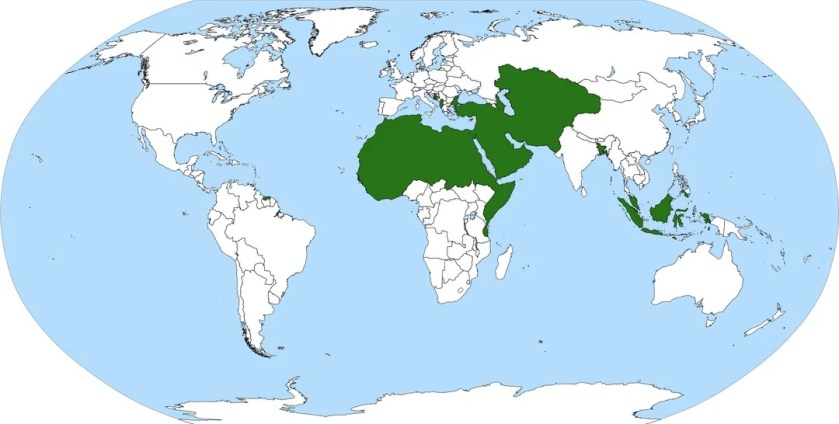
Assessing the maslaha (benefit) and mafsadah (harm) within the sphere of siyasa sharia is not an exact science. Every time and place needs to be assessed by highly skilled statesmen like the Prophet ﷺ, Rightly Guided Caliphs and those who follow in their footsteps, who can navigate these tumultuous waters. There are many options open to a Muslim ruler who is sincere in their attempts to implement Islam.
Israr Ahmed (d.2010) says, “Since we cannot recreate as such the Islamic Order as it functioned during the age of the Rightly Guided Caliphate, we must adopt the following principle: we should take the principles and ideals from the model of the Prophet Muhammad ﷺ and the Rightly Guided Caliphs (RAA), and then incorporate these principles and ideals in the political institutions that have been developed in the contemporary civilized world as a result of the process of social evolution.”[1]
Muhammad Haykal outlines a possible scenario for unification of the Muslim world once a caliphate has been established. He says, “When this Khilafah state is established via the bay’ah of the Muslims of a particular region from the Islamic regions to a Khalifah, upon the basis that he is the Imaam of all of the Muslims in the world who has been given the bay’ah to establish the ruling of Islaam in all internal relationships, to make Islaam the pivot upon which the foreign relations are regulated and to carry it as a message to the world, then in this situation, the bay’ah would have become binding upon the neck of every Muslim and even if that Muslim had not actually given the bay’ah in person. That is because the Imaam had been brought into existence and the bay’ah of contraction had been completed in a Saheeh (valid and correct) manner to him. It is then not allowed for any Muslim to not consider him as an Imaam and he (the Khalifah) has the right of obedience due to him. This is in accordance to the Hadeeth of the Messenger ﷺ:
وَمَنْ مَاتَ وَلَيْسَ فِي عُنُقِهِ بَيْعَةٌ مَاتَ مِيتَةً جَاهِلِيَّةً
“Whoever dies while having no bay’ah on his neck he dies the death of Jahiliyah.”[2]
Therefore, it is a duty upon all of the rest of the Islamic regions, once the validity of the bay’ah of contraction of the Khalifah has been realised, to present the bay’ah of obedience to him and to join the Khilafah state as Wilaayaat (provinces) of it. As for the people in authority (i.e. the rulers) in those lands and regions, then they will remain in their positions as long as they fulfil what is required for them to be able to maintain them. That is like what the Messenger of Allah ﷺ used to do in respect to the people in authority in those regions which were joined to the Islamic state, in the case where the Maslahah dictated that.”[3]
Another possibility is the emergence of independent emirates who agree to join together in a unified bloc, appointing one of the Emirs as the caliph. This occurred in America when thirteen former British colonies located along the East Coast of North America declared independence from Britain in 1776 and established the United States of America, appointing George Washington the former general as their first President.
If the ruling elites in the Muslim world make Islam the centre of their lives, then it’s not beyond the scope of the imagination for these elites and influentials to make great sacrifices in pursuit of the greater good, in this case the unification of the Muslim lands into a powerful bloc – A United States of Islam.
In 19th century Japan the ruling families sacrificed their lands in pursuit of a unified empire. If non-Muslims can make such an undertaking, then no doubt Muslims can do the same, especially since Allah has purchased from the believers their lives and wealth in return for Jannah. Allah ta’ala says,
إِنَّ ٱللَّهَ ٱشْتَرَىٰ مِنَ ٱلْمُؤْمِنِينَ أَنفُسَهُمْ وَأَمْوَٰلَهُم بِأَنَّ لَهُمُ ٱلْجَنَّةَ
“Allah has indeed purchased from the believers their lives and wealth in exchange for Paradise.”[4]
“[In 1866] Thirteen years after Commodore Matthew Perry steamed into Tokyo Bay (1853), a nationalist rebellion overthrew the conservative Tokugawa Shogunate, installed the Emperor Meiji in power, and implemented a program of sweeping national reform.[5]
In an act no less stunning than the revolution itself, nearly all of the former ruling families voluntarily surrendered their power to the emperor, declaring, “We therefore reverently offer up all our feudal possessions so that a uniform rule may prevail throughout the Empire. Thus, the country will be able to rank equally with the other nations of the world.”[6] [7]
Notes
[1] Dr. Israr Ahmad, ‘Khilafah in Pakistan: What, Why & How?’ Lahore Markazi Anjuman Khuddam-Ul-Qur’an, 2006, Second Edition, p.24 https://tanzeem.org/wp-content/uploads/files/pdf/english-books/Khilafah_in_Pakistan.pdf
[2] Sahih Muslim 1851a, https://sunnah.com/muslim:1851a
[3] Muhammad Khair Haikal, ‘Al-Jihaad Wal-Qitaal Fee As-Siyaasah Ash-Shar’iyah, Volume One, Dar ul Thaqafah, 2019, p.612
[4] Holy Qur’an, Surah Al-Tawbah, ayah 111
[5] The Meiji Restoration was a political and social revolution in Japan from 1866 to 1869 that ended the power of the Tokugawa shogun and returned the Emperor to a central position in Japanese politics and culture.
[6] Edward Behr, Hirohito: Behind the Myth (New York: Vantage Books, 1989), p.6
[7] Douglas Macgregor, ‘Margin of Victory: Five Battles that Changed the Face of Modern War,’ Naval Institute Press, 2016, p.41
 Islamic Civilization