

- The official language of the state is Arabic
- An International Currency
- The Hijri Calendar
- Coin Inscriptions
- Dispelling dispersions against the Caliphs
- Notes
The Islamic State has a bi-metallic currency based on gold and silver. This was first established by the Prophet Muhammad ﷺ in Madinah who made the state’s currency as the gold dinar and the silver dirham. The state had no ability at the time to mint its own currency so used the Roman Dinar and Persian Dirham. This continued throughout the Umayyad period until the Khaleefah Abdul-Malik ibn Marwan minted the first distinct Islamic currency in 74H.[1]
A point to note is that Tabari puts the date at 76H[2] and other historians say 75H, but after the ‘standing caliph’ coin emerged with the date 74H stamped on it we now know for definite when the minting started.
Abdul-Malik was the first to mint distinct gold dinars and silver dirhams based on the weight that the Prophet ﷺ had established. It was narrated from Ibn ‘Umar who said, ‘The Messenger of Allah ﷺ said: “The weight is the weight of the people of Makkah, and the measure is the measure of the people of Madinah.”’[3] This shows that the Islamic economic system was implemented by Abdul-Malik.
Although initially the coins resembled the Byzantine coins and pictured Abdul-Malik as the ‘standing caliph’[4] this iconography was quickly replaced with the shahada and other Islamic mottos.[5] Most likely this was due to the ulema of the time advising the Khaleefah that it’s prohibited to draw full pictures of living beings.
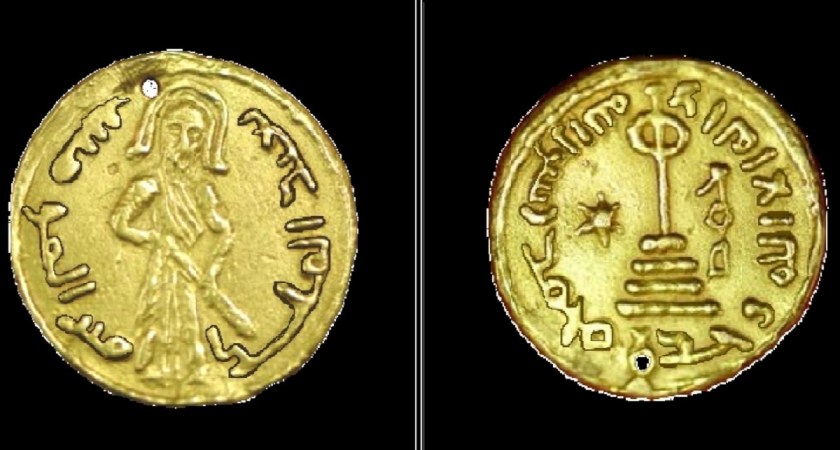
The official language of the state is Arabic
The inscriptions on the coins were all in Arabic because the official language of the Islamic State is Arabic. Abdul-Malik is the one who not only minted coins in the Arabic language, but also changed the state’s administration (diwan) from Greek and Pahlavi (middle Persian) to Arabic.
When Islam first conquered the Byzantine and Sassanian lands the taxation offices (diwan al-Kharaj) were all in Greek and Pahlavi. Only the military bureaus (diwan al-jund) which kept records of the soldiers were in Arabic because the army consisted solely of Muslim Arabs.[6] The diwan al-Kharaj was run by Christians and Zoroastrians due to their expertise in the administration of taxes. The state simply left them in place rather than wiping out the civil service. It’s permitted for dhimmi to be in state administration and be heads of the diwan as occurred during the Umayyad period. Sarjun ibn Mansur, was a prominent official in the diwan under Mu’awiyah and continued serving the Umayyads for the rest of his life. Transferring the diwan to Arabic forced all people in the provinces, whether Muslim or non-Muslim to begin using Arabic for official state business. This had a dramatic effect on the Arabisation of the state’s territories and the indigenous populations who in a short period of time adopted Arabic as their native tongue. Even Christians in Ash-Sham began conducting religious services in Arabic.
Hugh Kennedy writes, “The Middle East conquered by the Muslims in these early decades was a multicultural society, a world where different languages and religions coexisted and intermingled in the same geographical area. After the success of the conquests, the language of the new elite was Arabic. Even for government, however, the existing administrative languages – Greek in Syria and Egypt, Middle Persian (Pahlavi) in Iraq and Iran, Latin in Spain – continued to be used for the business of government.
After a couple of generations, however, this began to change. Around the year 700, sixty or more years after the earliest conquests, the Umayyad caliph Abd al-Malik decreed that Arabic and Arabic alone was to be used in the administration. The decree was surprisingly effective. From this time, anyone wanting a position in the expanding bureaucracy of the Islamic state, whether they were Arab or non-Arab by descent and upbringing, needed to be able to read and write in Arabic. The inscriptions on the new style, image-free coins and the roadside milestones were all in Arabic. There was no point for most people in learning Greek or Pahlavi because there were no career opportunities in them. It was around this time, in the early eighth century, that the Arabic traditions of the conquests began to be collected and written down.”[7]
An International Currency
On the coins we find the central inscription is “Allah is one, Allah is the eternal, He did not beget and He was not begotten”. This is in response to the Byzantine coins depicting an image of Jesus (as) on their coins. Despite ongoing hostilities between the Byzantines and the Islamic State, they were both major trading partners, and so inevitably their currency would find its way in to circulation in both states. Since the Islamic state was the centre of international trade, the Islamic coins soon found their way in to the heart of Europe. In the late 1930s, an Arabic silver dirham dating from the time of the Umayyad Khaleefah Marwān II (r. 744-50) was found in the village of Potoci in modern day Bosnia-Herzegovina.[8]
A copy of a dinar minted during the rule of the Abbasid Khaleefah Al-Mansur was even found during the reign of Offa, King of Mercia (r. 757–796CE) who ruled most of what is modern-day England. Although Offa was a Christian, he copied the Abbasid gold dinar including the shahada.[9]

The Hijri Calendar
The coins themselves also contain the date of manufacture which is evidence that the state was using the Hijri calendar. There are two papyrus documents surviving from Egypt bearing the dates Muharram 22H (December 642CE) and Safar 22H (January 643CE) which record requisition orders concerning the payment of one ardeb of wheat per month to the Arab forces.[10] These documents are from the time of Umar ibn Al-Khattab who conquered Egypt, established the hijri calendar and the diwan. These papyri therefore conform completely to the historical narrations we have of Umar’s rule.
Coin Inscriptions
As mentioned, the inscriptions on the coins were specifically chosen as a daw’ah to the Christian Byzantine empire and beyond.

Inscription position: obverse
Central inscription: There is no God but Allah, He is alone, He has no associate.
Marginal inscription: Muhammad is the Messenger of Allah. He sent him with Guidance and the true religion that he might overcome all… [religions even though the polytheists hate it][11]
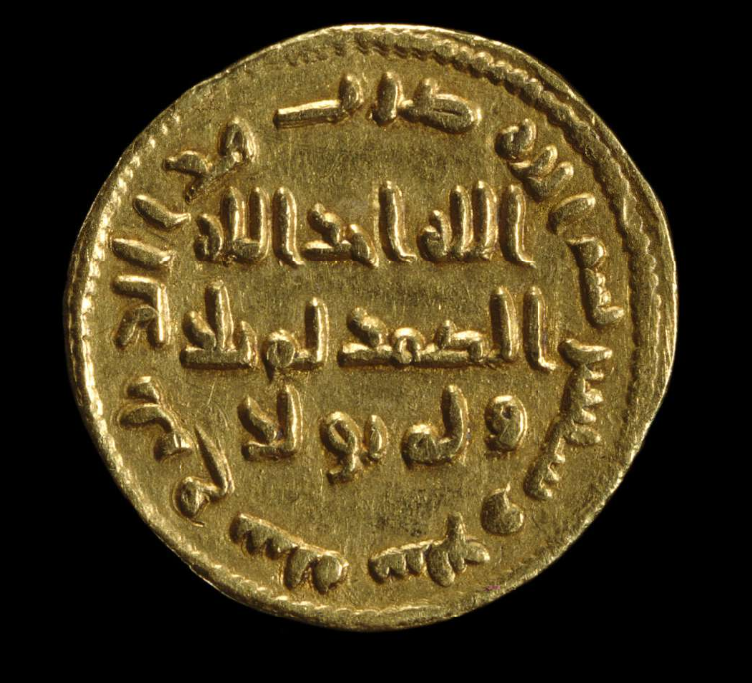
Inscription position: reverse
Central inscription: Allah is one, Allah is the eternal, He did not beget and He was not begotten
Marginal inscription: In the name of Allah, this dinar was struck in the year 77.[12]
Dispelling dispersions against the Caliphs
This is the importance of historical objects, as opposed to out of context quotes which cast dispersions over the Khaleefahs of the past. This is what Abdulwahab El-Affendi does when he quotes a statement from Abdul-Malik ibn Marwan telling a Makkan congregation that “anyone who after today says to me, ‘be conscious of Allah,’ I will have him beheaded”[13], as evidence of corrupt rulers who didn’t accept accountability. Abdul-Malik had just defeated Abdullah ibn az-Zubayr who was the legitimate Khaleefah, but who Abdul-Malik viewed as a rebel. The followers of ibn az-Zubayr in Makkah were therefore also seen as former rebels against his rule. This is not to excuse what Abdul-Malik did but to put his quote in to the wider context.
Abdul-Malik is also credited with restarting the Islamic conquests after years of decline due to the internal civil strife in the state against ibn az-Zubayr. He fought the Byzantines in Anatolia, Armenia and North Africa and won a decisive victory in Anatolia at the Battle of Sebastopolis in 692CE. He also built the famous Dome of the Rock Mosque in Al-Quds which is the oldest purpose-built mosque with its original structure still in existence today.
Notes
[1] http://www.arabinstitute.org/priceless-ancient-gold-coin-in-qatar-validated-by-dr-samir-al-khadem/
[2] al-Tabari, ‘The History of Al-Tabari’, State University of New York Press, Volume XXII, p.90
[3] Sunan an-Nasa’i 4594, https://sunnah.com/nasai:4594
[4] http://www.arabinstitute.org/priceless-ancient-gold-coin-in-qatar-validated-by-dr-samir-al-khadem/
[5] Michael Bates, ‘History, geography and numismatics in the first century of Islamic coinage,’ p.238 https://www.academia.edu/666263/History_geography_and_numismatics_in_the_first_century_of_Islamic_coinage
[6] Kosei Morimoto, ‘The Diwans as registers of the Arab stipendiaries in early Islamic Egypt,’ a chapter in ‘The Articulation of Early Islamic State Structures,’ p.238
[7] Hugh Kennedy, ‘The Great Arab Conquests,’ p.38
[8] M. Hadzijahic and N. Šukric, Islam I Muslimani u Bosni I Hercegovini [Islam and Muslims in Bosnia and Herzegovina] (Sarajevo: Starješinstvo Islamske Zajednice, 1977), p.21
[9] British Library, https://www.bl.uk/collection-items/gold-dinar-of-king-offa
[10] Kosei Morimoto, Op.cit., p.228
[11] The marginal legend is based on Surah 9, Taubah Verse 33. It states: “Muhammad is the Messenger of Allah, he was sent with guidance and the religion of truth to make it prevail over every other religion.” Note that these are not full Qur’anic verses by design.
[12] British Museum, https://www.britishmuseum.org/collection/object/C_1874-0706-1
[13] Abdulwahab El-Affendi, ‘Who needs an Islamic State?’ second edition, p.78
 Islamic Civilization