
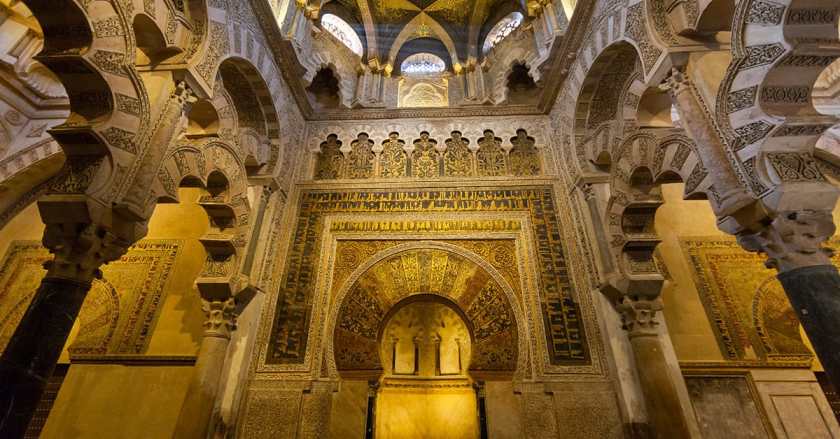
If you paid a visit to the Cathedral of Córdoba in Spain today you would notice a number of features which are out of place in a church. Most notably there is a mihrab covered in Qur’anic verses which points to the Cathedral’s origins as a mosque.
Construction of the mosque began in 785 (169 AH) and finished in 786 (170 AH). It was commissioned by Abd al-Rahman I who was the first Emir of the Emirate of Córdoba.
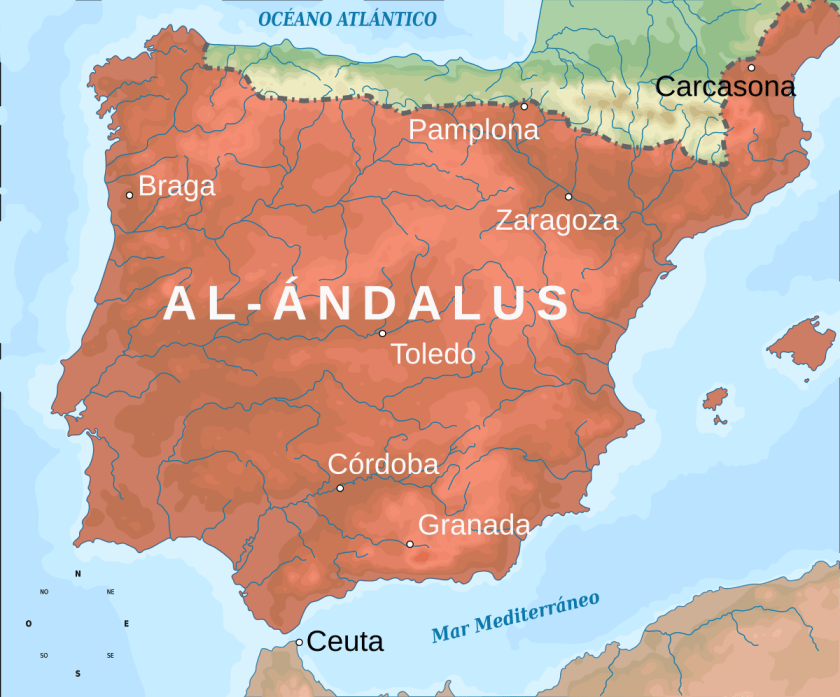
In 711CE / 92H the Umayyad general Tariq bin Ziyad crossed the Mediterranean from the province of Maghreb (modern day Morocco) and landed his army on a mountain in the Iberian Peninsula. This mountain became known as Tariq’s Mountain (Jabal Tariq) which is anglicised as Gibraltar. This was the beginning of the Islamic conquests in to modern-day Spain and which established Islamic rule over the region for nearly 800 years.[1]
The Problem of Disunity
After the Abbasids defeated the Umayyads in 750CE, Abd al-Rahman I (Abd al-Rahman ibn Mu’awiya ibn Hisham ibn Abd al-Malik) managed to escape to Al-Andalus after spending a number of years in exile. It is there he became an independent governor or Emir who ruled by Islam, but who was not under the authority of the Abbasid Khilafah. The Emirate of Córdoba continued as an independent province until the 11th century before splitting in to a number of independent Muslim principalities known as Ta’ifas.
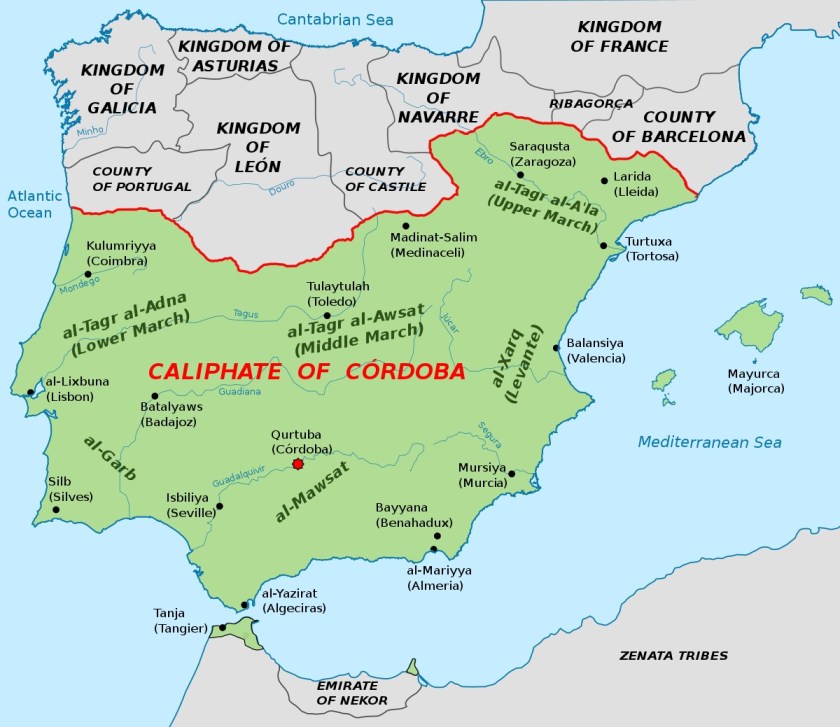
Infighting between the Ta’ifas allowed the Christian states in the North to exploit this disunity and they pushed south managing to conquer in turn each of the Ta’ifas including Cordoba in 1236 by King Ferdinand III of Castile as part of the Reconquista (a series of battles by Christian states to expel the Muslim Moors). Upon the city’s conquest the mosque was converted into a Catholic cathedral dedicated to the Virgin Mary.

Granada was the only Ta’ifa left and was conquered in 1492 by King Ferdinand II and Queen Isabella leading to the end of 800 years of Islamic rule in Spain. Ferdinand and Isabella established the Spanish inquisition in 1478 led to rid Spain of all non-Christians. This led to the expulsion of Muslims and Jews and the forced conversion of those who couldn’t escape.
Disunity will destroy Islam
Disunity is something we are very familiar with. Despite our huge population, abundant natural resources and most importantly believers in the correct deen, Muslim blood is split throughout the world, with no aspect of Islam safe whether hijab, mosques or even the Qur’an itself. This was prophesised by the Messenger of Allah ﷺ when he said, “The knots of Islam will be undone one by one, each time a knot is undone the next one will be grasped, the first to be undone will be the Ruling and the last will be Prayer.”[2]
The dynastic rule which plagued the Islamic State and provinces through the centuries was a principle factor in causing disunity and halting the conquests. This is because rulers became more concerned with the dunya – preserving their own ruling families – than the wider objective which is to spread Islam to the world. Without a shura based system of bay’a the only option for those seeking to come to power was by military force. This occurred in Spain with the Ta’ifas.
The was again prophesised where the Messenger of Allah ﷺ said, ‘The nations will soon summon one another to attack you as people when eating invite others to share their dish.’ Someone asked: ‘Will that be because of our small numbers at that time?’ He said: ‘No, you will be numerous at that time, but you will be scum and rubbish like that carried down by a torrent, and Allah will take fear of you from the breasts of your enemy and cast Al-Wahn into your hearts.’ Someone asked: ‘Oh Messenger of Allah, what is Al-Wahn?’ He said: ‘Love of the world and dislike of death.’[3]
Jewish Immigration to the Islamic State
It wasn’t only Muslims targeted in the Inquisition; Jews were also targeted. When the Ottoman Sultan Bayezid II heard about the expulsion of Jews from Spain by King Ferdinand, he said: “You venture to call Ferdinand a wise ruler,” he said to his courtiers, “he who has impoverished his own country and enriched mine!”[4]

Jews not only found sanctuary in the Ottoman domains but prospered a great deal. Hans Dernschwam, a travelling agent of the Fugger banking house, describes the Jews in Turkey in his travel diary:
“In Turkey you will find in every town innumerable Jews of all countries and languages. And every Jewish group sticks together in accordance with its language. Wherever Jews have been expelled in any land they all come together in Turkey, as thick as vermin; speak German, Italian, Spanish, Portuguese, French, Czechish, Polish, Greek, Turkish, Syriac, Chaldean and other languages besides these. As is their custom, everyone wears clothes in accordance with the language he speaks.
In Constantinople, the Jews are thick as ants. The Jews themselves say that they are very numerous. They live in the lower part of the city near the sea. Those Jews that are old, who have a little money, travel to the Holy Land, to Jerusalem, and still hope that they will one day all come together, from all countries, into their own native land and their secure hold of the government. The well-to-do Jews send money to Jerusalem to support them, for one cannot make any money there …
Many Marranos – that is Jews who turned Christian, as in Spain or voluntarily became Christians in other places – all come to Turkey and become Jews again. The Jews of Constantinople also have a printing press and print many rare books. They have goldsmiths, lapidaries, painters, tailors, butchers, druggists, physicians, surgeons, cloth-weavers, wound-surgeons, barbers, mirror-makers, dyers, silk-workers, gold-washers, refiners of ores, assayers, engravers …
The Jews do not allow any of their own to go about begging. They have collectors who go from house to house and collect into a common chest for the poor. This is used to support the poor and the hospital.”[5]
In fact, this led one academic David Wasserstein to make the claim that “Islam saved Jewry”.[6]
Muhammad Asad sums up Europe’s view towards Islam which continues to this day with the new ‘mini-crusades’, banning hijab, closing mosques and criminalising Islamic thought. He says, “On the contrary, that hatred [of Islam] grew with the passing of time and hardened into a custom. It overshadowed the popular feeling whenever the word “Muslim” was mentioned; it entered the realm of popular proverbs, it was hammered into the heart of every European man and woman. And what was most remarkable, it outlived all cultural changes. The time of the Reformation came, when religious factions divided Europe and sect stood in arms against sect: but the hatred of Islam was common to all of them.
A time came when religious feeling began to wane in Europe: but the hatred of Islam remained. It is a most characteristic fact that the great French philosopher Voltaire, who was one of the most vigorous enemies of the Christian Church in the eighteenth century, was at the same time a fanatical hater of Islam and its Prophet. Some decades later there came a time when learned men in the West began to study foreign cultures and to approach them sympathetically: but in the case of Islam the traditional aversion almost always crept as an irrational bias into their scientific investigations, and the cultural gulf which history had unfortunately laid between Europe and the world of Islam remained unbridged, the contempt for Islam had become part and parcel of European thought.
It is true that the first orientalists in modern times were Christian missionaries working in Muslim countries, and the distorted pictures which they drew of the teachings and the history of Islam were calculated to influence the Europeans in their attitude towards the “heathen”; but this twist of mind perseveres even now, when the orientalist sciences have long since become emancipated from missionary influences, and have no longer a misguided religious zeal for an excuse. Their prejudice against Islam is simply an atavistic instinct, an idiosyncrasy based on the impression which the Crusades, with all their sequels, caused on the mind of early Europe.”[7]
This is the clear difference between when the Islamic State is in authority over non-Muslims, and when non-Muslims are in authority over Muslims.
Notes
[1] al-Tabari, ‘The History of Al-Tabari’, State University of New York Press, Volume XXIII, p.182
[2] Hakim/Ahmed
[3] Abu Dawud, 4297 https://sunnah.com/abudawud/39/7
[4] The Jewish Encyclopedia: a descriptive record of the history, religion, literature, and customs of the Jewish people from the earliest times to the present day, Vol.2 Isidore Singer, Cyrus Adler, Funk and Wagnalls, 1912 p.460
[5] Dean Phillip Bell, ‘Jews in the Early Modern World,’ p.471
[6] https://www.thejc.com/comment/opinion/so-what-did-the-muslims-do-for-the-jews-1.33597
[7] Muhammad Asad, ‘Islam at the Crossroads,’ 1934, p.56
 Islamic Civilization