
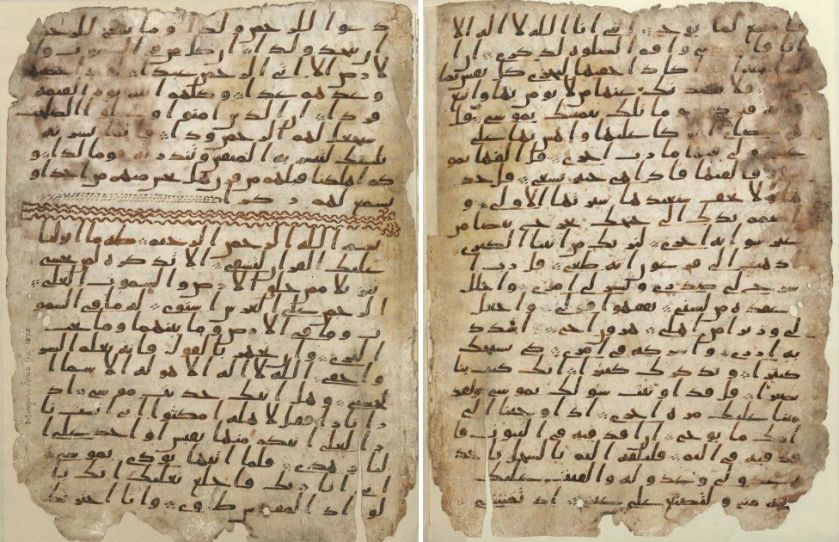
These are some of the oldest written manuscripts we have of the Holy Qur’an. They were discovered in 2015 not in Makkah or Madinah but in Birmingham University. How did they make their way to Birmingham?
After defeating the Ottomans in WW1, Britain occupied Iraq and then began ‘collecting’ its treasures as it did in Egypt and India. This Qur’an manuscript is part of the Mingana Collection of more than 3,000 Middle Eastern documents gathered in the 1920s by Alphonse Mingana, a Chaldean priest born near Mosul in modern-day Iraq. He was sponsored to take ‘collecting trips’ to the Middle East by Edward Cadbury, who was part of the chocolate-making dynasty.[1]
Radiocarbon dating found the Qur’an manuscript to be at least 1,370 years old, making it among the earliest in existence. Professor David Thomas of Oxford University says that some of the passages of the Qur’an were written down on parchment, stone, palm leaves and the shoulder blades of camels – and a final version, collected in book form, was completed in about 650.
He says that “the parts of the Koran that are written on this parchment can, with a degree of confidence, be dated to less than two decades after Muhammad’s death”.
“These portions must have been in a form that is very close to the form of the Koran read today, supporting the view that the text has undergone little or no alteration and that it can be dated to a point very close to the time it was believed to be revealed.”[2]
Preservation of the Qur’an
The majority of Muslims were indifferent to the discovery because they know with certainty that Allah (Most High) has preserved the Qur’an, and even to this day the tradition of hifz (preservation through memorization) continues throughout the world. Such a discovery does have value however, in that it complements the discussion when explaining the miracle of Qur’an to non-Muslims.
Taqiuddin an-Nabahani says, “It has been proven by decisive and definite evidence that when the Prophet ﷺ died the whole Qur’ān had been written on pieces of shoulder blades (of animals), palm risps and on lukhafs (a thin broad white stone). All of it was preserved in the hearts of the Sahabah (may Allah be pleased with them). When an ayah or ayāt would be revealed he ﷺ would order that they be written down before him at once. He did not prevent the Muslims from writing the Qur’ān in other than what he used to dictate to the scribes who wrote down the revelation.”[3]
The Qur’an was preserved through a combination of oral narration and writing. The narration was performed by thousands and thousands of independent narrators, making it impossible that they could have colluded together in corrupting the Qur’an. This method of successive narration is known as mutawatir.
An example of how the classical method of hifz preserves the Qur’an is the controversy caused by former Pakistan Interior Minister Rehman Malik when he faced a supreme court petition for failing to recite surah Ikhlaas correctly during a Cabinet meeting. He also failed to recite it again during a meeting of the Senate. Although his mistake was subtle, the rest of the Cabinet and Senate immediately noticed it and corrected him. This is because every Muslim is taught to memorise the final ten surahs of Qur’an when they are a child so they can perform their prayers. This is the same method of preservation which took place during the time of the Prophet ﷺ and Sahabah. The Qur’an was recited privately in every home, and aloud publicly in the mosques three times a day, and four times on a Friday.
Qadaa wal-Qadr
An important point to note is how the Sahabah understood the verse of Qur’an, where Allah (Most High) says,
إِنَّا نَحْنُ نَزَّلْنَا ٱلذِّكْرَ وَإِنَّا لَهُۥ لَحَـٰفِظُونَ
“It is We Who have sent down the Reminder (Qur’an) and We Who will preserve it.”[4]
After the Battle of Yamamah against the false prophet Musaylama the Liar, many Huffaz (memorisers of the Qur’an) were martyred. Due to this Umar ibn Al-Khattab feared the loss of some parts of the Qur’an and so had an idea to bring all the written sheets in to one book. He presented his idea to the Khaleefah Abu Bakr, and Abu Bakr tasked Zayd ibn Thabit, the scribe of the Prophet ﷺ who wrote down the revelation to begin the task of compiling the Qur’an.[5]
This shows that the Sahabah understood their responsibility in the sphere of actions which human beings have control over. They didn’t simply say Allah will preserve the Qur’an so we don’t have to do anything. They took the burden on themselves and utilized the state to do this.
The State is the method to protect Islam
The Islamic State implements, protects and propagates Islam. When Abu Bakr was Khaleefah, Umar ibn Al-Khattab was his Wazir. They both used the mechanisms and resources of state to compile and preserve the Qur’an. This along with Abu Bakr’s strong stance against the rebels during the Ridda Wars led Abu Hurairah to say, “By the One Whom there is no god but him, if Abu Bakr had not been appointed as Khaleefah then Allah would not have been worshipped.”[6]
During the time of Uthman bin Affan, a major fitna (discord) occurred due to the differences in recitation between the people of Ash-Sham and the people of Iraq. The people of Ash-Sham recited according to the recitation of Ubay ibn Ka’b and the people of Iraq according to Abdullah ibn Mas’ud. Since each side hadn’t heard the dialect of the other, they started accusing each other of disbelief. In order to avert this fitna, Uthman established an agency for compiling the Qur’an based on the master copy compiled by Abu Bakr, and fixing it on the dialect of Quraish. Seven copies were produced and then dispatched with a teacher to the various provinces of the state.[7]
Notes
[1] Sean Coughlan, ‘Oldest’ Koran fragments found in Birmingham University, BBC News, https://www.bbc.co.uk/news/business-33436021
[2] Ibid
[3] Taqiuddin an-Nabahani, ‘Shakhsiya Islamiyya,’ Vol.1, 6th edition, p.118
[4] Holy Qur’an, Surah Al-Hijr, ayah 9
[5] Sahih Bukhari, 4986 https://sunnah.com/bukhari:4986
[6] Jalal ad-Din as-Suyuti, ‘The history of the Khalifahs who took the right way’, translation of Tareekh ul-Khulufaa, Ta Ha Publishers, p.60
[7] Dr Ali Muhammad As-Sallaabee, ‘The Biography of Uthman bin Affan,’ Dar us-Salam Publishers, p.333
 Islamic Civilization