
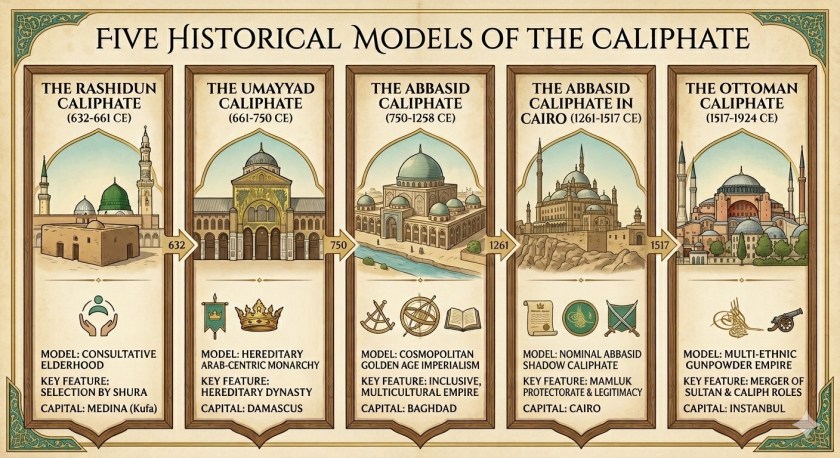
For most of Islamic history the Caliphate was a decentralised confederation, with executive power held by the various Islamic emirates and sultanates who recognised the caliph through a nominal bay’ah.
Al-Radhi (r.934-940CE) was the last independent Abbasid caliph after the rise of the Buwahids (Buyids) in 934CE, and the establishment of their emirate over Iraq, and central and southern Iran. This reduced the caliph’s executive power to the Dar ul-Khilafah which was a section of Baghdad that housed the Caliphal palace. Al-Khatib (d. 463H,1071CE) mentions that Al-Radhi was “the last of the Caliphs who undertook the sole direction of the army and the finances.”[1] After Al-Radhi, his brother Al-Muttaqi (r.940-944CE) became the caliph and Al-Suyuti says about him that “He had nothing of authority but the name.”[2]
Dr. Ovamir Anjum says, “This third model (940-1517CE) has been called classical Islamic constitutionalism.[3] It is important because, with the exception of the first couple of centuries, it is what the caliphate has actually looked like throughout most of Islamic history.”[4]
| Time period | Dates | Length |
| Rightly Guided Caliphate | 11-41H / 632-661 | 30 years |
| Umayyads, Abbasids until Al-Radi | 41-239H / 661-940 | 288 years |
| Abbasids – Al‐Radi onwards | 329-923H / 940-1517 | 600 years |
| Ottomans | 923-1326H / 1517-1908 | 403 years |
| 20th Century Ottomans (Young Turks) | 1326-1342H / 1908-1924 | 16 years |
| Time period | Features |
| Rightly Guided Caliphate | Religious and political authorities were not systematically distinguished |
| Umayyads, Abbasids until Al-Radi | The caliphate became a primarily political office, and religious authority gradually came to be shared between the caliph and the scholars (ʿulamāʾ). The caliph’s powers had never been absolute in practice, but the ʿulamāʾ began to theorize such limits and functions starting in the fourth/tenth century. |
| Abbasids – Al‐Radi onwards | The caliph was primarily a symbolic and spiritual authority; the actual rulers of various provinces were often local governors or invading military commanders who, lacking inherent legitimacy, paid homage to the caliph. These societies were largely self-governed by the Law of Islam as administered by local rulers and scholars. The kings or sultans served as ‘butlers’ or, more grandiosely, as the executive branch, who were important for defense and upkeep of the Law but nevertheless disposable. This third model has been called “classical Islamic constitutionalism”. With the exception of the first couple of centuries, it is what the caliphate has actually looked like throughout most of Islamic history. |
| Ottomans | The Ottoman sultans (who took on the title “caliph” after defeating the Mamluks in Cairo), upheld the Shariʿa Law that was expounded and administered by the scholars as muftis and judges. The caliph-sultan’s powers, therefore, were limited. We have cases of sultans who were deposed because of the verdict of the chief qadi (judge). |
| 20th Century Ottomans (Young Turks) | Western style constitutional caliphate |
Notes
[1] Jalal ad-Din as-Suyuti, ‘History of the Caliphs,’ a translation of Tarikh al-Khulufa’ by Major H. S. Jarrett, 1881, p.411
[2] Ibid, p.413
[3] Noah Feldman, ‘The Fall and Rise of the Islamic State,’ Princeton University Press, 2008, p.28
[4] https://yaqeeninstitute.org/read/paper/who-wants-the-caliphate
 Islamic Civilization