
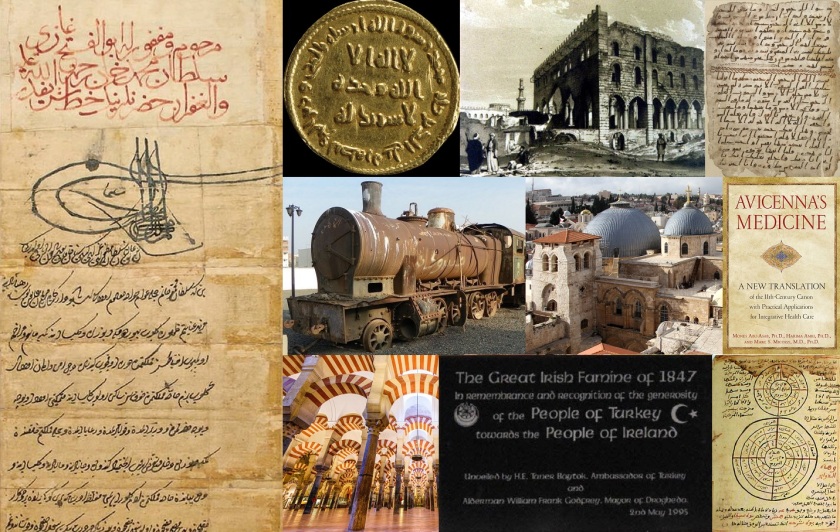
Historical objects such as artefacts, manuscripts and buildings are one of the primary sources in the study of history. Their presence or absence in a society can offer a unique insight in to the past, especially when combined with other sources such as oral narrations. They can offer a more holistic view towards society, and easily dispel the sweeping generalisations we see among those who attempt to distort Islamic history for their own nefarious purposes.
If we look to alcohol consumption in Britain, we know it’s a nation of drinkers and has a history of drinking simply from observing the huge number of pubs, bars and off licenses in the country. In 2019, according to the British Beer and Pub Association (BBPA) there were 47,200 public houses in the UK. Bus stops are named after pubs, and they are the centre of social activity in some places. The Old Ferry Boat Inn in Holywell, England is over 1500 years old!
Do we see the same in the ancient Muslim cities? In Istanbul as an example, despite decades of secularization we find mosques everywhere not pubs. There are 3,113 mosques in the city and some date back to the time of conquest in 1453. There are 304 bars today, but these date back to the start of secularization by the Young Turks and the final abolition of the Ottoman Khilafah.
The absence of pubs itself easily dispels ludicrous claims made by some that the Muslim world has a history of drinking! An article by Khaled Diab appeared in the Guardian newspaper in 2011 titled ‘A drinker’s guide to Islam’. Although his article was on a ‘beerfest’ taking place in a Christian village called Taybeh in Palestine, he used it to infer that Muslims also drink and have a history of drinking!
Diab says, “This is not just a recent ‘innovation’, as conservative Muslims might believe. The prominent 19th-century orientalist Edward William Lane – famous for his incredibly observant if somewhat condescending book, Manners and Customs of the Modern Egyptians – provides, in one of his lesser-known works, some fascinating details about the drinking habits of Egyptians.
‘From the conversations and writings of Arabs,’ he notes, ‘drinking wine in private and by select parties is far from being uncommon among modern Muslims.’ Lane also alludes to the fact that boozing was even more common in earlier centuries, before the introduction of tobacco and coffee as substitutes.[1]
There is plenty of historical evidence to back Lane’s assertion. Numerous prominent Muslims throughout the ages drank alcohol. Even caliphs, such as the Abbasid ruler Haroun al-Rashid of One Thousand and One Nights fame, were reputed to indulge, despite their title of ‘commanders of the faithful’.”[2]
Taqiuddin an-Nabahani says, “Archaeological objects would provide historical facts if studied honestly. Although they by themselves do not provide a historical timeline, they however denote occurrence of some events. If one examines the Islamic antiquities found in their countries, be they buildings, instruments, or any other thing, one can conclude that nothing was present in the Islamic world except Islam, the system of Islam and rules of Islam. Additionally, the Muslims way of life and actions conducted were Islamic.”[3]
Notes
[1] Edward William Lane, ‘Arab Society in the Time of The Thousand and One Nights,’ p.150
[2] Khaled Diab, ‘A drinker’s guide to Islam,’ The Guardian Newspaper, https://www.theguardian.com/commentisfree/belief/2011/oct/08/drinkers-islam-palestinian-beerfest-alcohol
[3] Taqiuddin an-Nabahani, ‘Nidham ul Islam,’ p.70
 Islamic Civilization