
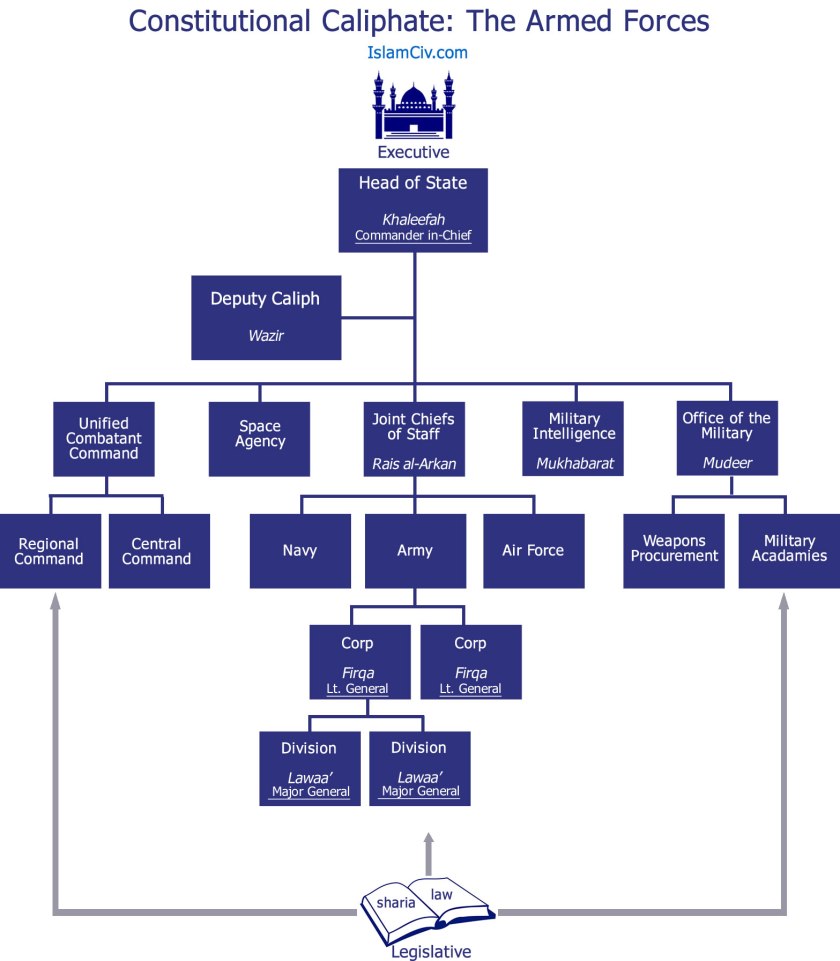
Al-Mawardi lists ten responsibilities[1] for the Amir of the army. These responsibilities in modern times fall under the remit of the defence department and the Chiefs of Staff who are tasked with creating a highly proficient and effective Islamic military, that is capable of assisting the caliph in protecting Islamic interests both at home and abroad.
| Protecting the army from attack |
| Choosing the best location for the army encampments |
| Preparing provisions for the army |
| Knowledge of the enemy, their movements and tactics |
| Organising the army for battle |
| Motivating the army to fight by remembering Allah’s help |
| Motivating the army to fight by remembering the immense reward of jihad |
| Consulting the military experts for advice (shura) |
| Ensuring that the army adheres to the sharia rules of engagement |
| The army must concentrate on military matters and not involve itself in trade and agriculture |
The duties listed above cover a wide-range of areas including logistics, intelligence and educational programmes (tarbiya). These areas require the input and assistance of many other parts of the state such as the education department and treasury. This is why it’s important that the caliph is the effective head of the army, so as head of the executive branch he can order all his department heads to assist the military when and if required.
It’s important to reiterate that administration (إِدارَة idara) can be adopted from any system. Every time period has its own specific realities and problems, and so the military must be structured in such a way as to meet these challenges. If that means copying the military structure of America, Russia or China then so be it. The Islamic state must be a dynamic state ready to do whatever is necessary within the limits of the sharia, to achieve rapid development and progress in all spheres of life. This can only be achieved with a clear understanding of what the sharia allows, and does not allow, when it comes to imitation of the non-Islamic systems of governance.
Sheikh Ibn al-Uthaymin (d.2001) says, “If it is said, ‘Imitating the disbelievers,’ means that we should not use anything of their crafts. No one would say that. During the time of the Prophet ﷺ and after him, people used to wear clothing made by the disbelievers and use utensils made by them.
Imitating the disbelievers means imitating their clothing, their adornments, and their special customs. It does not mean that we should not ride what they ride, or that we should not wear what they wear. However, if they ride in a specific way that is unique to them, then we should not ride in this way. If they tailor their clothes to a specific way that is unique to them, then we should not tailor them in this way, even if we ride in a car like the one they ride in, and we tailor from the same type of fabric that they tailor from.”[2]
He also mentions, “Imitating the disbelievers means that a person adopts their attire in dress, speech, or the like, such that when someone sees him, he says: This is one of the disbelievers.” As for what Muslims and disbelievers share, this is not imitation. For example, now men wear trousers. We do not say this is imitation, because it has become a habit for everyone.”[3]
Brigadier-General Dr. Muhammad Damir Witr lists eight military administrations that were found in the time of the Prophet ﷺ.
| planning and organisation |
| Shura (consultation) |
| directing the morale |
| information gathering |
| operations |
| training and equipping |
| provisions, supplies and booties |
| medical services |
He then says: “These administrations used to undertake their tasks according to the obligatory military requirements, and they did not have specific structures like we see today just as they were not (completely) separate from each other or from the field army in respect to its actions and elements. That is because it was possible for a fighter to also be charged with reconnaissance and with another task at the same time. All of these administrations were headed by a single head who assumed their administration and the supervision over them. He was the Commander-in-Chief (Qa’id Al-‘Amm).
Also, these administrations were not concentrated in a particular or specific location, but were rather included within the army and moved with it and were located or concentrated along with it. For that reason, the teeth of the army were stronger than its tail and its fighting elements were greater in number than its administrative elements”[4]
Muhammad Haykal comments on this, “From all of this, it becomes clear that the different organisational elements upon which the matters or affairs of the army and its conditions revolve, fall under the area or scope of the Mubaahaat (permissible matters). That is as long as they do not contravene the Ahkaam Ash-Shar’iyah, and that applies whether those matters are related to the centres where the army is established and its distribution upon the fronts and different regions, or related to its military formations, the clothing that it individuals wear or its organisation of military ranks, in addition to the many other organisational aspects related to the army…”[5]
Notes
[1] Abu l-Hasan al-Mawardi, Al-Ahkam as-Sultaniyah, Ta Ha Publishers, p.66
[2] Majmoo’ Fatawa al-Shaykh Ibn Uthaymin (12/Question 177), https://islamqa.info/ar/answers/45200/%D8%AD%D9%83%D9%85-%D8%AA%D9%82%D9%84%D9%8A%D8%AF-%D8%A7%D9%84%D9%83%D9%81%D8%A7%D8%B1-%D9%88%D9%85%D8%B9%D9%86%D9%89-%D9%85%D8%A7-%D8%B1%D8%A7%D9%87-%D8%A7%D9%84%D9%85%D8%B3%D9%84%D9%85%D9%88%D9%86-%D8%AD%D8%B3%D9%86%D8%A7-%D9%81%D9%87%D9%88-%D8%B9%D9%86%D8%AF-%D8%A7%D9%84%D9%84%D9%87-%D8%AD%D8%B3%D9%86
[3] https://www.islamweb.net/ar/fatwa/387583/%D8%AA%D9%82%D9%84%D9%8A%D8%AF-%D8%BA%D9%8A%D8%B1-%D8%A7%D9%84%D9%85%D8%B3%D9%84%D9%85%D9%8A%D9%86-%D9%81%D9%8A-%D8%A7%D9%84%D8%B9%D8%A7%D8%AF%D8%A7%D8%AA-%D8%B1%D8%A4%D9%8A%D8%A9-%D8%B4%D8%B1%D8%B9%D9%8A%D8%A9
[4] Brigadier-General Dr. Muhammad Damir Witr, ‘Al-Idaarah Al-‘Askariyah Fee Hurub Ar-Rasool Muhammad ﷺ),’ ‘The military administration in respect to the wars of the Messenger Muhammad,’ 1986, pp.107-108
[5] Muhammad Khayr Haykal, ‘Al-Jihad wa’l Qital fi as-Siyasa ash-Shar’iyya,’ vol.4, The Eighth Study, Qitaal Mughtasib As-Sultah (The First Study: The different types of organisation that the army)
 Islamic Civilization