
- The 12 Naqibs
- Sahifat al-Medina
- Al-Aws and Al-Khazraj (Ansar)
- Jewish Tribes
- The First Major Province
- Notes
The sunnah consists of the speech, actions and consent of the Prophet ﷺ. It is a fundamental source of Islamic Law (sharia) from which we guide our actions.[1] The sunnah is not just restricted to ‘ibadat (worships) but covers all aspects of life, state and society. Allah ta’ala says,
وَمَآ ءَاتَىٰكُمُ ٱلرَّسُولُ فَخُذُوهُ وَمَا نَهَىٰكُمْ عَنْهُ فَٱنتَهُوا۟
“Whatever the Messenger gives you, take it. And whatever he forbids you from, leave it.”[2]
The relative pronoun (مَا) is ‘aam (general) and means “whatever” so we do not restrict the sunnah to one sphere of life only. Today siyasa sharia (Islamic politics) is a neglected sunnah and an area which requires greater scrutiny and study to guide us through the maze of modern political life.
In regards to the Islamic ruling system, the speech and actions of the Prophet ﷺ in Medina related to government are a divine evidence (شَرْع دَلِيل shara’ daleel) for us to follow.
The 12 Naqibs
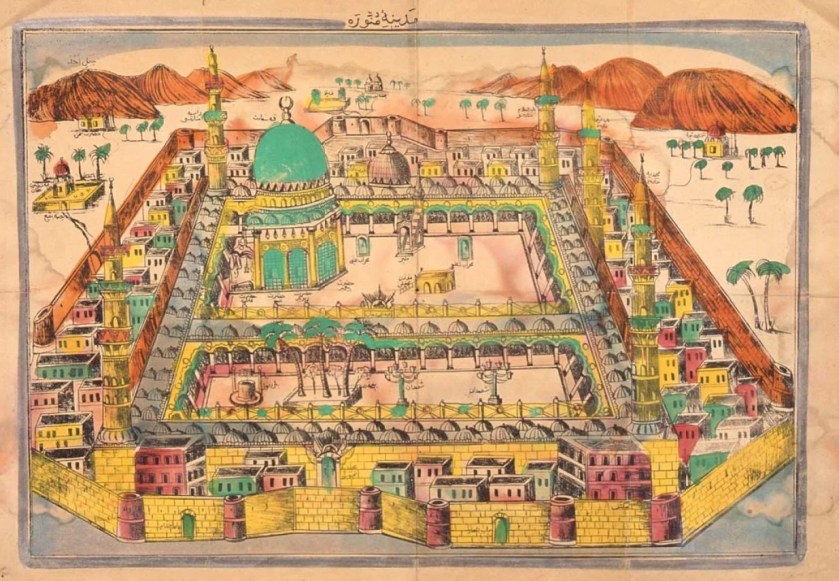
When the Prophet Muhammad ﷺ first established the state in Medina, the existing tribal structure was used to administer the state. The Aws and Khazraj tribes whom Islam united together as the Ansar (helpers), were sub-divided into various clans who managed their own administrative affairs as devolved ‘mini-provinces’.
The chiefs (naqibs) of these clans were not appointed by the Prophet ﷺ, but rather ‘elected’ by the tribes themselves on his ﷺ orders. Ka’b ibn Malik narrates that the Prophet ﷺ said,
أَخْرِجُوا إلَيَّ مِنْكُمْ اثْنَيْ عَشَرَ نَقِيبًا، لِيَكُونُوا عَلَى قَوْمِهِمْ بِمَا فِيهِمْ. فَأَخْرَجُوا مِنْهُمْ اثْنَيْ عَشَرَ نَقِيبًا، تِسْعَةً مِنْ الْخَزْرَجِ، وَثَلَاثَةً مِنْ الْأَوْسِ.
أَسَمَاءُ النُّقَبَاءِ الِاثْنَيْ عَشَرَ وَتَمَامُ خَبَرِ الْعَقَبَةِ
“Bring out to me from among you twelve chiefs (naqibs), so that they may be in charge of their people and whatever is in them.” So they brought out from among them twelve chiefs, nine from the Khazraj, and three from the Aws.[3]
He ﷺ said to the Naqibs:
أنتم على قومكم بما فيهم كفلاء ككفالة الحواريين لعيسى بن مريم، وأنا كفيل على قومي
“You are responsible for your people and what is in them, just as the disciples were responsible for Jesus, son of Mary. I am responsible for my people.”[4]
“The Naqib means: عريفُ القوم يتعرف أخبارهم وينقب “the leader (‘arif) of the people who learns their news and investigates.”[5]
Al-Asamm (d. 852 CE) says,
هُمُ المَنظُورُ إلَيْهِمْ والمُسْنَدُ إلَيْهِمْ أُمُورُ القَوْمِ وتَدْبِيرُ مَصالِحِهِمْ
“They (naqibs) are the ones who are looked to and entrusted with the affairs of the people and the management of their interests.”[6]
The 12 Naqibs[7]
| No. | Name | Tribe | Service to Islam |
| 1 | Abu Umama As’ad bin Zurara | Khazraj | Died before Badr. One of the original six who became Muslim at hajj one year before. |
| 2 | Rafi’ bin Malik | Khazraj | One of the original six who became Muslim at hajj one year before. |
| 3 | Ubada ibn al-Samit | Khazraj | Commander at Badr. Teacher and Judge in Ash-Sham under Umar ibn Al-Khattab. |
| 4 | Sa’d bin al-Rabi’ | Khazraj | Battle of Badr, martyred at Uhud |
| 5 | Abd Allah bin Rawaha | Khazraj | Battles of Badr, Uhud, Khandaq. Commander of the Battle of Mu’tah where he was martyred. |
| 6 | al-Bara’ bin Ma’rur | Khazraj | First to give 2nd bay’ah of Aqaba. He died before the arrival of the Prophet ﷺ in Medina. |
| 7 | Abd Allah bin ‘Amr bin Haram | Khazraj | Battle of Badr, martyred at Uhud |
| 8 | Sa’d ibn Ubadah | Khazraj | Candidate for post of Caliph at the Saqifah of his clan after Prophet’s ﷺ death. |
| 9 | al-Mundhir bin ‘Amr | Khazraj | Battles of Badr, Uhud. Commander at Bi’r Ma’una where he was martyred. |
| 10 | Usaid bin Hudair | Aws | Commander of Aws at Uhud, Hunayn and Tabuk. Part of bay’ah contract to Abu Bakr at the Saqifah. |
| 11 | Sa’d ibn Khaithamah | Aws | Martyred at Badr |
| 12 | Rifa’ah ibn ‘Abd al-Mundhir ibn Zunayr | Aws | Battle of Badr |
Sahifat al-Medina
Early in the formation of the state, the Prophet ﷺ drew up a charter called the Sahifat al-Medina, which was similar to a modern-day constitution. This document defined the relationships and responsibilities of the various tribes in Medina who made up the Islamic society. Muhammad Al-Massari says, “We also observe, through a mere reading of the Sahifa, that it represents, in its sum, constitutional texts which regulate the relationship between the different groups of a society which has been formed upon a tribal basis, where tribes represent important units and each tribe is equivalent to a state.”[8]
The Sahifa treaty “mentioned 40 subtribes or clans by name, and stated that each tribe will carry the responsibilities of its members; they will oversee their own blood-money disputes, prisoners of war, and the poor and needy.”[9] In other words the Prophet ﷺ devolved some ruling powers to these clans a process known in modern times as devolution.
An example of one of these clauses is Banu Sa‘ida, a sub-tribe of Khazraj headed by Sa’d ibn Ubadah, where the famous bay’ah to Abu Bakr was conducted after the Prophet’s ﷺ death. The Sahifa stated:
“Banu Sa‘ida shall be responsible for their own ward (مَعاقِلهم), and shall pay their blood-money in mutual collaboration and every group shall secure the release of its own prisoners by paying their ransom from themselves, so that the dealings between the believers be in accordance with the principles of goodness and justice.”[10]
It is clear from the Sahifa and the command of the Prophet ﷺ: أَخْرِجُوا إلَيَّ مِنْكُمْ اثْنَيْ عَشَرَ نَقِيبًا، لِيَكُونُوا عَلَى قَوْمِهِمْ بِمَا فِيهِمْ “Bring out to me from among you twelve chiefs (naqibs), so that they may be in charge of their people and whatever is in them,” that these naqibs had full powers over their clans as indicated by the relative pronoun (مَا) which is ‘aam (general) and means “whatever”. This is an evidence (شَرْع دَلِيل shara’ daleel) for elected governors as we will discuss in due course.
Since these naqibs were only amirs of a clan (district in modern speak), their powers would exclude anything to do with policies related to the common security and well-being of the state such as taxation and military expeditions. The sub-tribes would assist in these common issues such as participation in the battles as the Sahifa constitution of Medina outlined, but they would have no autonomy to pursue their own agendas separate to that of the Prophet ﷺ. No military expedition ever took place without the direct command and consent of the Prophet ﷺ who was the commander-in-chief, except that of Abu Basir who was outside the authority and jurisdiction of the Prophet’s ﷺ state at the time. The Sahifa states:
وَإِنَّهُمْ يَنْصُرُونَ بَعْضُهُمْ بَعْضًا عَلَى مَنْ دَهَمَ يَثْرِبَ
“And they (the signatories) support one another against whoever attacks Yathrib [Medina].”[11]
Al-Aws and Al-Khazraj (Ansar)
Prior to Islam, Sa’d ibn Mu’adh and Usaid bin Hudair were the chiefs (sayyid) of Banu Abd Al-Ashhal, a sub-tribe of Al-Aws.[12] Although Usaid bin Hudair was the ‘elected’ Naqib of Banu Abd Al-Ashhal, Sa’d ibn Mu’adh was the overall leader of Al-Aws. Sa’d ibn Ubadah, the Naqib of Banu Sa‘ida was the overall leader of Al-Khazraj[13], and both Sa’ds would represent the opinions of the Ansar as a whole. After the Prophet ﷺ passed away the Ansar’s candidate for the caliphate was Sa’d ibn Ubadah, and the bay’ah took place at his Saqifa (portico) because Sa’d ibn Mu’adh had passed away after the Battle of Khandaq in 5 Hijri.
At the Battle of Badr, Sa’d ibn Mu’adh carried the flag (liwaa’) of Al-Aws and since Sa’d ibn Ubadah was back in Medina protecting the city, Sa’d ibn Mu’adh represented the opinion of the entire Ansar, both Al-Aws and Al-Khazraj. Before the battle the Prophet ﷺ said to the sahaba, “Advise me, people!” When the Messenger of Allah ﷺ said that, Sa’d ibn Mu’adh said to him: “By Allah, it seems that you mean us [Ansar], O Messenger of Allah?” He ﷺ said: “Yes.”[14]
After the expedition of al-Muraysī’ in 627CE (5 AH), the munafiqun (hypocrites) concocted a malicious slander (ifk) against ‘Aisha (ra), the mother of the believers, and beloved wife of the Prophet ﷺ. The head of the munafiqun was Abd Allah ibn Ubayy ibn Salul, who was one of the prominent members of Al-Khazraj. The Prophet ﷺ gathered the Muslims in the Masjid and delivered a sermon exposing Abd Allah ibn Ubayy’s lies. Sa’d ibn Mu’adh of Al-Aws, stood up and said if he was from his tribe i.e. Al-Aws then he would execute him. However, if he was from another tribe (state) in this case Al-Khazraj, then he would need permission to do that since he had no authority over Al-Khazraj. This is an indication of the administrative setup and devolved powers of the various tribes of Medina.
‘Aisha narrates that the Messenger of Allah ﷺ addressed the sahaba in the Masjid saying, “O group of Muslims, who will excuse me from a man who has harmed my family? I have been informed about him. By Allah, I have never known anything about my family except good. They have mentioned a man about whom I have never known anything except good, and he never enters upon my family except with me.” She said, then Sa’d ibn Muadh, the brother of Banu Abd al-Ashhal, said: “O Messenger of Allah, I excuse you. If he is from Al-Aws, I will strike his neck, and if he is from our brothers from Al-Khazraj, you order us and we will do what you order.”[15]
Jewish Tribes
The tribes of Medina were not just Muslim. There were a number of Jewish tribes, and they also managed their own affairs except in matters of common security and disputes with the Muslims. “The treaty clarified that the Jewish nation is responsible for all its internal affairs, such as internal disputes, blood-money, and the poor and needy, as aforementioned. However, if there are disputes between the two nations (i.e., the Jews and Muslims), it will be deferred to the judgement of the Prophet ﷺ. The Jews therefore enjoyed semi-independent statehood within the Islamic state.”[16]
The Prophet ﷺ did not appoint separate Amirs over the Jewish tribes, or establish mosques within them, or force Muslims to move and live among them. This clearly shows that there was no agenda to dilute or pressure these communities to ‘Islamicise’ in a religious and cultural sense. Only in relation to the common security and overarching interests of the state, were they obliged to obey the Prophet ﷺ, something they renegaded on time after time jeopardising the security of Medina and leading to their eventual expulsion from Hejaz. The Sahifa states:
وَإِنَّ الْيَهُودَ يُنْفِقُونَ مَعَ الْمُؤْمِنِينَ مَا دَامُوا مُحَارَبِينَ
“And the Jews spend with the believers as long as they are at war.”[17]
This independence of the dhimmi (non-Muslim citizens) in their religious and communal matters continued throughout the caliphate’s history, and old churches and synagogues can still be seen to this day in the Christian and Jewish quarters of many Muslim countries.
This use of the tribal structure to administer the state on a local level continued throughout the lifetime of the Prophet ﷺ.
The First Major Province
After the Treaty of Hudaibiyah (628CE/6Hijri), the state dramatically expanded, and the city-state model transformed into an ‘empire’ model where vast regions of Arabia became part of the Islamic State. The first of these new territories was Yemen under Bādhān ibn Sāsān the former Persian governor. Yemen was the first major province (wiliyah) of the state with Bādhān its first appointed governor (wali). The Wali or Amir as he was more commonly known, would be the top-level official in the province with the tribal chiefs operating at a local level beneath him. The Amir would never interfere in the local affairs of the tribes or appoint their heads. It was left to the members of the tribe to ‘elect’ or consent to whomever they wished to be their tribal chief.
Notes
[1] Muhammad Hussein Abdullah, ‘Al-Waadih Fee Usool ul-Fiqh,’ 1995, First Translated English Edition 2016, p.94
[2] Holy Qur’an, Surah Al-Hashr, ayah 7
[3] Ibn Hisham, narrated by Ka’b ibn Malik, https://shamela.ws/book/23833/466
[4] Ibn Kathir, Al-Bidaya wa l-Nihaya, https://shamela.ws/book/23708/855
[5] Muhammad Hassan Hassan Jabal, ‘The etymological dictionary of the words of the Holy Qur’an,’ https://tafsir.app/ishtiqaqi/%D9%86%D9%82%D8%A8
[6] https://tafsir.app/alrazi/5/12
[7] Ibn Hisham, narrated by Ka’b ibn Malik, https://shamela.ws/book/23833/466
[8] Dr Muhammad Al-Massari, ‘The Prophetic Constitution of Madinah,’ Hizb Al-Tajdeed, p.163
[9] Yasir Qadhi, ‘The Sirah of the Prophet ﷺ,’ The Islamic Foundation, 2023, Treaty of Medina
[10] Ibn Hisham, https://shamela.ws/book/23833/525#p1
[11] Ibn Hisham, https://shamela.ws/book/23833/527
[12] Ibn Hisham, https://shamela.ws/book/23833/459#p1
[13] Sahih al-Bukhari 4141, https://sunnah.com/bukhari:4141
[14] Ibn Hisham, https://shamela.ws/book/23833/638
[15] Sahih al-Bukhari 4141, https://sunnah.com/bukhari:4141
[16] Yasir Qadhi, ‘The Sirah of the Prophet ﷺ,’ The Islamic Foundation, 2023, Treaty of Medina
[17] Ibn Hisham, https://shamela.ws/book/23833/527
 Islamic Civilization