
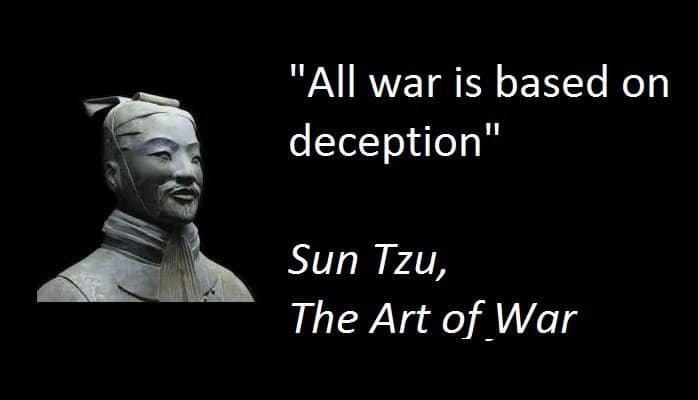
Continuing our series on war and peace in Islam, there is a clear difference between deception in war and treachery.
Some may argue that since war is deception then it’s permitted to enter a land with a visa and then renegade on that based on an incorrect understanding of a hadith by Ka’b ibn Malik who reported that when the Prophet ﷺ intended to set out on a military expedition, he would pretend to go somewhere else. The Prophet would say, الْحَرْبُ خُدْعَةٌ “War is deception.”[1]
This misconception shows the importance of understanding the Arabic language and the principles of Islamic jurisprudence (usul al-fiqh) before issuing Islamic edicts. We cannot read a hadith in English and apply the meaning of the word ‘deception’ in English and extract a ruling. There is a clear difference between deception (خُدْعَة) and treachery (خِيانَة) in Islam and even in the English language.
Deception (خُدْعَة) in war is related to battle tactics and all militaries since wars began have used deceptive tactics against each other. During WWII Britain hatched an ingenious plan to deceive the Germans called Operation Mincemeat which used a corpse and false papers to disguise the 1943 Allied invasion of Sicily.
Treachery (خِيانَة) on the other hand in war or at any time is not permitted in Islam.
The hadith “War is deception.”[2] forms part of the laws of war (ahkam al-jihad) so is not applicable to those who reside in a country as citizens or as a musta’min (visa holder and resident), even if that country is perpetuating or supporting horrific crimes against Muslims. Taking up arms against a country and its people that has provided an Aman (security covenant) is treason, and the antithesis of the Islamic sharia related to good conduct.
Al-Nawawi says,
الْعُلَمَاءُ عَلَى جَوَازِ خِدَاعِ الْكُفَّارِ فِي الْحَرْبِ وَكَيْفَ أَمْكَنَ الْخِدَاعُ إِلَّا أَنْ يَكُونَ فِيهِ نَقْضُ عَهْدٍ أَوْ أَمَانٍ فَلَا يَحِلُّ
The scholars have agreed upon the permissibility of deceiving the disbelievers during war when or however the deception is possible to accomplish, unless it relates to the breaching of an ‘Ahd (covenant) or Aman (security), as that is not Halal.”[3]
Indirect speech (التَّعْرِيضِ) is a form of deception if misapplied, such as selling a defective car or attempting to circumvent visa requirements. Al-Nawawi says in relation to this,
فَفِيهِ دَلِيلٌ عَلَى جَوَازِ التَّعْرِيضِ وَهُوَ أَنْ يَأْتِيَ بِكَلَامٍ بَاطِنُهُ صَحِيحٌ وَيَفْهَمُ مِنْهُ الْمُخَاطَبُ غَيْرَ ذَلِكَ فَهَذَا جَائِزٌ فِي الْحَرْبِ وَغَيْرِهَا مالم يَمْنَعْ بِهِ حَقًّا شَرْ
“This provides evidence for the permissibility of indirect speech, which is when one utters words whose underlying meaning is correct, but the listener understands something else from them. This is permissible in war and other situations, as long as it does not prevent the fulfillment of a legitimate right.”[4]
Muhammad Al-Yaqoubi says, “Deception and treachery are not permissible for Muslims who live in Western countries, such as the U.S. or Canada, or in the Far East in China or Japan, or anywhere else in the world, such as Brazil, Scandinavia, or Australia. It is impermissible for them to go against their contract. They must respect the law of the lands in which they live, as was the case of the Companions of the Prophet ﷺ when they migrated from Mecca to Abyssinia and lived many years under the shade of a just Christian king. They found security with him despite the fact that his people were Christians who opposed their faith.”[5]
Salafi Manhaj says, “There is a big difference in the Divine Legislation between breaking an agreement (treachery) and deception. The first is prohibited according to consensus and as for the second (i.e. deception) it is permitted during warfare by consensus. Deception is not
breaking an agreement rather it is putting something forward and not doing or implementing it, deceiving the combatants. So whoever equalized the two has equalized between what the Divine Legislation has separated and making an analogy (qiyas) between the two is corrupt due to it being an error in its very basis and due to it opposing the Divine Legislation from another aspect, the Qur’anic verses and multiple narrated Prophetic hadeeth about fulfilling trusts.”[6]
What about the incident of Ka’b Ibn Al-Ashraf?
Ka’b Ibn Al-Ashraf, was a member of the Jewish tribe Banu Nadir in Medina and used to incite the Meccans against the Prophet ﷺ so the Prophet ordered him to be killed for treason. Some Jihadi-Salafis say the Prophet’s companions provided Ka’b with a false Aman in order to gain his trust, and then used it to lure him out of his house at night and kill him.
Yasir Qadhi answers this point where it is clear that Ka’b had already broken the treaty of Medina (Sahifa).
“This event is often cited as being controversial, as some criticise it as an extrajudicial assassination. In reality, Kaʿb’s secret alliance and plot against the Prophet was clear grounds for capital punishment, as it was a threat of treason. Moreover, Kaʿb was consistent in inciting hatred towards Allah and His Messenger, going as far as sexually enticing the men of Medina towards the female Companions. The Banū Naḍīr had already violated the Treaty of Medina in the Battle of Sawīq by assisting Abū Sufyān. It is not clear whether Kaʿb physically participated, though it is possible, considering their secret alliance shortly after.
This event is described as extrajudicial because Kaʿb was assassinated without proper proceedings. This requires a broader commentary of the political norms of 7 century Arabia and the danger of imposing contemporary norms onto a society which holds inherently different legal mechanisms and societal understandings. The Prophet’s leadership was religious, political, and legal; therefore, his order was inherently judicial. The Prophet did not order such attacks in Mecca, but in Medina, he was the ruler with executive power, and thus his commands were given with legal authority. Kaʿb’s own wife stated, “You are a man at war”, even though he was not in a physical battle, because it was understood as per the norm of the time that his engagements were of a hostile nature.”[7]
Notes
[1] Sunan Abi Dawud 2637, https://sunnah.com/abudawud:2637
[2] Sunan Abi Dawud 2637, https://sunnah.com/abudawud:2637
[3] An-Nawawi, Sharh of Saheeh Muslim: 7/320, https://shamela.ws/book/1711/2613
[4] An-Nawawi, Sharh of Saheeh Muslim, https://shamela.ws/book/1711/2727#p1
[5] Muhammad Al-Yaqoubi, ‘Refuting ISIS: A Rebuttal Of Its Religious And Ideological Foundations Paperback,’ Sacred Knowledge, 2015, p.31
[6] Salafi Manhaj, ‘The clear proofs for refuting the doubts of the people of takfeer and bombing,’ p.57
[7] Yasir Qadhi, ‘The Sirah of the Prophet ﷺ,’ The Islamic Foundation, 2023, The Killing of Kaʿb ibn al-Ashraf
 Islamic Civilization