
- Yazid ibn Mu’awiya and Abdul-Malik ibn Marwan gain power through force
- What enabled this abnormal situation to become the norm?
- Notes
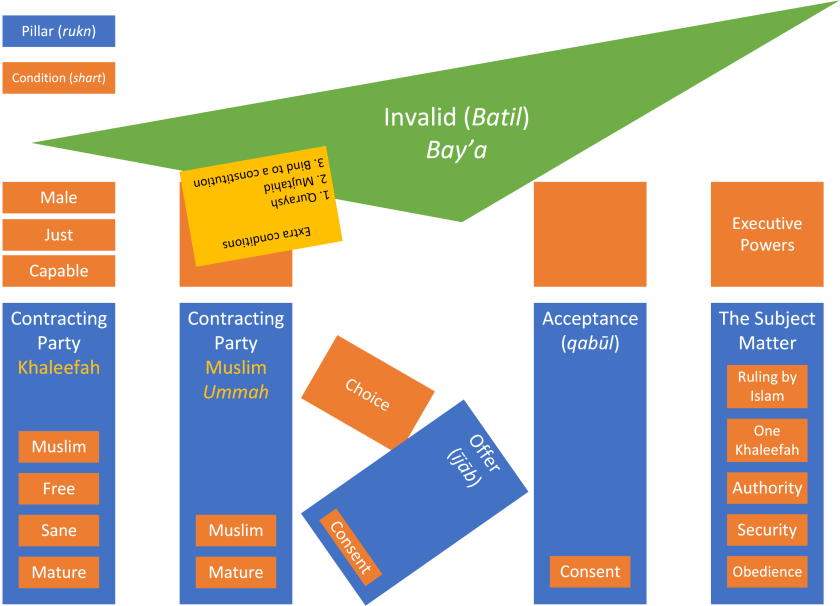
The last way of appointing a caliph by the ummah is where a usurper or dominant sultan takes power by force. Since the ummah in origin has not consented to this dominant sultan then he cannot be a caliph and the bay’ah would be considered batil as one of its pillars (rukn) is missing. The bay’ah is a contract and must conform to the rules of contracts in Islam which is free choice and consent of both parties.
If the ummah and her representatives decide to accept the legitimacy of this ruler, then the bay’ah will become legally convened. Ibn Hajar says, “The jurists have unanimously agreed that it is obligatory to obey the dominant sultan and jihad with him, and that obedience to him is better than revolting against him because of that of shedding blood and pacifying the masses.”[1]
Such a situation has been permitted by the ‘ulema but it is an emergency situation and should not be the norm. If this occurred in a future Islamic state due to the removal of a corrupt caliph in a coup d’etat for instance, then elections need to be held as soon as is feasibly possible because the ummah is the source of authority not the dominant sultan.
Shaykh Khudari Bak says, “There is a fourth way [of bay’ah] which the scholars after the first era instituted for the establishment of the imamate, and that is by way of dominance. This happens when the Muslims have no imam, there are differences among them, and they cannot agree on a particular person. In such a situation, it is lawful for a person who knows that he has the capacity to lead the Muslim community because of his knowledge or the influence of his tribe, to demand this post of caliph. He would hence oblige the people to obey him, whether they responded willingly or by force. Once the situation subsides and his claim is accepted, his caliphate will be established and obedience to him will become obligatory.”[2]
Dr. Wahbah Az-Zuhaili says “Subjugation (Al-Qahr) is an exceptional circumstance which does not conform to the origin which dictates that the authority be established by choice. Approving or accepting it, is based upon giving consideration to a situation that has befallen due to the necessity (Daroorah) and to prevent the shedding of blood …”[3]
Muhammad Haykal says, “Likewise, in respect to the method of gaining mastery (At-Taghallub), the Mutaghallib (one who takes over the rule by force) does not become the caliph by the mere taking control over the authority. Rather, he would only become the caliph at a time when the people accept him (by choice) and give the bay’ah to him. If they refuse to give him the bay’ah (pledge) he would remain a ruler who has usurped the authority.
That is just like when a person usurps a commodity from another and then if that other accepts and sells it to him (the usurper) the ownership of the property would be transferred to him. However, if the owner remains adamant about not selling the commodity to the usurper, then the one refusing remains the rightful Shar’i (legal) owner of the commodity. The usurper would remain as such irrespective of how much time passes over his usurpation.”[4]
Yazid ibn Mu’awiya and Abdul-Malik ibn Marwan gain power through force
Two examples of the use of force to take the bay’ah during the Umayyad Caliphate, are the rule of Yazid ibn Mu’awiya (r.60-64H/680-683CE) and Abdul-Malik ibn Marwan (r.73-86H/692-705CE).
There is ikhtilaaf (difference of opinion) among the ulema on Yazid’s legitimacy. Many scholars accept he was a legitimate caliph such as Al-Dhahabi, but that he was sinful and blameworthy for the oppression and persecution he committed against the sahaba, and the murder of al-Hussain and his family. Others such as Ibn Al-Jawzi reject his legitimacy and call him a usurper, because he never had a legally convened bay’ah that was given through free choice and consent by the majority of the Ahlul hali wal-aqd (political representatives of the ummah). The strongest opinion seems to be that of Ibn Al-Jawzi that Yazid was not a legitimate caliph.
It was mentioned in the Tafseer of Al-Alusi: “Ibn al-Jawzi (May Allah’s mercy be upon him) stated in his book: ‘As-Sirr ul-Masun’: “From the general beliefs that is prevalent amongst those attributed to the Sunnah is that they say: That Yazid was in the right and that Al-Hussain (ra) was wrong to rebel against him. Had they examined the Seerahs they would have become aware of how the bay’ah was contracted to him and that the people were compelled with it! And that he did every ugly (or abominable) act. If we would have evaluated the Sihhah (correctness and validity) of the bay’ah contract, then there appeared from it all that would oblige the annulment of the contract. Nobody inclines to that view except every ignorant person, blind in the Madhhab who believes that by adopting that opinion he is being harsh against the Rawaafid (i.e. Shi’ah).”[5]
With regards to Abdul-Malik, Suyuti summarises his bay’ah. “He received the bay’ah according to his father’s contract during the Caliphate of Ibn Al-Zubayr, but his Caliphate was not valid and he remained as the usurper (mutaghallib) of Egypt and Syria. He then seized Iraq and its provinces before Ibn Al-Zubayr was killed in 73H/692CE. From that day, his Caliphate became valid and his authority firmly established.”[6]
This then explains the difference between the bay’ah to Yazid ibn Mu’awiya and Abdul-Malik ibn Marwan who were both usurpers. The bay’ah to Yazid was never legally convened because the Ahlul hali wal-aqd never gave bay’ah through free choice and consent. Whereas with Abdul-Malik, the Ahlul hali wal-aqd in Hijaz and Iraq, finally agreed to give bay’ah once Abdullah ibn Al-Zubayr had been killed by Abdul-Malik’s infamous commander, Hajjaj bin Yusuf. Among those who gave bay’ah to Abdul-Malik after Ibn Al-Zubayr’s death were Abdullah ibn Umar and his family in Madinah.
Bukhari narrates from Abdullah bin Dinar: “I witnessed Ibn Umar when the people gathered around Abdul Malik. Ibn Umar wrote: ‘I gave the bay’ah that I will listen to and obey Allah’s Slave, Abdul-Malik, Ameer of the believers according to Allah’s Laws and the Traditions of His Messenger as much as I can; and my sons too, give the same pledge.’”[7]
There are numerous examples in Islamic history of rulers taking power and then the ummah consenting to their rule, legitimising the bay’ah. This occurred not just in the Umayyad period but also in the Abbasid and Ottoman Caliphates.
What enabled this abnormal situation to become the norm?
Rashid Rida answers this question. “You know now that what enabled—and enables—tyrants to rule is nothing but the partisan support of their own kin. Tyrants are motivated purely by a desire for power. Their aim in fighting is not to glorify Allah’s word, nor is it to establish the scales of truth and justice for all people. This community has had its affairs corrupted and its power stripped by nothing other than:
• people assuming that obedience to unjust and violent rulers is an absolute obligation under the shari‘ah
• people assuming that the rule of tyranny is lawful under the shari‘ah
• people assuming that the rule of a tyrant has the same legal validity as the rule of a rightful imam, an imam whose rule rests on a pledge of allegiance given by those in authority and those who loose and bind who elected him
• every unjust tyrant restricting authority and power and might to his own family by asserting that the right to appoint his son, or someone else among his kin, is his entitlement under the shari‘ah, and a principle to be observed in and of itself
• the failure to see how Mu‘awiyah’s designation of his son Yazid as his successor differed from Abu Bakr As-Siddiq’s designation of ‘Umar bin al-Khattab. Yazid was a dissolute wrongdoer, and Mu‘awiyah’s designation of him was rejected by the Muslims. ‘Umar, the just imam, was a man of great virtue. Abu Bakr consulted with the people who loose and bind, persuading them and receiving their consent before designating him.”[8]
Notes
[1] Ibn Hajar, Fath Al-Bari (13/7)
[2] Shaykh Muhammad Al-Khudari Bak Al-Bajuri, The History of the Four Caliphs, Itmam al-Wafa fi Sirat al-Khulafa’, Turath Publishing, p.27
[3] Al-Fiqh ul-Islaamiy Wa Adillatuhu: 6/682
[4] Muhammad Khayr Haykal, ‘Al-Jihad wa’l Qital fi as-Siyasa ash-Shar’iyya,’ vol.1, The Eighth Study, Qitaal Mughtasib As-Sultah (Fighting the usurper of the authority)
[5] Tafseer Aloosi (Ruh Al-Maani), 26/73
[6] Jalal ad-Din as-Suyuti, ‘History of the Umayyad Khaleefahs,’ translated by T.S.Andersson, Ta Ha Publishers, p.45
[7] Sahih al-Bukhari 7203, https://sunnah.com/bukhari:7203
[8] Muhammad Rashid Rida, ‘The Caliphate or Supreme Imamate,’ Translated by Simon A Wood, Yale University Press, 2024, p.98; Original Arabic: https://shamela.ws/book/9682
 Islamic Civilization