
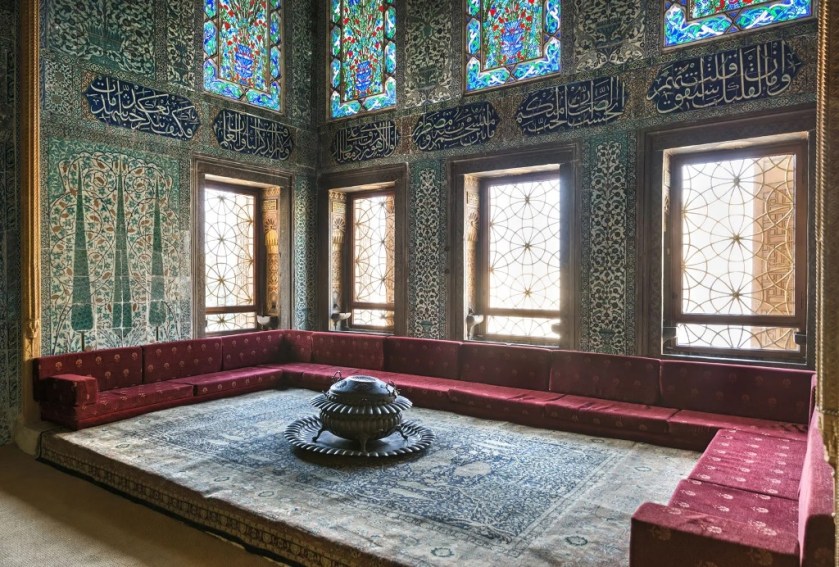
“The Arabic word dīwān (دِيوان) refers to a sitting room, where scribes can sit and attend to their work; it can also mean a collection of notebooks, or a ledger, containing the names of those who are registered in the military or who receive grants from the government.”[1]
In modern times a dīwān is called a government department (دائِرَة da’ira).
Al-Mawardi says, “The dīwān is a place for maintaining what is related to the authorities of the Sultan in terms of public works, finance, and the armies and governors (Al-‘Ummal) who carry them out.”[2]
The original term dīwān is from Pahlavi (Middle Persian), because this administration of state bureaucracy was adopted from the Persian empire by Umar ibn Al-Khattab, the second caliph of Islam in the year 20H[3]. Abu Hurayra, who was the governor of al-Bahrain came to Umar with 500,000 dirhams in tax revenue. After Umar’s initial shock at the size of this amount he consulted the sahaba and he was advised to adopt the diwan of the Persians.[4]
Administration (إِدارَة idara) can be adopted from any system, because they are simply methods (الأَسالِيب Al-‘Asalib) and means (الوَسائِل Al-Wasa’il) to implement an original (‘asl) rule (hukm). They therefore derive their sharia daleel (divine evidence) from the original hukm, and do not need specific evidence to enact them. As an example, the Qur’an and Sunnah establishes the hukm that it is an obligation for the bay’a to a caliph to be based on free choice and consent (shura), but how the consent of millions of Muslims is achieved will fall under methods and means. A House of Representatives, electoral committee, voting, polling booths and voting machines are all permissible methods and means to achieve the hukm of shura.
The majority of laws in modern states relating to economy, military, agriculture, health care etc are administrative, and so an Islamic State can simply copy the most appropriate systems from the west or China or elsewhere, resulting in the rapid development of the country.
This is highlighted in the famous incident of the fertilising of the date palms. Musa bin Talha narrates that, “I and Allah’s Messenger ﷺ happened to pass by people near the date-palm trees. He (the Holy Prophet) said: ‘What are these people doing?’ They said: ‘They are grafting,’ i.e. they combine the male with the female (tree) and thus they yield more fruit. Thereupon Allah’s Messenger ﷺ said: ‘I do not find it to be of any use.’ The people were informed about it and they abandoned this practice. Allah’s Messenger ﷺ (was later) informed (that the yield had dwindled), whereupon he said: ‘If there is any use of it, then they should do it, for it was just a personal opinion of mine, and do not follow my personal opinion; but when I say to you anything on behalf of Allah, then do accept it, for I do not attribute lies to Allah, the Exalted and Glorious.’”[5]
Farming and agriculture are permissible in Islam and in fact Fard Al-Kifiya (collective obligation) for a state. The Messenger of Allah ﷺ said,
مَا مِنْ مُسْلِمٍ يَغْرِسُ غَرْسًا، أَوْ يَزْرَعُ زَرْعًا، فَيَأْكُلُ مِنْهُ طَيْرٌ أَوْ إِنْسَانٌ أَوْ بَهِيمَةٌ، إِلاَّ كَانَ لَهُ بِهِ صَدَقَةٌ
“There is none amongst the Muslims who plants a tree or sows seeds, and then a bird, or a person or an animal eats from it, but is regarded as a charitable gift for him.”[6]
The artificial fertilisation of date-palms is simply a branch (فَرْع far’) action of the original (‘asl) hukm.
Noah Feldman describes the administrative laws. “In the classical Sunni constitutional balance, the shari’a existed alongside a body of administrative regulations that governed many matters in the realms of taxation and criminal law. The Ottoman Empire had long featured thousands of such regulations, called kanun, a word whose derivation from the Latin canon testified to its origins outside the shari’a.”[7] He continues, “The administrative regulations that covered so much of life in the classical Islamic legal world were understood by one and all to derive from the authority of the ruler that was recognized by the shari’a. A regulation could never contradict or supersede the shari’a.”[8]
While Umar ibn Al-Khattab is credited with the formal establishment of the diwan, the Prophet ﷺ himself established the rule on state administration by appointing secretaries (Kuttab) with the responsibility for documenting official state business. Mustafa Al-Azami mentions three ledgers were used in the Islamic State of the Prophet ﷺ:
1- A record of letters dispatched and received by the government, which became known in later times as the Dīwān Al-Inshā’ (Chancery Bureau)[9]
2- A military file listing those who were registered in the military, which became known as the Dīwān Al-Jaysh.
3- An account of the treasury, bearing the relevant income and expenditure figures, which became known as the Dīwān Al-Kharaj.[10]
“Al-Qalqashandi (d.1418CE) argues that Dīwān Al-Inshā’ (Chancery Bureau) was initially put together by the Prophet himself, and is the first recording system to come into use in Islam, while the Dīwān Al-Jaysh (military archive) was founded by Umar during his caliphate.”[11]
The head of state can organise the executive departments and the executive office as he so wishes, in accordance with the principles of the Islamic ruling system. If we look at the Dīwān Al-Khatam (Office of the Official Seal) the Prophet ﷺ appointed Muayqib ibn Abi Fatimah Al-Dusi as the Sahib ul-Khatam (Secretary of the Official Seal) [12] who would stamp the official letters with the Prophet’s ﷺ silver ring engraved with: ‘Muḥammad, the Messenger of Allah.’[13]

No other sahabi, even Abu Bakr and Umar, his wazirs had this power despite them being beyond reproach. This is an additional lesson we can learn in terms of limiting the powers of the wazirs i.e. restricting them to specific portfolios, and separating the duties of the secretaries (kuttab).
Ibn Khaludun says, “Mu’awiyah was the first one who used a Dīwān Al-Khatam. The reason for that was that Mu’awiyah ordered one hundred thousand dirhams for Amr bin Al-Zubayr to relieve the latter of his debts. Mu’awiyah wrote about that to Ziyad bin Sumayyah while the latter was in charge of Iraq. Amr then opened the letter and changed the one hundred to two hundred. When Ziyad presented his invoice, Mu’awiyah disclaimed it, required Amr to return the money, and imprisoned him. His brother, Abdallah bin Al-Zubayr, paid it on his behalf. At that, Mu’awiyah established the Diwan Al-Khatam, and he tied up letters, which had not been tied (before).”[14]
The majority of Al-Mawardi’s twenty government functions (wilayat) in modern times would fall under the organisation of executive departments and offices.
Notes
[1] Ibn Manzur, Lisan al-Arab (d-w-n) https://shamela.ws/book/1687/6727#p1 quoted in Muhammad Mustafa Al-Azami, ‘The Scribes of the Prophet,’ Turath Publishing, 2003, p.24
[2] Al-Mawardi, https://shamela.ws/book/22881/293
[3] Muhammad Ibn Sa’d, Kitab at-Tabaqat al-Kabir, Volume III, ‘The Companions of Badr,’ translated by Aisha Bewley, Ta-Ha Publishers Ltd, 2013, p.229
[4] Muhammad Ibn Sa’d, Kitab at-Tabaqat al-Kabir, Volume III, ‘The Companions of Badr,’ translated by Aisha Bewley, Ta-Ha Publishers Ltd, 2013, p.232
[5] Sahih Muslim 2361, https://sunnah.com/muslim:2361
[6] Sahih al-Bukhari 2320, https://sunnah.com/bukhari:2320
[7] Noah Feldman, ‘The Fall and Rise of the Islamic State,’ p.61
[8] Noah Feldman, Op.cit., p.43
[9] This office covers the Umayyad Offices of Correspondence (diwan al-rasa’il) and official seal (diwan al-khatam)
[10] Muhammad Mustafa Al-Azami, ‘The Scribes of the Prophet,’ Turath Publishing, 2003, p.25
[11] Ibid
[12] Sunan an-Nasa’i 5205 https://sunnah.com/nasai/48/166
[13] Ibn Khaldun, ‘The Muqaddimah – An Introduction to History,’ Translated by Franz Rosenthal, Princeton Classics, p.339
[14] Abu Ja`far Muhammad b. Jarir al-Tabari, ‘The History of Al-Tabari’, translation of Ta’rikh al-rusul wa’l-muluk, State University of New York Press, Vol. 18, p.217
 Islamic Civilization
Pingback: Al-Mawardi’s Structure of an Islamic State | Islamic Civilization