
- Can we use any title for the caliph?
- Caliph of the Messenger ﷺ (khalīfat Rasūl Allāh)
- Caliph of Allah (khalīfat Allāh)
- Imam
- Custodian of the two holy mosques (Khadim al-Haramayn ash-sharifayn)
- Leader of the Believers (Amīr al-Muʿminīn)
- King (Malik)
- Sultan
- Shadow of Allah (Zill Allāh)
- First among equals
- Conclusion
- Notes
The term khaleefah (خليفة) or caliph, literally means successor or deputy. Imam Al-Mawardi says, “Imamate[1] is prescribed to succeed prophethood as a means of protecting the deen and of managing the affairs of this world. There is a consensus of opinion that the person who discharges the responsibilities of this position must take on the contract of Imamate of the Ummah.”[2]
Throughout Islamic history the caliphs were known by multiple titles. It’s important to note however, that you don’t need to be explicitly called a caliph to be a caliph. In fact, a leader today or in history may take a title used by the caliphs of the past, or even have the title ‘caliph’ but they are not caliphs.
Can we use any title for the caliph?
Abdul-Qadeem Zallum answers this question. According to his opinion he says, “With regards to his title, it could be the Khaleefah, or the Imam or the Amir of the believers…It is not obligatory to adhere to these three titles, rather it is allowed to give whoever takes charge of the Muslims’ affairs other titles.
Any other title has, however, to indicate the same meaning such as ‘the ruler of the believers’ or ‘the head of the Muslims’ or ‘the Sultan of the Muslims’ or any other title that does not contradict with their meaning. As for titles which carry a specific meaning and which contradict the Islamic laws connected with ruling, such as the title of king or president of the republic or emperor, these are forbidden to be used by whoever takes charge of the affairs of the Muslims because they contradict the meaning of the laws of Islam.”[3]
As a principle we should use the language of Islam when describing our laws, institutions and systems. There has been a tendency in modern times to use western terms which causes confusion as to what political Islam actually is, and also distances us from our history. In 1953 TheInternational Herald Tribune reported that, “The Constituent Assembly of Pakistan today [Nov. 2 1953] unanimously decided that under the new constitution Pakistan shall be a republic and that its name shall be the Islamic Republic of Pakistan. There was no opposition from any member.”[4]
Commenting on this choice of title, Bernard Lewis said, “How far, one may ask, can a republic, as that word is normally understood, be really and truly Islamic – that is to say, not simply in the sense of being a State with a Muslim population, but of being one that is really based on the principles of Islamic faith and law? How far is traditional or orthodox Islam compatible, even familiar with republican ideas and institutions?”[5]
Therefore a future Islamic State needs to choose titles for its leaders, systems and institutions which are in-line with Islamic traditions.
What follows now is a list of the main titles used by the caliphs of the past which are from the Islamic traditions and in-line with Islamic thought.
Caliph of the Messenger ﷺ (khalīfat Rasūl Allāh)
After the death of the Prophet Muhammad ﷺ, the Muslims elected Abu Bakr as-Siddiq (ra) as the leader of the Islamic State. A debate then ensued on what title he should be given, because the Messenger of Allah ﷺ in his dual role of prophet and ruler, never had a separate title as a ruler, although “before becoming Muslim, people used to call the Prophet ‘Amir of Mecca’ and ‘Amir of the Ḥijâz’.”[6]
The title khaleefah was already known to the sahaba because the Prophet ﷺ referred to his successors in ruling as khulufaa’ (caliphs). The Prophet Muhammad ﷺ was a ruler-prophet like Dawud and Sulayman (peace be upon them) before him. Prophethood has now ended, but ruling by the law (sharia) that the Prophet ﷺ brought continues. He ﷺ said,
كَانَتْ بَنُو إِسْرَائِيلَ تَسُوسُهُمُ الأَنْبِيَاءُ كُلَّمَا هَلَكَ نَبِيٌّ خَلَفَهُ نَبِيٌّ وَإِنَّهُ لاَ نَبِيَّ بَعْدِي وَسَتَكُونُ خُلَفَاءُ فَتَكْثُرُ قَالُوا فَمَا تَأْمُرُنَا قَالَ فُوا بِبَيْعَةِ الأَوَّلِ فَالأَوَّلِ وَأَعْطُوهُمْ حَقَّهُمْ فَإِنَّ اللَّهَ سَائِلُهُمْ عَمَّا اسْتَرْعَاهُمْ
“The prophets ruled over the children of Israel, whenever a prophet died another prophet succeeded him, but there will be no prophet after me. There will soon be Khulafaa’ and they will number many.” They asked, “What then do you order us?” He said, “Fulfil the bay’ah to them, one after the other, and give them their dues for Allah will verily account them about what he entrusted them with.”[7]
Therefore, the caliphs are successors to the Prophet ﷺ in ruling only and not prophethood, i.e. the caliph is not sovereign.
This is why Abu Bakr took the title Khaleefah of the Messenger of Allah ﷺ (خليفة رسول الله) or simply Khaleefah (خليفة). Al-Mawardi says, “He is called the khaleefah (successor) as he stands in for the Messenger of Allah at the head of his Ummah and so it is permitted for someone to say, ‘Oh, Khaleefah of the Messenger of Allah!’ or for someone to say, ‘Khaleefah,’ on its own.”[8]
Ibn Khaldun says, “Political laws consider only worldly interests. On the other hand, the intention the Lawgiver has concerning mankind is their welfare in the other world. Therefore, it is necessary, as required by the religious law, to cause the masses to act in accordance with the religious laws in all their affairs touching both this world and the other world. The authority to do so was possessed by the representatives of the religious law, the prophets; then by those who took their place, the caliphs.”[9]
Caliph of Allah (khalīfat Allāh)
During the Umayyad period some of the caliphs took the title caliph of Allah (خليفة الله) instead of caliph of the Messenger of Allah ﷺ. This continued during the Abbasid and Ottoman periods. Two modern orientalists Patricia Crone and Martin Hinds focused much attention on this title and wrote an entire book called ‘God’s Caliph’, implying that the ‘divine right of kings’ which existed in Europe under Christianity also applied to the early caliphate, with the caliphate being a theocracy, and the caliph a legislator i.e. sovereign. They say, “In short, the ultimate source of caliphal law was divine inspiration: being the deputy of God on earth. the caliph was deemed to dispense the guidance of God Himself.”[10]
While the title “Caliph of Allah” was controversial in some circles[11], the use of the title never implied divinity or that the caliph was sovereign. It simply meant that the caliph as head of the Islamic State would implement the law of sharia and look after the affairs of people according to this law. Ibn Khaldun says, “Allah made the caliph his substitute to handle the affairs of His servants. He is to make them do the things that are good for them and forbid them to do those that are harmful.”[12]
This is based on the famous verse of the Holy Qur’an where Allah ta’ala says,
وَإِذْ قَالَ رَبُّكَ لِلْمَلَـٰٓئِكَةِ إِنِّى جَاعِلٌۭ فِى ٱلْأَرْضِ خَلِيفَةًۭ ۖ قَالُوٓا۟ أَتَجْعَلُ فِيهَا مَن يُفْسِدُ فِيهَا وَيَسْفِكُ ٱلدِّمَآءَ وَنَحْنُ نُسَبِّحُ بِحَمْدِكَ وَنُقَدِّسُ لَكَ ۖ قَالَ إِنِّىٓ أَعْلَمُ مَا لَا تَعْلَمُونَ
When your Lord said to the angels, ‘I am putting a caliph on the earth,’ they said, ‘Why put on it one who will cause corruption on it and shed blood when we glorify You with praise and proclaim Your purity?’ He said, ‘I know what you do not know.’[13]
Sayyid Qutb comments on this verse, “Allah, in His infinite wisdom, decided to hand over the earth’s affairs and destiny to man and give him a free hand to use, develop and transform all its energies and resources for the fulfilment of Allah’s will and purpose in creation, and to carry out the pre-eminent mission with which he was charged. It may be assumed, then, that man has been given the capability to take on that responsibility, and the necessary latent skills and energies to fulfil Allah’s purpose on earth. It may, therefore, be concluded that a perfect harmony exists between those laws that govern the earth and the universe, and those governing man’s powers and abilities. The aim of this harmony is to eliminate and avoid conflict and collision, and to save man’s energies from being overwhelmed by the formidable forces of nature.”[14]
Al-Qurtubi says, “This āyah is sound evidence for having a leader and a caliph who is obeyed so that he will be a focus for the cohesion of society and the rulings of the caliphate will carried out.”[15] He also says, “Khalīfah (caliph) has the form of an active participle (fa’il), meaning ‘the one who replaced the angels before him on the earth’, or other than the angels, according to what has been reported. It is also possible that it is in the passive mode (maf’ul), in which case it means someone who is sent as a representative.”[16]
The Abbasid Caliphs used khalīfat Allāh as a title
Hüseyin Yilmaz says, “Since the late Abbasid period, the use of khalīfat Rasūl Allāh gradually disappeared from political literature in favor of imam and khalīfat Allāh. To point to the increasing reception of this controversial title, Rosenthal stated that ‘in the later Abbasid period the designation khalīfat Allāh for the caliph has gained wide currency . . . , in marked distinction from the insistence of earlier periods that the caliph was only the khalīfat Rasūl Allāh.’”[17]
Is it permitted to use the title khalīfat Allāh?
Al-Mawardi answers this question. “There is a difference of opinion as to whether it is permitted to say, ‘Oh Khaleefah of Allah!’ Some have permitted this based on the fact that he fulfils Allah’s rights over His creation and because of His saying: “It is He who appointed you Khulafaa’ on the earth and raised some of you above others in rank”.[18] The majority of the ‘ulama, however, do not permit this and treat those who do say this as corrupt, arguing that the Khaleefah succeeds someone who is absent or dead and Allah is not absent and does not die. When Abu Bakr as-Siddiq was addressed[19], ‘Oh Khaleefah of Allah,’ he replied, ‘I am not the Khaleefah of Allah but rather the Khaleefah of the Messenger of Allah (ﷺ).’”[20]
Imam
This title is found in the hadith and is used as a synonym for the caliph. The Messenger of Allah ﷺ said,
وَمَنْ بَايَعَ إِمَامًا فَأَعْطَاهُ صَفْقَةَ يَدِهِ وَثَمَرَةَ قَلْبِهِ فَلْيُطِعْهُ إِنِ اسْتَطَاعَ
“Whosoever gave a bay’a to an Imam, giving him the clasp of his hand, and the fruit of his heart shall obey him as long as he can.”[21]
The contract of bay’a is only for a caliph.
He ﷺ also said,
ومن مات وليس عليه إمام جماعة فإن موتته موتة جاهلية
“Whoever dies and does not have an Imam of the jama’at over him then his death is a death of jahiliyah.”[22]
The word jama’at here refers to the Muslim Ummah, and not an individual group or group prayer in a masjid.
In the fiqh books of the ‘ulema such as Al-Mawardi, the terms Imam and Imamate were used more frequently than the terms Khaleefah and Khilafah.
Ibn Khaldun in reference to the Islamic State says, “The person in charge of it is called ‘the khaleefah’ or ‘the imam’. In later times, he has been called ‘the sultan’, when there were numerous (claimants to the position) or when, in view of the distances (separating the different regions) and in disregard of the conditions governing the institution, people were forced to render the bay’a to anybody who seized power.”[23]
Hugh Kennedy when discussing the titles used by the caliphs mentions, “We also find the use of the title imam. Imam means essentially anyone who stands in front or leads. It often describes the prayer leader in a mosque. It is also used, especially among the Shia, to describe the ruler of the whole Muslim community and, as such, is often a synonym for caliph.”[24]
Custodian of the two holy mosques (Khadim al-Haramayn ash-sharifayn)
The Mamluk Sultans based in Cairo used the title ‘Custodian of the two holy mosques’ (Khadim al-Haramayn ash-sharifayn)[25] which was then transferred to the Ottoman Sultan Salim I in 1517, after he conquered Egypt and brought the Mamluk Sultanate under his authority.
Today the Saudi King holds this title, but he rules over a country whose systems and laws in the mu’aamilat (societal transactions), are for the most part not in accordance with the sharia and in some cases are manifest kufr (kufr buwaa) such as implementing a riba (interest) based economy[26], and facilitating material support to those who are committing a genocide of Muslims in Palestine.[27]
Leader of the Believers (Amīr al-Muʿminīn)
Ibn Sa’d narrates, “When Abu Bakr died and ‘Umar ibn al-Khattab became khaleefah, ‘Umar was called ‘the Khaleefah of the Khaleefah of the Messenger of Allah’. The Muslims said, ‘Whoever comes after Umar will be called the ‘khaleefah of the khaleefah of the khaleefah of the Messenger of Allah’. That is lengthy. Agree on a name by which successive khulufaa’ can be called.’ Some of the Companions of the Messenger of Allah ﷺ said, ‘We are the believers and Umar is our Amir. Umar should therefore be called the Amir al-Mu’minin.’ He was the first to be called that.”[28]
This title was predominant throughout the Umayyad period of the Caliphate and continued in to the Abbasid period.
In relation to the post-1258 Abbasid Caliphs based in Cairo under the Mamluk Sultanate, Mona Hasan says, “The new caliphs are also referred to as Amīr al-Muʿminīn (Commander of the Faithful), Khalīfat al-Muslimīn (Caliph of the Muslims), al-Imām (the Leader), Mawlānā al-Khalīfah (Our Master the Caliph), and al-Sayyid (The Master).”[29] Although Hüseyin Yilmaz comments that “No Ottoman sultan seems to have used commander of the faithful [Amīr al-Muʿminīn] as a sovereign title.”[30]
Hibatullah Akhundzada, is the Emir of the Islamic Emirate of Afghanistan and holds the title Amīr al-Muʿminīn but is not a caliph.
King (Malik)
Abdul-Qadeem Zallum mentions that the word mulk commonly translated as monarchy, while it can have this meaning, is also a synonym for ruling and authority. He says, “Ruling (al-hukm الحكم), reign (al-mulk الملك) and authority (al-sultan السلطان) have the same meaning which is the authority that executes the rules.”[31]
The Prophet ﷺ referred to the period after the Rightly Guided Caliphate as a monarchy. This doesn’t mean the caliph was a king in the sense of being sovereign, but the Caliphate took on the characteristic of a monarchy with the introduction of hereditary rule.
The Messenger of Allah ﷺ said,
تَكُونُ الْخِلَافَةُ ثَلَاثِينَ سَنَةً ثُمَّ تَصِيرُ مُلْكًا
“The Khilafah will be for thirty years. Then it will become mulk (monarchy).”[32]
The hidden pronoun (dameer mustatir) in the verb تصير is a هي and it refers back to the word Khilafah. This doesn’t mean the Khilafah will end after thirty years, rather it means the Khilafah will continue but with the characteristics of mulk. Sayf ad-Deen al-Amidi (d.1233CE) says,
أنه قال: «ثم تصير ملكا» والضمير فى قوله: تصير ملكا، إنما هو عائد إلى الخلافة؛ إذ لا مذكور يمكن عود الضمير إليه غير الخلافة، وتقدير الكلام، ثم تصير الخلافة ملكا، حكم عليها بأنها تصير ملكا، والحكم على الشيء، يستدعى وجود ذلك الشيء
He ﷺ said, «ثم تصير ملكا» “Then it becomes a kingdom.” The [hidden] pronoun in his phrase, تصير ملكا “It becomes a kingdom,” refers to the caliphate, as there is no mentioned entity to which the pronoun can refer other than the caliphate. The interpretation of the statement, ثم تصير الخلافة ملكا “Then the caliphate becomes a kingdom,” is a hukm that it will become a kingdom, and a ruling on something requires the existence of that thing.[33]
Ibn Kathir says, “The first monarchy began with the rule of Mu‘awiyah, making him the first king (malik) in Islam and the best of them all.”[34]
The reason some of the ‘ulema used the title Malik for the Umayyad and Abbasid Caliphs was because these caliphs were not following completely in the footsteps of the Prophet Muhammad ﷺ when it came to ruling. Abu Bakr, the first caliph was given this title because khaleefah means successor, and Abu Bakr was a successor to the Prophet ﷺ in ruling as mentioned previously. If the caliph deviated from the sunnah, then calling him a khaleefah wasn’t deemed appropriate. This is the understanding the sahaba had of the difference between a king and a khaleefah, not in terms of sovereignty but in terms of justice.
Umar ibn al-Khattab said, “By Allah, I do not know whether I am a Khaleefah or a king, for if I am a king then this is a tremendous matter.” Someone said, “Amir al-Mu’minin, there is a distinction between the two of them.” He said, “What is it?” He said, “A Khaleefah does not take except what is due and he does not use it except in the right way, and you, praise be to Allah, are like that. The king treats people unjustly, and takes from this one and gives to that one.” ‘Umar was silent.[35]
Hugh Kennedy makes an interesting point that “During the Umayyad period, many features of the caliphate became established and in time traditional in ways which continued long after the dynasty itself had been swept away. Among the most obvious of these were the rituals of inauguration. Caliphs were not crowned. A crown of the Byzantine or Persian sort would have represented an acceptance of all the traditions of ancient monarchy, with its pomp and hierarchy, which the early Muslims rejected and sought to replace.”[36]
Sultan
This term is found in the hadith and is used in a general sense of authority but also can refer to a ruler. The Prophet ﷺ said,
مَنْ سَكَنَ الْبَادِيَةَ جَفَا وَمَنِ اتَّبَعَ الصَّيْدَ غَفَلَ وَمَنْ أَتَى السُّلْطَانَ افْتُتِنَ
“He who lives in the desert will become rough, he who follows the chase will become negligent, and he who goes to a ruler (Sultan) will be led astray.”[37]
The Umayyad and Abbasid Caliphs didn’t use the title Sultan as this title was used by the semi-autonomous governors who ruled the lands of the Caliphate from the 10th century CE. Starting with the Buyids[38] and then later the Seljuks and finally the Ottomans, the rulers of these lands held the executive authority of the Caliphate, rendering the caliph to a mere ceremonial position.
Al-Radhi (r.934-940CE) was the last independent Abbasid Caliph since the rise of the Buwahids (Buyids) in 934CE, and the establishment of their emirate over Iraq, and central and southern Iran, which reduced the caliph’s executive power to the Dar ul-Khilafah which was a section of Baghdad that housed the Caliphal palace. Al-Khatib (d. 463H,1071CE) mentions that Al-Radhi was “the last of the caliphs who undertook the sole direction of the army and the finances.”[39] After Al-Radhi, his brother Al-Muttaqi (r.940-944) assumed the rule after him and Al-Suyuti says about him that “He had nothing of authority but the name.”[40]
Ibn Khaldun comments, “From the time of an-Nâṣir (r. 1180-1225) on, the caliphs were in control of an area smaller than the ring around the moon.”[41]
The Ottoman sultan Bayezid I was the first to be granted the title of Sultan by the Abbasid Caliph al-Mutawakkil (r.1361-1383/1389-1406) based within the Mamluk Sultanate in Egypt. Mona Hasan describes how Bayezid “sent precious gifts to the Abbasid Caliph al-Mutawakkil along with the request to be honored as his deputized ruler of Anatolia or Sulṭān al-Rūm in 797/1394, a request which was granted.”[42]
This splitting of the sultanate and the caliphate i.e. the splitting away of the executive authority from the caliph continued in this way until 1517CE when the Ottoman Sultan Selim I united the institutions of sultanate and the caliphate once again.[43] This is why the Ottoman Caliphs all used the title Sultan after this time until 1922 when the Sultanate was officially abolished, handing executive power to the Turkish Parliament. Two years later on 3rd March 1924, the office of the Caliphate was also abolished.
Shadow of Allah (Zill Allāh)
This title was used by the Ottomans and a plaque bearing this phrase from the hadith below still exists on the Imperial Gate of the Topkapi Palace in Istanbul.
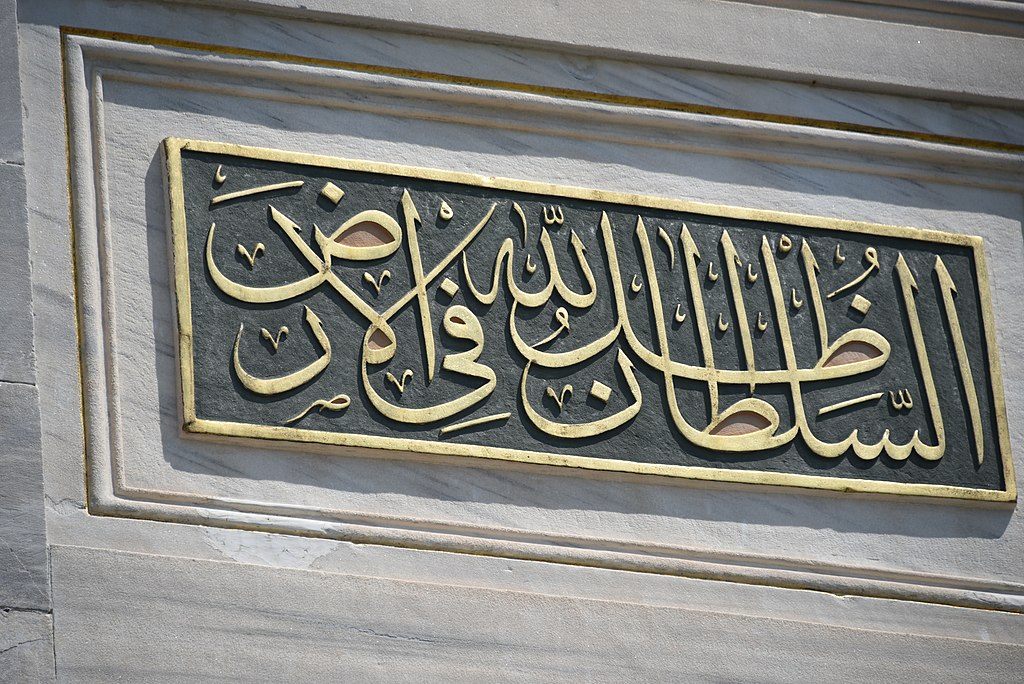
This title comes from the hadith of the Prophet Muhammad ﷺ where he said,
السلطان ظل الله في الأرض فمن أكرمه أكرمه الله ومن أهانه أهانه الله الطبراني والبيهقي عن أبي بكرة
“The Sultan is the shadow of Allah on earth, so whoever honors him (the Sultan), Allah will honor him, and whoever despises him, Allah will despise him.”[44]
First among equals
This is not a title as such but a description of Mu‘awiya by the famous Greek chronicler Theophanes. It’s an interesting perspective on the caliph from someone outside the religion who viewed the rule of the caliph, in this case Mu’awiya, as one of justice.
Aisha Bewley says, “The ruler is a guardian, a custodian and a shepherd, not a despot. Theophanes, the Greek chronicler of early Umayyad times, was surprised by the status of Mu‘awiya, the first Umayyad khalifa, and refers to him as protosymboulos (first among equals).”[45]
Conclusion
The head of a future Islamic State needs to use the title caliph, in order to dispel any confusion among the ummah and so he can be recognised as the leader, not just of the new state, but the entire Muslim world. This will facilitate global support from the Muslims, albeit in the beginning this will be slow since any new state needs to prove itself and its Islamic credentials on the world stage. Commenting on the use of the title Caliph by the Ottomans, Rashid Rida (d.1935) says, “The title remains useful as people would accept actions taken in the name of the caliph that they would not accept if they were taken in somebody else’s name.”[45.5]
The emergence of a state which declares itself a caliphate and its ruler a caliph must be judged on its actions, which is why ibn Jamāʾah said that “the seizure of power itself gave authority.”[46] In other words, if there is a ruler and he is implementing Islam and has full authority over his territories then he is the ruler. He may even be the caliph if he receives a valid bay’a regardless of what he calls himself, and regardless of whether some of the minor or recommended contractual conditions of the bay‘a such as being from Quraysh are present or not. It should be obvious from a future Caliphate’s domestic and foreign policies that it is the real-deal, and not just another state giving lip service to Islam and Muslim interests.
Lütfi Paşa says, “If asked, who is Sultan Süleyman?[47] Is he the leader of our time or not? Then we answer as follows: No doubt, he is the leader of our time. He is the defender of the religious law. So are his deputies and governors. The wise men of our time serve him. So do the sultans of the Arab, the Turk, the Kurd and the Persian. He has many cities under his control as mentioned. The definition of leader suits him. He is the deputy of the Prophet in upholding the religion. Thus it is incumbent upon the whole community to obey him.”[48]
Notes
[1] Imamate is synonymous with Caliphate, and Imam is synonymous with Caliph.
[2] Abu l-Hasan al-Mawardi, The Laws of Islamic Governance, translation of Al-Ahkam as-Sultaniyah, Ta Ha Publishers, p.10
[3] Abdul-Qadeem Zallum, ‘The Ruling System in Islam,’ translation of Nizam ul-Hukm fil Islam, Khilafah Publications, Fifth Edition, p.55
[4] International Herald Tribune, https://www.nytimes.com/2003/11/03/opinion/IHT-1953-pakistan-to-change-name-in-our-pages-100-75-and-50-years-ago.html
[5] Bernard Lewis, “The Concept of an Islamic Republic.” Die Welt Des Islams 4, no. 1 (1955): 1–9. https://doi.org/10.2307/1569481
[6] Ibn Khaldun, ‘The Muqaddimah – An Introduction to History,’ Translated by Franz Rosenthal, Princeton Classics, p.287
[7] Sahih Muslim 1842a, https://sunnah.com/muslim:1842a ; sahih Bukhari 3455, https://sunnah.com/bukhari:3455
[8] Abu l-Hasan al-Mawardi, Op.cit., p.27
[9] Ibn Khaldun, Op.cit., p.252
[10] Patricia Crone, Martin Hinds, ‘God’s Caliph: Religious authority in the first centuries of Islam,’ Cambridge University Press, 1986, p.56
[11] Abu l-Hasan al-Mawardi, Op.cit., p.27
[12] Ibn Khaldun, Op.cit., p.258
[13] Holy Qur’an, Surah Al-Baqara, ayah 30
[14] Sayyid Qutb, ‘In the Shade of the Qur’an,’ translation of Fi zilal al-Quran, Vol.1, p.50
[15] Tafsīr al-Qurṭubī, translated by Aisha Bewley, Vol.1, p.148
[16] Ibid, https://tafsir.app/qurtubi/2/30
[17] Hüseyin Yilmaz, ‘Caliphate Redefined: The Mystical Turn in Ottoman Political Thought,’ Princeton University Press, 2018, p.197
[18] Holy Qur’an, Surah Al-An’am, ayah 165
[19] Ibn Sa’d, ‘Kitab at-Tabaqat al-Kabir,’ Volume III: The Companions of Badr, translated by Aisha Bewley, Ta Ha Publishers, 2013, p.140
[20] Abu l-Hasan al-Mawardi, Op.cit., p.27
[21] Sahih Muslim 1844a, https://sunnah.com/muslim:1844a
[22] Al-Hakim, Al-Mustadrak, 267
[23] Ibn Khaldun, Op.cit., p.253
[24] Hugh Kennedy, ‘The Caliphate: A History of an Idea, Basic Books, 2016
[25] Thomas Arnold, ‘The Caliphate,’ Oxford University Press, 1924, p.151
[26] https://www.reuters.com/markets/rates-bonds/pakistan-receives-3-billion-loan-saudi-arabia-2021-12-04/
[27] https://en.wikipedia.org/wiki/UAE%E2%80%93Israel_land_corridor#:~:text=The%20UAE%E2%80%93Israel%20land%20corridor,established%20on%2013%20December%202023.
[28] Ibn Sa’d, ‘Kitab at-Tabaqat al-Kabir,’ Volume III: The Companions of Badr, translated by Aisha Bewley, Ta Ha Publishers, 2013, p.216
[29] Mona Hassan, ‘Longing for the Lost Caliphate,’ Princeton University Press, 2016, p.87
[30] Hüseyin Yilmaz, Op.cit., p.182
[31] Abdul-Qadeem Zallum, Op.cit., p.12
[32] Hadith reference: Ibn Taymiyyah, Majmu’ Al-Fatawa, https://shamela.ws/book/7289/16461
[33] Sayf ad-Deen al-Amidi, ‘al-Imaamah min abkar al-afkar fi usul ad-din,’ Shamela edition, p.1151
[34] Ibn Kathir, ‘The Khilafah of Banu Umayyah,’ translation of Bidiyah wan-Nihiya, Darussalam, p.21
[35] Jalal ad-Din as-Suyuti, ‘History of the Khalifahs who took the right way,’ translated by Abdassamad Clarke, Ta Ha Publishers, p.146
[36] Hugh Kennedy, ‘Caliphate – The History of an idea,’ Basic Books, 2016, p.60
[37] Mishkat al-Masabih 3701, https://sunnah.com/mishkat:3701
[38] They used the title Emir not Sultan
[39] Jalal ad-Din as-Suyuti, ‘History of the Caliphs,’ a translation of Tarikh al-Khulufa’ by Major H. S. Jarrett, 1881, p.411
[40] Ibid, p.413
[41] Ibn Khaldun, Op.cit., p.385
[42] Mona Hassan, Op.cit., p.97
[43] Prior to this Al-Musta’in (r.1406-1414CE) held the dual position of Sultan and Caliph. Shaykh Mahmudi became his Wazir but later declared himself Sultan and deposed the Caliph. [Jalaluddin As-Suyuti, ‘History of the Caliphs,’ translation of Tareekh ul-Khulufa, translated by Major H.S.Jarrett, Calcutta, 1881, p.534]
[44] At-Tabaraani & Al-Bayhaqi. Narrated by Abu Bakrah. Al-Albani classified the hadith through this chain as hasan.
[45] Aisha Abdurrahman Bewley, ‘Democratic Tyranny and the Islamic Paradigm,’ Diwan Press, 1st edition, 2018, Kindle Edition, p.83
[45.5] Muhammad Rashid Rida, ‘The Caliphate or Supreme Imamate,’ first published 1922-1923, translation of Al-Khilafa aw al-Imama al-‘Uzma, translated by Simon A Wood, Yale University Press, 2024, p.211; original Arabic https://shamela.ws/book/9682
[46] Mona Hassan, Op.cit., p.109
[47] Suleiman The Magnificent (r.1520-1566). The longest reigning Caliph of 46 years.
[48] Lütfi Paşa, Khalās al-Umma, p.42; Hüseyin Yilmaz, ‘Caliphate Redefined: The Mystical Turn in Ottoman Political Thought,’ Princeton University Press, 2018, p.218
 Islamic Civilization