

ذِمَّةُ اَلْمُسْلِمِينَ وَاحِدَةٌ يَسْعَى ِبهَا أَدْنَاهُمْ
“The protection granted by one Muslim is like one given by them all, and this right is extended to the humblest of them.”[1]
The Qur’anic character of the companions (sahaba) and early Muslims lead to their extraordinary restraint in the height of war, something virtually unheard of in modern warfare. The ‘civilised’ west, with all their talk of the rule of law, human rights and the Geneva convention have perpetrated according to Dr Gideon Polya a “Post-9/11 Muslim Holocaust & Muslim Genocide” where 30 million Muslims have been killed in avoidable deaths due to western, or western backed military intervention. There is no clearer example of this than the horrific ongoing genocide in Gaza, which America and its allies are actively financing, arming and providing cover for at the United Nations with their right of veto. As Samuel Huntington said, “The West won the world not by the superiority of its ideas or values or religion (to which few members of other civilizations converted) but rather by its superiority in applying organized violence. Westerners often forget this fact; non-Westerners never do.”[2]
The Islamic conquest of Damascus in Sept 634CE is an outstanding example of the rule of law at the height of war, where one of the corp commanders Abu Ubaydah ibn al-Jarrah made a dhimma (covenant of protection) with the Christians of Damascus in return for them peacefully surrendering the city. Khalid ibn al-Walid, who according to Al-Waqidi was the overall campaign commander, was not aware of Abu Ubaydah’s treaty and so continued fighting to conquer the city. Both commanders met in the middle of Damascus at the main Cathedral and Khalid ibn al-Walid, even though he outranked Abu Ubaydah in this battle, was forced to accept Abu Ubaydah’s dhimma and the conditions agreed with the Christians. Khalid’s conduct is based on the hadith of the Prophet ﷺ,
ذِمَّةُ اَلْمُسْلِمِينَ وَاحِدَةٌ يَسْعَى ِبهَا أَدْنَاهُمْ
“The protection granted by one Muslim is like one given by them all, and this right is extended to the humblest of them.”[3]
Al-Waqidi narrates the events, “I (al-Waqidi) have been informed that when Abu ‘Ubaydah entered the city of Damascus through the al-Jabiyah Gate with his companions, the monks and priests walked ahead of them, raising the Bible and burning incense of aloe-wood, amergis, musk and frankincense. Khalid did not know because he was launching an attack.
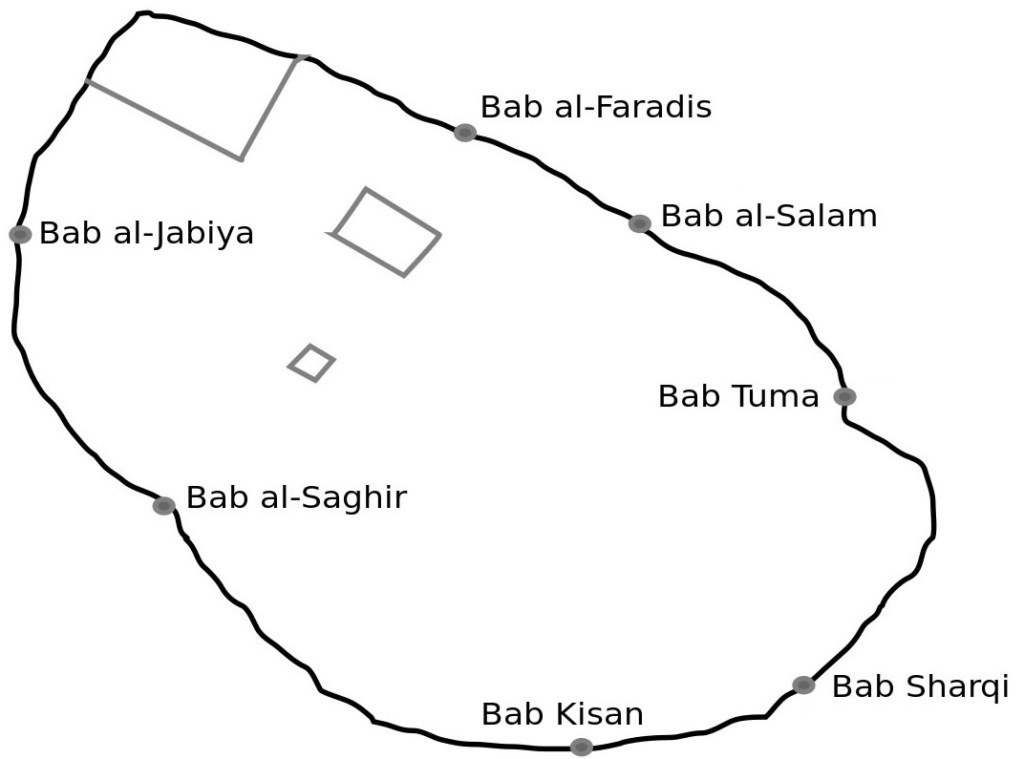
A Roman priest named Jonah, son of Murcius, lived a house attached to the city wall joining the Eastern Gate where Khalid was. Jonah possessed the Prophecies of Daniel (as) wherein it was written, “Allah Most High will conquer the lands through the sahabah and their deen will triumph over every other religion.” That night he dug a hole from his house (to the outside of the city) and unknown to his family, went to the Muslim camp. He told Khalid, “I have come out of my house and dug a hole (under the city wall). I want a guarantee of safety for myself, my family and children.” Khalid agreed and sent with him 100 men, mostly Himyaris, and said, “When you enter the city go to the gate, break the locks and remove the chains so that we can enter if Allah wills.” So they followed Jonah and entered his house via the hole where they put on their armour and made preparations. Then they emerged and went to the gate where they raised cries of “Allahu Akbar!” When the Christians heard, they became alarmed. The sahabah broke the locks and cut the chains. Khalid and the Muslims entered and began killing and capturing the Romans until they reached the Church of Mary.
Khalid’s army met Abu Ubaydah’s army at the church. Aby Ubaydah’s men were walking, with the monks walking in front of them. When Abu Ubaydah saw Khalid’s amazement at them having their swords sheathed, he said, “O Abu Sulayman, Allah has peacefully conquered the city through me. Allah suffices the Muslims in battle. Peace has been made.”
Khalid said, “What peace? May Allah never rectify their condition. How can they have a peace agreement when I have conquered them by the sword and the Muslims’ swords drip with their blood and I have taken their children as slaves and seized their wealth?!”
Abu Ubaydah said, “O commander, I entered through peaceful surrender.”
Khalid said, “You were always so unaware. I entered with the sword through conquest and they had no defence left!”
Abu Ubaydah said. “Fear Allah, O commander. By Allah! I have accepted their surrender and implemented it. I have given them a written agreement.”
Khalid said, “You make peace with them without my instructions when I am your commander-in-chief? I will not remove my sword from them until I have finished off every last one of them!”
Abu Ubaydah said, “By Allah! I did not think that you would oppose me when I made the agreement. I held an opinion and Allah is in control of my affairs. I have spared all their lives and guaranteed them the safety of Allah and Rasulullah ﷺ. All the Muslims with me were satisfied with that and treachery does not become us.”
The argument intensified with everyone looking on. Abu Ubaydah saw that Khalid was not shifting and that those sahabah who were with him were Arab bedouins, adamant on killing the Romans and seizing their wealth. He called out, “Alas, by Allah! I gave them protection and it has been violated.” He pointed at the bedouins, once to the left and once to the right and said, “O Muslims, I take oath on behalf of Rasulullah ﷺ that you will not do what you are doing until Khalid and I come to an agreement.”
The killing and looting stopped and the horsemen, flag-bearers and generals went to meet at the church. Amongst them were Mu’ath bin Jabal, Yazid bin Abi Sufyan, ‘Amr bin al-‘As, Shurahbil bin Hasanah, Rabi’ah bin ‘Amir, ‘Abdullah bin ‘Umar bin al-Khattab and others. A party which included Mu’ath and Yazid said, “We feel that Abu ‘Ubaydah’s treaty should be implemented and the killing halted. All the cities have not yet been conquered and Heraclius is still in Antioch. If they find out about the surrender and its betrayal, then not a single city will surrender, whereas surrendering to you is better than killing them. (0 Khalid), you keep what you have taken by the sword while Abu Ubaydah administers for you his area. In the meantime, the two of you can write to the Khaleefah (Umar) for arbitration and we will do whatever he says.”
Khalid said, “I accept and grant them all temporary safety except for Thomas and Herbius[4].”
Abu Ubaydah said, “Those two were the first to enter into the pact, so do not break my word, may Allah have mercy on you.”
Khalid said, “Were it not for your word I would have killed them, but they will have to leave the city. May Allah curse them wherever they may go.”
Abu Ubaydah said, “Then on these terms is their surrender.”
Thomas and Herbius observed the argument and feared their destruction so they went with a translator to Abu Ubaydah and said, “What is that other one saying?”
The translator said, “What are you and your friend saying? Your friend intends treachery whereas we and the citizens have entered into a pact with you and he breaks it, which does not become you. So permit me and my companion to leave and go wherever we want to go to.”
Abu Ubaydah said, “At the moment you are under my protection.”
The Translator said, “We remain your responsibility for three days, in whatever direction we go in. After three days your responsibility is over. Then, whoever of you meet us after three days and overcomes us can kill us or capture us as he desires.”
Khalid said, “We accept that, but you will not carry away with you anything except your food.”
Abu Ubaydah said, “That condition will contravene the treaty because it allows them to leave with all their men and wealth.”
Khalid said, “Then I will allow it, except for weapons of which I will not let them take anything.”
Thomas said, “We need weapons for the journey to defend ourselves until we reach our lands. Otherwise, we are now in your hands, decide what you will.”
Abu Ubaydah said, “Let each man take one weapon only – sword or spear or knife or bow.”
Thomas said, “We are pleased with that. We do not want more than one weapon each. But I fear that man, Khalid, so I want this agreement in writing.”
Abu Ubaydah said, “May your mother be bereft of you! It is not our Arab way to betray or lie. Abu Sulayman’s[5] word is his word and his promise is his promise and he only speaks the truth.”[6]i will
Was the conquest of Damascus achieved by means of a treaty or by force?
As-Sallabi answers this question, “The scholars differ as to whether Damascus was conquered by means of a treaty or by force. Most of the scholars are of the view that the matter was settled by means of a peace deal, because they are not sure which came first: was it conquered by force and then the Byzantines agreed to a peace deal, or was one part conquered by means of a peace deal, then the other side was taken by force? Some suggested that half of it was conquered by means of a peace deal and the other half by force. This is more likely to be the case because what the sahabah did in the case of the main church which was the largest place of worship, when they took half of it and left the other half. And Allah knows best.”[7]
Notes
[1] Agreed Upon, Narrated by Ali ibn Abi Talib, https://sunnah.com/bulugh/11/43
[2] Samuel Huntington, ‘The Clash of Civilizations and the Remaking of World Order,’ p.51
[3] Agreed Upon, Narrated by Ali ibn Abi Talib, https://sunnah.com/bulugh/11/43
[4] Thomas had appointed Herbius as sub-governor of half the city since he took power.
[5] Khalid ibn al-Walid
[6] al-Imam al-Waqidi, ‘The Islamic Conquest of Syria,’ a translation of Futuhusham, Translated by Mawlana Sulayman al-Kindi, Ta-Ha Publishers Ltd, p.133
[7] Dr Ali Muhammad Sallabi, ‘Umar bin al-Khattab, His life and Times,’ Vol. 2, International Islamic Publishing House, p.280
 Islamic Civilization