

The Islamic State (al-dowlah al-Islamiyyah الدولة الإسلامية) consists of a distinct form (shakl شَكْل) and structure (tanzeem تَنْظِيم) of government that is unlike any other ruling system. It is unique in terms of the foundations (usul أُصُول) upon which it is built, and the principles (qawa’id قَواعِد) which underpin its institutions (ajhizah أَجْهِزَة) and systems (anzimah أَنْظِمَة).
Abdul-Qadeem Zallum says, “The Islamic ruling system is distinct from all other existing ruling systems in the world. It is unique in terms of the basis upon which it is built. As a result it is distinct in the thoughts, concepts, criteria and laws by which it looks after the affairs, the constitution and laws which it implements and executes, and in the shape by which the state is represented and distinguished from all other shapes of ruling in the whole world.”[1]
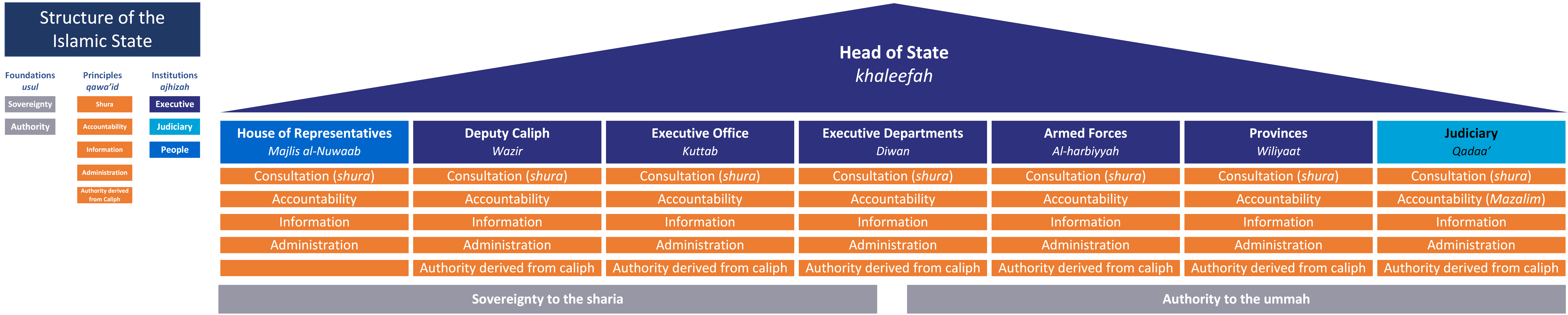
Having said this, the Islamic ruling system will inevitably share characteristics with other forms of government, since the top-level institutions such as having a ruler, judiciary, military, police, executive departments and so forth are the same for all ruling systems. What distinguishes them is the underlying ideology and foundations upon which the state is built, which in the case of an Islamic State is the sharia (شريعة). Ann Lambton says, “The basis of the Islamic state was ideological, not political, territorial or ethnical and the primary purpose of government was to defend and protect the faith, not the state.”[2]
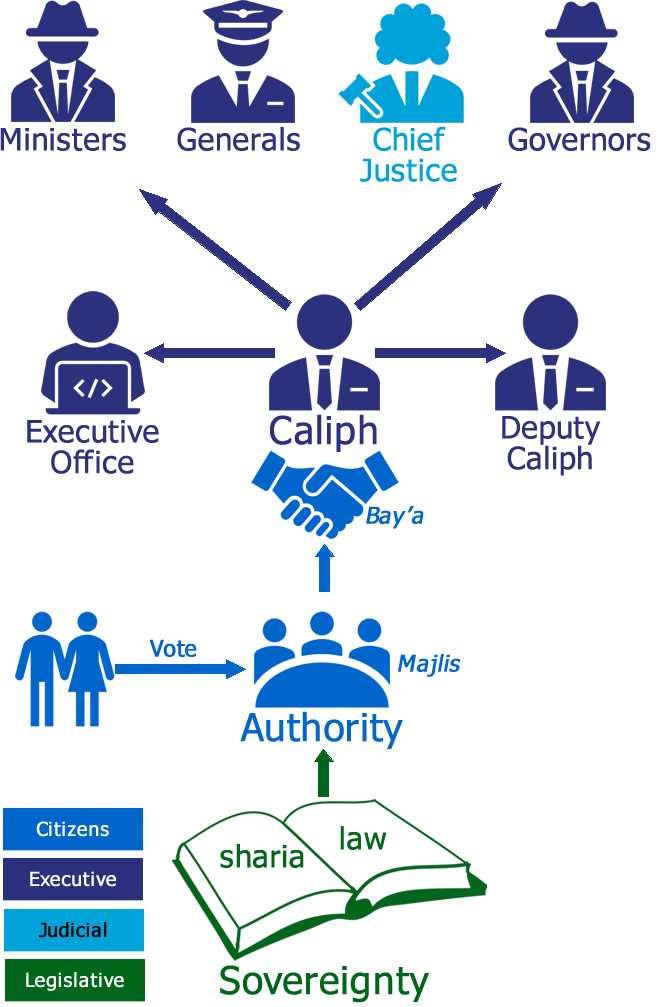
Sayyid Qutb says, “It may happen, in the development of human systems, that they coincide with Islam at times and diverge from it at others. Islam, however, is a complete and independent system and has no connection with these systems, neither when they coincide with it nor when they diverge from it. For such divergence and coincidence are purely accidental and in scattered parts. Similarity or dissimilarity in partial and accidental matters is also of no consequence. What matters is the basic view, the specific concept from which the parts branch out. Such parts may coincide with or diverge from the parts of other systems but after each coincidence or divergence Islam continues on its own unique direction.”[3]

Ayatollah Khomeini says, “Islamic government does not correspond to any of the existing forms of government. For example, it is not a tyranny, where the head of state can deal arbitrarily with the property and lives of the people, making use of them as he wills, putting to death anyone he wishes, and enriching anyone he wishes by granting landed estates and distributing the property and holdings of the people.
The Most Noble Messenger ﷺ, the Commander of the Faithful (‘a), and the other caliphs did not have such powers. Islamic government is neither tyrannical nor absolute, but constitutional. It is not constitutional in the current sense of the word, i.e., based on the approval of laws in accordance with the opinion of the majority. It is constitutional in the sense that the rulers are subject to a certain set of conditions in governing and administering the country, conditions that are set forth in the Noble Qur’an and the Sunnah of the Most Noble Messenger ﷺ. It is the laws and ordinances of Islam comprising this set of conditions that must be observed and practiced. Islamic government may therefore be defined as the rule of divine law over men.”[4]
Notes
[1] Abdul-Qadeem Zallum, ‘The Ruling System in Islam,’ translation of Nizam ul-Hukm fil Islam, Khilafah Publications, Fifth Edition, p.30
[2] Ann K. S. Lambton, ‘State and Government in Medieval Islam,’ Routledge Curzon, 1981, p.13
[3] Sayed Khatab, ‘The Power of Sovereignty-The Political and Ideological Philosophy of Sayyid Qutb,’ Routledge, 2006, p.35
[4] Imam Khomeini, ‘Governance of the Jurist,’ translation of Velayat-e-Faqeeh, Iran Chamber Society, https://www.iranchamber.com/history/rkhomeini/books/velayat_faqeeh.pdf p.29
 Islamic Civilization