

- What is Al-Kifayah?
- A Ruling Personality
- How is a ruling personality developed?
- Capability vs piety
- Capability vs infallibility
- Capability vs Lineage
- Disabilities which are impediments to ruling
- Who determines if someone is capable to rule?
- Mitigations against weaknesses in al-kifāyah
- Conclusion
- Notes
Al-Kifāyah الكِفايَة (competency or capability) is a condition (shart) of the bay’ah[1] because “Imamate is prescribed to succeed prophethood as a means of protecting the deen and of managing the affairs of this world,”[2] and the one contracted with this great responsibility must be capable of fulfilling the task. Although kifāyah is a general term which may apply to many areas of competency, in the context of the bay’ah, and as a condition of the Khaleefah, the scholars such as al-Mawardi, al-Ghazali and al-Juwayni all mentioned it in terms of capability to rule i.e. having a ruling mentality and disposition, and free from any disability which may affect his ability to fulfil the task of discharging people’s affairs. Other conditions related to kifāyah such as sanity, being free, mujtahid and brave were mentioned as separate conditions and pillars[3], even though they are all linked to the reality of the Khaleefah’s ability to run the state. Mona Hassan says, “The caliph’s ability to actually do so, termed kifāyah, is all that remains after al-Juwaynī’s process of intellectual distillation as the most essential qualifying attribute for an imam.”[4]
What is Al-Kifayah?
Ibn Khaldun says, “Al-Kifāyah means that he is willing to carry out the punishments fixed by law and to go to war. He must understand warfare and be able to assume responsibility for getting the people to fight. He also must know about group feeling (asabiyah) and the fine points (of diplomacy). He must be strong enough to take care of political duties. All of which is to enable him to fulfil his functions of protecting religion, leading in the holy war against the enemy, maintaining the (religious) laws, and administering the (public) interests.”[5]
Abdul-Qadeem Zallum says, “The Khaleefah must be able (qadir) and skilled (kifāyah) in carrying out the task of the Khilafah; this is an integral part of the bay’ah. One who is unable to do so cannot perform the duty of running the people’s affairs by the Book and the Sunnah upon which he took the bay’ah.”[6]
Although al-Mawardi didn’t use the term kifāyah, he refers to the same condition as:
الرأي المفضي إلى سياسة الرعية وتدبير المصالح “a judgement capable of organising the people and managing the offices of administration”.[7]
Another condition closely linked to kifāyah is being free from any physical disabilities that could affect the Khaleefah’s ability to rule. Al-Mawardi, al-Ghazali, al-Qurtubi and ibn Khaldun all made this a separate condition[8], whereas modern scholars like Abdul-Qadeem Zallum combined it into one condition. Ibn Khaldun defines this condition as, “Freedom of the senses and limbs from defects or disabilities such as insanity, blindness, muteness, or deafness, and from any loss of limbs affecting (the imam’s) ability to act, such as missing hands, feet, or testicles, is a pre-requisite of the imamate, because all such defects affect his full ability to act and to fulfil his duties. Even in the case of a defect that merely disfigures the appearance, as, for instance, loss of one limb, the condition of freedom from defects (remains in force as a condition in the sense that it) aims at his perfection.”[9]
In summary, there are two aspects to competency in governing the affairs of people. The first is having a ruling personality i.e. a ruling mentality (aqliyah) and a ruling disposition (nafsiyah), and the second is being free from any disability which may affect the Khaleefah’s ability to rule.
A Ruling Personality
In terms of the first aspect Allah ta’ala addresses the Prophet ﷺ:
وَإِنَّكَ لَعَلَىٰ خُلُقٍ عَظِيمٍ
And you are truly ˹a man˺ of outstanding character.[10]
The Prophet ﷺ held multiple roles in addition to being a prophet and messenger, and he was an outstanding character in all of them. He ﷺ was a statesman, ruler, commander and judge, and as a ruler he exemplified the ruling personality. Ibn Ashur says,
واعْلَمْ أنَّ جُماعَ الخُلُقِ العَظِيمِ الَّذِي هو أعْلى الخُلُقِ الحَسَنِ هو التَّدَيُّنُ، ومَعْرِفَةُ الحَقائِقِ، وحِلْمُ النَّفْسِ، والعَدْلُ، والصَّبْرُ عَلى المَتاعِبِ، والاعْتِرافُ لِلْمُحْسِنِ، والتَّواضُعُ، والزُّهْدُ، والعِفَّةُ، والعَفْوُ، والجُمُودُ، والحَياءُ، والشَّجاعَةُ، وحُسْنُ الصَّمْتِ، والتَّؤُدَةُ، والوَقارُ، والرَّحْمَةُ، وحُسْنُ المُعامَلَةِ والمُعاشَرَةِ.
والأخْلاقُ كامِنَةٌ في النَّفْسِ ومَظاهِرُها تَصَرُّفاتُ صاحِبِها في كَلامِهِ، وطَلاقَةِ وجْهِهِ، وثَباتِهِ، وحُكْمِهِ، وحَرَكَتِهِ وسُكُونِهِ، وطَعامِهِ وشَرابِهِ، وتَأْدِيبِ أهْلِهِ، ومَن لِنَظِرِهِ، وما يَتَرَتَّبُ عَلى ذَلِكَ مِن حُرْمَتِهِ عِنْدَ النّاسِ، وحُسْنِ الثَّناءِ عَلَيْهِ والسُّمْعَةِ.
وأمّا مَظاهِرُها في رَسُولِ اللَّهِ ﷺ فَفي ذَلِكَ كُلِّهِ وفي سِياسِيَّتِهِ أُمَّتِهِ، وفِيما خُصَّ بِهِ مِن فَصاحَةِ كَلامِهِ وجَوامِعِ كَلِمِهِ.
“Know that the comprehensive set of great character traits, which represents the highest level of good character, includes: piety, knowledge of truths, self-control, justice, patience in the face of hardships, acknowledgement of the doer of good, humility, asceticism, chastity, forgiveness, steadfastness, modesty, courage, good silence, tranquillity, dignity, mercy, good treatment, and companionship.
Character is intrinsic to one’s self, and its manifestations are seen in a person’s speech, behaviour, and interaction with others.
As for its manifestations in the Messenger of Allah ﷺ they encompass all aspects of his life, including his countenance, firmness, judgment, movements, and stillness, as well as his eating and drinking habits. It also includes how he disciplined his family and those under his care, and the sanctity associated with him among people, as well as his commendation and reputation.
As for the manifestations of great character in the Messenger of Allah ﷺ they encompass all of the mentioned aspects and are evident in his governance of his ummah, as well as in his eloquence and the comprehensive nature of his speech.”[11]
Taqiuddin an-Nabhani says, “The Legislator (i.e. Allah) fixed the obligatory general responsibilities upon the ruler explicitly without leaving any area for obscurity or confusion. He clarified the ruler’s responsibilities in relation to what is obligatory upon him in his personal capacity as a ruler, and his responsibilities in respect of his relationship with the citizens.
As for the ruler’s responsibilities in his personal capacity as a ruler, they are clear in the ahadith in which the Messenger ﷺ clarified some of the ruler’s attributes. The most apparent of them are:
1. strength (al-Quwa)
2. consciousness of Allah (al-Taqwa)
3. kindness to the citizens (al-Rifq bil-ra’iyyah)
4. and that he should not be one who causes aversion (munaffir).
The Messenger ﷺ declared that the ruler must be strong, and that the weak person is not suitable to become a ruler. Muslim narrated from Abu Dharr (ra) that the Messenger of Allah ﷺ said:
يَا أَبَا ذَرٍّ إِنِّي أَرَاكَ ضَعِيفًا وَإِنِّي أُحِبُّ لَكَ مَا أُحِبُّ لِنَفْسِي لاَ تَأَمَّرَنَّ عَلَى اثْنَيْنِ وَلاَ تَوَلَّيَنَّ مَالَ يَتِيمٍ
“O Abu Dharr, I find that you are weak, and I like for you what I like for myself. Do not (even) rule over two persons and do not manage the property of an orphan.”[12]
Muslim also narrated from Abu Dharr who said:
قُلْتُ يَا رَسُولَ اللَّهِ أَلاَ تَسْتَعْمِلُنِي قَالَ فَضَرَبَ بِيَدِهِ عَلَى مَنْكِبِي ثُمَّ قَالَ “ يَا أَبَا ذَرٍّ إِنَّكَ ضَعِيفٌ وَإِنَّهَا أَمَانَةٌ وَإِنَّهَا يَوْمَ الْقِيَامَةِ خِزْىٌ وَنَدَامَةٌ إِلاَّ مَنْ أَخَذَهَا بِحَقِّهَا وَأَدَّى الَّذِي عَلَيْهِ فِيهَا “
“I said: O Messenger of Allah, Why do you not appoint me to an (official) position?” He ﷺ patted me on the shoulder with his hand and said, “O Abu Dharr, you are a weak man and it is a trust and it will be a cause of disgrace and remorse on the Day of Resurrection except for the one who takes it up with a full sense of responsibility and fulfills what is entrusted to him.”[13]
The meaning of strength here is strength of personality i.e. intellectual and emotional strength. It is necessary that this intellect (aqliyah) be the ruling intellect by which he understands matters and relationships, and that his emotional disposition (nafsiyya) be that of a ruler who understands that he is a ruler so he directs his inclinations with the command of an ameer.”[14]
The hadith of Abu Dharr contains a strong prohibition of giving the responsibility of authority to someone who is incapable of discharging the task. This is due to the decisive qareenah (indication) mentioned in the hadith, “it will be a cause of disgrace and remorse on the Day of Resurrection”.
There are two other important characteristics of a ruler that we can add to Nabhani’s list. These are being a true politician or statesman, and sabr (perseverance).
The Statesman
The ruler must have a problem-solving mentality and the knowledge required to administer people’s affairs.
The scholars mentioned knowledge as a condition for the Khaleefah in terms of his ability to do ijtihad. Al-Mawardi says, الْعِلْمُ الْمُؤَدِّي إلَى الِاجْتِهَادِ فِي النَّوَازِلِ وَالْأَحْكَامِ “Knowledge which equips him for ijtihad in unforeseen matters and for arriving at relevant judgements.”[15] But another area of knowledge, which is the subject of our discussion, because it falls under the condition of kifāyah, is knowledge of politics and solving problems. Al-Mawardi says the Imam must have, الرأي المفضي إلى سياسة الرعية وتدبير المصالح “a judgement capable of organising the people and managing the offices of administration.”[16]
Allah ta’ala says:
وَقَالَ لَهُمْ نَبِيُّهُمْ إِنَّ ٱللَّهَ قَدْ بَعَثَ لَكُمْ طَالُوتَ مَلِكًۭا ۚ قَالُوٓا۟ أَنَّىٰ يَكُونُ لَهُ ٱلْمُلْكُ عَلَيْنَا وَنَحْنُ أَحَقُّ بِٱلْمُلْكِ مِنْهُ وَلَمْ يُؤْتَ سَعَةًۭ مِّنَ ٱلْمَالِ ۚ قَالَ إِنَّ ٱللَّهَ ٱصْطَفَىٰهُ عَلَيْكُمْ وَزَادَهُۥ بَسْطَةًۭ فِى ٱلْعِلْمِ وَٱلْجِسْمِ ۖ وَٱللَّهُ يُؤْتِى مُلْكَهُۥ مَن يَشَآءُ ۚ وَٱللَّهُ وَٰسِعٌ عَلِيمٌۭ
Their prophet told them, “Allah has appointed Talut (Saul) to be your king.” They protested, “How can he be our king when some of us are more deserving of kingship than he, and he has not been blessed with vast riches?” He replied, “Allah has chosen him over you and blessed him with knowledge and stature. Allah grants kingship to whoever He wills. And Allah is All-Bountiful, All-Knowing.”[18]
Al-Qurtubi comments on this āyah saying, “He (Talut) also possessed knowledge, which is the basis of a person’s character, and physical strength which helped him in war and fighting. This āyah, therefore, provides the description of what a ruler should be like and the conditions governing rulership.
A ruler merits his authority on the basis of knowledge, piety and strength, not on the basis of lineage. Lineage has no real say in the matter since knowledge and virtue supersede it as Allah makes clear by informing us that He chose Ṭālūt over them on account of his knowledge and strength even though their lineage was more noble. We have already mentioned the preconditions of leadership at the beginning of the sūrah. This āyah is the basis for it.
Ibn ‘Abbās said, ‘At the time, Ṭālūt was the most knowledgeable man among the tribe of Israel, and the most complete. His physical stature alarmed the enemy.’ It is said that he was called Ṭālūt because of his height (ṭawl). It is also said that the increased strength took the form of great charity and courage, not actual physical strength.”[19]
Sabr
Sabr (perseverance or patience) is another essential quality of a ruler. Without sabr there can be no rule, because the leader will succumb to his whims and desires, or act recklessly being easily provoked in to actions which will harm the interests of the Islamic State and its citizens. Allah ta’ala says:
وَجَعَلْنَا مِنْهُمْ أَئِمَّةًۭ يَهْدُونَ بِأَمْرِنَا لَمَّا صَبَرُوا۟ ۖ وَكَانُوا۟ بِـَٔايَـٰتِنَا يُوقِنُونَ
We raised from among them leaders (imams), guiding by Our command, when they patiently endured and firmly believed in Our signs.[20]
Tabari comments on this verse saying,
وتأويل الكلام إذا قُرئ ذلك بفتح اللام وتشديد الميم، وجعلنا منهم أئمة يهدون أتباعهم بإذننا إياهم، وتقويتنا إياهم على الهداية، إذ صبروا على طاعتنا، وعزفوا أنفسهم عن لذّات الدنيا وشهواتها
“The interpretation of the speech لَمَّا صَبرُوا if it is recited with a fatha on the lam and a shadda on the mim, [means] we made them imams who guide their followers with our permission, and we strengthen them for guidance, as they were patient in obedience to us, and abstained from the pleasures and desires of the world.”[21]
قَالَ سُفْيَانُ: وَلَا يَنْبَغِي لِلرَّجُلِ أَنْ يَكُونَ إِمَامًا يُقتَدى بِهِ حَتَّى يَتَحَامَى عَنِ الدُّنْيَا
Sufyan said, “A man cannot be an imam to be followed unless he shuns the temptation of this world.”[22]
Allah ta’ala mentions three situations of sabr in the Qur’an which the righteous must exhibit. He says,
وَٱلصَّـٰبِرِينَ فِى ٱلْبَأْسَآءِ وَٱلضَّرَّآءِ وَحِينَ ٱلْبَأْسِ ۗ أُو۟لَـٰٓئِكَ ٱلَّذِينَ صَدَقُوا۟ ۖ وَأُو۟لَـٰٓئِكَ هُمُ ٱلْمُتَّقُونَ
and who are patient in times of suffering, adversity, and in ˹the heat of˺ battle. It is they who are true ˹in faith˺, and it is they who are mindful ˹of Allah˺.[23]
The three situations mentioned are:
ٱلْبَأْسَآءِ – hardship and poverty
وَٱلضَّرَّآءِ – illness
َ ٱلْبَأْس – time of war[24]
Each of these has an added importance for the ruler who is responsible for relieving hardship, poverty and illness in society, and protecting the people in war. Sayyid Qutb commenting on this verse says, “Steadfastness and perseverance in times of adversity and hardship, and in the face of danger, are necessary qualities for the education and development of strong individuals with solid characters who will stand firm, come what may. Under such conditions the faithful never lose hope or confidence in Allah, nor will they seek help from any source other than Him.
For the Muslim community, or ummah, to fulfil its great role of universal leadership of mankind and its task of instituting justice and equality in the world, it is necessary to collectively acquire these qualities. All should have the resilience to withstand poverty, weakness, loss of friends and allies, shortage of manpower and resources, and the rigours and consequences of war and striving to serve Allah’s cause.
The construction of this part of the verse in the Arabic original indicates that this quality is singled out as especially significant in the context of the verse as a whole.[25] This gives added importance and a higher status in the sight of Allah to those possessing this quality.”[26]
Sabr in solving problems
The Khaleefah cannot be provoked into rash action.
Sun Tzu says, “There are five dangerous faults which may affect a general: (1) Recklessness, which leads to destruction; (2) cowardice, which leads to capture; (3) a hasty temper, which can be provoked by insults; (4) a delicacy of honor which is sensitive to shame; (5) over-solicitude for his men, which exposes him to worry and trouble.”[27]
Taqiuddin an-Nabhani says, “It is dangerous for humans to jump from sensation to action without thinking. Such behaviour will never change the reality. Instead it will make the person succumb to reality and become reactionary proceeding in life with declined thinking and making reality the source of thinking rather than the subject of the thinking. Therefore, sensation should first lead to thought, and then this thought should lead to action. This is the approach that enables man to rise above the reality and enables the effort to move to better situations in a radical way. Any person acting on the basis of his sensation alone will never be able to change the reality but rather adapts himself to it. Thus he will remain backward and in a state of decline.”[28]
There is no doubt that when a future Khilafah is established, the enemies of Islam will try and provoke the state into rash actions, like America did by goading Russia into invading Ukraine. When the state is established, we can expect a surge in Muslim civilians being killed, the burning of the Qur’an and public insults of the Prophet ﷺ in some of the western media. This will be done to try and undermine the Islamic credentials of the state, and sow despair in the minds of the ummah, ‘look! You have your caliphate but it can do nothing to help you!’ Such a situation however is not new. Allah ta’ala says:
وَعَدَ اللَّهُ الَّذِينَ آمَنُوا مِنْكُمْ وَعَمِلُوا الصَّالِحَاتِ لَيَسْتَخْلِفَنَّهُمْ فِي الْأَرْضِ كَمَا اسْتَخْلَفَ الَّذِينَ مِنْ قَبْلِهِمْ وَلَيُمَكِّنَنَّ لَهُمْ دِينَهُمُ الَّذِي ارْتَضَىٰ لَهُمْ وَلَيُبَدِّلَنَّهُمْ مِنْ بَعْدِ خَوْفِهِمْ أَمْنًا يَعْبُدُونَنِي لَا يُشْرِكُونَ بِي شَيْئًا وَمَنْ كَفَرَ بَعْدَ ذَٰلِكَ فَأُولَٰئِكَ هُمُ الْفَاسِقُونَ
“Allah has promised those of you who have iman and do right actions that He will make them successors in the land as He made those before them successors, and will firmly establish for them their deen with which He is pleased and give them, in place of their fear, security. ‘They worship Me, not associating anything with Me.’ Any who are kafir after that, such people are deviators.”[29]
Al-Rabi’ ibn Anas related that Abu’l-‘Aliyah said regarding this verse: “The Messenger of Allah ﷺ and his Companions remained in Mecca, after the advent of the revelation, for ten years in a state of fear: sleeping at night and waking in the morning with weapons at their sides. Then the Prophet was commanded to migrate to Medina. One of his Companions asked him: ‘O Messenger of Allah, there is not a single day in which we feel safe such that we can put down our weapons!’ The Messenger of Allah ﷺ said: ‘It will not be long before one of you will be sitting unarmed amidst huge numbers of people, none of whom carries a weapon.’ Then, Allah, exalted is He, revealed “Allah has promised those of you who have iman and do right actions…” up to the end of the verse.
Consequently, Allah, exalted is He, enabled His Prophet ﷺ to have the upper hand over the Arabian peninsula, and the Muslims were able to put down their weapons and feel safe. They remained safe after Allah, exalted is He, took to Himself His Prophet, and during the reign of Abu Bakr, ‘Umar and ‘Uthman, may Allah be well pleased with them. When they fell into that which they fell and were ungrateful, Allah brought fear into their hearts; they changed and so Allah, exalted is He, changed what they had.”[30]
Therefore, we should not expect all of the ummah’s problems to be resolved overnight. This is not the sunnah of the Prophet ﷺ, or the sunnah of how civilisations rise and fall. On entering Madinah, the Prophet ﷺ undertook a census and there were only 1,500 available fighters.[31] At the Conquest of Makkah there were 10,000 and at the Battle of Tabuk there were 30,000 fighters. This increase was due to the spread of Islam in the Arabian Peninsula, caused by the signing of the treaty of Hudaibiyah in 6 Hijri which propelled the Islamic daw’ah far and wide. This is why Allah refers to this treaty as a “clear victory”.[32] In only two years after signing this treaty, Makkah was liberated and then before he ﷺ passed away the entire Arabian Peninsula came under the authority of the Islamic state.
Sabr therefore, is an essential quality in the ruler and the ruling apparatus, when addressing the multitude of issues facing the state on a daily basis.
Who has a ruling personality?
It’s important to note that a ruling personality is not only for Muslims, but is a general concept applicable to any civilisation. In the time of the Prophet ﷺ the tribal leaders and some governors, remained in positions of authority and responsibility after their conversion to Islam, because they already had a personality capable of looking after people’s affairs.
Muhammad As-Sallabi says, “Kisra’s[33] viceroy to Yemen was Bādhān ibn Sāsān. During the Prophet’s lifetime, Bādhān embraced Islam, and the Prophet ﷺ recognizing good leadership qualities in Bādhān allowed him to remain governor of Yemen. It was always the case that the Messenger of Allah ﷺ appointed people based on their qualities and on the job performance that could be expected of them. The Prophet ﷺ knew that Bādhān was an experienced leader and that he was well-acquainted with the people of Yemen and with their needs; thus he, and not a person of high-ranking from Makkah or Al-Madeenah, was best suited for the job; hence the Prophet’s decision to allow Bādhān to stay on as governor.”[34]
Something similar occurred in Bahrain, where the current ruler Al-Mundhir ibn Sawa remained in office after embracing Islam.[35]
In both cases capability was prioritised in these major provinces of Yemen and Bahrain over individual piety.
How is a ruling personality developed?
Abu Hurayra reported that the Messenger of Allah ﷺ said,
إِنَّمَا بُعِثْتُ لِأُتَمِّمَ صَالِحَ الأَخْلاقِ
“Indeed, I was sent to perfect good character.”[36]
Salih al-Akhlaq (good character) is mutlaq (unrestricted) and so encompasses all types of character which includes the ruling personality. This development and training (tarbiyah) of the sahaba began in Makkah at the House of Al-Arqam and continued throughout the Prophet‘s ﷺ life in Madinah. Tarbiyah is a life-long process that never ends for the believer. It is clear when studying the seerah that the Prophet ﷺ had a development plan for the sahaba, and appointed specific people to positions of authority and responsibility so they would become leaders in the Islamic state after his ﷺ death.

As-Sallabi says, “In less than one half of a century, the singularly superior men that the Prophet educated were blessed with many great victories as they carried the message of Tawheed (Islamic Monotheism) all over the world. In the early years of his Prophethood, the Messenger of Allah wisely chose and trained the key people that would be needed to lead the Muslim nation through its glorious first century of being. It is with that end in mind – the spread of Islam all over Arabia and to many parts of the world – that we can truly appreciate the early days of education and training in the house of Al-Arqam.”[37]
The clearest example of this tarbiyyah programme is Abu Dharr Al-Ghafari. As mentioned previously, Abu Dharr requested to be appointed to office but the Prophet ﷺ said إِنَّكَ ضَعِيف “you are a weak”. However, this situation changed and Abu Dharr overcame his weak ruling personality and according to Al-Waqidi[38] was appointed to a wiliyah (ruling) position by the Prophet ﷺ as his Khaleefah (deputy) in Madinah[39] while he ﷺ was away leading the expedition to Khaybar in 7 Hijri.[40]
Case Study: The Army
An extract from the book: History of the Islamic State’s Institutions
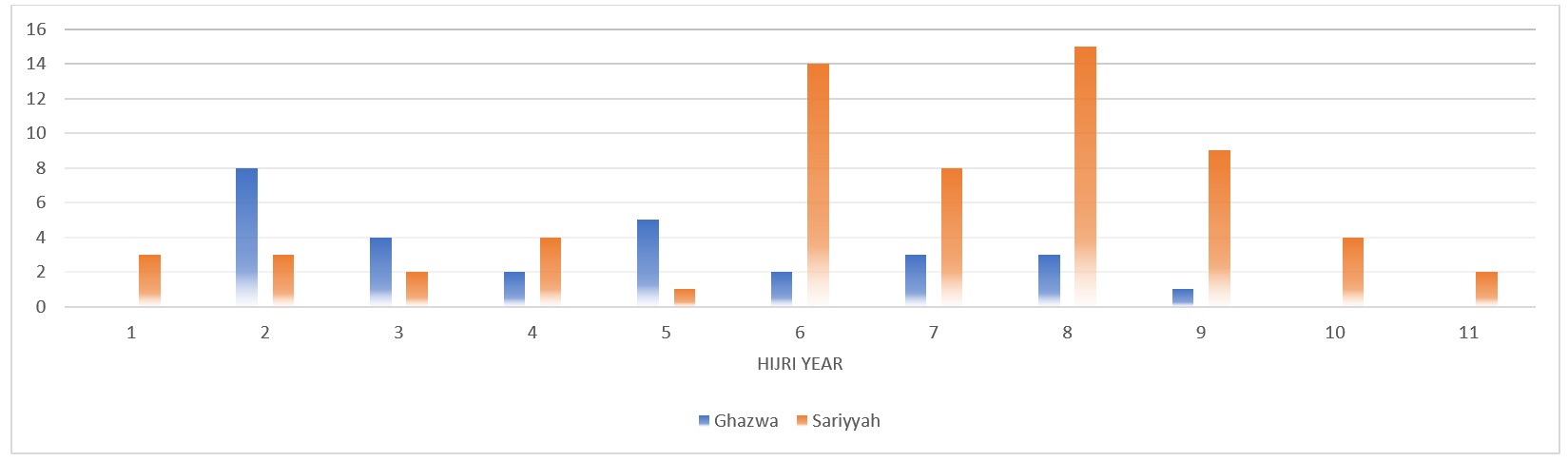
Another example is the army commanders of the Prophet ﷺ who lived after his death, who were pivotal in the conquest of the Persian and Roman Empires. The historians divided the military expeditions of the Prophet ﷺ in to two:
- Ghazwa – a battle led by the Prophet ﷺ
- Sariyyah – a battle led by a sahabi[41]

If we study the difference between the number of Ghazwas and Sariyyahs over the Madinah period, we find the Prophet ﷺ initially took a hands-on role leading most of the battles. Then after Al-Hudaibiyah in 6 Hijri the sahaba began to take the lead. This shows the confidence of the Prophet ﷺ in the sahaba’s abilities, and is a testament to the success of the Prophet’s ﷺ training programme.
How did the later Khulufa’ gain a ruling personality?
After the time of Mu’awiya, the Khilafah transferred into hereditary rule for the rest of its existence. The future khulufa’ who were mostly the sons of the reigning Khaleefah would become known as the wali ul-ahd (heir apparent), and be trained from an early age to rule. The main training ground was for the sons to be appointed as governors of a province where they could hone their ruling skills in a specific location, before scaling up to the entire state on the death of their father. Other positions held by the wali ul-ahd were leading the army expeditions and being made the Ameer of Hajj.[42] [43]
The Umayyads
In the Umayyad period Yazid ibn Mu’awiya led the expedition to Constantinople in 49H[44] and was Amir of Hajj in 51H[45] before becoming the wali ul-ahd and then taking power on the death of his father.[46]
Abdul-Malik ibn Marwan was made governor of Palestine by his father Marwan ibn al-Hakam[47] before becoming the first[48] wali ul-ahd[49] and then the Khaleefah.
Abdul-Aziz ibn Marwan, the father of Umar bin Abdul-Aziz was the wali ul-ahd for his brother Abdul-Malik ibn Marwan. Abdul-Aziz remained as governor of Egypt for 20 years, but he passed away before his brother so never became the Khaleefah.
Umar bin Abdul-Aziz[50] was the governor of Khanasser (the city of Anasartha located in western Syria)[51] under Abdul-Malik and also his advisor[52]. Under Walid I, he was governor of Madinah 87-93H, and in 91H Ta’if was also added to his mandate.[53] Umar was also the wazir[54] for Sulayman ibn Abdul-Malik before becoming the wali ul-ahd[55] and then the Khaleefah after his death.
The Abbasids
In the Abbasid period this situation of the future Khaleefahs being prepared and trained for rule continued. On the annual Hajj in 802CE, the Abbasid Khaleefah Harun al-Rashid (r. 786– 809CE) drew up an agreement between his two sons – Al-Amīn and Al-Ma’mun – the successors to the Khilafah, to respect one another’s rights to the succession. Harun had suspected that tensions between his sons would lead to civil strife and fitna after his death[56], so he drew up this public agreement as a preventative measure. He assigned Iraq and the western provinces (Syria) to his son al-Amīn, the heir apparent, and the eastern provinces (Khorasan) to the second in succession, his son al-Maʾmūn.[57]
Al-Maʾmūn was also made the deputy Khaleefah (na’ib or wazir al-tafweedh) which is the second most powerful position after the Khaleefah. Tabari narrates, “In this year (190H/806CE), al-Rashid led the summer expedition (against the Byzantines). He left behind his son Abdallah al-Maʾmūn as his deputy[58] at al-Raqqah[59] and entrusted affairs to him. He wrote letters to the (governors in the) farthermost parts of the empire ordering them to give al-Maʾmūn full obedience, and he handed his seal ring over to al-Maʾmūn so that he might benefit from its auspiciousness; this was his personal seal ring, on which was engraved the motto ‘Allah is my trusted patron, in His hands I have placed my security’.[60]
From the 10th to 13th century, the Abbasid khulufa’a became mere figureheads with the sultans and other ameers holding delegated (tafweedh) executive power, which was nominally conferred on them by the Khaleefah. Even during this period, the khulufa’a from a young age were still capable rulers, and some of them managed to regain some semblance of independence from the sultans and increased their powers. Eric Hanne says, “What is most telling about the preceding events[61] is the change of status for the Abbasid caliph in the minds of the Saljuqs. In the narratives we have for these events, al-Mustarshid [r. 1118-1134CE] is treated somewhat as an equal in relation to the Saljuqs. The caliph’s position in Baghdad at this point had become important enough that the Saljuqs had to keep his needs and opinions in mind in order to ensure stability in central Iraq.
No longer could the Saljuqs view the caliph as the theoretical leader of the Islamic community, going to him only for recognition of their own status. They had begun to realize and accept his value as both a political and a potential military ally. Along with this positive aspect, however, was the threat that the revitalized Caliphate offered to the Saljuqs.”[62]
Al-Mustarshid’s father was the Khaleefah Al-Mustazhir (r. 1094-1118CE). During Al-Mustazhir’s reign there was a rival state based in Egypt ruled by the Fatimid Ismaili (Batiniyah) dynasty (909–1171CE), which claimed itself to be a Khilafah in opposition to Baghdad. Although their claim to the Khilafah was illegitimate, since it is not permitted for there to be more than one Khaleefah[63], the state was a powerful challenge to the Abbasid khulufa’a, who as mentioned had become mere figureheads with limited powers.
The Fatimids claimed that Al-Mustazhir was not fit to be the Khaleefah, especially since he was only 16 years old when he assumed office.[64] In response, Al-Ghazali wrote a refutation of the Ismaili (Batiniyah) thought and rebutted their claims against the illegitimacy of the Khaleefah Al-Mustazhir. This book is commonly known as Al-Mustazhiri.
Regarding the condition of al-kifāyah being present within Al-Mustazhir, Imam Ghazali says in summary, “On the second quality: al-kifāyah. Al-Mustazhir’s reflection and governance is based on his astuteness and intelligence admired by all. He seeks enlightenment from consulting men of insight and experience and in choosing an able Wazir…This is the competence sought.”[65] He then uses the example of how Al-Mustazhir managed to complete his bay’ah while under the Seljuq occupation of Baghdad, which was awash with soldiers who had previously tried to depose his father Al-Muqatadi.[66]
The Ottomans
The Ottomans continued the tradition of appointing their sons to provinces so they could learn statecraft in preparation for their future role as Sultan. However, they differed with the Umayyads and Abbasids by not nominating a specific son as the wali ul-ahd. Instead, they adopted a ‘survival of the fittest’ approach, leaving the sons to literally fight it out after the reigning Sultan’s death, leaving the succession open to whichever of the Sultan’s sons could make it to Constantinople[67] first and claim the authority. The victorious son would then become the Sultan and execute his brothers to prevent any disunity occurring within the empire. This ‘survival of the fittest’ approach created very capable Sultans, but ultimately weakened the empire over time. Aside from being a flagrant breach of the sharia, this fight to the death among the sons, where surrender and reconciliation was not an option, led to bloody civil wars and the loss of tens of thousands of Muslim soldiers.
The Turco-Mongol Sultan Timur (r.1370-1405) exploited this succession arrangement and after defeating the Ottoman Sultan Bayezid in 1402, “Bayezid’s sons, Suleyman, Isa, Musa, and Mehmed, were all kept alive by Timur, who gave each a small fiefdom, knowing that they would have to fight amongst themselves before one could emerge as the successor to their father. Thus began a period of eleven years of war among Bayezid’s sons, which came to be known as the Interregnum or ‘‘Fetret’’ in Turkish.”[68]
Mehmed II (Al-Fatih) the most victorious of the Ottoman Sultans who opened Constantinople at the age of 21, was made governor of Amasya in Northern Turkey near the Black Sea at a young age in preparation for rule.[69]
Alan Mikhail in reference to Selim I who was the governor of Trabzon before becoming the first Ottoman Khaleefah (r.1517-1520) says, “To win the ottoman throne, Selim and his half-brothers had first to prove their mettle by governing a city in the east of the empire.”[70]
In 1595 Sultan Mehmed III went a step too far in the ‘survival of the fittest’ approach to succession and executed 19 of his brothers, which led to outcry among the people, ulema and other officials of the state. Imber says, “Since Mehmed III’s accession in 1595, fratricide was no longer the means of securing the throne.”[71] After his successor and son Ahmet I died a new system of Kafes (cage) was adopted, where instead of executing the Sultan’s brothers who were potential rivals to the throne, they were imprisoned under house arrest in the harem. This meant they had no ruling experience if at a later date they were called upon to succeed the Khaleefah upon his death or removal. After Ahmet’s death his brother Mustafa became Sultan, but due to his long imprisonment in the Kafe his mental health meant he was not capable of ruling and only ruled for a short time. Mustafa Agha a representative of the Inner Palace, said that Mustafa’s ‘defect in intelligence came from his long confinement . . . and he might come to his senses if he had contact with people for a while’.[72]
Capability vs piety
Piety الوَرَع (al-Wara’) is one of the fundamental characteristics of the ruler without which the implementation of Islamic rule itself is in jeopardy. Imam Ghazali refers to this as “the fundamental and noblest quality”[73] in the ruler. Taqiuddin an-Nabhani says, “Since the strength of the personality has within it the potential of domination and authority, there is an obvious need that the ruler has an attribute which protects him from the evil of authority. So it is necessary that he has the attribute of taqwa within himself and in his taking care of the Ummah.
Muslim and Ahmad from Sulayman bin Buraydah from his father:
كَانَ رَسُولُ اللَّهِ صلى الله عليه وسلم إِذَا أَمَّرَ أَمِيرًا عَلَى جَيْشٍ أَوْ سَرِيَّةٍ أَوْصَاهُ فِي خَاصَّتِهِ بِتَقْوَى اللَّهِ وَمَنْ مَعَهُ مِنَ الْمُسْلِمِينَ خَيْرًا
“Whenever the Messenger of Allah ﷺ would appoint an Amir over an army or expedition, he would command him with taqwa with himself and to be good to those Muslims who are with him.”[74]
The ruler, if he is conscious of Allah ta’ala and fears Him, and accounts Him in his own soul secretly and openly, then this would stop him from enslaving the citizens.”[75]
Shehu Uthman Dan Fodio, (1754-1817), founder of the Sokoto Sultanate[76] which was established in 1804 in West Africa, says concerning the rule, “He must maintain an open door to the aggrieved and oppressed. His job is to establish justice and prevent injustice, not simply to devote himself to personal acts of piety.”[77]
As mentioned in the hadith concerning Abu Dharr, piety and someone’s high rank in Islam is not enough for someone to assume authority. Kifāyah is considered of higher importance when it comes to governing people than individual taqwa, although this is still an essential attribute of a ruler as an-Nabhani mentions.
Abu Dharr was one of the fourth or fifth Muslims[78], and had one of the highest ranks among the sahaba, yet the Prophet ﷺ refused to appoint him to a wiliyah saying to him إِنَّكَ ضَعِيفٌ “Indeed you are weak!” i.e. not capable of ruling at this time. Compare this to Bādhān ibn Sāsān and al-Mundhir ibn Sawa who were new Muslims, yet remained as governors of Yemen and Bahrain respectively.
As-Sallabi says, “choosing a leader, did not involve a random selection; on the contrary, the Prophet carefully chose the right man for the job, taking into consideration a candidate’s character, level of piety, experience and knowledge; at times, he ﷺ would choose someone who was influential in his tribe, in the hope that he could, in the capacity of overall leader of that tribe, convince all of his fellow tribesmen to embrace Islam. In such situations, the Prophet appointed not one of his own Companions but a member of the tribe he had just conquered. For it is always the case that people want one of their own to lead them, and not an outsider.”[79]
Appointing people to leadership positions based on merit continued throughout the Rightly Guided Khilafah. After Ali ibn Abi Talib was martyred, his son al-Hasan was given the bay’ah by the Ahlul hali wal-aqd based in the capital Kufa. There is no doubt that Ali and al-Hasan are of a higher rank among the sahaba than Mu’awiya. Mu’awiyah even said so during the civil war with Ali, “I know that Ali is better than me,”[80] but when it came to governing the Muslims al-Hasan made a conscious decision to abdicate from the Khilafah and hand over power to Mu’awiya. His motivation for resigning from the Khilafah was to restart the Islamic conquests which had halted after Uthman’s assassination, and to deal with the other territories who had taken advantage of the situation and rebelled in the East. Al-Hasan said, “I have been thinking of going to Madinah to settle there and yielding (the Khilafah) to Mu’awiya. The turmoil has gone on for too long, blood has been shed, ties of kinship have been severed, the roads have become unsafe, and the borders have been neglected.”[81]
This is why “the caliph’s ability to actually do so, termed kifāyah, is all that remains after al-Juwaynī’s process of intellectual distillation as the most essential qualifying attribute for an imam.”[82]
Capability vs infallibility
The Sunni Position
The Sunni position is clear that the ruler (Imam) is not infallible, and is not divinely appointed through the line of Imams from the Prophet ﷺ through the lineage of Ali (ra) and Fatima (ra). Al-Mawardi says in response to the claim that the Imams from Ahl e Bait are more suitable to rule than the Abbasids of his time, “If it seems to the electors (ahlul hali wal-aqd) that one of the two [candidates] is the more excellent and they make the bay’ah to him for the Imamate but then someone more excellent than him appears then this first Imamate stands and it is not permitted to abandon it for someone who is more excellent than him.”[83]
As-Subki says, ‘According to the consensus of the Companions after the death of the Prophet ﷺ, men should appoint an imam who will look after their interests. They gave this precedence over all other obligations and people have been abiding by this over the ages. Even if the appointed imam is not the most suitable, nevertheless the mere act of appointing him is sufficient to discharge the obligation.’[84]
Al-Qurtubi says, “It is not a precondition that he (the Imam) be protected from slips and errors or that he should know the Unseen.”[85] He also says, “It is permitted to appoint a less excellent candidate when there is someone better if there is fear of civil unrest and that the affairs of the community will not be in order. That is when the ruler is appointed to repel enemies, protect territory, block gaps, deliver rights, establish the ḥudūd, and collect revenue for the Treasury and distribute it to its people. If it is feared that appointing the better person will result in bloodshed and unrest and that things will be disordered because of the appointment of that leader, that is a clear excuse for turning away from the better man for the lesser one. That is also indicated by the knowledge shown by ‘Umar and the rest of the Community at the time of the Shūrā. The six of them included those who were better and those who were less qualified. It was permitted to give the leadership to any of them when the best interest lay in that choice. They agreed on that and none of them objected to it. Allah knows best.”[86]
The Shī‘i position
The Shī‘i position regarding the necessity of the Imam being infallible (ma’sum) is well-known. They state, “If a divinely appointed leader is not infallible, he would be liable to errors and to deceive others as well. In such a case, no implicit confidence may be placed in his sayings/commands/actions. A divinely appointed Imam is the most liable person to rule as the head of the community, and people are supposed to follow him in every matter.”[87]
In response to this condition that the ruler must be infallible, Abdul-Qadeem Zallum says: “As for the infallibility (‘Isma) of the Messenger of Allah ﷺ, this results from the fact that he is a Prophet and not from being a ruler. This is because infallibility is an attribute of all the Prophets and Messengers, regardless of whether they themselves ruled people with their shari’a and implemented it or whether they just conveyed their shari’a without holding the post of ruler or managing its implementation. Musa, ‘Isa and Ibrahim (as) were all infallible, as was Muhammad ﷺ. Therefore, infallibility is for Prophethood and the Messengership, not for ruling. The fact that the Messenger of Allah ﷺ never committed a forbidden act (Haram) nor neglected a duty (wajib) whilst executing the functions of ruling resulted from the fact that he was infallible with respect to Prophethood and Messengership and not because he was a ruler.
Thus his execution of ruling does not require infallibility as such, but in reality he ﷺ was infallible because he was a Prophet and a Messenger. He ﷺ, therefore, assumed his duties as a ruler just as any other human being, who rules over other humans, does. The Qur’an has clearly stated this, Allah ta’ala says:
قُلْ إِنَّمَآ أَنَا۠ بَشَرٌۭ مِّثْلُكُمْ
Say, ˹O Prophet,˺ “I am only a man like you” [88]
Allah’s saying in the same verse outlines the difference between him ﷺ and other humans:
يُوحَىٰٓ إِلَىَّ
˹but˺ it has been revealed to me[89]
The distinction, therefore, lies in the fact that he ﷺ received revelation, namely the Prophethood. Other than that, he ﷺ was a man like any other man. Therefore, in ruling he ﷺ was human, and undoubtedly his successors (Khulafaa’) would also be humans just like any other human, because they would only be successors to him in ruling, not Prophethood and Messengership.
Infallibility does not therefore apply to the Khaleefah, as this is not required in ruling but it is a requirement of Prophethood. The Khaleefah is only a ruler no more, so the condition of infallibility is irrelevant to those who take up this post. It is even forbidden to stipulate infallibility as a precondition incumbent upon whoever takes up the post of Khilafah. This is because infallibility is restricted to the Prophets and it is forbidden to claim it on behalf of anyone other than a Prophet.”[90]
An interesting development occurred within Shī‘i political thought when Ayatollah Khomeini turned the concept of infallibility for the ruler on its head with the introduction of the concept of Velayat-e Faqeeh (Governance of the Jurist), where a fallible scholar would take the place of the infallible Imam in governing the nation. In doing so, the Shī‘i and Sunni positions on authority and government in the modern era are now almost identical. This means in a future Khilafah the seeds of division being sown by corrupt regimes between Shī‘i and Sunni are not the major obstacle to political unity that some may think.
Khomeini says “From the time of the Lesser Occultation[91] down to the present (a period of more than twelve centuries that may continue for hundreds of millennia if it is not appropriate for the Occulted Imām to manifest himself), is it proper that the laws of Islam be cast aside and remain unexecuted, so that everyone acts as he pleases and anarchy prevails? Were the laws that the Prophet of Islam labored so hard for twenty-three years to set forth, promulgate, and execute valid only for a limited period of time? Was everything pertaining to Islam meant to be abandoned after the Lesser Occultation? Anyone who believes so, or voices such a belief, is worse situated than the person who believes and proclaims that Islam has been superseded or abrogated by another supposed revelation.”[92]
Capability vs Lineage
al-Qurṭubī says, “An Imam merits his authority on the basis of knowledge, piety and strength, not on the basis of lineage. Lineage has no real say in the matter since knowledge and virtue supersede it as Allah makes clear by informing us that He chose Ṭālūt over them on account of his knowledge and strength even though their lineage was more noble.”[93]
It should be noted here, that when al-Qurṭubī refers to lineage, he means within the tribe of Quraish, because he and the majority of scholars in Islamic history stipulated that the Khaleefah must be from Quraish, and made this a contractual condition (shart) of the bay’ah contract, though not a pillar (rukn).[94] The Abbasids came to power claiming their lineage was superior to that of the Umayyads even though they were both from Quraish.[95] Their revolution rallied the Muslims of Iraq and Khorasan, and in particular the Shi’ah, against the Umayyads on the basis that the Imam should be from the family of the Prophet ﷺ i.e. Banu Hashim as opposed to the Umayyads who were from Banu Umayyah. Al-Qurṭubī refutes this stance saying, “nor must he (the Imam) come from the Banū Hāshim or any other clan of Quraysh. There is consensus on the validity of the leadership of Abū Bakr, ‘Umar and ‘Uthmān, and they were not from the Banū Hāshim.”[96]
A question then arises as to whether it’s better to have a non-Quraishi Khaleefah, if he is more capable than a Quraishi one who is less capable?
In answer to this, each time period is different and has its own unique circumstances. In one particular time, lineage may be the most important consideration for the Khaleefah or governor as Dr As-Sallabi mentioned previously, when the Prophet ﷺ would sometimes appoint an influential member of the tribe as its governor. This also occurred in the heated debate with the Ansar at the saqeefah, during the election of Abu Bakr as-Siddiq as the first Khaleefah of Islam. When Hubab bin Al-Mundhir from the Ansar said, “there must be an ameer from us and an ameer from you.” Abu Bakr said,
لاَ، وَلَكِنَّا الأُمَرَاءُ وَأَنْتُمُ الْوُزَرَاءُ هُمْ أَوْسَطُ الْعَرَبِ دَارًا، وَأَعْرَبُهُمْ أَحْسَابًا
“No, we will be the ameers and you will be the wazirs, for they (i.e. Quraish) are the best family amongst the Arabs and of best origin.”[97]
This is because the Arab tribes would only give leadership to someone from Quraysh. If someone from other than Quraysh became the Khaleefah then this may have led to fragmentation of the state. The Messenger of Allah ﷺ said,
النَّاسُ تَبَعٌ لِقُرَيْشٍ فِي هَذَا الشَّأْنِ مُسْلِمُهُمْ لِمُسْلِمِهِمْ وَكَافِرُهُمْ لِكَافِرِهِمْ
“People are subservient to Quraysh in this matter: the Muslims among them [being subservient] to the Muslims among them, and the disbelievers among them [being subservient] to the disbelievers among them.”[98]
To illustrate this superiority of Quraysh among the Arab tribes, in the period 72-74H in which the Umayyad Khaleefah Abdul-Malik ibn Marwan was in power, conflict and fitna broke out in Khurasan between the Arab tribes – Muqa’is and Butan vs Tamim, Awf and Abna – under its governor Bukayr bin Wishah who was from Banu Tamim. The Arab tribes in Khurasan wrote to the Khaleefah Abdul-Malik saying that Khurasan would only recover from its disarray under the direction of a man of Quraysh, one who would be the object of neither their envy nor their partisanship.
Abd al-Malik said, “Khurasan is the frontier of the East. It has had its troubles under the governance of this Tamimi, and the troops have broken into factions. Fearing that they will return to the factionalism of the past, and that the region and its people will then be destroyed, they have asked me to appoint as governor over them a man of Quraysh, whom they would heed and obey.” He then appointed Umayyah bin Abdallah from Banu Umayyah i.e. Quraysh as their governor.[99]
Since the mid-10th century, executive power in the Khilafah was held by the Turkic Sultans who ran provinces of the state as Sultanates giving nominal allegiance to the Abbasid Qurayshi Khaleefah in Baghdad. After the Mongol invasion and killing of the Abbasid Khaleefah in 1258, the Abbasid Khulufa’a transferred to Cairo, Egypt, holding authority within the Mamluk Sultanate. The Mamluks were freed Turkic slaves and as Sultans were the real holders of power within the state. This was mirrored in Anatolia with the rise of another Turkic tribe – the Ottomans who in 1517 managed to defeat the Mamluks and combined the two offices of Khaleefah and sultan under the first Ottoman Khaleefah Salim I. This is why there was a shift in Islamic political thought in the later part of the Abbasid Khilafah by some ulema (al-Juwaynī, Ibn Khaldun and Ibn Jamāʾah) who lessened the importance of the Khaleefah being from Quraysh, and prioritised other attributes of the Khaleefah such as al-kifāyah.
“The caliph’s ability to actually do so, termed kifāyah, is all that remains after al-Juwaynī’s process of intellectual distillation as the most essential qualifying attribute for an imam.”[100] Ibn Jamāʾah said that “the seizure of power itself gave authority,”[101] and ibn Khaldun writing in the late 14th century said, “The group feeling (asabiyah) of the Fâṭimids and the Ṭâlibids, indeed, that of all the Quraysh, has everywhere disappeared. There are other nations whose group feeling has gained the upper hand over that of the Quraysh.”[102]
Mona Hasan says, “The overall purpose of establishing a leader for the Muslim community, al-Juwaynī argues, is not affected by the question of genealogy, whereas to insist upon a leader of Qurashī blood may in fact be detrimental. Preference, al-Juwaynī explains, should be assigned at all times to a scholarly, capable, and pious candidate for caliph over one who is merely Qurashī. Should a candidate who possesses these former three traits in addition to being of Qurashī descent suddenly emerge, however, those extenuating circumstances would constitute grounds for the deposition of the non-Qurashī already in office. Yet were it somehow unfeasible or undesirable to adopt that course of action, the partially qualified leader’s position could be legally confirmed.”[103]
This is what led Mustafa Sabri, the last Sheikh ul-Islam of the Ottoman Khilafah to declare, “If Mustafa Kemal had wanted, Mustafa Sabri pointed out, he could have had himself recognized as caliph, following this tradition, and Muslims around the world would have happily acquiesced. He was after all widely hailed as the hero of Islam and the restorer of its glory, and Muslims no longer felt compelled to limit a caliph’s lineage to Quraysh alone as they had with the Abbasid caliphs in Baghdad and Cairo. That Mustafa Kemal did not choose this path was proof of his clique’s aversion to the state’s religious character: Mustafa Kemal and his collaborators took what they wanted, political power, and tossed aside what they despised, the Islamic caliphate.”[104]
Mufti Taqi Usmani nicely concludes this discussion saying, “all of this is when one who is qualified for caliphate from Quraysh is present. As for when one who combines the qualities required is not found, then there is no dispute in the permissibility of contracting the caliphate for a non-Qurayshi, and I would think it is the same when the people have forsaken their lineages and it is not certain [whether] a man is from Quraysh or not. Furthermore, these conditions are only considered when the caliphate is contracted by the Ahl al-Hall wa ‘l-‘Aqd. However, when a Muslim man becomes dominant and becomes imam by his dominance, then he assumes the rules of imamate even if these conditions are absent in him, and his regulations are executed and his appointments are sound, and following his judgement is permissible, as was clarified by the fuqaha (jurists). See for example Sharh al-Ashbah wa l-Nazair by al-Hamawi (2:267).”[105]
It should be pointed out that the condition of Quraish is based on textual evidences i.e. hadith, such as the Messenger of Allah ﷺ saying,
لاَ يَزَالُ الأَمْرُ فِي قُرَيْشٍ مَا بَقِيَ مِنْهُمُ اثْنَانِ
“This matter (al-Amr) will remain with the Quraish, even if only two of them remained.”[106]
This means the shara’ has given consideration to this condition and made it husn (good). Therefore, even though the superiority of Quraysh has all but disappeared nowadays, this does not represent a sharia ‘illa (legal reason) for the existence or not of the Quraish condition. Rather this is a hikmah (wisdom) which doesn’t affect the validity of the text. The Quraish condition therefore remains, albeit a mandub (recommended) condition and not a contractual condition. Taqiuddin an-Nabhani says, “these ahadith indicate that it is a recommendation and not an obligation, thus it is a condition of preference not a contracting condition.”[107]
Disabilities which are impediments to ruling
The second aspect of al-kifāyah is related to the Khaleefah being free from any disability which could affect his ability to rule. This is an important topic because in a future Rightly Guided Khilafah i.e. one in which the ruler is elected, the Khaleefah will be an elder statesman who would have held a military command and potentially fought in many battles prior to coming to office. Therefore, it’s possible he will have some injuries, scars and disabilities from his military service. Abu Sufyan who was commander of the Tulaqaa’[108] at the Battle of Hunayn, lost an eye during the subsequent Siege of Ta’if[109] even though he had only been Muslim for 4 weeks!
Al-Mawardi listed three types of physical defects[110] which may exclude the Khaleefah from contracting the bay’ah:
- a deficiency in the senses
- a deficiency in his limbs
- a deficiency in his mobility
There are no specific texts for these, so whatever incapacity causes the Khaleefah to be unable to fulfil the task of ruling would be applicable here. Taqiuddin an-Nabhani says, “it cannot be said that losing limbs from his body necessitates removal or not, in the same way that it cannot be said that if he is afflicted by a specific illness it necessitates his removal or not. This is because there is no text regarding this at all. Rather the Shari’ah rule is that the one incapable of executing the actions which they have been commissioned for, necessitates their removal, whatever the reason for this incapacity.”[111]
This topic falls under manat ul-hukm (reality of the rule) and is for the experts to decide upon, with the Mazalim Court providing the final judgement. Taqiuddin an-Nabhani says, “As for how should the capability be defined, this requires examination since it could be connected to bodily or mental illness etc., and for that reason it is left undefined for the Mazalim Court to confirm that, for example, the candidates for the Khaleefah fulfill the necessary requirements.”[112]
Al-Mawardi’s list of disabilities which affect the Khaleefah’s ability to rule
Many of the disabilities that al-Mawardi lists here can be mitigated to some extent through advances in modern technology. Speech to text for those with no hands, prosthetic limbs, hearing aids and spectacles etc, were not available in the 11th century when al-Mawardi laid down his list of disabilities that affect the Khaleefah’s ability to rule.

It should be noted that kifāyah is not a pillar (rukn) of the bay’ah. This means if the bay’ah has been legally convened to a Khaleefah, and then during his term of office something occurs which affects his ability to rule, the Khaleefah will remain in office while under investigation. If the disability is serious enough then it will make the bay’ah fasid (defective) and the Mazalim Court will issue a judgment forcing the Khaleefah to leave office. Until this point though, the Khaleefah remains in office and obedience to him is obligatory. This is different to a rukn of the bay’ah being violated such as the Khaleefah becoming a murtad (apostate), irreversibly insane or captured and imprisoned by an enemy with no immediate hope of release. In these cases, the bay’ah becomes void (batil) and the Mazalim Court issues an immediate annulment of the contract. But even before the judgment from the Mazalim, there is no obedience to the Khaleefah because there is no bay’ah.[113] This protects the state and interests of Islam, because the Khaleefah under duress in a foreign prison could issue orders which seriously affect the interests of the state, or an apostate Khaleefah could issue executive orders which contradict Islam.[114]
It should be noted that al-Mawardi makes a distinction between contracting the bay’ah with the disability, and continuing in office with the disability. Since the bay’ah is a contract then it is either sahih (correct), batil (void) or fasid (defective). This will occur at the time of contracting the Khaleefah or while he is in office. Taqiuddin an-Nabhani says, “all the texts which have been related in regards to the conditions of the Khaleefah; they are comprehensive texts which encompass the perpetual characteristics that are necessary for the one described, which indicates that they are conditions of continuation and not simply conditions for the taking the position alone.”[115]
| Disability | Excluded from contracting the bay’ah | Excluded from continuing in office |
| Fainting | no | no |
| Temporary loss of intellect (mental illness) | yes | yes if severe, otherwise no |
| Permanent loss of intellect (brain damage) | yes | yes |
| Weak-sighted | no | no |
| Partial blindness (unable to recognise people) | yes | yes |
| Total blindness | yes | yes |
| Smell | no | no |
| Taste | no | no |
| Partial deafness | no | no |
| Total deafness | yes | yes |
| Speech impediment | no | no |
| Unable to speak (mute) | yes | yes |
| Blemishes, scars disfigurement[116] | No but some ulema say yes | no |
| Loss of private parts | no | no |
| Loss of both ears | no | no |
| Loss of one hand | yes | No but some ulema say yes |
| Loss of both hands | yes | yes |
| Loss of one leg | yes | No but some ulema say yes |
| Loss of both legs | yes | yes |
Who determines if someone is capable to rule?
1- The Khaleefah or the Candidate for the Khilafah Post
It is forbidden for someone to seek authority if they are not qualified for it. This is understood from numerous ahadith including the famous hadith of Abu Dharr quoted earlier. Taqiuddin an-Nabhani says, “As for the prohibition of asking for the imarah leadership mentioned in the ahadith, this is a prohibition for weak persons who are not fit for it like Abu Dharr (ra).”[117]
Therefore, the candidate’s taqwa should prevent him from even putting himself forward. If the Khaleefah is already in office, and a serious change occurs in him which affects his ability to rule, then he should resign. Al-Qurtubi says, “If a leader finds in himself an impediment which would impair his leadership, he should retire.”[118]
2- The People’s Representatives (Ahlul hali wal-aqd) who will contract the bay’ah
The Khaleefah is only in office if he has a valid bay’ah contract. No bay’ah means no rule. The bay’ah is a contract of one-to-millions i.e. between the Khaleefah and the Muslim ummah. This is different to other Islamic contracts which are one-to-one such as buying, selling and marriage. This therefore poses a challenge on how you get the consent of millions of people which is a condition in Islamic contracts. It’s not possible for every Muslim to participate in the election of the Imam, which is why in the rightly guided Khilafah of the sahaba, the senior representatives of the people would contract the bay’ah to the Khaleefah. The rest of the Muslims would accept their opinion and rush to pledge their bay’ah to the newly appointed Khaleefah. This was done either directly in the Prophet’s Mosque in Madinah, which was the capital of the state, or indirectly through the governors in the other provinces.[119] The classical scholars called this contracting group the أهل الحل والعقد Ahlul hali wal-aqd which literally means the ‘people who loosen and bind’.
Ahmad ibn Hanbal says: “The imamah is not effective except with its conditions […], so if testimony was given to that by the Ahlul hali wal-aqd of the scholars of Islam and their trustworthy people, or the imam took that position for himself and then the Muslims were content with that, it is also effective.”[120]
Therefore, the Ahlul hali wal-aqd are the ones who will decide who they want to rule them, and the attributes that are most important for the state at that time. Rashid Rida (1865-1935) mentions this when he explains ‘the caliphate or imamate of necessity’. “This type would be allowed when the ahl al-hall wa’l ‘aqd decided to install a caliph who had most but not all the legal requirements.[121] To this type of caliphate belonged some of the Umayyad and Abbasid caliphs who lacked ‘ilm (knowledge), imperative in exercising ijtihad.”[122]
The Ahlul hali wal-aqd could therefore decide to appoint a Khaleefah, who despite his kifāyah weaknesses, is a hero of the ummah due to his past role in establishing the state or commanding the Muslim armies to victory. Something similar occurred with Nelson Mandela, who became the first President of the Republic of South Africa at the age of 76 after serving 27 years in prison. His Presidency was symbolic and actual day to day affairs fell to his deputies (wazirs), Thabo Mbeki and former President F.W. de Klerk. The mitigations against kifāyah weaknesses will be discussed later.
The Ahlul hali wal-aqd in a future Khilafah will be institutionalised in an elected Majlis al-Nuwaab, with the Muslim members – male or female – forming an electoral committee to decide on who the Khaleefah should be and formally contract the bay’ah to them.
Hassan al-Banna says, “As for respecting the ummah’s opinion, and the obligation for her to be properly represented and participate in the ruling, Islam did not require that the opinion of all its members be sought in every issue, which in modern terminology is known as a ‘referendum’. Instead, under normal circumstances, Islam was satisfied with the Ahlul hali wal-aqd and did not specify them by their names, nor by their persons, and it appears from the sayings of the fuquha and their description of them, that this description applies to three categories:
1 – Mujtahid jurists whose opinions are relied upon in fatwas and deduction of rulings.
2- People with experience in public affairs.
3- Those who have a kind of command or leadership among people, such as heads of households and families, sheikhs of tribes and heads of groups.”[123]
Al-Mawardi says, “If it seems to the electors (ahlul hali wal-aqd) that one of the two [candidates] is the more excellent and they make the oath of allegiance to him for the Imamate but then someone more excellent than him appears then this first Imamate stands and it is not permitted to abandon it for someone who is more excellent than him.
Most of the fuqaha and mutakallimun, however; say that his Imamate is valid and the existence of the one who is more excellent does not disqualify the Imamate of the one surpassed in excellence as long as he is not deficient regarding the conditions of the Imamate-just as in the case of the administration of judgeship it is permitted to follow the one surpassed in excellence even though the more excellent person is available since a greater degree of excellence is only an extra dimension of choice and is not considered as one of the necessary conditions.”[124]
3- The Mazalim Court
Article No 41 of the Draft Constitution of the Islamic State written initially by Taqiuddin an-Nabhani and then updated by Abdul-Qadeem Zallum states, “The court of the mazalim (injustices) is the only one who can decide if the change in the situation of the Khalifah, is a change which removes him from the leadership or not, and it is the only one who has the power to remove or warn him.”
In their explanation of this article they say, “However, if the Khalifah is afflicted by any of the circumstances [of removal] and removes himself then the issue is closed[125], and if the Muslims see that it is necessary for him to be removed due to this situation occurring, and he disagrees with them, then the issue is referred to judgement due to the words of Allah ta’ala: فَإِن تَنَـٰزَعْتُمْ فِى شَىْءٍۢ فَرُدُّوهُ إِلَى ٱللَّهِ وَٱلرَّسُولِ “and if you differ in anything amongst yourselves then refer it to Allah and His Messenger.”[126] In other words, if you and the people of authority disagreed, and this is a disagreement between the person of authority and the Ummah, then refer it to Allah ta’ala and His Messenger ﷺ which is to refer it to judgement, in other words the court of the mazalim.
The mazalim court has the power to limit the period of notice to remove the mastery over him, or the period of grace for the freeing him from imprisonment, during which the temporary leader (Ameer Mu’aqqat)[127] would work, and after if the Khalifah then could carry out his powers without being under the mastery of others or imprisoned, then the work of the temporary leader would end. If the mastery over him or imprisonment did not end then the court would rule to remove him, and the temporary leader would begin the process of appointing the new Khalifah.”[128]
The Sheikh ul-Islam in the Ottoman Khilafah held this role of Qadi Mazalim, and so had the power to issue a fetva (fatwa) to depose a sultan, as occurred in 1909 when a fetva was issued on behalf of the National Assembly to remove Sultan Abdul-Hamid II.
Case Study: The Removal of Ottoman Khaleefah Sultan Mustafa I
After the Ottoman Khaleefah Sultan Ahmed I (r.1603-1617) died in 1617, his brother Mustafa became the Khaleefah before being removed due to mental illness.
Colin Imber mentions, “Ahmed died in 1617, when he was less than thirty, leaving a problem of succession for which there was no precedent. With the ending of the practice of fratricide, his brother Mustafa was still alive and, by the new principle of seniority, entitled to inherit the throne. Mustafa, however, was mentally defective, presenting the dilemma of whether to give the throne to a minor, Osman, or to an idiot, Mustafa. This time, the negotiations took place between a representative of the Inner Palace, Mustafa Agha, and two dignitaries from outside, the Deputy Grand Vizier, Sofu Mehmed Pasha and the Chief Mufti, Es’ad. It was, in Pechevi’s version of events, Mustafa Agha’s word that was decisive. He argued that public disapproval was inevitable if a child came to the throne when an adult candidate was available, and that Mustafa’s ‘defect in intelligence came from his long confinement . . . and he might come to his senses if he had contact with people for a while’. It was the decision of this group of people that brought Mustafa to the throne.
Mustafa’s mental condition did not, however, improve. He was, Pechevi tells us, in the habit of ‘scattering the gold and silver coins, with which he filled his pockets, to the birds and to the fish in the sea, and to paupers whom he met in the street’, and when ‘the Viziers came to present business to him . . . he would push their turbans and uncover their heads’. The same group of people as had planned his accession now plotted his deposition. In February 1618, they called the dignitaries and troops to the Palace, where Mustafa Agha locked the door on Mustafa and, as the Throne was set up, released Ahmed’s eldest son, Osman, from the other.”[129]
Mitigations against weaknesses in al-kifāyah
1- Delegating some executive power to a Wazir (Deputy Khaleefah)
There will never be a perfect Khaleefah because ‘to err is human’. In his inaugural speech as the first Khaleefah of Islam, Abu Bakr as-Siddiq said, “O people, I have been put in authority over you and I am not the best of you. If I do the right thing, then help me. If I do wrong, then correct me. Truthfulness is a sacred trust and lying is a betrayal. The weak among you is strong in my sight. I will surely try to remove their pain and suffering. And the strong among you is weak to me. I will, if Allah wills, fulfill the rights in full. When obscene things spread among any nation, calamities continue to descend upon them. As long as I obey Allah and His messenger, you should obey me. If I do not obey Allah and His messenger, then obedience to me is not an obligation upon you. Now, stand for the prayer, may Allah have mercy upon you.”[130]
We know that Abu Bakr was the best of the sahaba, and the best of the khulufa’ because Abu Hurairah said, “By the One Whom there is no god but him, if Abu Bakr had not been appointed as Khaleefah then Allah would not have been worshipped.”[131]Yet he taught us a very important attribute of the ruler which is humility, and that ALL rulers have some weakness and defects. This is why the Messenger of Allah ﷺ said,
مَنْ وَلِيَ مِنْكُمْ عَمَلاً فَأَرَادَ اللَّهُ بِهِ خَيْرًا جَعَلَ لَهُ وَزِيرًا صَالِحًا إِنْ نَسِيَ ذَكَّرَهُ وَإِنْ ذَكَرَ أَعَانَهُ
“Whoever among you is appointed to a position of authority – if Allah wills good for him – He will give him a righteous wazir who will remind him if he forgets and help him if he remembers.”[132]
Umar ibn al-Khattab was the wazir[133] to Abu Bakr. One day ‘Uyaynah ibn Hasan and al-Aqra’ ibn Habis came to Abu Bakr and said: “O Khaleefah of the Messenger of Allah ﷺ, there is some swampy land where no grass grows and it is of no use. Why don’t you give it to us to cultivate it, so that perhaps there will be some benefit in it after today?”
Abu Bakr said to those who were around him, “What do you think of what they said, if it is swampy land that is of no use?” They said, “We think that you should give it to them, so that perhaps there will be some benefit in it after today.”
So he gave it to them and wrote a document for them stating that it was theirs. He wanted ‘Umar to witness it, but he was not among the people, so they went to ‘Umar and asked him to bear witness. They found him applying pitch to a camel of his and said, “Abu Bakr has asked you to bear witness to what is in this document. Shall we read it to you or will you read it?” He said, “I am as you see I am, if you wish you can read it and if you wish you can wait until I am finished and I will read it myself.” They said, “No, we will read it.”
So they read it and when he heard what was in the document, he took it from their hands, then he spat on it and wiped it (i.e., obliterated what was written). They complained about that and said something bad. He said, “The Messenger of Allah ﷺ used to be kind to you, and Islam was in a weak position at that time. Now Allah has made Islam strong, so go and work hard. May you never succeed if you graze your flocks in that land!”
They went to Abu Bakr and started to complain, saying, “By Allah, we do not know if you are the Khaleefah or ‘Umar!” He said, “No, he could have been the Khaleefah if he had wanted to be.” Then ‘Umar came, and he was angry. He stood over Ahu Bakr and said, “Tell me about this land that you gave to these two. Is it your own land or does it belong to all the Muslims?” He said, “No, it belongs to all the Muslims.” He said, “Then what made you give it to these two only and not to all the Muslims?” He said, “I consulted these people who were around me and that is what they advised me to do.” He said, “If you consulted those who were around you, did you consult all the other Muslims, and were they pleased with it?”
Abu Bakr said, “I told you that you were more qualified for this role than I, but you insisted.”[134]
Umar was indeed a righteous wazir (وَزِيرًا صَالِحًا ) to Abu Bakr and a mirror for him[135], mitigating the minor shortcomings that occurred during his Khilafah.
Having said this, the Khaleefah cannot over-delegate (tafweedh) his executive powers to a wazir, because this will make the bay’ah contract fasid (defective), since the bay’ah is to the Khaleefah and no one else in executing the rules of Islam.
Al-Mawardi says, “He [the Imam] must personally take over the surveillance of affairs and the scrutiny of circumstances such that he may execute the policy of the Ummah and defend the nation without over-reliance on delegation of authority (al-Tafweedh) – by means of which he might devote himself to pleasure-seeking or worship (ibadah) – for even the trustworthy may deceive and counsellors behave dishonestly.”[136]
Wael Hallaq says, “According to Juwayni, the principle of delegation is indispensable in governmental institutions, for it constitutes the only means by which the imam can control and run the far-flung provinces of the empire. But by delegating his powers to others the imam always runs the risk of officials rebelling against him. To minimize such a risk the imam must employ informants who would be directly responsible to him to provide him with a brief report about the main events in each province.”[137]
2- Appointing an advisory council
In addition to appointing a wazir, the Khaleefah should appoint an advisory council Maktab Al-Mutashareen (مَكْتَب المُسْتَشارَيْنِ)[138] as part of his executive office. This will consist of specialists and ulema in various fields who the Khaleefah can seek shura from. This will mitigate against his lack of knowledge, because the Prophet ﷺ said, “The cure for ignorance is asking”.
Jābir narrated: We set out on a journey. One of our people was hit by a stone that injured his head. He then had a wet dream. He asked his fellow travellers: “Do you find a concession (rukhsa) for me to perform Tayammum?” They said: “We do not find any concession for you since water is available to you.” He, thus, took a bath and died (as a result). When we came to the Prophet ﷺ the incident was reported to him. He said: “They killed him, may Allah kill them! Why had they not asked when they did not know? The cure for ignorance is asking. It would have been enough for him to perform Tayammum and to press – or bind – a cloth over his wound then wipe with wet hands over it and wash the rest of his body.”[139]
Shehu Uthman Dan Fodio says, “The ruler must have upright and courageous scholars to advise him and he must listen to their advice. The scholars have a duty to advise the ruler on what is best for ruler and ruled and not fear his displeasure. They are obliged to raise their voices against injustice or what is not correct. If the ruler fails to establish justice, then they must sever relations with the ruler.”[140]
Mona Hasan says, “The level of scholastic competence that would enable someone to engage in independent legal reasoning, or ijtihād, was also required of the imam.[141] In contrast to the stipulation of lineage, the absence of ijtihād could significantly impair the leader of the Muslim community’s ability to perform his duties. al-Juwaynī resolves this dilemma by suggesting that the otherwise capable Muslim leader refer matters requiring juridical investigation to the scholars of the community. These religious scholars would be in a position to guide the caliph’s policy by clarifying Islamic rulings on any perplexing issues that should emerge. According to Islamic principles, such a resolution would be far more preferable than allowing the community to flounder in a political and administrative void.”[142]
Conclusion
Al-Kifāyah is an essential condition for the Khaleefah, and any government official within the state. If incompetent rulers come to power, making bad decisions and enforcing flawed policies on the people, then there is a risk to societal harmony at home, and the weakening of the state’s interests abroad. The Prophet ﷺ said, “The worst of your Imams are those whom you hate and they hate you, and whom you curse and they curse you.”[143]
Even though the Khaleefah is the state, this does not mean he can run the state on his own. He needs a competent administration across all areas of ruling, and he needs cooperation with the ummah in whose hands the authority lies. Only through this cooperation between the ummah and the ruler (ummatics) can this occur. The Prophet ﷺ said, “The best of your Imams are those whom you love and they love you, who invoke Allah’s blessings upon you and you invoke His blessings upon them.”[145]
Ibn al-Qayyim says, “Ponder upon the Hikmah (Wisdom) of Allah عز وجل where He has made people’s kings, leaders, and those of authority over them, of the same kind as their own deeds. It is as if the people’s deeds appeared in the forms of their kings and leaders. If the people are upright, then their kings and rulers will be upright, and if they turn away (from uprightness), then their leaders will turn against them. And if they oppress and tyrannize, then their kings and rulers will tyrannize and oppress. And if deception and treachery becomes manifest amongst them, then the same will appear in their rulers. If the people refrain from fulfilling the rights of Allah upon them and become niggardly (regarding their execution), then their kings and rulers will refuse to give them their rights and will become niggardly (withhold their rights from them). And if they take away from those whom they oppress that which they deserve not to take, then the kings will take away from the people that which they deserve not to take and will levy taxes and impose tasks upon them. And whatever the people unjustly take from the oppressed, their kings take the same by force from them. So those in charge of the people appear in the forms of their (the ruled) deeds. And it befits not the Divine Wisdom that the evil and wicked be ruled except by those of the same kind. And since the early (Muslims) were the best and most righteous of generations, their rulers were of the same standing. But when the people turned weak, their rulers turned to be of their own rank.
So it befits not the Hikmah of Allah in these times that rulers, the like of Mu`awiyah and `Umar bin `Abdul-`Azeez, be in charge over us, and even less the like of Abu Bakr and `Umar. Rather, our rulers are in accordance with our own rank and standing, and the ones who ruled those before us were (also) in accordance with these people own rank and standing. And both matters (the status of the former rulers and those of this time) are as necessitated and entailed by (Allah’s) Hikmah.”[146]
Today, the Muslim ummah is spread far and wide with a huge diversity of skills and talents. Those working in their respective fields wherever they are, can contribute hugely to the ummatic project by developing papers and policies on contemporary problems and how a future state can address them. This can become “beneficial knowledge” which will continue to credit their accounts after their death. The Messenger of Allah ﷺ said, “When the human being dies, his deeds end except for three: ongoing charity, beneficial knowledge, or a righteous child who prays for him.”[147]
We saw this at the time of the Prophet ﷺ, when Salman al-Farsi brought his knowledge of war tactics from Persia to Arabia. Al-Waqidi relates that Salman al-Farsi said at the Battle of Khandaq, “O Messenger of Allah, when I was in the land of Persia, and when we feared an attack by (men riding on) horses, we would dig trenches all around us. O Messenger of Allah, would you consider doing the same?”[148]
Ovamir Anjum says, “Who, then, must develop ummatic knowledge and do ummatic work? The duty falls not to a single person or institution, but all those who have the resources to contribute to this in the Umma. Our responsibility corresponds to our resourcefulness, and given that today nearly endless resources are available to some Muslims whereas most are kept in great misery and poverty, the few who can must meet the challenge.”[149]
Visit the Ummatics Institute for further details on this noble work.
Notes
[1] https://islamciv.com/2022/12/03/what-is-the-bayah/
[2] Abu l-Hasan al-Mawardi, The Laws of Islamic Governance, translation of Al-Ahkam as-Sultaniyah, Ta Ha Publishers, p.10
[3] https://islamciv.com/2022/12/12/conditions-of-the-caliph/
[4] Mona Hassan, ‘Longing for the Lost Caliphate,’ Princeton University Press, 2016, p.105
[5] Ibn Khaldun, ‘The Muqaddimah – An Introduction to History,’ Translated by Franz Rosenthal, Princeton Classics, p.257
[6] Abdul-Qadeem Zallum, ‘The Ruling System in Islam,’ translation of Nizam ul-Hukm fil Islam, Khilafah Publications, Fifth Edition, p.59
[7] al-Mawardi, Op.cit., p.12
[8] https://islamciv.com/2022/12/12/conditions-of-the-caliph/
[9] Ibn Khaldun, Op.cit., p.257
[10] Holy Qur’an, Surah Al-Qalam, ayah 4
[11] https://tafsir.app/ibn-aashoor/68/4 Translation courtesy of Abu Yusuf
[12] Sahih Muslim 1826, https://sunnah.com/muslim:1826
[13] Sahih Muslim 1825, https://sunnah.com/muslim:1825
[14] Taqiuddin an-Nabhani, ‘The Islamic Personality,’ translation of Shakhsiya Islamiyya, Vol.2, http://www.maktabaislamia.com, 5th Edition, 2003, p.83
[15] al-Mawardi, Op.cit., p.12
[16] al-Mawardi, Op.cit., p.12
[18] Holy Qur’an, Surah Al-Baqara, ayah 247
[19] Tafsīr al-Qurṭubī, translated by Aisha Bewley, Vol.2, p.602
[20] Holy Qur’an, Surah Al-Sajda, ayah 24
[21] https://tafsir.app/tabari/32/24
[22] https://tafsir.app/ibn-katheer/32/24
[23] Holy Qur’an, Surah Al-Baqara, ayah 177
[24] Al-Qurtubi, ‘Tafsir al-Qurtubi,’ Vol.2, Translated by Aisha Bewley, Diwan Press, p. 98,99
[25] Ata Bin Khalil Abu Al-Rashtah says, “In the language of the Arabs, if there is amendment of the Nominative to the Accusative in such subjects, it becomes the Accusative of Specification and here there is Specification for praise and high rank.” [Tafseer of Surah al-Baqarah, verse 177]
[26] Sayyid Qutb, ‘In the Shade of the Qur’an,’ translation of Fi zilal al-Quran, p.190; Arabic: https://quran-tafsir.net/qotb/sura2-aya177.html
[27] Sun Tzu, ‘Art of war’
[28] Taqiuddin an-Nabhani, Mafahim, Khilafah Publications, p.57
[29] Holy Qur’an, Surah An-Nur, ayah 55
[30] Alī ibn Ahmad al-Wāhidī, ‘Asbāb al-Nuzūl,’ Translated by Mokrane Guezzou, 2008 Royal Aal al-Bayt Institute for Islamic Thought. p.120
[31] Dr Ali Muhammad As-Sallaabee, ‘The Noble Life of the Prophet ﷺ,’ p.882
[32] Holy Qur’an, Surah Al-Fath, ayah 1
[33] Persian Emperor
[34] Dr Ali Muhammad As-Sallaabee, ‘The Noble Life of the Prophet ﷺ,’ p.1625
[35] Ibid, p.1620
[36] Al-Adab Al-Mufrad, https://sunnah.com/urn/2302710
[37] Dr Ali Muhammad As-Sallaabee, ‘The Noble Life of the Prophet ﷺ,’ p.173
[38] Michael Cook, ‘Muḥammad’s Deputies in Medina,’ Princeton University, 2015, p.7, https://academiccommons.columbia.edu/doi/10.7916/jann-zz24/download
[39] The authority of the deputy leader is not just in the capital but over the whole state. This position was named Wazir Al-Tafweedh by Al-Mawardi and which referred to the Buyid Amirs and Seljuk Sultans of his time, who effectively ran the state with the Abbasid Khaleefah in Baghdad a mere figurehead.
[40] Ibn Hisham differs with Al-Waqidi and names Abu Dharr as the deputy for the expeditions of Dhaat al-Riqaa and Banu Al-Mustaliq in 5 Hijri, not Khaybar. Michael Cook, Op.cit., p.9
[41] J. M. B. Jones (1983). A. F. L. Beeston; et al. (eds.). The Mag̱ẖāzī Literature. Vol. Arabic Literature to the End of the Umayyad Period. Cambridge University Press. p.344.
[42] The Amir of Hajj is a wiliyah position not just administrative as al-Mawardi mentions.
[43] Andrew Marsham, ‘Rituals of Islamic Monarchy Accession and succession in the first Muslim empire,’ Edinburgh University Press, p.125
[44] al-Tabari, ‘The History of Al-Tabari’, translation of Ta’rikh al-rusul wa’l-muluk, State University of New York Press, Volume XVIII, p.94
[45] Ibid, p.164
[46] There is difference of opinion on Yazid’s legitimacy. Was Yazid a Legitimate Caliph?
[47] al-Baladhuri, Ansab al-Ashraf (Genealogies of the Nobles), https://shamela.ws/book/9773/2328
[48] https://islamciv.com/2021/12/19/baya-in-islamic-history-marwan-ibn-al-hakam/
[49] Marwan ibn al-Hakam introduced the method of appointing not just the next Khaleefah but the one after as well in succession. The ijtihad behind this delegating two successors is explained by Mawardi. He states: “It is permitted for the Khaleefah to designate succession to two persons or more and to lay down an order of succession amongst them by saying, ‘The Khaleefah after me is such and such a person, and if he dies then the Khaleefah after his death will be such and such, and if he dies then the Khaleefah after him will be such and such a person.’ Thus the Khilafah will be transferred to the three persons in the order he has designated. [al-Mawardi, Op.cit., p.23]
[50] https://islamciv.com/2021/02/20/umar-bin-abdul-aziz-reviver-of-the-rightly-guided-caliphate/
[51] Dr. Ali Muhammad As-Sallabi, ‘Umar bin Abd al-Aziz,’ Darussalam, p.76
[52] Ibid, p.75
[53] Ibid, p.77
[54] Ibid, p.92
[55] Umar bin Abdul-Aziz was unaware he was the wali ul-ahd until after Sulayman died.
[56] This fitna occurred, and both brothers fought a bitter civil war with Al-Ma’mun emerging victorious and killing Al-Amin.
[57] al-Tabari, Op.cit., Vol. XXX, p.180
[58] The verb used is اِسْتَخْلَفَ rather than a formal title of na’ib. This is the same verb used in the hadith about the Prophet ﷺ appointment of a deputy over the state when he was away on an expedition. This title and role became subsumed in to what Al-Mawardi termed a Wazir Al-Tafweedh. See Michael Cook, ‘Muḥammad’s Deputies in Medina,’
[59] The capital of the Khilafah from 796 to 809CE
[60] Ibid, p.261
[61] The two Saljuq brothers Mahmud and Mas’ud bin Muhammad who fought over control of the sultanate.
[62] Eric J. Hanne, ‘Putting the Caliph in His Place: Power, Authority, and the Late Abbasid Caliphate,’ 2007, Fairleigh Dickinson University Press, p.151
[63] إِذَا بُويِعَ لِخَلِيفَتَيْنِ فَاقْتُلُوا الآخَرَ مِنْهُمَا “When bay’ah has been taken for two Khaleefahs, kill the latter of them.” Sahih Muslim 1853, https://sunnah.com/muslim:1853 Killing a believer in origin is haram, so when it is ordered in a command then it becomes a decisive qareenah making the rule haram.
[64] This is a feature of hereditary rule and teenage khulufa’a would not occur in a future Khilafah which is based on meritocracy like the Rightly Guided Khilafah of the sahaba. https://islamciv.com/2013/08/31/conditions-of-the-caliph-will-there-will-be-teenage-caliphs-in-a-future-caliphate/
[65] Al-Ghazali, Fada’ih al-Batiniyya wa Fada’il al-Mustazhiriyya, translated by Richard J. McCarthy, Twayne Publishers, 1980, p.278 https://www.ghazali.org/works/bati.htm Arabic: https://shamela.ws/book/6554/187#p1
[66] The Seljuq Sultan Malik Shah I (r. 1072-1092CE) attempted to depose Al-Muqatadi and ordered him to vacate Baghdad, but this failed because 10 days later Malikshah died. His death came one month after his Wazir and defacto ruler of the Seljuqs Nizam ul-Mulk passed away. This created turmoil within the Seljuq Sultanate and allowed the Abbasid Caliph Al-Mustazhir to begin clawing back many of the executive powers lost to the Sultans, although they never regained complete independence and the bay’ah remained fasid (defective).
[67] Post 1453 when Constantinople was opened. Prior to this the capital was Edirne.
[68] Mehrdad Kia, ‘The Ottoman Empire,’ Greenwood publishing, p.28
[69] Franz Babinger, ‘Mehmed the Conqueror and His Time,’ Bollingen Series, 1992, p.14
[70] Alan Mikhail, ‘God’s Shadow,’ chapter 4, learning the family business, p.71
[71] Colin Imber, ‘The Ottoman Empire, 1300–1650 – The Structure of Power,’ 2002, Palgrave Macmillan, p.112
[72] Ibid, p.110
[73] Al-Ghazali, al-Mustazhiriyya, Op.cit., p.278
[74] Sahih Muslim 1731a,b, https://sunnah.com/muslim:1731a
[75] an-Nabhani, ‘The Islamic Personality,’ Op.cit., p.83
[76] The Sokoto Sultanate is also referred to as the Sokoto Caliphate, but since the Ottoman Caliphate was in existence and it’s prohibited to have more than one Caliph, Sultanate is a more appropriate term for the reality of this state even if the term Caliphate was used.
[77] Aisha Bewley, ‘Democratic Tyranny and the Islamic Paradigm,’ Diwan Press, 1st edition, 2018, Kindle Edition, p.85
[78] al-Tabari, Op.cit., Vol. VI, p.87
[79] Dr Ali Muhammad As-Sallaabee, ‘The Noble Life of the Prophet ﷺ,’ p.1938
[80] Al-Dhahabi, ‘Tarikh al-Islam – Ahd ul-Khulufa’ Rashida,’ ‘Vol.3, p.540
[81] Ibn Sa’d, at-Tabaqat al-Kubra at Tabaqat al-Khamisah min as-Sahabah, 1:331
[82] Mona Hassan, ‘Longing for the Lost Caliphate,’ Princeton University Press, 2016, p.105
[83] al-Mawardi, Op.cit., p.15
[84] Aisha Bewley, ‘Democratic Tyranny and the Islamic Paradigm,’ Diwan Press, 1st edition, 2018, kindle edition, p.79
[85] Tafsīr al-Qurṭubī, Op.cit., translated by Aisha Bewley, Vol.1, p.157
[86] Ibid
[87] https://www.al-islam.org/shiite-encyclopedia/leadership-and-infallibility-part-1
[88] Holy Qur’an, Surah Al-Kahf, ayah 110
[89] Ibid
[90] Zallum, Op.cit., p.132
[91] A period of about 70 years (872-939CE) when, according to Shī‘i belief, Muhammad al-Mahdi, the Twelfth Imām, absented himself from the physical plane but remained in communication with his followers through a succession of four appointed deputies.
[92] Imam Khomeini, ‘Governance of the Jurist,’ translation of Velayat-e-Faqeeh, Iran Chamber Society, p.19 https://www.iranchamber.com/history/rkhomeini/books/velayat_faqeeh.pdf
[93] Tafsīr al-Qurṭubī, translated by Aisha Bewley, Vol.2, p.602
[94] “Is it compulsory for a caliph to be from Quraysh?” by Mehfooz_Husein and “Is it a condition for the Imam to be from Quraysh?” by Mufti Muhammad Taqi Usmani
[95] al-Tabari, Op.cit., Vol. XXVII, pp.96-97
[96] Tafsīr al-Qurṭubī, translated by Aisha Bewley, Vol.1, p.157
[97] Sahih al-Bukhari 3667, https://sunnah.com/bukhari:3667
[98] Sahih Muslim 1818a, https://sunnah.com/muslim:1818a
[99] al-Tabari, Op.cit., Vol. XXII, p.9
[100] Mona Hassan, ‘Longing for the Lost Caliphate,’ Princeton University Press, 2016, p.105
[101] Ibid, p.109
[102] Ibn Khaldun, Op.cit., p.394
[103] Mona Hassan, Op.cit., p.104
[104] Mona Hassan, Op.cit., p.238
[105] Mufti Muhammad Taqi Usmani, “Is it a condition for the Imam to be from Quraysh?”
[106] Sahih al-Bukhari 7140, https://sunnah.com/bukhari:7140
[107] Taqiuddin an-Nabhani, ‘The Islamic Personality,’ translation of Shakhsiya Islamiyya, Vol.2, http://www.maktabaislamia.com, 5th Edition, 2003, p.30
[108] Tulaqaa literally means ‘the freed ones/ and the term specifically applies to those who were freed and pardoned from the Quraish when Makkah was conquered
[109] al-Baladhuri, ‘The Origins of the Islamic State’ a translation of kitab futuh al-buldan. Translated by Philip Hitti, Gorgias Press, 2002, p.208
[110] al-Mawardi, Op.cit., p.30
[111] Taqiuddin an-Nabhani, ‘An Introduction to the Constitution and its obligation’ translation of Muqadimatud-Dustur Aw al-Asbabul Mujibatulah, Article 38, p.123
[112] Ibid, p.73
[113] Ibid, p.124
[114] Ibid, p.124
[115] Ibid, p.123
[116] Some scholars said it would lead to mockery of the Khaleefah and lessen the majesty of his office.
[117] Taqiuddin an-Nabhani, ‘The Islamic Personality,’ Vol.2, Op.cit., p.33
[118] Al-Qurtubi, ‘Tafsir al-Qurtubi,’ Vol.1, Translated by Aisha Bewley, Diwan Press, p.158
[119] Dr Ali Muhammad As-Sallabi, ‘The Biography of Abu Bakr As-Siddeeq’, Dar us-Salam Publishers, p.250
[120] Ahmad, al-ʿAqīdah bi-Riwāyah al-Khallāl, 1/124
[121] The conditions he lists are not pillars of the contract and are differed over. The strongest opinion is that they are mandub (preferable) and not contractual conditions. His opinion by allowing the bay’ah without them would indicate this as well.
[122] Haddad, Mahmoud. “Arab Religious Nationalism in the Colonial Era: Rereading Rashīd Riḍā’s Ideas on the Caliphate.” Journal of the American Oriental Society, vol. 117, no. 2, 1997, pp. 253–77. JSTOR, https://doi.org/10.2307/605489
[123] Hassan al-Banna, IkhwanWiki
[124] al-Mawardi, Op.cit., p.15
[125] This is what al-Qurtubi mentions above
[126] Holy Qur’an, Surah Al-Nisaa’, ayah 59
[127] The role of Ameer Mu’aqqat is held by one of the wazirs while the Khaleefah is in office. On the death or removal of the Khaleefah then a new Ameer Mu’aqqat will be appointed to oversee the election.
[128] Taqiuddin an-Nabhani, ‘An Introduction to the Constitution and its obligation,’ p.125
[129] Colin Imber, Op.cit., p.110
[130] Ibn Hisham, al-Sīrah al-Nabawīyah 2/661
[131] Jalal ad-Din as-Suyuti, ‘The history of the Khalifahs who took the right way’, translation of Tareekh ul-Khulufaa, Ta Ha Publishers, p.60
[132] Sunan an-Nasa’i 4204, https://sunnah.com/nasai:4204
[133] In classical Islamic thought, the wazir ul-tafweedh is one who contractually has general authority anywhere in the state, so the Khaleefah can use him for any task he wishes. Al-Mawardi says, “Those officials who have general authority over all provinces in general: these are the wazirs as they are representatives in all matters, without specialisation.” [al-Mawardi, Op.cit., p.36]
[134] Dr Ali Muhammad As-Sallaabee, ‘Umar bin al-Khattab, His life and Times’, Vol. 1, International Islamic Publishing House, p.149
[135] Al-Adab Al-Mufrad 238, https://sunnah.com/adab:238
[136] al-Mawardi, Op.cit., p.28
[137] Hallaq, Wael B. “CALIPHS, JURISTS AND THE SALJUQS IN THE POLITICAL THOUGHT OF JUWAYNI?” The Muslim World 74, no. 1 (1984): 26–41. doi:10.1111/J.1478-1913.1984.TB03447.X. https://www.academia.edu/63763301/Caliphs_Jurists_and_the_Saljuqs_in_the_Political_Thought_of_Juwayn
[138] Al-Waie Magazine, Issue 150, 1999, http://www.al-waie.org/archives/article/6783
[139] Sunan Abu Dawud 336, https://sunnah.com/abudawud:336
[140] Aisha Bewley, ‘Democratic Tyranny and the Islamic Paradigm,’ Op.cit., p.85
[141] This is the Al-Shafi’i mazhab opinion where being mujtahid is a contractual condition for the Khaleefah.
[142] Mona Hassan, Op.cit., p.104
[143] Sahih Muslim 1855a, https://sunnah.com/muslim:1855a
[145] Ibid
[146] Ibn al-Qayyim, Miftaah Daarus-Sa`aadah (1/177-178), https://shamela.ws/book/6840/252#p1 Translation courtesy of Fahad Barmem. https://ilm4all.blogspot.com/2012/01/people-will-recieve-leaders-which-they.html
[147] Sahih Muslim 1631, https://sunnah.com/muslim:1631
[148] Dr Ali Muhammad As-Sallaabee, ‘The Noble Life of the Prophet ﷺ,’ p.1359
[149] Ovamir Anjum, ‘What is Ummatics?’, Ummatics Institute, https://ummatics.org/papers/what-is-ummatics/
 Islamic Civilization
Pingback: Conditions of the Caliph | Islamic Civilization